
By: Courtney Turrin

Published Date: February 16, 2026
Modified Date: February 17, 2026
AI shouldn’t offload cognitive labor onto collaborators.
AI has made it remarkably easy to generate content at work.
Strategy memos. Research summaries. Brainstorms. Competitive analyses.
In minutes, you can produce pages of text that look substantial — thorough, researched, impressive.
And to be clear: teams should be using AI. Anyone ignoring it is falling behind.
But somewhere along the way, we’ve started confusing output with contribution.
Generating volume isn’t contribution if it offloads the cognitive labor of synthesis onto everyone else.
That’s the real risk in the AI era.
Cognitive Load Is the Constraint
Human attention is finite.
Working memory, the mental space where we process and connect ideas, can only hold a handful of meaningful elements at once. When we overwhelm working memory, performance drops. Priorities blur. Decisions slow. Insight degrades.

AI, meanwhile, has no such constraint. It can generate content endlessly.
The friction appears when human processing limits collide with machine-scale output. When long, unfiltered AI documents circulate without interpretation, the issue isn’t that the information exists. It’s that someone else now has to sort through it.
What was intended as productivity becomes additional processing work.
The Anti-Pattern: Raw AI Output
Cognitive labor is the work of turning information into meaning. That means deciding:
- What matters most?
- What can be ignored?
- What decision does this inform?
- What do we recommend?
AI can surface patterns and assemble data. What it cannot do is determine strategic relevance in context. That still requires judgment.
When someone shares a 15-page AI-generated document with no synthesis, the implicit message becomes:
“Here’s everything. You figure out what matters.”
This redistributes the team’s workload. It doesn’t lighten it.
When AI Starts Talking to AI
There’s another pattern emerging that’s even more telling.
One person uses AI to generate a massive document.
The recipient feeds it into their own AI to summarize it.
Now we’ve created a loop: AI generating bulk content so another AI can compress it, while the human insight never meaningfully enters the process.
This is not only inefficient, it’s expensive.

Large models require substantial compute power. Compute requires energy. Energy carries a carbon cost. When we generate unnecessary volume only to reduce it again, we’re consuming time, attention, and environmental resources without increasing clarity.
If your collaborator has to run your document through AI just to extract the takeaway, the work wasn’t complete.
The value was never in the volume. It was in the interpretation.
A Simple Example
Raw AI dump:
“Here’s a 12-page AI overview of our competitors’ marketing strategies.”
No context. No recommendation. No prioritization.
Now multiply the reading, filtering, and decision-making effort across everyone who receives it.
That’s cognitive labor scaled across the team.
Synthesized contribution:
“I used AI to analyze competitor positioning. Three patterns stood out:
- Everyone emphasizes speed, not trust
- No one addresses mid-market complexity
- Video is emerging as the differentiator
Recommendation: We double down on trust and clarity in our next campaign.
Full notes linked below.”
Same tool. Different standard.
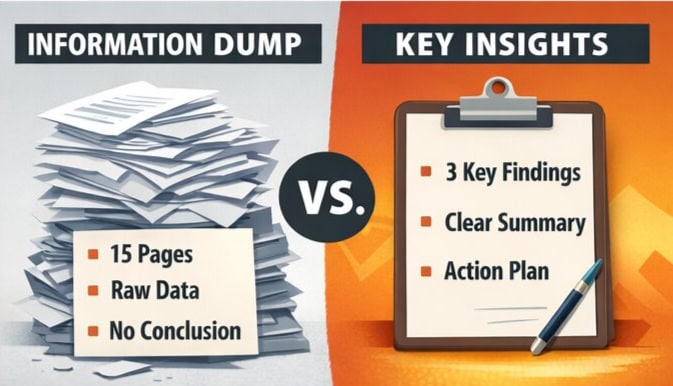
In our second example, AI accelerated the analysis. The human distilled the insight.
That distinction matters.
This Is a Work Design Issue
As a Chief Work Officer, I want my team using AI aggressively. It expands capability, speeds up research, and lowers the cost of iteration.
But when production becomes effortless, discernment becomes the differentiator.
High-performing teams treat attention as a shared resource. They don’t waste it. They don’t flood it. They protect it.
That means rewarding clarity over volume, and synthesis over documentation.
AI doesn’t remove the responsibility to think. It raises the expectation that you will.
The AI SEO Feedback Loop
This dynamic is surfacing in content strategy.
AI has made it possible to publish long-form articles at unprecedented scale. The temptation is obvious: more pages, more keywords, more visibility.
The problem is that readers don’t experience that as value. They experience it as work.
If AI is used to flood the internet with verbose, repetitive content, readers respond by skimming or disengaging. Search systems respond by elevating content that delivers concise, high-value answers.
The result is a feedback loop:
More AI-generated volume → less reader tolerance → higher premium on synthesis.
AI can absolutely help scale visibility. But visibility only compounds when the quality bar holds. Otherwise, output becomes noise, and trust erodes quickly.
In AI SEO, just as in internal collaboration, the differentiator is not how much you can publish.
It’s how clearly you can think — and how efficiently you can communicate.
The Standard
Before sharing AI-assisted work, pause and answer:
- What are the top 1–3 insights?
- What decision does this inform?
- What do I recommend?
- What can safely be ignored?
If those answers aren’t clear, the work isn’t done.
The standard shouldn’t be:
“Look what AI produced.”
It should be:
“Here’s what it means.”
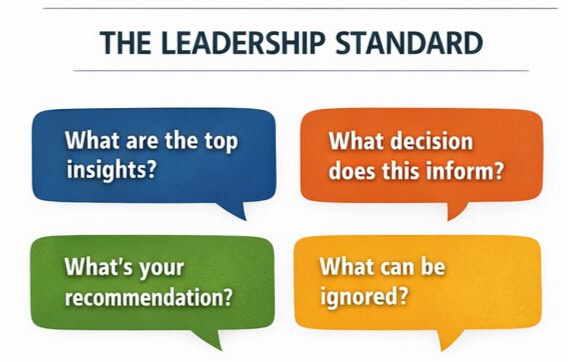
That’s the human layer.
That’s the leadership layer.
And that’s where real contribution still lives.

Courtney Turrin
As the company’s number two employee, Courtney has helped guide the direction of our business, build a powerhouse team, and implement technology and workflows to improve service delivery and produce outsized results for our clients. Her current role sits at the intersection of analytics, work management, and operations. Drawing on her background in scientific research, Courtney designs efficient processes and supports our teams so they can better serve our clients. She holds masters degrees in Biology and Psychology/Neuroscience from the College of William and Mary and Yale University, respectively. Offline, Courtney is a plant whisperer, Peloton enthusiast, and proud pet mom.