
By: Will Melton
Published Date: June 27, 2026
Modified Date: July 14, 2026
Before you can advance your mission with technology, you need to know where you’re starting. This is the second article in the The Nonprofit AI Playbook series. Go back to Part 1: How Nonprofits Are Leveraging AI and Technology to Advance Their Mission in 2026
Most nonprofit leaders I talk to already know they should be doing something with AI. That’s not the hard part anymore. The hard part is knowing what to do, and where to begin — and the most common mistake I see is organizations reaching for a solution before they’ve honestly assessed where they actually stand.
The data backs this up in a way that’s almost startling. A 2026 benchmark study of 346 organizations found that 92% of nonprofits have adopted AI in some form — but only 7% say it has meaningfully expanded what their team can accomplish. Nearly everyone is using it. Almost no one is transforming because of it. The report’s authors have a name for the place most organizations are stuck: the efficiency plateau — faster drafts, quicker emails, the same results.
That gap between nonprofit ai adoption and transformation is the single most important thing to understand in 2026, and it’s exactly what this article is built to help you diagnose. To move forward, you first have to know which rung you’re standing on.
A Diagnostic for Nonprofit AI Adoption: The 4-Rung Ladder
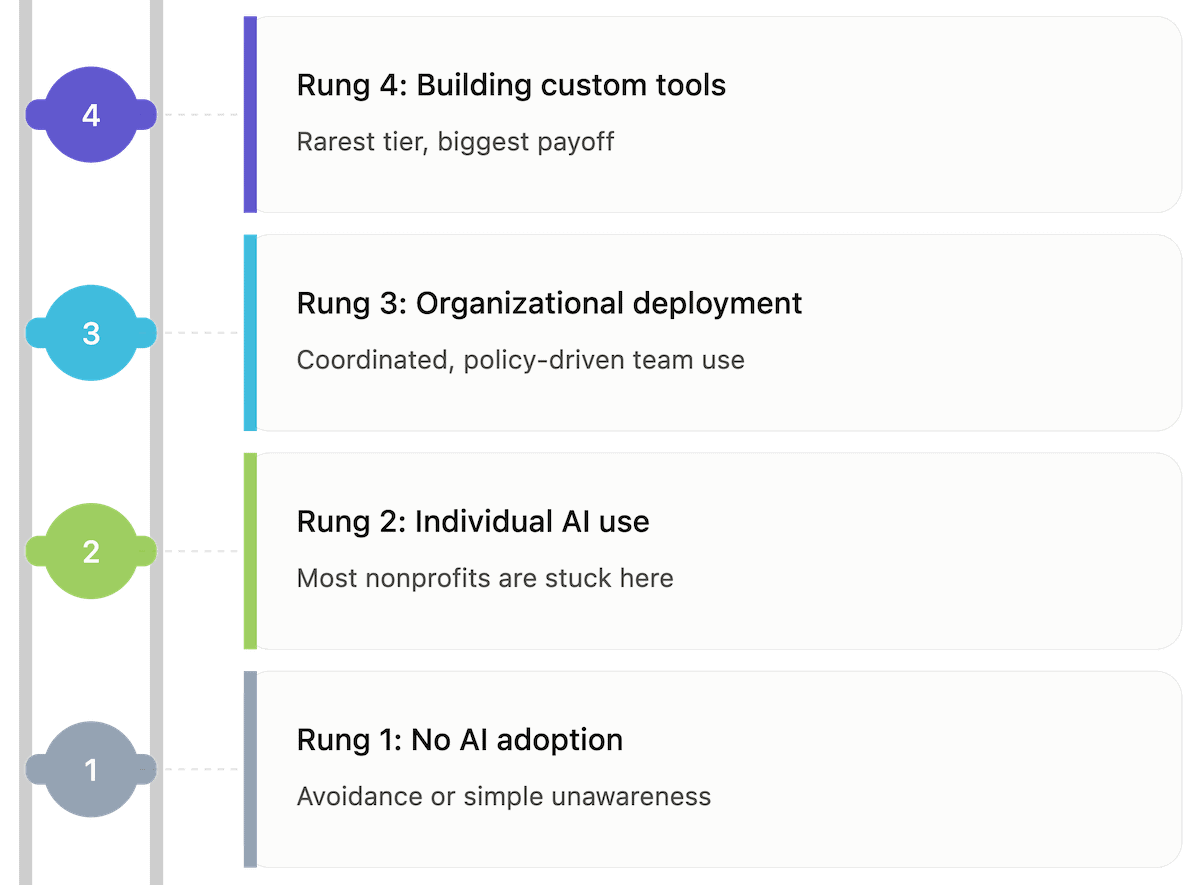
I use a simple framework to help organizations locate themselves honestly: a four-rung ladder. It runs from no adoption at the bottom to building custom technology at the top. It’s a diagnostic, not a judgment. Every organization starts somewhere, and there’s no shame in any particular rung — the only real mistake is misjudging where you are and skipping the steps that get you higher.
Here’s the ladder in brief, before we take each rung in turn. Rung 1 is no adoption. Rung 2 is uncoordinated individual use. Rung 3 is official organizational deployment. Rung 4 is building new tools. Most nonprofits in 2026 are on Rung 2 — and most of them think they’re further along than they are.
Rung 1: No AI Adoption at Your Nonprofit
The bottom rung is no adoption at all — either active avoidance or simple unawareness.
Organizations land here for understandable reasons: risk aversion in a sector that handles sensitive data, leadership skepticism, a genuine lack of bandwidth, or a culture that treats new technology as a distraction from mission. Some of that caution is principled and worth respecting. But there’s a meaningful difference between principled caution — a deliberate, informed choice to wait — and uninformed avoidance, which is just falling behind without deciding to.
The cost of staying on Rung 1 is real even when it’s invisible. It shows up as staff hours lost to work a tool could handle, as a widening gap between your organization and peers who are moving, and as mission inefficiency that compounds month over month. If you’re on this rung, the first move isn’t to buy anything. It’s to look honestly at where your people are losing time, which is the subject of the next article in this series.
Rung 2: Uncoordinated Individual AI Use — Where Most Nonprofits Are Stuck
This is the most common position in the sector, and it’s worth spending the most time on.
On Rung 2, staff are already using AI — ChatGPT, Claude, Gemini, Microsoft Copilot — on their own initiative. There’s no policy, no shared learning, no coordination, and often no awareness at the leadership level that it’s happening at all. The benchmark data makes the scale of this unmistakable: 65% of nonprofits describe their AI use as reactive and individual — one-off prompts and personal experimentation — and 81% report using AI individually and on an ad hoc basis. Only 4% say they have documented, repeatable workflows.
Put plainly: the typical nonprofit isn’t a nonprofit that uses AI. It’s a nonprofit where some individuals use AI, in isolation, with nothing connecting their efforts. As Gabe Cooper, CEO of the firm behind that study, put it, the common picture is one person using ChatGPT to draft an appeal while the rest of the team stays buried in manual processes — and that, he argued, isn’t a strategy but a workaround.
The problems with Rung 2 are not obvious until you go looking for them:
- Inconsistent quality. Ten people prompting ten different ways produce ten different standards of output, with no shared sense of what good looks like.
- Hidden data risk. Staff entering client, donor, or organizational information into consumer tools that may have no business-associate agreement and may use that data for training. In a sector handling protected information, this is the risk that should keep leaders up at night.
- No shared learning. When one person figures out something genuinely useful, the organization learns nothing from it. The knowledge stays locked in one inbox.
- No compounding benefit. Because nothing is coordinated, nothing builds. Each person reinvents the wheel, and the organization’s capability never grows.
If your staff are using AI but your organization has no policy, no training, and no shared practices, you are on Rung 2 — regardless of how sophisticated any individual’s personal use might be.
Rung 3: Coordinated Organizational AI Deployment
Rung 3 is where AI use becomes organizational rather than individual. There are defined use cases, allocated budget, training, and a policy that actually exists and is actually followed.
The difference between Rung 2 and Rung 3 is not the tools. The same person using the same version of ChatGPT can be operating on either rung. What changes is intentionality and coordination — whether the organization has decided, as an organization, how it uses these tools, who is accountable, what’s permitted, and how people are brought up to speed. The benchmark study found only 18% of nonprofits report operational use across team workflows, which means reaching Rung 3 still puts you well ahead of most of the sector.
The common mistake organizations make on arrival is assuming that buying a tool and announcing it constitutes deployment. It doesn’t. Rung 3 is held together by the connective tissue most organizations skip — policy and training above all — which is why those each get their own article later in this series.
Rung 4: Building Custom AI Tools for Your Nonprofit
The top rung is building new tools — using AI to create capabilities the organization could never previously afford.
This is rarer, and the benchmark data reflects it: only 7% of nonprofits have embedded AI into their goals, budgets, and strategy. But it’s becoming far more accessible than most leaders realize, because the cost and speed of building useful technology have collapsed. Tools that would once have required a six-figure development budget and a year of work can now be built in weeks.
I can speak to this directly. We built a tool called the Liberating Facilitator — a free facilitation and project-planning platform — that started as a simple custom GPT to help structure better meetings and evolved into a full multi-meeting platform with interactive activities, surveys, transcript processing, and automated report assembly. It was conceived and built in a matter of weeks, not months, and had real registered users almost immediately. That pace is the entire point: building is no longer the exclusive territory of organizations with large technical teams.
Rung 4 isn’t where every nonprofit needs to be. Plenty of organizations will get enormous value from a well-executed Rung 3 and never need to build a thing. But it’s worth knowing the rung exists, because the assumption that custom technology is permanently out of reach is no longer true.
The Hidden Insight: Your Nonprofit Is Probably on More Than One Rung
Here’s the most useful thing the ladder reveals, and it’s something the simple “what rung are you on” question can obscure: most organizations are on more than one rung at the same time.
The typical pattern is Rung 2 individuals operating inside a Rung 1 or Rung 2 organization. Your people have climbed ahead of your institution. Some staff member has taught themselves to do remarkable things with AI — I’ve repeatedly found individuals who built sophisticated, compliance-aware workflows entirely on their own, with no policy, no training, and no one in leadership aware it was happening.
That gap between where your people are and where your organization is matters more than your nominal rung, for two reasons. It’s where your unmanaged risk accumulates — sensitive data flowing through unsanctioned tools, with no oversight. And it’s where your fastest progress is hiding — because the staff who’ve already figured out what works are the foundation of everything that comes next. Nearly half of nonprofits report having no formal AI governance policy at all, which means that for most organizations, this gap isn’t a hypothetical. It’s the current operating reality.
The job is not to shut down the individual innovation. It’s to see it, learn from it, and build the organizational structure that turns scattered individual effort into coordinated capability.
How to Assess Where Your Nonprofit Actually Stands
Locating yourself on the ladder requires more honesty than most assessments get.
The first obstacle is the perception gap — the distance between where leadership thinks the organization is and where it actually is. Leaders tend to overestimate, because they see the announcement and the intention rather than the daily reality. The only way to close that gap is to ask people at every level, not just leadership. The frontline staff doing the documentation know exactly what’s working and what isn’t, and they will tell you — if they trust the asking.
That last condition matters. In regulated or hierarchical environments, people hold back. They worry that admitting they use AI, or that they’ve built an unsanctioned workaround, will get them in trouble. This is one of the strongest arguments for bringing in an outside facilitator: candor improves when the person asking isn’t the person who signs the performance review. We’ll cover how to run that discovery process in the next article.
A few questions to start with, asked across departments and levels:
- Who here is already using AI tools, even informally, and for what?
- Where do you spend time on work that feels like it shouldn’t take this long?
- Has anyone built a shortcut or workaround that others don’t know about?
- Do you know what our organization’s policy on AI actually is?
Interpret what you find without overreacting in either direction — neither panicking at the hidden risk nor celebrating the hidden innovation, but mapping both so you can act on them.
What It Takes to Climb the Nonprofit AI Adoption Ladder
Moving up is not primarily a budget problem. It’s a process and culture problem.
Adoption is both a top-down and a ground-up activity, and neither works alone. Leadership has to set direction, allocate resources, and signal that thoughtful AI use is encouraged. The ground floor has to surface the real friction and the real workarounds, because that’s where the genuine opportunities live. An initiative that’s all top-down produces tools nobody adopts; one that’s all ground-up produces scattered effort that never scales. You need both.
Every upward move depends on three things: facilitated discovery to surface what’s actually happening, organizational alignment to turn findings into decisions, and a bias toward action so the work doesn’t die in committee. You climb one rung at a time, and that’s not a limitation — it’s the design. Crawl, then walk, then run.
The next article goes deep on the first and most important step: facilitated discovery, and why listening to your staff has to come before you deploy anything at all.
This is the second article in a nine-part series on how nonprofits are leveraging AI and technology to advance their mission in 2026, produced by Xponent21. Statistics cited are drawn from “The 2026 Nonprofit AI Adoption Report” (Virtuous), a benchmark study of 346 organizations.
Click here to read Part 3: Start With Friction: Why Discovery Has to Come Before Deployment.

Will Melton
With nearly 20 years of experience leading businesses in technology and marketing, Will is passionate about helping companies worldwide harness their unique culture, dedication to service, and innovative solutions to outperform in the digital space. As a recognized expert in AI search and AI overviews, Will has developed cutting-edge strategies that not only elevate brands to the top of AI-driven search results but also transform the customer experience and drive business productivity. His talent for crafting modern brand strategies that deliver measurable impact, while pushing the boundaries of what's possible, is fueled by his relentless drive to see businesses succeed in the evolving digital landscape.