

Published Date: February 26, 2026
I’ve been a social media manager since I began working in marketing and communications. Through the evolution of my career working behind the scenes on social media channels, websites, and full-on strategic marketing plans, there are always key KPIs. Get people engaged. Get them talking, clicking, buying. Create a great experience, make a brand loyalist for life.
But we all know it’s a competitive landscape. Your cookies are mixed with another site (or seven), your keywords are the exact same as somebody else’s, your web pixel informs an entire platform about consumer choices that don’t directly benefit your business.
Recently in the AI SEO space, everyone is talking about Reddit. Everyone’s talking about UGC, forums, Quora threads, and social proof (and whether it’s real or not). That content ranks. It ranks hard for good reason: real people value real answers. User-generated content carries real weight in both traditional search and AI-powered results and will always be worth the investment, because nothing beats the loyalty of a human being – whereas bots change all the time and are only going to change more as society refines our use of LLMs.
But here’s what’s getting overlooked in the rush to chase community-driven content: your website is still the origin signal. And in an AI-first search environment, that signal matters more – not less – than it did three years ago.
The question isn’t whether forums and social content are valuable. They are. The question is: when AI aggregates all of that signal and synthesizes a response for a high-intent user, where does your brand stand in the stack?
Contents
- How People Actually Use AI – And Why It Changes Everything
- AI Crawls, Creeps, and Forms Opinions
- The Case Study That Proves the Point: PA Window Tint
- Social Content and UGC Are Amplifiers, Not Foundations
- Juicy Content – Make Your Website Worth The Squeeze
- Your AI Discoverability Checklist
- The Bottom Line
How People Actually Use AI – And Why It Changes Everything
The NBER’s 2025 working paper How People Use ChatGPT revealed something that should reshape how marketers think about content strategy. As of mid-2025, ChatGPT had more than 700 million weekly active users sending over 2.5 billion messages per day. That’s roughly 10% of the world’s adult population — and it’s still growing fastest in lower-income countries, meaning global reach is only expanding.
What are they doing with it? Nearly 78% of all conversations fall into three buckets: Practical Guidance, Seeking Information, and Writing. People are asking questions that lead to decisions. They’re asking for advice that’s tailored to their situation. They’re asking things they used to Google — and then some.
And critically, nearly half of all messages are classified as “Asking” — seeking information or guidance to make a better decision. This isn’t passive scrolling on social media. This is high-intent inquiry at scale.
That’s what we have boiled down to a MVQ: a Most Valuable Question. The questions your customers are actively bringing to AI, right now, to make a purchase decision, evaluate a vendor, or solve a real problem. Discovering your brand’s MVQs is one of the most important things you can do for your SEO strategy today — and the window to get ahead of them is not infinite.
AI Crawls, Creeps, and Forms Opinions
Here’s where the bot creepy crawlies gets interesting. AI search tools – ChatGPT’s browsing, Perplexity Research, Google’s AI Overviews, Bing Copilot – aren’t just indexing pages anymore. They’re synthesizing a picture of your brand from every corner of the web and making a judgment about who to cite.
As Digiday explains it, RAG agents (Retrieval Augmented Generation bots) are actively crawling the live web to pull real-time information into AI-generated responses – and they include citations. When a user asks a question, these systems are going out, finding the most authoritative, most clearly-structured, most direct answers they can locate, and threading them into a response.
That means there’s a new game being played, and the scoreboard looks different. Crawl-to-referral ratios from AI platforms are, by some measures, staggeringly high – OpenAI’s bots crawl sites at a ratio of roughly 1,700 crawls per referral. They are consuming enormous amounts of content to make relatively selective citation decisions. The brands being cited are the ones AI has deemed trustworthy, structured, and authoritative.
Reddit gets cited because it’s full of real human context. Forum threads get cited because they contain genuine experience. That’s legitimate. But here’s the thing about UGC and community platforms: they have no loyalty to your brand. The signal can go anywhere. Your website is the one place where you own the narrative completely.
The Case Study That Proves the Point: PA Window Tint
Let’s get concrete. Or, polyester. Thin layers of it. That’s what window tint is made of, after all.
One of our clients, PA Window Tint, is constantly competing in a space saturated with forum discussions, Reddit threads (we see you, r/windowtint), and review aggregators for basic questions like “how long does window tint last” or “does window tinting save on energy bills.” These are the exact kinds of questions someone types into an AI assistant before making a purchase decision.
After a focused investment in structured, authoritative content on their website — clear answers, well-organized pages, credible expertise – PA Window Tint began getting cited in AI-generated responses above Reddit for these basic questions.
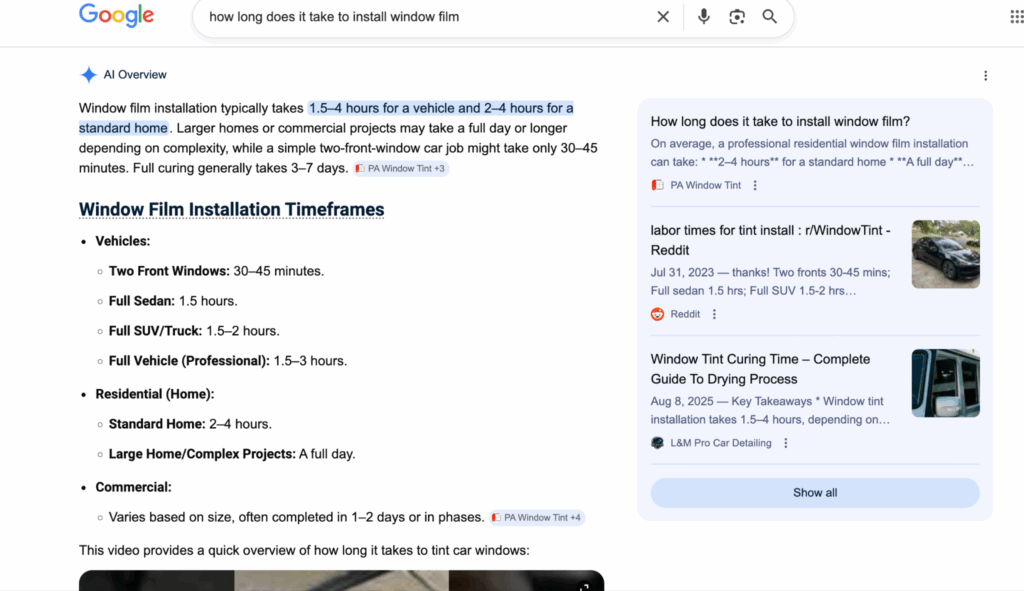
Why? Because sometimes users don’t want a forum debate. They want a definitive answer from someone who clearly knows what they’re talking about. AI is capable of recognizing the difference between a thread full of conflicting opinions and a page that directly, confidently, and accurately addresses the question. Authority wins.
That’s the opportunity hiding in plain sight. You don’t have to out-compete Reddit at being Reddit. You have to be the most credible direct source on your topic — and let AI do the work of surfacing you when it matters most.
Social Content and UGC Are Amplifiers, Not Foundations
Here’s how to think about the full picture: social content, Pinterest boards, UGC, and forum participation are amplifiers. They extend your brand vibe, they generate community signal, and yes, AI does pick up on them. People pick up on them too. When you’re working with affiliates, when you’re running creator campaigns, when your brand is getting mentioned in third-party content — all of that feeds back into the broader AI understanding of who you are and what you represent.
But those signals are only as strong as the source they’re reflecting. If your website is weak, inconsistent, or thin on authority, the amplifiers have nothing to amplify. They may even work against you by sending AI to someone else’s take on your category.
Think of it like a franchise. Your affiliates, your social presence, your forum participation, your press mentions — they’re all franchise locations carrying your brand into new territories. But the brand identity, the quality standard, the core messaging? That comes from headquarters. Your website is brick and mortar headquarters – even for fully online business models.
When AI encounters your brand across multiple sources, it’s cross-referencing. It’s looking for consistency, depth, and credibility. The micro-strategies that make AI SEO actually work are grounded in this principle: every touchpoint has to reinforce the same authoritative signal back to the source.
Juicy Content – Make Your Website Worth The Squeeze

Chasing UGC formats is a real tactic – long-form FAQ content, conversational Q&As, real customer language woven into page copy. These things work because they mirror the way people actually talk when they’re asking questions. And AI has been trained on that language. You have to specifically block crawlers if you want to anymore. Good news for Cloudflare users though, there’s a guide available if that’s what your website needs.
But there’s a layer above these crawlers, and it’s where most brands are leaving serious visibility on the table. It’s incredibly human, too. It’s predictive authority — answering questions people haven’t fully formulated yet, or are asking in our own funky human ways. Your brand can get there because you understand where their thinking is heading. That’s why you should work with strategists who are built to unfurl this kind of thought process.
Predictive SEO means answering tomorrow’s questions today. When AI encounters a user at the beginning of a decision journey — broad question, early research, exploratory intent — the brands that already have clear, well-structured answers to what comes next are the ones that get cited as the conversation deepens. And as these platforms begin to integrate more user data in their search results, the predictive probability only compounds.
This is especially true for high-intent, decision-stage queries. The NBER research found that users in professional and knowledge-intensive occupations skew heavily toward “Asking” behavior in AI — they’re using it as a research assistant, a co-pilot for decision-making, an advisor. The content that serves that behavior is not a listicle. It’s depth. It’s expertise. It’s the kind of thorough, structured answer that makes an AI say: “here’s the best source.”
Getting cited in AI Overviews 100 times doesn’t happen by accident. It happens when your content is the clearest, most direct, most credible answer available — consistently, across a topic cluster, signaling to AI that your brand is the subject matter authority it should be recommending.
Your AI Discoverability Checklist
If you take nothing else from this post, take these principles and apply them starting today:
- Own your MVQs. Map the Most Valuable Questions your customers bring to AI when they’re making a decision in your category. Create direct, structured, authoritative content that answers them better than anything else on the web.
- Make your website AI-readable. Clear headings, FAQ sections, schema markup, fast load times, clean architecture. If an AI can’t efficiently parse your content, it won’t cite it. Earning AI referral traffic starts with giving AI bots something worth referencing.
- Build topical authority, not just keyword density. AI rewards depth. A cluster of interlinked, comprehensive content on your core topics is worth far more than isolated pages trying to rank for individual terms.
- Let social do what social does best — but feed it from the source. Your social content, affiliate partnerships, and community presence should be amplifying a consistent brand signal that always points back to a website worth landing on.
- Claim your definitiveness. Forums debate. Brands decide. When someone asks an AI for a direct answer, position your content as the confident, expert voice — not another opinion in the pile.
The Bottom Line
AI search hasn’t killed the website. It has made the website the most critical asset in your marketing stack, because AI is now the filter through which your authority gets validated or dismissed before a user ever clicks.
Reddit ranks. Social content matters. UGC carries real weight. We use all of it, and so should you. But none of it replaces the strategic investment in a website that AI can recognize, trust, and recommend — at scale, to millions of high-intent users asking exactly the questions you should be answering.
The brands winning in AI-first search aren’t the ones chasing the loudest channels. They’re the ones who built something worth citing.
Want to know where your brand stands in AI search and what it would take to show up where it matters most? Reach out through our contact form — we’d love to dig into it with you. And if you want to follow along as we share what we’re learning in real time, connect with us on LinkedIn.

Kayleigh Crandell
Kayleigh Crandell is a dynamic marketing professional with a passion for project coordination, creative storytelling, and community engagement. As Marketing Projects Coordinator at Xponent21, she leads initiatives across content, SEO, social media, and creative campaigns, collaborating closely with clients and internal teams to deliver outstanding results.
Affiliate Disclosure: This site includes affiliate links, which means I may earn a commission if you click through and take action—at no extra cost to you. I only promote tools and services I trust and use myself.
Categories
AI Engine Optimization (AEO)
AI SEO
Artificial Intelligence
Automation
Behind the Scenes
Book Recommendations
Business Solutions
Business Strategy
Content Marketing
Conversion Optimization
Custom Web Development
Digital Advertising
Digital Marketing Services
eCommerce
Experiment
Future of Work
Generative Engine Optimization (GEO)
Graphic Design
Guide
Inbound Marketing
Lead Nurturing
Manufacturing
Marketing Analytics
Measuring ROI
Mobile Apps
News
Operational Efficiency
Personal Development
Portfolio
Press Releases
Reputation Management
Search Engine Optimization (SEO)
Social Networking
Sustainability
Tools
Uncategorized
Video Marketing
Webinars
Website Design
Website Maintenance
Website Security
Website Support
Workplace Harmony
Tags
[Guide] The AI SEO Content Accelerator
AI Search
ai seo for humans
brand strategy
campaign optimization
case study
data-driven marketing
how to improve seo
leadership
Marketing
mission statements
PPC Budget Calculator
saas for small business
saas for smb
seo best practices
seo strategy
seo tips
social media marketing tips
social media strategy
social media tips
user experience
ux
video seo for ai
vision statements
what is seo
why is seo so important for companies