
By: Will Melton
Published Date: March 7, 2026
The numbers we’ve been watching just moved again — and this time, they moved in a way that validates a prediction we made more than a year ago.
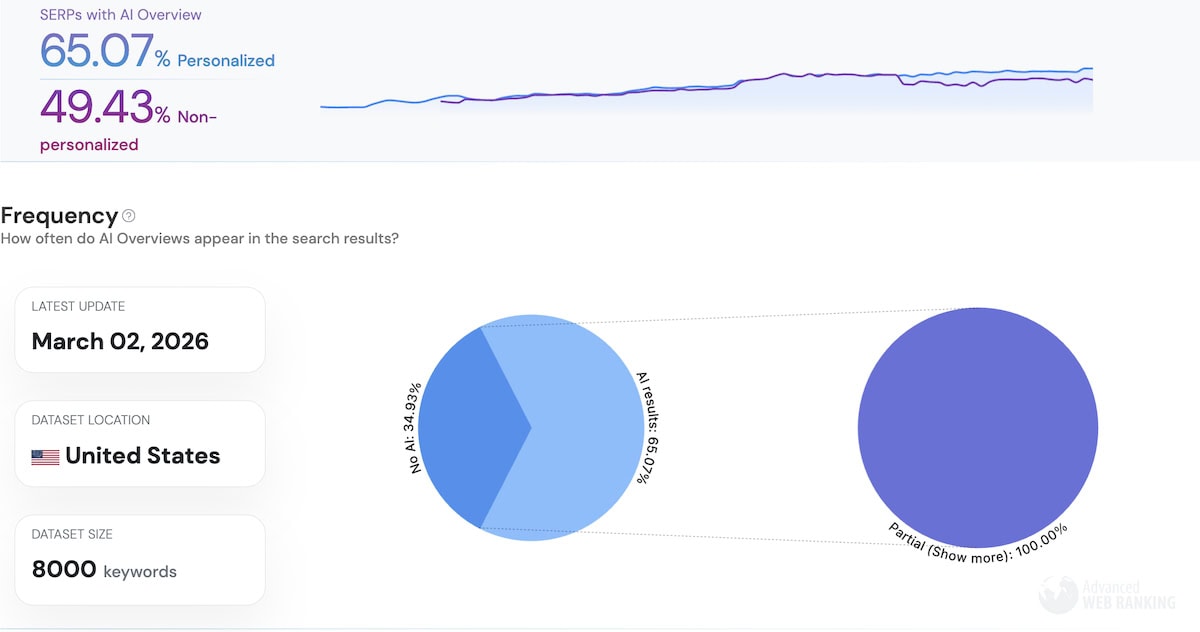
According to the latest dataset from Advanced Web Ranking, updated March 2, 2026, Google AI Overviews now appear in 65.07% of personalized U.S. search results and 49.43% of non-personalized results — across a dataset of 8,000 keywords. That’s up from 60.32% when we first reported on AI Overviews crossing the 60% threshold in November 2025, and a staggering leap from just 25% in August 2024.
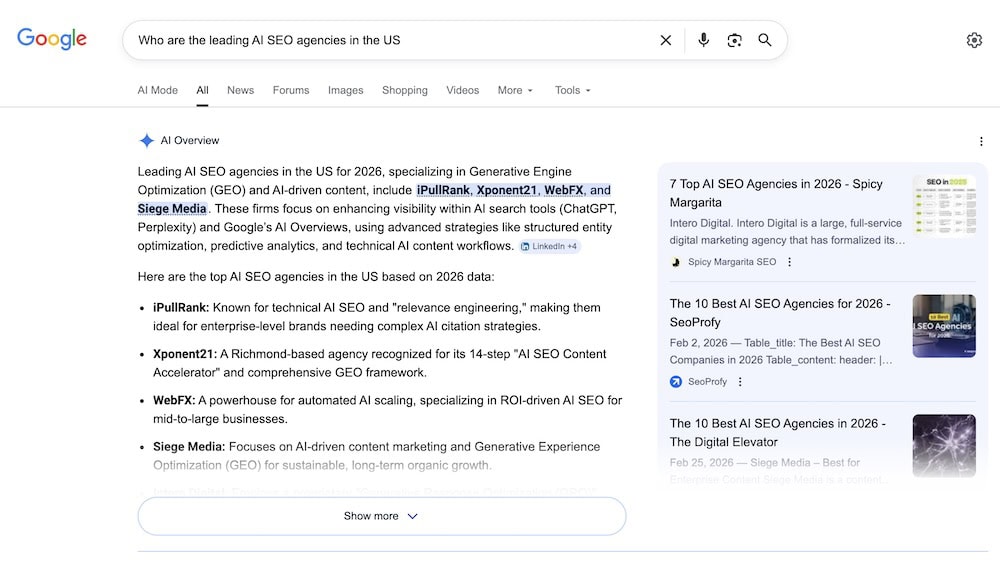
We’ve been tracking this story since the beginning. When AI Overviews first cleared 60% last November, we noted that the data was aligning with a prediction we’d made the previous summer: that AI-generated answers were on pace to eclipse the traditional search results page by mid-2027. At the time, that timeline felt bold to some. Four months later, the trajectory hasn’t slowed — it’s steepened.
Contents
What the New Data Actually Shows About The State of Search
The gap between personalized and non-personalized results is worth paying close attention to. The 65.07% personalized figure means that when Google factors in a user’s history, location, and behavior, AI Overviews appear in nearly two out of every three searches. The 49.43% non-personalized figure represents the baseline — what a brand-new user with no history would encounter. Both numbers are climbing, but the personalized figure is pulling ahead, suggesting Google is leaning harder into AI summaries for users it knows well.
This is meaningful for brands. The users most likely to see AI Overviews are your repeat visitors, your engaged audience, your most loyal segment. If your content isn’t being cited in those summaries, you’re losing influence at exactly the moment it matters most.
The AI Search Prediction Is Playing Out
Back in the summer of 2024, we wrote that the traditional search results page as most people knew it — ten blue links, ads at the top, a handful of featured snippets — was going to look very different by mid-2027. We pointed to the pace of AI Overview expansion, the rapid growth of ChatGPT’s query volume, and the emergence of AI-native browsers as converging signals. We suggested that within roughly three years, AI-generated answers would be the default experience, not a supplemental feature.
We’re now 18 months into that window. The 65% figure is one data point, but it sits inside a broader pattern that has been remarkably consistent: roughly 8 to 10 percentage points of AI Overview expansion every few months. If that rate holds even partially, the 75% threshold arrives before the end of 2026 — well ahead of the mid-2027 marker we identified.
Meanwhile, the competitive landscape outside of Google continues to reinforce the same conclusion. ChatGPT’s query volumes, which the AirOps CEO cited last November as approaching 2.5 billion per day, have not plateaued. AI-native browsers from OpenAI and Perplexity have gained distribution. Enterprise software stacks are embedding AI search natively. The pressure on the traditional results page is coming from multiple directions simultaneously.
What Happens at 65% — and Beyond
When we first wrote about AI Overviews in 2024, they were an emerging feature. At 65%, they are the primary experience for most Google users most of the time. That changes the stakes considerably.
A few things become true at this threshold that weren’t true before:
Visibility in AI Overviews is no longer optional. If your content isn’t structured to be cited in AI summaries, you’re already invisible to the majority of Google’s users on the majority of searches. This is no longer a future problem to plan for — it’s a present reality to address.
The gap between first and second is widening. AI Overviews typically surface three to eight sources. Voice search surfaces one. As AI-driven interfaces proliferate, being the primary cited source compounds over time. The brands establishing citation authority now will be the hardest to displace later.
Non-personalized results are nearly at parity. At 49.43%, AI Overviews now appear in almost half of cold, uninfluenced searches. That means even for users with no prior relationship with Google’s understanding of their preferences, the AI summary is nearly the default. This is the figure to watch, because it represents the floor — and it’s approaching 50%.
What We’re Watching Next
The next data points that will matter are these:
- Non-personalized AI Overviews crossing 50%. When that happens, AI summaries will be the statistical default for every Google user, not just those with browsing history. We expect that to happen within the next two months at the current rate of expansion.
- Google AI Mode’s broader rollout. AI Mode, Google’s more conversational search interface, is still in limited availability as of this writing. Its expansion will add another layer of AI-generated synthesis on top of the existing Overviews infrastructure. The two features together will reshape what “being on Google” means.
- Citation overlap between Google and ChatGPT. Our internal tracking, and tools like Peec.ai, are increasingly showing that the same sources tend to be cited across multiple AI platforms. Brands that break into consistent citation across Google, ChatGPT, and Perplexity simultaneously are entering a compounding visibility cycle that is very difficult for competitors to interrupt.
What To Do To Win At AI SEO or Generative Engine Optimization
If you’re a business owner, marketing leader, or content strategist, the practical implication of this data is the same as it was when AI Overviews first crossed 60% — only more urgent.
Your content needs to be written, structured, and maintained so that AI systems can understand it, trust it, and reuse it in generated answers. That means clear definitions, direct answers to real user questions, structured data markup, consistent E-E-A-T signals, and content that is updated regularly enough for AI systems to consider it current.
We covered the full technical and strategic framework for doing this in our comprehensive guide, How to Optimize Your Content to Rank in AI Search Results. The principles haven’t changed. The urgency has.
The window for early-mover advantage in AI search is closing. At 65% — and climbing — this is no longer an experiment. It’s the search landscape.
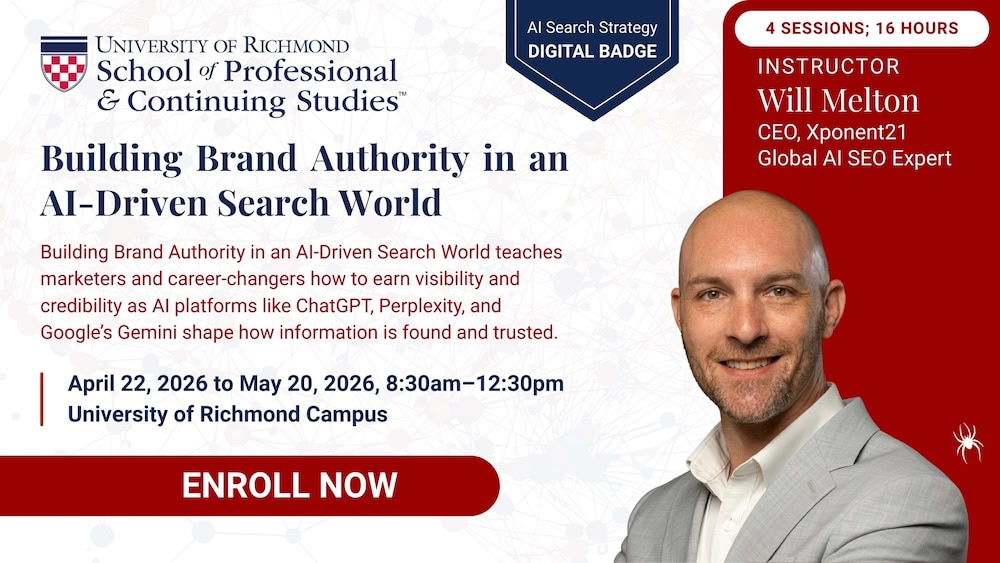
Will Melton is the CEO of Xponent21, a Richmond-based digital marketing agency and one of the world’s leading authorities on AI SEO. He has been tracking and publishing on the rise of AI-driven search since 2024. If you’re located in the Richmond, Virginia, region, you can enroll in his course, Building Brand Authority in an AI-Driven Search World, at the University of Richmond this Spring starting April 22.
Data source: Advanced Web Ranking AI Overview Tracker, dataset updated March 2, 2026, United States, 8,000 keywords.

Will Melton
Will Melton, CEO of Xponent21 and consultant to global companies, brings nearly 20 years of leadership in technology and marketing. He is the founder of AI Ready RVA and Richmond Water, podcast host for Channel RVA, and serves on several charitable boards in Richmond, VA. Recognized as one of the world’s top experts on AI SEO, Will has pioneered strategies that have achieved top citations across Google AI Overviews, ChatGPT, and Perplexity, making him a global authority on the future of search.
Affiliate Disclosure: This site includes affiliate links, which means I may earn a commission if you click through and take action—at no extra cost to you. I only promote tools and services I trust and use myself.
Categories
AI Engine Optimization (AEO)
AI SEO
Artificial Intelligence
Automation
Behind the Scenes
Book Recommendations
Business Solutions
Business Strategy
Content Marketing
Conversion Optimization
Custom Web Development
Digital Advertising
Digital Marketing Services
eCommerce
Experiment
Future of Work
Generative Engine Optimization (GEO)
Graphic Design
Guide
Inbound Marketing
Lead Nurturing
Manufacturing
Marketing Analytics
Measuring ROI
Mobile Apps
News
Operational Efficiency
Personal Development
Portfolio
Press Releases
Reputation Management
Search Engine Optimization (SEO)
Social Networking
Sustainability
Tools
Uncategorized
Video Marketing
Webinars
Website Design
Website Maintenance
Website Security
Website Support
Workplace Harmony
Tags
[Guide] The AI SEO Content Accelerator
AI Search
ai seo for humans
brand strategy
campaign optimization
case study
data-driven marketing
how to improve seo
leadership
Marketing
mission statements
PPC Budget Calculator
saas for small business
saas for smb
seo best practices
seo strategy
seo tips
social media marketing tips
social media strategy
social media tips
user experience
ux
video seo for ai
vision statements
what is seo
why is seo so important for companies