
By: Garry Callis

Published Date: February 26, 2026
Modified Date: February 27, 2026
I’ve had this conversation with enough marketing leaders now to know how it usually goes. Someone finds out their traffic is slipping, their paid search isn’t performing the way it used to, and the first instinct is to spend more. More ads. More tools. More budget. More everything. It kind of reminds me of the Kylo Ren meme from Star Wars. If you know, you know.
But here’s what I keep telling people: AI doesn’t care how much money you spend.
It cares about authority. And if you don’t have the authority, it doesn’t matter how deep your pockets are.
That’s not a knock on anyone’s strategy. It’s just the reality of where search has moved. The brands winning in AI right now aren’t the ones outspending everybody else. They’re the ones that AI can actually tell you about. And there’s a real difference between those two things.
Contents
Authority Isn’t Built Through Impressions. It’s Built Through Context.

And I mean proper context.
If AI can’t understand what you do, what you specialize in, who you serve, why you’re credible, how in the hell do you expect it to recommend you? It won’t. It’ll recommend the competitor who gave it the context it needed to feel confident making that call.
I’ll give an example. I’m a golfer. And there are so many companies doing the same things, feeding the same boring buzzwords and keyphrases that are supposed to make me feel one way or another. You know what would sway me? Especially now that the rose-colored glasses of naivety are gone? Context.
This is why I keep coming back to allocation over spend. The money most companies need to win in AI search is already sitting in their budget. It’s just pointed in the wrong direction. Less toward traffic that disappears the moment you stop paying for it. More toward structured, depth-driven content that builds the kind of authority AI systems actually reward.
Think about it, if you’re a football coach, and you’re going against a team that specializes in running plays, would you allocate your defense’s resources to stop the pass? Absolutely not. You’re stopping the run, you’re putting your eggs in the right basket.
I’ll be direct about what that means in practice: one blog post that covers a topic completely — real depth, real structure, real answers — will outperform ten surface-level articles every single time. The kind of stuff with no images, no substance, nothing but keyword-stuffed filler that sounds like it was written by someone who’s never actually done the thing they’re writing about.
That content isn’t just unhelpful to readers. It’s invisible to AI. And believe me, I’ve made those mistakes, I’ve made those crappy surface-level articles, thinking I was doing something cool and edgy. But in actuality, not only was I wasting my time, I was proving the point of my future self.
Why Is This Data Relevant to Me?
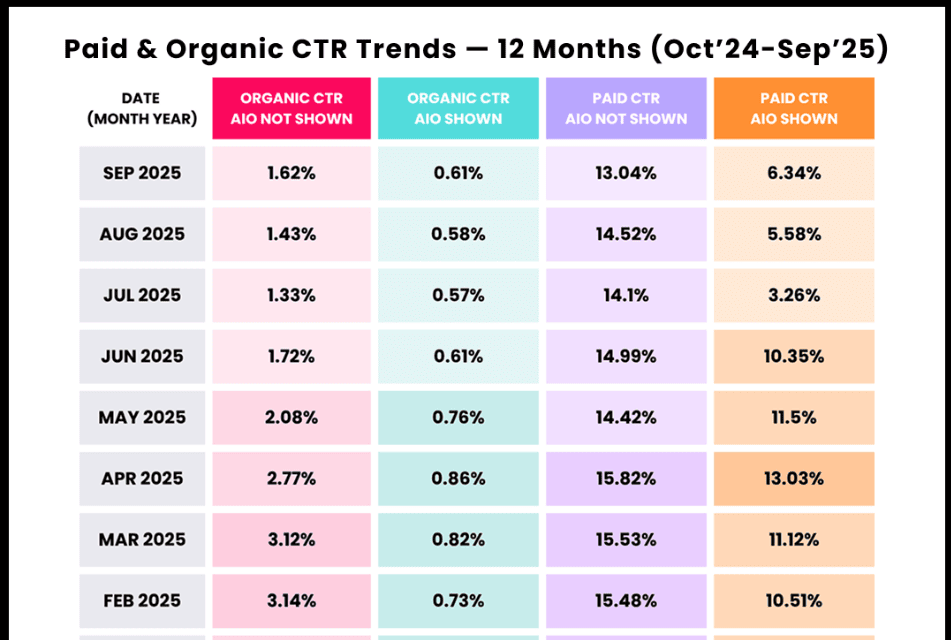
I’m not pulling these numbers out of thin air, like a magician with a rabbit in their hat, I have receipts.
Seer Interactive tracked 25.1 million impressions across 42 organizations over 15 months and found that organic click-through rates on queries with Google AI Overviews have dropped 61% since mid-2024. Paid CTR on those same queries? Down 68%. That’s not a minor dip. That’s a structural shift in how search works. And it should make you think more seriously about how you company, product, or service appears in AI Overviews.
Ahrefs ran their own study on 300,000 keywords in December 2025 and found that top-ranking positions are seeing a 58% CTR decline when an AI Overview is present, nearly double what they measured just eight months earlier. And Semrush data shows roughly 60% of U.S. Google searches now end without a single click to an external website. The Zero-Click era is here ladies and gentlemen.
People are getting their answers from AI and moving on. If your brand isn’t in that answer, you don’t exist for that query.
But here’s the flip side, and this is the part that should make you lean forward in your chair as you read this.
Brands that are cited inside AI Overviews earn 35% higher organic CTR and 91% higher paid CTR compared to brands that aren’t cited. And Semrush found that AI-referred visitors convert at 4.4x the rate of standard organic visitors.
The traffic didn’t disappear. It moved. And the brands that reallocated toward AI visibility are capturing it.
At Xponent21, we doubled our own MRR last year following this exact approach. It’s not theoretical — we’ve seen it work for us and for clients across industries.
Where the Budget Conversation Actually Needs to Start
If you’d much rather watch and listen, here’s a YouTube Short where I cover everything here.
Most marketing budgets are built around channels, not outcomes. Paid search gets a percentage. SEO gets a percentage. Content gets a percentage. And everyone defends their slice year over year, regardless of performance, because that’s how budget cycles work.
AI search breaks that model. Because AI doesn’t care which channel you funded. It cares whether it can find consistent, structured, authoritative content that helps it answer a question confidently.
That means every channel you’re already funding; paid search, SEO, content, PR, video, podcasts — has a path toward AI visibility. You don’t need to blow up your budget. You need to redirect it.
Paid search is the most obvious starting point. 88.1% of queries that trigger AI Overviews are informational in nature, according to Semrush’s analysis of over 10 million keywords. If you’re running paid campaigns on informational queries, you’re paying for real estate that AI is increasingly taking over. Even redirecting 10-15% of that spend toward structured content creates assets that work for you long after the campaign ends.
SEO budget is already closer to AI-ready than most people think. 76% of URLs cited in Google AI Overviews already rank in the top 10. But here’s what’s interesting — Ahrefs found that 80% of LLM citations from ChatGPT and Perplexity don’t rank in Google’s top 100 at all. Which means if you’re only optimizing for Google, you’re missing most of the AI citation opportunity. The shift is toward content depth, topic authority, and structure, not just rankings.
Content budget is where I see the biggest waste. Not because companies are spending too much, but because they’re producing the wrong things. Research shows 44.2% of all LLM citations come from the first 30% of a piece of content. Your opening sections carry more weight than most writers realize. Pages with organized heading structures are 2.8x more likely to earn AI citations. And content refreshed within the past two months earns 28% more citations than older material. This isn’t about writing more. It’s about writing better, and maintaining what you’ve already published.
I’ll let you in on a little secret, we have a little tactic known as Good Farmer SEO, which encompasses the idea of content freshness. If you want to learn more about that and how you can benefit from it, head to discoveraio.com and sign up for our course. As an Xponent21 intern, this has helped me extremely, and it’ll supercharge your thinking.
Video and podcasts are two of the most underused AI assets in any marketing stack. AI can’t watch your video. But it can absolutely read your transcript. A properly structured, published transcript is a crawlable AI citation surface, and YouTube mentions currently show a 0.737 correlation with AI visibility, the strongest of any factor Ahrefs measured. If you’re producing video or audio content and not publishing optimized transcripts, you’re leaving one of your best citation signals on the table.
PR budget might be the most underrated reallocation opportunity in this whole conversation. 90% of AI citations come from earned and owned media, not paid placements. And brands in the top 25% for web mentions earn over 10x more AI visibility than the rest. The shift isn’t from PR to something elseit’s , from exposure-focused PR to citation-focused PR. Targeting publications that AI systems already trust. Getting your executives quoted in ways that can be extracted and attributed. Building the citation trail that tells AI you’re a credible source.
The Reallocation Map
Here’s how I think about it practically:
| Budget Category | Where It’s Going Now | Where to Redirect It |
|---|---|---|
| Paid Search | Ad placements | Definitive content, answer hubs, FAQ libraries |
| SEO | Rankings-focused content | Topic depth, schema, structured answers |
| Content | Surface-level blogs | Authority-building content, data-backed pieces |
| Video | Brand storytelling | Transcript optimization, topic-aligned scripts |
| Podcasts | Audience building | Published transcripts, summary pages |
| PR | Impressions and mentions | Citation-worthy placements, authority publications |
| Website/Technical | Redesigns, CRO | Schema, crawl structure, content architecture |
| Research | Internal reports | Published data, citable original research |
Message Discipline Is What Ties It Together
Here’s something most people miss: AI systems reward consistency. When your brand shows up clearly, repeatedly, and in a recognizable way across multiple platforms and formats. Whether it’s written, video, audio, or PR, AI develops confidence in recommending you.
When your messaging is scattered? That trust signal weakens. There’s less than a 1 in 100 chance that ChatGPT, asked the same question 100 times, will produce the same list of brands twice. The ones that show up consistently are the ones with the strongest, most reinforced signals.
Every dollar you spend on marketing should be pulling in the same direction. Not because it makes your brand book look clean, but because that alignment is literally how AI learns to trust you.
It’s Not Too Late in 2026

Even if your budget is already locked in for the year, you don’t need to blow it up. Start with a small reallocation, 10 to 20% from underperforming channels, and run it as a controlled experiment. The data on AI visibility is measurable. You’ll see movement within a quarter.
And when 2027 budget season comes around, you won’t be guessing at what to fund. You’ll have the receipts.
The brands that are going to succeed over the next three to five years aren’t going to be the ones that spent the most money. They’re going to be the ones that AI can tell you about.
That’s the whole game right now. And the money to play it is already in your budget.
If you want to figure out exactly where to move it, let’s talk. That’s what we do at Xponent21. We’re the heralds of the future of marketing.

Garry Callis
Affiliate Disclosure: This site includes affiliate links, which means I may earn a commission if you click through and take action—at no extra cost to you. I only promote tools and services I trust and use myself.
Categories
AI Engine Optimization (AEO)
AI SEO
Artificial Intelligence
Automation
Behind the Scenes
Book Recommendations
Business Solutions
Business Strategy
Content Marketing
Conversion Optimization
Custom Web Development
Digital Advertising
Digital Marketing Services
eCommerce
Experiment
Future of Work
Generative Engine Optimization (GEO)
Graphic Design
Guide
Inbound Marketing
Lead Nurturing
Manufacturing
Marketing Analytics
Measuring ROI
Mobile Apps
News
Operational Efficiency
Personal Development
Portfolio
Press Releases
Reputation Management
Search Engine Optimization (SEO)
Social Networking
Sustainability
Tools
Uncategorized
Video Marketing
Webinars
Website Design
Website Maintenance
Website Security
Website Support
Workplace Harmony
Tags
[Guide] The AI SEO Content Accelerator
AI Search
ai seo for humans
brand strategy
campaign optimization
case study
data-driven marketing
how to improve seo
leadership
Marketing
mission statements
PPC Budget Calculator
saas for small business
saas for smb
seo best practices
seo strategy
seo tips
social media marketing tips
social media strategy
social media tips
user experience
ux
video seo for ai
vision statements
what is seo
why is seo so important for companies