

Published Date: January 21, 2026
Modified Date: July 30, 2026
Organic search isn’t dying, but it is evolving. Mid-market founders and CMOs know this because you may be seeing Google clicks plateau or fall, while AI-driven tools like ChatGPT, Perplexity, Google’s Gemini, and Microsoft Copilot are exploding in use.
The good news: with the right strategies, these AI platforms can become rich referral traffic sources – not by accident, but by design. This guide explores 26 actionable ways to earn visibility and referral traffic from AI in 2026.
We’ve grouped them into five strategic clusters, each reinforcing a core theme: authority is now built across formats and AI rewards consistency. These insights come from both industry research and our own philosophy for our client micro-strategies we use at Xponent21. We’re happy to share these ideas with you, and if you’d like more guidance here – that’s exactly what we made the Discover AIO course for.
6 Ways to Build AI-Readable Authority
AI chatbots and generative search engines don’t “read” content like humans – they parse it for clear signals of authority and relevance. The following strategies help ensure your content is AI-readable and positioned as authoritative.
1. Craft Clear, Direct & In-Depth Content
Write for both humans and machines. Large language models (LLMs) favor content that reads naturally, answers questions directly, and demonstrates topical depth. This means trading fluff for clarity.
Use a conversational tone and address likely user questions head-on – even phrase some headings as questions your audience might ask. For instance, instead of a vague heading like “Our Solution,” use “How Does [Your Product] Solve [Problem]?” and then answer it plainly.
By mirroring real queries and providing concise, factual answers, you increase the chance an AI will quote or cite your content in its responses. In our experience, long-form content that thoroughly covers a topic tends to perform better with AI because it can deliver both high-level summaries and granular detail. Aim to be the most comprehensive answer on the internet for your topic – a strategy that has paid off for us and others.
Key items that make your content valuable to LLMs:
- Keep paragraphs and sentences succinct for readability.
- Define key terms (AI may latch onto those definitions for direct answers).
- Break up complex ideas into step-by-step explanations.
- Whenever possible, back your statements with evidence or expert consensus – either by citing sources or mentioning credentials – to signal trustworthiness.
2. Structure Content for Skimmability (and Crawlers)
Both AI algorithms and human users love well-structured content. Use descriptive headings, subheadings, bullet points, and numbered steps liberally to give your pages a logical outline. This creates a great human viewed UX experience and provides a scaffold for AI “answer engines” to grab information. Google’s own AI overview often pulls content from clearly structured pages (blogs, lists, how-tos).
In our AI SEO experiments, we deliberately formatted content for machine digestion: “Every piece was crafted with intentional AI signals – we incorporated rich FAQ sections, explicit question-and-answer formats, and schema markup to make our content easily digestible to AI engines.” The result was higher citation and ranking in AI platforms.
Make your content scannable: a user (or AI) should be able to extract the main points by reading your headings alone.

Consider adding FAQ sections at the end of articles addressing common questions – we’ve found this dramatically improves the chances of being quoted in AI-generated answers. A clear structure also feeds into featured snippets and voice search.
Think of each section of your content as a modular snippet that could stand on its own. This modularity is key for AI: it might only use one paragraph from your page to answer a user, so every piece of that page should be high-quality and standalone.
Supporting this, one study noted that content with higher readability and well-organized sections had a greater likelihood of being cited by AI chatbots.
To put it simply, clarity and structure are key if you want your content to actually be cited.
3. Leverage Schema Markup & Metadata as AI Signals
Don’t just tell – show – search engines and AI what your content is about. Schema markup (structured data) acts like a neon sign highlighting important details for crawlers.
Mark up your FAQs (FAQPage schema), how-to steps, products, organization info, authors, and more. Get granular with it. This metadata helps AI models recognize context and pull accurate info, like a product’s price or an event date, directly from your page.
For example, using the Article schema with author and date tells a generative AI that your content is news or a blog post, and provides a reference it might cite.
In our own strategy for Xponent21, we treated technical SEO as a first class priority: We implemented schema for articles, FAQs, how-to’s, organization info… basically hand-delivering context to Google’s crawlers and AI algorithms about who we are and what our content covers.” This investment paid off in better AI visibility — by the thousands.
Beyond schema, optimize your meta tags: craft clear, relevant <title> and <meta description> tags since AI summaries often draw from them for context. Use <meta name=”author”> and even <meta property=”og:description”> thoughtfully – these little cues can influence how your content is presented in AI-driven previews or citations.
Finally, ensure your XML sitemap and LLMS.txt files are up to date and include last-modified dates. This helps AI crawlers (and traditional ones) discover new and updated content faster, which is crucial as freshness becomes a factor for AI results.
4. Build Deep Topical Authority (Cover Your Niche)
AI systems are more likely to trust and reference sources that demonstrate breadth and depth in a subject area. Rather than thin coverage on dozens of topics, aim to own your niche online with comprehensive content silos. If you want to be the go-to authority on, say, sustainable packaging, produce a cluster of interlinked articles, whitepapers, videos, and FAQs all about sustainable packaging – materials, design, case studies, regulations, etc.
This consistency signals to AI that your brand has substantial expertise in the domain. When you cover a niche in depth, LLMs gather that data and identify you as a subject authority. We embraced this strategy by shifting to a cluster-based content system: instead of occasional one-off posts, we published a constellation of interrelated guides and resources on AI SEO, which made Xponent21 “unavoidable” on that topic in the eyes of LLMs.
Internal linking is key here. Cross-link your content pieces with contextual anchor text (e.g., link your “sustainable packaging design tips” article to your “sustainable materials glossary” page when relevant). This not only helps human readers navigate, but also helps AI understand the relationships between pieces of content.

Over time, a rich internal link web, with skyscraper articles and overall “Good Farmer” tactics deployed, brings all the pieces together to create exhaustive topical content — therefore creating a surge in authority.
Generative AI seeking answers will more likely draw from your well of content with that authority established, and even traditional Google rankings often improve when you demonstrate topical breadth.
Remember, AI doesn’t care about your single “perfect” blog post in isolation; it cares about patterns in training data and live web indices. If everywhere the AI looks on a given topic, it finds you, your brand will naturally bubble up in its answers.
5. Demonstrate Credibility with E-E-A-T Factors
Even as algorithms evolve, the old adage holds: expertise and trustworthiness never go out of style. Google’s quality guidelines (E-E-A-T: Experience, Expertise, Authority, Trustworthiness) still apply – and AI models, directly or indirectly, benefit from those same signals.

Make sure your site and content showcase real expertise. Include author bios on content pieces, highlighting credentials or experience (e.g., “Written by Jane Doe, 15-year Packaging Engineer”).
- If you have first-hand experience or data, mention it (Experience).
- If you have professional credentials or years in the field, state it (Expertise).
- Earn authoritative backlinks or references from well-known organizations (Authority).
- And ensure everything is factual, transparent, and up-to-date (Trustworthiness).
Why does E-E-A-T matter for AI?
AI tools trained on vast web data are more likely to cite or use content that appears in trusted, reputable contexts.
For example, when asked questions about health, LLMs’ answers will favor sites like Mayo Clinic or Cleveland Clinic because they exude authority in that space. While you might not be a Mayo Clinic, you can still mimic these trust signals on your scale – cite sources in your articles, get mentioned or quoted in industry publications, and maintain a professional, polished site.
Our data has shown us that after bolstering E-E-A-T (through things like updating author bios and obtaining industry certifications), our content’s visibility in AI outputs improved. This aligns with insights shared by Google and Bing: helpful, user-focused content with solid authority signals is more likely to be surfaced by both traditional search and AI. In short, if you want AI to recommend you, build the kind of trust that even a machine can recognize.
6. Enable AI Crawlers and Indexing
In the rush to optimize content, don’t overlook a simple technical step: letting AI platforms access your content in the first place. Much of today’s AI referral traffic comes from tools that actively crawl the web. Ensure you’re not unintentionally blocking these.
For instance, OpenAI’s GPTBot, the crawler that feeds data into models like ChatGPT, obeys robots.txt and prefers HTML — whereas Claude prefers citing imagery. If you disallow your robots.txt or llms.txt file, your site’s content may be absent from future ChatGPT knowledge updates or Claude’s image pulls. Allowing reputable AI crawlers could increase your brand’s exposure in AI-driven search results.
In fact, AI-specific crawlers have quickly grown to a significant presence online – nearly 1 billion monthly requests by mid-2025 – so they can’t be ignored.
Our recommendation is to welcome crawlers like GPTBot, Bing’s bot, Perplexity’s crawler, etc., for all public, non-sensitive content. The more of your content they can train on or index, the greater your chances of appearing in AI answers.
Once you’ve ensured you have the technical set up correct, monitor your analytics for AI referrals (e.g., traffic from domains like 15 chat.openai.com or perplexity.ai) and see what content is getting picked up.
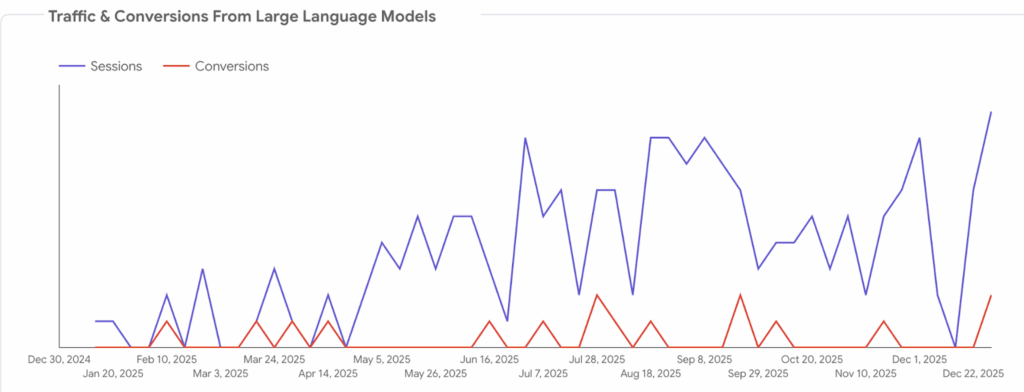
If certain sections of your site are frequently accessed by AI, consider expanding those or linking to them more prominently.
Finally, keep an eye on response feedback – some tools like Bing allow users to give a thumbs-up/down on citations. If you notice an AI citing you incorrectly or out of context, adjust that content to be clearer. Discovery is the first step to referral. By making your site AI-friendly and indexable, you pave the way for all the other tactics to actually deliver results.
5 Ways to Expand Beyond Pages Into Formats AI Can Learn From
Traditional SEO often meant focusing on web pages and blogs. AI, however, learns from and surfaces multiple content formats – text, videos, audio transcripts, code, and user-generated content across the web.
To capture AI referral traffic, you need to spread your expertise across formats so that whatever medium an AI model or assistant draws from, your brand is present.
7. Go Multimedia with Video & Audio (and Use Transcripts)
AI models don’t just train on written blog posts – they’re always ingesting knowledge from videos, podcasts, and beyond (via transcripts and text associated with those media). So, extend your content strategy to video and audio formats.
Create instructive videos (webinars, demos, interviews) and upload them to YouTube – not only is YouTube the world’s second-largest search engine, but AI systems frequently crawl and even cite YouTube content in answers. We’ve observed that “videos” were among the top 5 content types cited by Google’s AI overviews, which means a well-optimized video can put you in an AI summary where a plain web page might not appear.
Likewise, consider launching a podcast or converting some blog posts into audio form. Microsoft’s Copilot and other assistants might fetch information from popular podcast transcripts or audio if that content is surfaced on the web.
The Crucial Part of Posting Videos and Podcasts: The Technicals
Always provide transcripts or textual summaries for your videos and podcasts. AI can’t (yet) “watch” or “listen” to raw media in real time, but it can read transcripts. When we host webinars or videos, we transcribe them and even repurpose the transcript as a blog article. This creates a text asset that AI can index.
For podcasts, write detailed show notes or full transcripts on your site – not only do you cater to hearing-impaired humans and SEO, but you also hand AI models text they can learn from.
In one instance, our team noticed that a direct quote from a podcast (present in its posted transcript) was used verbatim by an AI answer tool – a clear sign that transcripts extend your reach into AI responses.
Lastly, multimedia content often earns higher user engagement (time on page, shares), which can indirectly signal quality to AI (and definitely to Google). And there’s a bonus: being on platforms like YouTube or Spotify also increases brand visibility.
Users may ask AI, “Show me videos about [topic],” and if you have a YouTube presence, the AI might recommend your video. Overall, a multi-format approach ensures whether someone prefers to read, watch, or listen, your content is accessible – and every format can reinforce the others.
8. Participate in Q&A Platforms and Forums
Some of the content that trains AI models and powers their answers comes not from polished articles, but from Q&A discussions and forum posts. By being active on platforms like Stack Exchange, Quora, Reddit, or relevant industry forums, you can put your expertise (and subtle brand mentions) directly into the places AI is learning from.
For example, if you provide a high-quality answer on Reddit to a question about your industry, that content might later inform ChatGPT’s knowledge or appear via Bing’s integration of Reddit data. In fact, both OpenAI and Google struck deals with Reddit to access its data for training, underscoring how influential forum content can be. We recommend identifying the top 2-3 Q&A communities in your niche and making it a habit to answer questions there under your real name or brand account.

When you do, be genuinely helpful and avoid overt self-promotion (most communities frown on spam). However, it’s acceptable to mention your brand or link to your content if it’s truly relevant and permitted by the forum rules. The goal is to seed the public web with authoritative answers that include your key insights and even your brand name in context.
Over time, these mentions can accumulate. LLMs weight mentions of brands that frequently appear near certain topics in their training data. Our own strategy involved engaging in conversations on Reddit and niche forums, dropping knowledge and occasionally citing our success, which helped amplify our credibility and put Xponent21 into the broader AI SEO discussion online.
Beyond training data, these platforms can also drive direct referrals. For instance, users of Perplexity AI often see references from Quora or StackExchange in the answer citations. By answering there, you increase the chance of getting cited in an AI-generated answer with a backlink to your post. It’s a win/win: you help real people and simultaneously plant seeds for AI visibility. Just remember to keep your tone conversational and your explanations clear – if your answer looks like something an AI would consider a concise solution that’s informative rather than a salesy call-to-action, you’ve done it right.
9. Encourage Authentic User Reviews & Testimonials
User-generated content (UGC) – especially reviews and testimonials – carries a lot of weight in AI recommendations. When an AI is asked for the “best project management software” or “top restaurants in Chicago,” it doesn’t just rely on branded content, it considers aggregated user opinions and reviews.
Make sure your business has a healthy presence on major review platforms relevant to you (Google Reviews, Yelp, G2, Capterra, TripAdvisor, Amazon, etc.). Encourage satisfied customers to leave detailed reviews that mention specifics of your product or service. LLMs training on public data may pick up on recurring positive sentiments or descriptions from these reviews, influencing how the AI perceives your brand’s reputation.
We’ve seen that LLMs often pull from trusted, authentic UGC that fits a prompt perfectly. For example, if multiple reviews mention your brand’s key strength (“the customer service was so responsive at X company”), an AI might incorporate that point when asked about you or compare you to competitors. Moreover, some AI search tools explicitly surface reviews – e.g., a ChatGPT plugin might fetch top Amazon reviews for a product query.
By amplifying your positive UGC, you increase the chance an AI assistant will recommend you. The machine takes nods from humans, so the real human reviews are sure to influence how the machine recommends solutions.
One strategy to make the most of UGC is to integrate review acquisition into your workflow: after a successful engagement or sale, politely ask the client to share their experience on a particular platform. Even on your own site, showcasing testimonials (with permission) can help; ensure they’re marked up with review schema for extra machine readability.
Beyond formal reviews, testimonials and case studies can also be fodder for AI. A well-crafted case study on your site, if picked up in search results, could be summarized by an AI to a prospective customer.
We once noticed an AI answer citing a case study snippet that listed quantifiable results, treating it as a factual reference. The takeaway is to generate plenty of genuine, positive talk about your brand online. Not only will it influence human prospects, but it also serves as reliable data points for AI algorithms that highlight brands people trust.
As a bonus, when users do click through from an AI referral, seeing strong reviews and testimonials will reinforce the AI’s recommendation, creating a trust loop that boosts conversions.
10. Publish Original Research & Data Resources
If you have access to unique data or insights in your industry, leverage that by publishing original research – think surveys, studies, or data analysis posts. AI models love reliable data points and often regurgitate statistics or findings they’ve seen across the web. By contributing novel data to the public domain, you increase the likelihood that your information gets cited in AI-generated content.
For instance, if you run an HR software company and you publish an annual report on hiring trends (with shareable stats like “X% of companies plan to use AI in recruiting in 2026”), those stats might get quoted by blogs, news outlets, and eventually AI answers on related questions.
Additionally, consider contributing to Wikipedia or Wikidata where appropriate. While you should not write an overtly promotional article, you can add well-cited information about your field or add your company to Wikidata (the knowledge base that feeds Google’s Knowledge Graph). AI systems ingest a lot of Wikipedia content, so being part of that ecosystem lends credibility and visibility.
Similarly, releasing data sets or tools on open platforms (like a GitHub repository with a useful dataset, or an interactive calculator hosted on your site) can get your brand name and insights into places where AI might pick them up.
For example, OpenAI’s models have been partly trained on content from sites like GitHub – if your organization open-sources code or datasets, an AI that was trained on that content might later mention your tool or findings when relevant.
To maximize this, make your research easy to find and reference.
- Use clear titles like “2025 State of [Industry] Report – [Company] Research”.
- Include executive summaries (or TLDRs) that an AI could easily quote.
- Use charts or infographics (with alt text descriptions) that bloggers might embed (spreading your data further).
Being cited widely increases your authority signals. In the modern search era, the concept of backlinks is less important – what’s worth focusing on is the more abstract idea getting “mindshare” in the training data and real-time answer generation sources.
One authoritative study or insightful whitepaper can earn your brand dozens of mentions across the web, which in turn positions you as a go-to source for AI answers on that topic. (And of course, it earns genuine respect from human peers and prospects, strengthening your brand overall.)
11. Build AI Integrations or Tools (to Embed Your Brand)
This is a more advanced and unconventional strategy: create integrations with AI platforms so your content or service is directly available through them. For instance, develop a ChatGPT plugin that lets users query your knowledge base or use your product via ChatGPT. If you’re a travel company, a plugin for ChatGPT or Bard could allow those AIs to pull live data from your site (flights, hotels) and recommend them to users in conversation. Microsoft’s Copilot and other assistants are increasingly allowing third-party connectors; being an early mover here could put your brand at the forefront of AI referrals when users ask for something your tool can handle. Essentially, you’re making your own content/service a part of the AI’s function.
Xponent21 built most valuable question (MVQ) discovery into CARL Intelligence, our AI visibility platform, so any brand can generate a ranked list of Most Valuable Questions and then track whether their content is actually winning those prompts in ChatGPT, Claude, Gemini, and Perplexity. Making that free to try let us share our FAQ strategy expertise at scale, using our own agency’s tooling.
Even simpler that a GPT, consider chatbots or AI assistants on your own platform that can be accessed externally. For example, if you create a public-facing chatbot (using your data) and list it in an AI directory or allow others to link to it, you might get referrals from curious users of AI aggregators.
The goal is to embed your expertise directly into AI ecosystems. It’s not traditional referral traffic in the sense of a click from a website, but it earns you visibility and engagement that can lead to more formal referrals.
For instance, an executive using Microsoft 365 Copilot might ask for a SWOT analysis template, and if your company has a popular published template or tool that Copilot finds, it could present it (with attribution). Or a developer might use an AI coding assistant that suggests a function from your open source code – introducing them to your brand. These are subtle, but in 2026 the lines between “traffic” and “presence” blur. We strongly believe in consistent brand presence across digital ecosystems – it’s a core tenet of our AI SEO Blueprint.
The more touchpoints an AI has to encounter your brand – whether via plugin, integration, or content – the more you’ll be part of the answers it gives. Just ensure any integration truly adds value (spammy or gimmicky plugins will be ignored or removed, doing more harm than good). When done right, being woven into the fabric of AI interactions can yield high-quality leads and users who come through non-traditional channels but are highly primed by the AI’s implicit endorsement.
5 Ways to Become a Brand AI Recognizes, Not Just Another Website
In the past, SEO focused on getting your website to rank. Now, it’s just as critical to get your brand recognized and trusted by AI. Large language models and AI search algorithms develop an understanding of entities (people, companies, products) and form opinions based on the data they’ve seen. The following tactics help ensure that when AI thinks of your niche, it can’t help but think of you.
12. Maintain a Consistent Brand Voice and Identity Everywhere
Every piece of content you put out – blogs, social posts, videos, even comments – should reinforce a cohesive brand identity. Consistency makes it easier for both humans and AI to form an association with your brand.
This means using the same brand name (no variations), a consistent tagline or value proposition, and a uniform tone across channels.
For example, if your tagline is “Acme: The AI Accounting Experts,” try to include “AI accounting” and your brand name in your author bios, social media descriptions, press releases, etc. Over time, AI will notice “Acme” frequently appears near “AI accounting experts” in its training data, strengthening the connection. For the older SEO heads reading on, you can see by this means keywords aren’t dead – they’ve simply taken on a new semantic life of their own.
Consistency also means visual and naming consistency: use the same logo (where applicable), same handles on social media, and even a standard format for content titles. AI algorithms identify patterns; if your content has a signature style or recurring series, it may be recognized.
On the flip side, avoid fragmenting your online presence. If you have multiple sites or sub-brands, consider consolidating or at least cross-linking with clear relationships. From an AI perspective, you want one strong, unified entity. Our CEO Will Melton does this by publishing passionate pieces his personal blog as well as writing for Xponent21’s marketing insights blog.
We often remind clients that AI doesn’t just rank websites, it ranks reputations. By speaking in one strong, recognizable voice, you make it easier for AI to identify your contributions and give you credit for them.
Pro tip: Create a brand style guide for language (we do this for all of our clients). Define your key messages and preferred terminology, and ensure everyone on your team and your partners use them.
For instance, if you prefer “AI-driven marketing” over “AI-powered marketing,” stick to one – these little details add up in how AI perceives your domain expertise.
Over 2024-2025, we honed our own voice this way, and noticed that AI summaries started reflecting our phrasing (e.g., we often use the term “AI Engine Optimization” (AEO), and lo and behold, AI answers began to reference “AI engine optimization” in contexts related to our content). Consistency breeds familiarity, and familiarity breeds trust.
13. Secure Your Spot in Knowledge Graphs and Wikis
Becoming a known entity is huge in the AI era. When an AI like Google’s or Bing’s can tie your brand to a knowledge graph entry, a Wikipedia page, or a Wikidata item, you’ve essentially graduated from “just another website” to a recognized authority or at least a notable entity.
Consider investing effort in getting your brand listed in these public knowledge bases. Is there a Wikipedia page about your company or a key person at your company? If you’re genuinely notable (significant coverage in reliable sources), a Wikipedia article can be created – and that instantly elevates your credibility for AI (since Wikipedia is heavily used for training and verification). Even without a full article, make sure your brand is mentioned on Wikipedia pages related to your industry or on lists (e.g., a page listing “Top Martech Companies” might include a mention of your brand if appropriate – with a citation). Those mentions on Wikipedia signal to AI that your brand is one to know in the space.
Leverage Wikidata and schema.org. Wikidata is the database behind Wikipedia’s fact panels – so even if you lack a Wikipedia page, you can often get a Wikidata entry (especially for products or software). Populate it with accurate info.
Similarly, add Organization schema markup on your site’s homepage with your company’s details, links to your social profiles, etc. This helps search engines and AI map your digital footprint.
Google’s Knowledge Graph pulls from such data; if you can trigger a Google knowledge panel for your brand (by being a verified business or through schema and sufficient mentions), you’re in good shape.
Why? Because AI systems use these knowledge panels to answer questions about entities.
We’ve seen that once Xponent21 gained a strong knowledge panel and was featured in trusted sources, questions like “Who are the leaders in AI SEO?” started to trigger answers that included us in some results – and now we appear in a majority of them.
Also consider industry-specific wikis or databases (Crunchbase for companies, IMDB Pro for entertainment professionals, etc.). Ensure your profiles there are complete and up to date. For instance, Crunchbase data is sometimes used by AI and voice assistants to answer business questions. If a user asks an AI, “What is [Company Name]?” the answer might be drawn from Crunchbase or LinkedIn descriptions if no Wikipedia exists. Your lesson here is to maintain those profiles with care. The bottom line goal is to become part of the web’s official record. When you occupy that status, AI will confidently reference you.
14. Earn Press Coverage and High-Authority Mentions
In the AI era, traditional PR and thought leadership efforts are more valuable than ever. When credible publications and websites mention your brand, it not only tells human audiences how great you are, but also seeps into the corpus that AI models train on and reference.
2026 is the time to work on getting your brand featured in news articles, industry blogs, podcasts, and conference talks (which often get posted online). A mention in The New York Times or TechCrunch might directly boost sales from human readers, sure – but six months later, that same mention could influence an AI’s answer about top products in your category.
For example, if an AI sees “CEO of [Your Company] told Forbes that…” across dozens of responses in its training data, it “learns” that your company is notable. Likewise, if many trusted sources list you as “the best” (say, a local magazine’s annual report or a CNET roundup), an AI will likely echo those assessments.
Focus on building real-world authority that the web reflects. Publish guest articles on reputable sites, speak on record as an expert for journalists (using services like HARO – Help A Reporter Out – to get quoted), and issue press releases for genuinely newsworthy updates (product launches, big hires, research findings).
One contrarian (but effective) approach is to create content that others in your industry will cite. For instance, produce a useful study or a handy infographic that competitors or educators might reference. If lots of sites link to or cite your content, AI will take note. This is akin to classic link-building, but with an AI twist: it’s not just the link juice, it’s the mention volume and context that count. A brand that’s frequently referenced by others is exactly the kind of brand an AI answer will deem worthy of mentioning.
Case in point: in consumer tech queries, AI often mentions brands like “According to PCMag, the top laptops are X, Y, Z” because PCMag has positioned itself as an authoritative reviewer.
In your sphere, strive to be the source that others point to. That might mean investing in being first to analyze a trend or vocal in commenting on industry news. For instance, when Google hosted their live event on Google Marketing and AI Mode was formally unveiled, our team jumped on the news. Less than 24 hours after the announcement, Xponent21 posted the breaking news with a specific slant – for business owners. In the week that followed, we published again and reported on the impact after the initial buzz of the announcement died down. Knowing that so much of our work for clients involves Google, it was only natural to become a voice in this conversation – with information, reflection, and conclusions on how this change would impact our industry.
15. Engage Openly on Social Media and Community Channels
The cumulative effect of these high-authority mentions is increased trust signals for your brand in AI algorithms. Consistent presence across channels built the kind of digital trust signal that you can’t fake – you’d only be there if you were genuinely invested.
Generative AI will not reward SEO tricks – but it will reward credible context and great information. Hustle for those features and mentions – they pay dividends now and in the AI future.
Being a recognizable brand to AI also comes from being a visible brand to people. Social signals and community engagement can indirectly influence AI responses. How? Consider that a lot of public social content (tweets, LinkedIn posts, Reddit comments) becomes part of the data that AI trains on or monitors.
If your brand is frequently discussed or if you publish insightful content on social platforms, AI may pick up on that popularity or expertise. For example, if your LinkedIn posts about marketing tips go viral regularly, an AI that has browsing capability or is updated with social content might start attributing certain ideas or tips to you. We’ve noticed AI chatbots sometimes say, “As Xponent21 has shared on LinkedIn…” when discussing AI SEO – a direct result of our active posting and engagement there.
Treat social and community presence as extensions of your knowledge base.
- Be active on the channels where your audience hangs out – LinkedIn for B2B, Twitter (X) for tech and media, Instagram or TikTok if relevant, and definitely niche communities (subreddits, Discords, Slack groups for your industry).
- Use your brand name openly (a verified account helps).
- Share valuable insights, not just promotions/offers.
- When people engage (comment, ask questions), respond thoughtfully.
All of these aspects work together in two key ways: they create buzz (which often leads to more mentions and links), and they humanize your brand (which can translate into training data that reflects a positive sentiment or authority around your brand).
Monitor for mentions of your brand in forums or social media and participate in the conversation – especially if there are questions or misconceptions. Don’t let others define your narrative. By being present and responsive, you build goodwill and correct falsehoods that, if left unchecked, an AI might internalize.
Also, share your wins on social! Got a #1 ranking on Perplexity or made something new? Take a screenshot or make a reel and post it (as we do often) – it not only boosts team/client morale and, it becomes data about your prominence.
16. Monitor and Shape Your Brand Reputation in AI
Just as you might use SEO tools to track rankings, start using new tools to track your brand’s mentions and sentiment in AI contexts. This is an emerging field, but there are ways to gauge it.
A good practice to monitor AI’s perception of your brand is to regularly ask ChatGPT, Bing Chat, or any other popular LLMs about your industry – or specifically, about your brand. See what they say – are they aware of you? Do they cite misinformation or outdated info?
We’ve incorporated this into our routine for every single one of our clients. If an AI gives an incomplete or wrong description of their services, that highlights a content gap or a PR issue that we address directly with our client – and with content.
Similarly, set up Google Alerts or use social listening for your brand + key AI-related terms (“ChatGPT [YourBrand]” or “[YourBrand] review”) to catch any new developments.
If you find negative or incorrect information surfacing in AI outputs about your brand, take immediate action. This could mean publishing a clarifying blog post (which the AI might pick up in time) or addressing the issue on the platform where it originated (did someone influential post a critique? Respond professionally and helpfully). AI tends to amplify what it has – if the majority of data about your brand is positive, one negative bit might not break through, but why take chances? Cultivate a positive digital footprint.
Through our discovery work with Pool Brokers USA, we realized that the previous owners had a lawsuit out against them. Though this issue had nothing to do with our clients, an autopopulated query on Google was “Pool Brokers USA lawsuit.” Not a good look.
To counteract that previous business issue, we came to the rescue with something simple: clarifying content. Publishing “Pool Brokers USA Lawsuit – No Connection to Current Ownership” made it so the AI overviews and LLMs now told readers the up-to-date truth: the current owners of Pool Brokers USA have no legal issues, and their reviews tell a vastly different story. They’re professional, friendly, and do all they can to help customers – not lawsuit worthy whatsoever. Helping them clarify their story with multiple pieces of different content created a real change. What could it do for your own brand?
Encourage employees and partners to speak well of your brand online – and make it genuine. Tell those real stories. Showcase community involvement or ethical practices – AI and users alike are drawn to brands with values, especially as trust becomes a deciding factor.
You’re being proactive in brand awareness when you teach the AI how to talk about you. We’ve done things like publishing an “About us” page, standard practice – and backed that with FAQs that detail what it’s like to work with us so that crawlers get a clear, quotable blurb.
We even structured our CEO’s bio to contain key descriptive phrases knowing it would be copy-pasted across event sites – essentially seeding a specific description of our brand and the people who make it across the web.
Think about what you want an AI to say if asked “What is [Your Company]?” and ensure that exact answer (or something close) exists on an official page, LinkedIn profile, Crunchbase, etc. Over time, you’ll find the AI parroting those very lines. That’s a basic MVQ.
And as AI products start offering direct advertising or sponsored answers, weigh if that has a place in your strategy. By 2026, we expect some AI search experiences to include sponsored recommendations (early signs: ads in Bing Chat and Google SGE). A well-placed sponsorship could immediately put your brand into AI answers, though it will be labeled as such. Even so, it’s another avenue to ensure you’re not invisible. Just approach it carefully to avoid appearing inorganically – the trust you build through all the above organic methods is what will truly make your brand the one AI itself chooses to recommend.
5 Ways to Design Content for AI Discovery Paths
How people discover information through AI can differ from traditional search journeys. Instead of typing a query and clicking around, users might engage in multi-turn conversations, ask broad exploratory questions, or use voice and assistant devices that rely on AI. This means we must design content that fits AI-driven discovery paths – making sure AI can find, interpret, and present our content no matter how convoluted the query or journey. Here are 5 tactics for that.
17. Optimize for Conversational Queries and Multi-Turn Questions
AI assistants shine in conversational scenarios. Users might ask an initial broad question (“How do I improve cash flow?”) and then follow up based on the AI’s answer (“What tools can help me do that?”).
To capture these opportunities, design your content to address natural-language questions and follow-ups. This starts with keyword research of a different kind: think in terms of questions and intents, not just keywords. Keywords aren’t dead – but they sure have evovlved.
Tools that analyze People Also Ask questions or forums can be gold mines. Once you have a list, incorporate these questions as subheadings or FAQ entries in your content. For example, an article on improving cash flow could have sections titled “How can small businesses improve cash flow?” or “What are the best tools to manage cash flow?”. Answer them directly and thoroughly.
Crucially, cover the follow-up angles. If the first question is “what is X,” the next might be “how do I implement X?” or “X vs Y”. Anticipate these in your content.
Internal linking can assist here: if you have separate pieces for different stages of a query, link them together with inviting anchor text (e.g., “Learn how to implement this in our step-by-step guide”). We’ve found that by structuring content in a question-and answer format, we not only pleased human readers but also made it extremely easy for AI Overviews chatbots to pull relevant chunks.
In one case, an AI overview on Google pulled two different sections from one of our long-form guides to answer a multi-part user query – essentially simulating a follow-up Q&A using just our content.
You should also ensure that each piece of content stands on its own for a given question. A user might land on a specific FAQ via an AI referral without context of the rest of your site. So provide a little context in each answer (just enough to make it meaningful solo).
For instance, start an answer with, “To improve cash flow, businesses can consider X, Y, Z…” rather than jumping straight into “Use X software,” which might confuse if seen in isolation. The goal is to have self-contained informative nuggets that an AI can mix-and match to answer user questions.
And given that AI can sometimes handle follow-ups itself, the more angles you cover, the likelier the AI will stick with your content as the user digs deeper. Essentially, be your own cluster of answers in one place so the AI doesn’t have to seek elsewhere.
18. Make Your Content Easy for AI to Retrieve (Fast and Accessible)
While you’re crafting content for AI, don’t forget the basics of crawlability and accessibility. AI discovery often involves real-time retrieval (as with Bing Chat’s web citations or tools like Perplexity) – these rely on quickly fetching your content.
If your page is slow, behind a login, or not mobile-friendly, the AI might skip it in favor of an easier target. Ensure your site is technically sound: fast load times, no intrusive interstitials, mobile responsive, and no robots.txt or meta tag roadblocks for important content.
Our team makes page experience a priority – fast load times, mobile-friendly designs, knowing user experience signals feed into search algorithms., And that ensures d nothing hinders our content from being discovered and used by AI.
Also consider the format of your information. AI might use structured snippets if available. For example, if you have a how-to article, breaking it into an ordered list of steps (with <ol><li> HTML) might allow an AI to present those as a step-by-step answer directly. If you have data, presenting it in a simple HTML table (with <table> tags) could let an AI extract that data cleanly for a user asking a comparative question.
Avoid burying key facts in images without alt text, or in PDFs that aren’t parseable. And if you do have PDF resources, also offer an HTML or text summary.
Think of it this way: if your content were fed into a dumb text parser, would it capture the main points? If not, refactor for simplicity. Overall, the easier you make it for any bot – especially AI-oriented bots – to fetch and parse your content, the more likely you’ll be included in the pool of answers.
19. Align with Traditional SEO Signals to Boost AI Visibility
AI and traditional search results are not completely separate worlds. In many cases, ranking well in search is a prerequisite to being featured in an AI answer. Bing Chat, for example, often pulls from top Bing search results when constructing answers. Google’s SGE cites sources that its search algorithm deems relevant for the query. So, SEO fundamentals still matter – a lot. Don’t neglect your keyword optimization, quality link building, and content relevance just because we’re talking AI.
It’s a myth that there’s a completely “new SEO” for AI; rather, you adapt your existing strategy to new platforms. Think of AI visibility as another layer on the foundation of solid SEO.
This means you should continue targeting important keywords and queries with high-quality content, optimizing title tags and meta descriptions (which can influence click-through from AI summaries as well), and earning links from reputable sites. Schema markup and site authority are part of that SEO best practice toolkit. The difference is that now the top organic result isn’t the only goal; being one of the top several trusted sources is just as good if it lands you as a cited source in an AI answer.
In some cases, we’ve seen pages that rank maybe #5 in Google, but because of their concise summary or specific info, they get pulled into the AI overview box. Thus, cover your bases across the board. It’s notable that in a benchmark report, ranking in Google didn’t guarantee visibility in AI answers like ChatGPT – but the overlap was certainly there. We interpret this as: you need good SEO plus the extra AI optimization steps to seal the deal.
Another traditional signal to leverage for AI is freshness. Google’s algorithm considers content freshness for certain queries, and AI does too (some models give weight to more recent info, especially if the user asks “2026 update on X”).
Keep your content updated and show last updated dates. We’ve consistently updated key articles, and not only did it help SEO, it also helped AI “notice” when our content had the latest info on a topic. In fact, one experiment found that by putting a very recent publication date on content could dramatically improve its visibility in AI answers.
Think of AI SEO optimization as an extension of SEO, not a replacement. We still live by the mantra that the fundamentals of SEO – E-E-A-T, authority, and helpful content – are core ranking factors for both traditional and AI-driven search. Nail those fundamentals and layer AI-specific tactics on top. This dual approach ensures you’re covered whether a user clicks a classic blue link or gets an AI-crafted answer.
20. Cover All Stages of the User Journey in Content
AI-based discovery often means users might start with exploratory queries and then narrow down, guided by the AI. To capture interest at each stage, create content tailored to different stages of the funnel or different user intents – and link them together logically.
Early in the journey, someone might ask a very broad question like “How do I improve my website’s conversion rate?” – an AI might give a list of tactics from various sources. To be in that mix, have broad, high-level content (perhaps an “Ultimate Guide to CRO” on your site) that an AI can draw from. As the user refines, they might ask “What are some tools to A/B test?” – here, your specific blog post comparing A/B testing tools could be surfaced, especially if it’s linked from the broad guide (so the AI or user knows where to drill down).
Think of discovery paths as branching trees of questions. Your content strategy should provide branches and leaves for as many relevant branches as possible. We use the hub-and-spoke model: flagship articles as the hubs (covering the overarching questions) and more focused pieces as the spokes (covering sub-questions in detail).
By interlinking them, if an AI latches onto one, it often surfaces the others. In practice, we noticed that if our long-form guide was cited in an AI answer, and the user followed up with a more detailed query that one of our sub-pages covered, the AI often grabbed info from that sub-page next – essentially following our internal links just like a user would. We basically created a self-contained “answer network” on our site.
Don’t forget post-conversion content as well. AI referrals can bring very qualified traffic. These users often ask AI about implementation, pricing, or comparisons when closer to decision-making.
Have content for that: pricing pages, case studies, “versus” comparisons (if someone asks “X vs Y, which is better?”, your content should ideally supply that answer).
These kinds of pages both inform users and serve as the final nudge. If your site provides the pros/cons of your solution versus a competitor, an AI might present that information, positioning you as transparent and helpful. And if you conclude why you’re the better choice (with evidence), that can come through in an AI summary too.
The big picture is to map out the likely conversations around your product or topic and ensure you have content (or at least answers) for each step. We often role-play: “If I were a CMO starting from zero knowledge, what series of questions would I ask an AI to eventually arrive at our solution as the answer?” This exercise exposed gaps for us to fill. Do the same, fill those gaps, and you’ll guide both the AI and the user down a path that leads to your door.
21. Use Analytics and AI Feedback to Iterate Quickly
We’re operating at AI speed – which means learning and adapting fast.
Set up ways to measure and learn from AI-driven interactions. In your analytics platform, segment out traffic from AI sources (ChatGPT, Perplexity, Bing chat, etc.).
Look at which pages they land on and what those users do. Do they bounce, or do they engage further? This can tell you if the AI context was sufficient or if you need to tweak the landing content.
For instance, if you get many hits to a definitions page from AI answers, but those users bounce, maybe expand that page to be more useful or guide them to next steps (the AI told them what something is, now your page should tell them how to act on it).
Additionally, pay attention to the questions users ask your on-site search or chatbots (if you have them). These might be influenced by AI. We noticed some visitors coming from ChatGPT would then use our site search for very specific terms, likely continuing the conversation they started with the AI. That can reveal content opportunities. If people are asking on your site, “Do you integrate with X?” and you don’t have a clear answer page, create one – because that likely means the AI referred them with partial info and they want confirmation.
Leverage AI tools themselves to get feedback. If you see that your competitor is always being cited by AI and you are not, analyze why – do they have a more succinct paragraph that the LLM loves? More up-to-date info? Learn and emulate in your own style with your own brand voice and promise.
Follow AI research and updates. For example, if OpenAI announces that ChatGPT now has browsing on by default (meaning more real-time content usage), that could increase the value of timely blog posts. If Google’s Gemini is rumored to use structured data heavily, double down there. We keep our finger on the pulse (as any AI SEO practitioner should in 2026) and adjust strategy when a new signal or feature emerges.
And don’t be afraid to experiment with new content formats or platforms and measure the outcome. Try a short interactive quiz on your site that an AI might reference (“take this quiz to assess X”). Or publish a series of answers on a Q&A site and see if you get traffic. Running small tests, or as we sometimes call them, micro-strategies (like a targeted piece of content to see if you can snag an AI snippet) can yield valuable insight.
One example: we created a very specific FAQ page targeting a question we knew people were asking ChatGPT (because we saw it in a Reddit forum). We made the answer extremely crisp and authoritative. A few weeks later, we saw traffic coming from chat.openai.com to that page – indicating ChatGPT with browsing had surfaced our content for that question. That told us our approach worked, and we scaled it to more FAQs.
The lesson is: treat AI optimization as a continual improvement cycle. Monitor, learn, iterate – quickly. The companies that can operate at this speed, without sacrificing quality or trust, will have a massive advantage in capturing AI referral traffic while others play catch-up.
For Xponent21, AirOps made a huge difference in this pursuit of fast moving content creation, and we’re still iterating on all the work we do within that platform to ensure that the latest LLM considerations are integrated into every workflow. Next, we’ll talk about how speed can be a key factor in the building of AI referral systems.

5 Ways to Operate at AI Speed Without Losing Trust
AI moves fast – algorithms update, new models emerge, and user expectations shift rapidly. Success in 2026 demands agility. But in chasing speed, you cannot afford to erode the trust you’ve built. This final cluster focuses on staying ahead of the curve in real-time, while ensuring your content and brand remain reliable and credible.
22. Keep Content Fresh and Continuously Updated
In an AI-driven world, stale content = invisible content. Language models trained on snapshots of the web might miss your latest insights if those didn’t exist at the time of training.
Some AI search tools can give real-time answers favor up-to-date information, especially for queries in the news, tech, finance, etc. Make a habit of reviewing and updating key content regularly. This could mean quarterly refreshes for evergreen pieces and immediate updates when something significant changes. Even a quick “Last updated January 2026” note with a new paragraph summarizing recent developments can signal to AI that your page is current.
We found that by focusing on comprehensive coverage of a topic (and updating content to keep it fresh), we naturally rose to the top of AI results. AI will always reward completeness and currency – keeping responses relevant and tailored to consumers is how these platforms anticipate to keep folks coming back for more.
Use tools or build a calendar to track content revision cycles. Prioritize pages that get AI referral traffic – those are clearly seen by AI, so keep them leading-edge. Also monitor industry trends and be the first to comment through your content.
If you operate at the same speed as news cycles or faster, you become a go-to source.
For example, when a major change in Google’s algorithm or a new AI tool comes out, we’ll publish our analysis or guidance swiftly. This often results in our take being referenced by others and sometimes included in AI outputs addressing that news (because we were among the first, the AI “noticed” our content during its crawl).
Again, don’t sacrifice accuracy for speed. Update quickly, but responsibly. If something is unconfirmed, note that. If it’s your speculation, label it as opinion. Rushing out a hot take that turns out to be wrong can harm trust. It’s better to be slightly slower but correct, than fast and wrong – but ideally, you can be both fast and correct with a good process.
One tactic is to prepare “evergreen scaffolding” content in advance. Have draft frameworks for likely scenarios (e.g., “What to do if Regulation X passes” ready to fill in once it happens). That way you aren’t starting from scratch under time pressure, reducing errors.
By keeping content fresh, you also future-proof it for the next generation of AI models. When OpenAI or Google updates their models, they often include a more recent web crawl. You want your site shining in those crawls.
In essence, treat your content as a living document. This constant care signals to users and AI alike that yours is a voice that stays relevant. And relevancy is a core component of authority.
23. Scale Content Creation with AI (Carefully) to Meet Demand
To operate at “AI speed,” you may need to produce more content than ever – faster than ever. Leveraging AI tools (like AirOps) for content generation and research can help you scale without losing quality, if done right.
We teach in our AI SEO Blueprint Course that AI can be an accelerator – but it will never be a true replacement for your content team. Use AI to draft outlines, suggest headings, or even generate first drafts for straightforward content. This can compress production timelines dramatically.
For example, what used to take a week to research and draft might now take a day with an AI co-writer assisting. We embraced AI-powered workflows to increase our output – but every piece still went through human strategists and editors to refine tone, accuracy, and value.
The key is not to let the convenience undermine trust. AI-generated content can be rife with errors or generic phrasing – or worst of all, straight up hallucinations.
Always fact-check and personalize. Blend in your expert insights, case studies, and unique voice. Your audience – and by extension, all the LLMs – will detect if you’re churning out formulaic stuff with no real novel value.
Use AI to speed up the grunt work, but put human effort into the polish. It’s a balance of quantity and quality.
Also consider AI for content repurposing to maximize speed. Take a well-researched whitepaper and have AI split it into a series of blog posts or social posts. Use AI to generate transcripts and summaries of your webinars – we do this consistently. Explore tools like NotebookLM that can make videos into blogs into podcasts into listicles – and then the whole other way around.
Automate what you can: e.g., an AI tool to convert a blog post into a script for a video, saving your team time. All this allows you to cover more ground swiftly, staying present on every channel that matters. But again, maintain oversight. We have an internal rule: no content goes out without human review, no matter how minor. That keeps our trust bar high.
By scaling smartly with AI assistance, you can meet the content demands of the moment (trends, FAQs, responses to competitors, etc.) without burning out your team or draining budget.
This is critical because in 2026, the conversation moves fast – if it takes you 3 months (rather than 26 days – but we’ve been busy!) to publish an article, the world (and the AI answers) may have moved on.
We want you to be part of every relevant conversation in real-time, and judicious use of AI in your workflow is how you get there. Just pair the machine’s speed with the human touch of expertise, and you’ll maintain the trust you’ve earned while greatly increasing output.
24. Double-Down on Accuracy and Fact-Checking
We’ve hinted at this, but it deserves its own spotlight: never sacrifice accuracy for any of these optimizations. In an era of rampant AI hallucinations (where AI might make up info), the brands that stand out are those that consistently provide reliable, factual content.
Users are increasingly skeptical of AI provided answers and often look for the source. If they click through to you and find well-supported, accurate information, that cements trust.
Conversely, if your content is found to be incorrect or misleading, you risk not only user trust but also being downranked or ignored by AI systems that incorporate accuracy signals.
How to ensure accuracy? Establish a rigorous fact-checking process for all content, new and old. Whenever you update content (as per tip #22), verify that stats and references are still valid. If you’re quoting a study, link to it – and AI might even see the context of that link and give you credit for being thorough.
If you speculate or give an opinion, clearly label it as such. For content in YMYL (Your Money, Your Life) categories – health, finance, legal – consider having a credentialed expert review it.
Google’s guidelines emphasize E-E-A-T strongly for these, and by extension, AI does too. It’s not farfetched to assume that future AI models might have a form of “content verification” step (e.g., cross-checking facts with a knowledge base). We’ve already seen Bing’s AI tool sometimes cross-verify factual queries with its knowledge panel. So, being accurate not only helps users, it could be algorithmically rewarded.
A practical tip: incorporate sources or citations within your content when appropriate. For instance, we often include something like “According to Google’s Search Console guidelines…” within our articles (note: in this very article, you’ve seen numerous bracketed citations – we practice what we preach!). This shows that we aren’t just pontificating; we’re backing claims.
If an AI is summarizing content and it encounters a reference, it might even choose to cite that original source, which is fine – we still gain credibility for presenting correct info. In some cases, the AI might attribute the fact to us since we consolidated it. Either way, we’d rather be right than falsely take credit.
Being a stickler for accuracy also means addressing mistakes openly. If you discover an error in your content, fix it and note the correction (especially if it was a significant point). This kind of transparency is a trust signal.
Trust is hard to earn and easy to lose. With AI amplifying whatever is out there about you, one slip-up can be magnified. Guard your reputation by being the most accurate source in your space. Quality over quantity, always. Speed is important (as discussed), but never at the expense of truth. By upholding this, you position your brand as a rock in a sea of misinformation – and both users and AI will gravitate toward that rock.
25. Streamline Site Performance and User Experience
AI referral traffic often comes with high expectations. Think about it: if an AI like ChatGPT or Bing recommends your site (“According to [xyz.com]…”) the user clicking through assumes you’re a top-tier source. Don’t disappoint them with a sluggish, cluttered, or confusing experience.
Site speed and UX are crucial not just for SEO, but for retaining the trust that the AI handed you. In our case study, we made sure technical performance was solid – fast loads, no crazy pop-ups – because we know that if users bounced immediately, it would send negative signals all around. Plus, a slow site might even prevent an AI agent from fetching your content effectively in the first place.
Use tools like Google Lighthouse or Core Web Vitals to gauge your performance. Aim for sub-2 second load times on both desktop and mobile. Optimize images, use efficient caching, and consider a CDN. These are old tips but surprisingly still an issue for many sites.
If your page is being used in an AI answer, sometimes the AI will show a snippet before a user clicks. But if they do click, it might be because they want more detail or to verify. A snappy site with a clean design will make them feel they made the right choice. A slow, ad ridden site might make them think, “Ugh, I’ll just ask the AI something else” – or give up on their query entirely, just like we used to see in the days of plain old SEO.
User experience goes beyond speed. Match the clarity of your content with clarity in design. Ensure that when AI sends traffic your way, the page is easy to read and logically structured (especially since the user likely comes seeking a specific answer).
Use TOC (table of contents) for long articles, or highlight key takeaways at the top (some sites do a “In short…” or “TLDR;” box).
If you know a lot of traffic comes from a particular AI query, consider adding a custom blurb addressing those users. For instance, if we noticed many users coming from AI asking “What is AI SEO?”, we could put a quick definition or a link to our beginner guide right up front on our landing page for them.
Mobile experience is key too – many AI-driven searches happen on mobile devices (voice assistants, mobile chats). Make sure buttons are tap-friendly, text is large enough, and you’re not using formats that mobile doesn’t support. Accessibility matters – a well-structured, accessible site not only helps disabled users but also helps AI parse your site better. All around, the discovery of your brand will benefit.
Consider this: an AI recommendation is essentially a micro-endorsement. If a friend recommended your business, the prospect would come with high hopes. The same applies here. By delivering a seamless experience that respects the user’s time and needs, you validate the AI’s endorsement – which reinforces to the user that AI-driven answers can be trusted (and that your brand can be trusted). This positive feedback loop is intangible but powerful.
On a more tangible note, Google’s algorithms still consider user engagement metrics; if AI-sourced visitors spend a long time and engage deeply, it could indirectly boost your search rankings too. So, tighten those screws on UX – it’s part of maintaining trust at scale.
26. Cultivate Agility and a Culture of Experimentation
The only constant anyone can take away from the newfound nature of AI search is change. To stay ahead, you need to embrace agility in your marketing operations. This goes beyond all content updates we’ve suggested in this article – it’s a mindset. Be ready to pivot tactics when new evidence or opportunities emerge. Cultivate a team culture that is not afraid of rapid experimentation and learning.
In our AI SEO course, one principle we drive home is the idea of iterative optimization – launch, test, measure, tweak, repeat. We wouldn’t have achieved a 4,162% traffic growth if we stuck to an annual plan and never deviated. Instead, we adapted monthly, weekly, sometimes daily, as we gleaned new insights from the AI landscape.
Set up a small “R&D” group or allocate a few hours each week for key team members to play with new AI tools and features. For example, if a new AI search engine pops up (and they do, seemingly every quarter), task someone to explore it: How does it source answers? Can we optimize for it early and claim a top spot? This is reminiscent of early SEO days – those who jumped on YouTube SEO early, or voice search optimization early, reaped outsized rewards.
Always ask: where is our audience going next, and how can we be there first?
That said, keep a cool head amid hype. Not every shiny AI toy will matter to your bottom line. Part of agility is deciding what not to chase. Evaluate experiments quickly. Set clear success criteria (“We’ll try being active on this new AI Q&A app for 2 months; success = at least 500 visits or 5 leads”). If an experiment doesn’t pan out, document why and move on. If it does, allocate more resources and formalize it into your strategy.
Importantly, agility must be grounded in purpose. It’s easy to get caught in reactive mode, jumping at every trend. Balance that with your strategic north star: building authority, trust, and visibility. If a trend doesn’t serve those, you can probably skip it.
Lastly, nurture a learning mindset in your team. Share findings, celebrate both wins and instructive failures. The more your team understands the AI landscape, the more proactive they’ll be.
Perhaps set up an “AI referral traffic” dashboard that everyone can see, keeping it top-of-mind. Encourage questions like, “Why did AI traffic spike or dip this week?” and dig into it collaboratively. If you make adaptation a positive, ongoing process, you won’t be wrong-footed by the next algorithm update or the next ChatGPT capability. You’ll already be in a stance of readiness. In essence, organizational agility is the ultimate strategy – it’s what ties all previous 25 tactics together into a sustainable approach. Operate swiftly, learn constantly, and hold true to your brand’s values, and you’ll navigate 2026’s AI-driven waters with confidence.
Authority in the AI Era is Earned, Not Given
The decline in old-school organic traffic has a silver lining: it’s forcing us to up our game. Earning referral traffic from AI platforms isn’t a mere byproduct of traditional SEO – it’s a fundamental shift in how visibility and authority are won across the digital ecosystem. We’ve outlined 26 strategies, but they converge on a simple ethos: be the source of the best answers, everywhere. That means producing clear, accurate, and insightful content in formats beyond just webpages, nurturing a brand that both humans and machines recognize as authoritative, and doing it all at a pace that keeps up with AI’s rapid evolution.
Xponent21’s philosophy is echoed throughout these tactics we’ve shared. We believe in holistic visibility – optimizing not just for blue links, but for the myriad of ways information surfaces today. We’ve lived this transformation: from experimenting on our own site, to becoming a globally recognized AI SEO authority, to building an AI SEO platform and training program to help others do the same.
Our journey underscores that generative AI rewards completeness, clarity, and trust.
There are no shortcuts: spammy tricks and keyword-stuffing are relics in this new world. Instead, success comes from consistent execution of the kind of strategies we detailed: structuring content for AI readability, embracing multi-format publishing, strengthening brand signals, and continually refining based on real feedback.
For mid-market professionals, founders, and CMOs reading this, the path forward is empowering. While the landscape is indeed shifting, you have new opportunities to leapfrog bigger competitors by excelling in areas they might overlook.
Many large companies are slow to adapt – but you can be agile. Many still treat AI as a novelty – but you can treat it as a core channel. By implementing these strategies, you won’t just cope with the decline of traditional organic traffic – you’ll proactively build new streams of highly qualified traffic from AI referrals, be it from a ChatGPT recommendation, a Perplexity citation, a voice assistant suggestion, or an AI-powered search result. And those streams convert – after all, if an AI has vetted you as a top answer, users arrive primed to trust you.
One final thought: authority is built across formats, and across time. Every blog, video, answer, or tool you put out is a brick in your authority wall. In the AI era, the mortar holding those bricks is your commitment to clarity, speed, and consistency. Keep laying those bricks, and soon the AI “architects” of the web won’t be able to build an answer without using your contributions.
At Xponent21, we’re continuing to innovate and share in this space – and we invite you to join us. Whether through our AI SEO Leadership Blueprint Course, our consulting services, or simply by leveraging tips from this article, we’re here to help you become the definitive voice in your industry, 2026 and beyond.
The AI revolution in search is already underway – your brand’s opportunity is to revolutionize with it and come out on top as a trusted, go-to source. Let’s make that happen in 2026.

Kayleigh Crandell
Kayleigh Crandell is a dynamic marketing professional with a passion for project coordination, creative storytelling, and community engagement. As Marketing Projects Coordinator at Xponent21, she leads initiatives across content, SEO, social media, and creative campaigns, collaborating closely with clients and internal teams to deliver outstanding results.