
By: Jenna Pace
Published Date: September 24, 2026
TL;DR: More and more buyers go to AI platforms for recommendations. These seven mental models explain how brands earn a place in those answers and what to expect from an AI visibility management partner.
A few years ago, if you needed a recommendation for an accountant, a contractor, or a software vendor, you’d probably ask a friend or colleague you trusted. Today, more of your buyers are asking ChatGPT, Claude, Perplexity, or Google’s AI Overviews the same question, and those platforms answer with all the confidence of a well-connected friend. Google alone now shows AI Overviews in 80% of personalized U.S. search results.
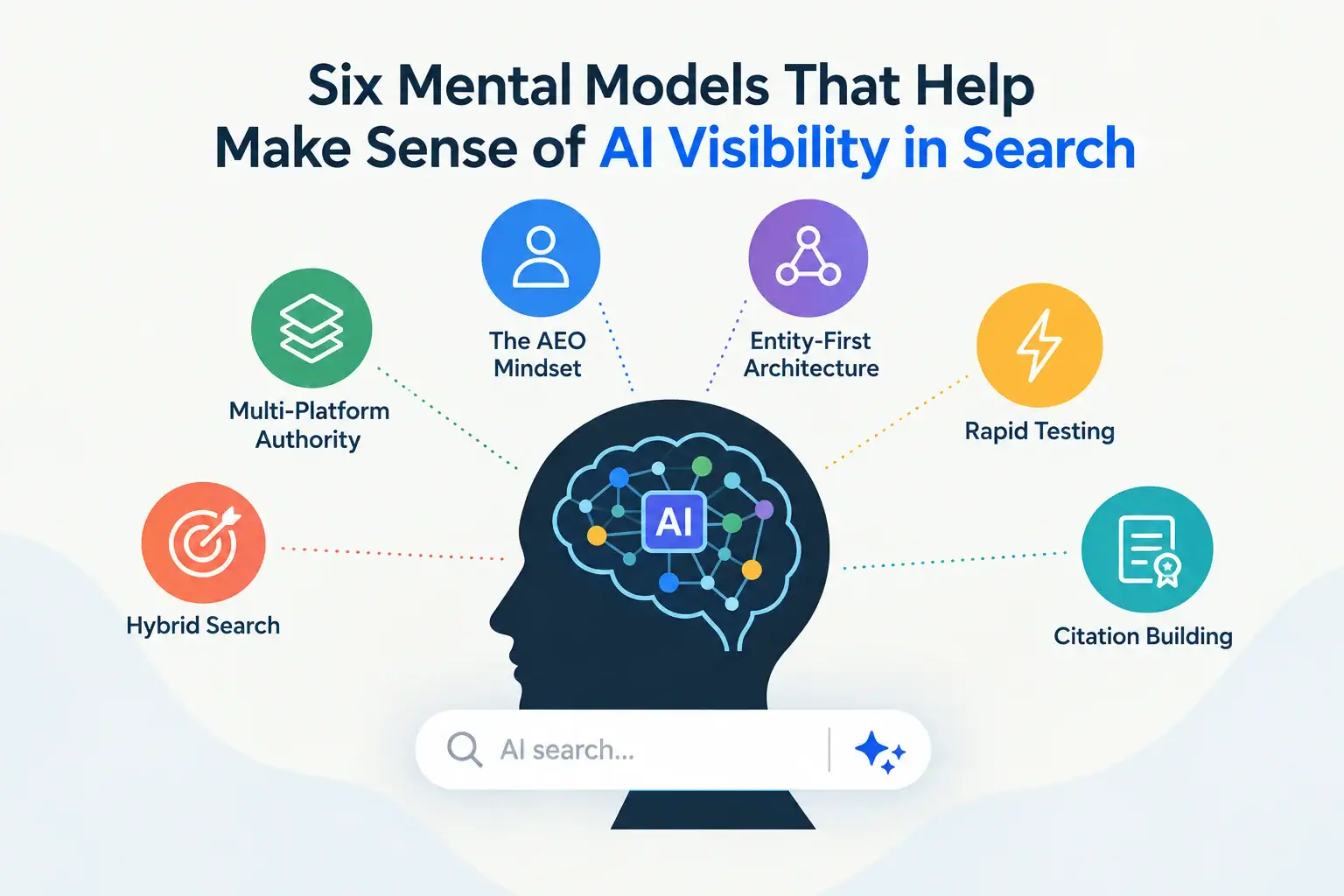
When an AI platform recommends your brand, it vouches for you the same way a trusted referral would, and just like word-of-mouth, that recommendation has to be earned. These six mental models below are how we think about earning it at Xponent21. Each one covers what it means for your business and what to look for in a partner managing the work.
1. Multi-Platform Authority: Your Buyers Don’t All Ask the Same AI
Some of your prospects live in ChatGPT. Others prefer Perplexity for research, use Claude at work, or never scroll past Google’s AI Overview. Each platform weighs content a little differently:
- ChatGPT favors comprehensive, conversational content with clear explanations
- Claude values nuanced, well-researched perspectives with proper citations
- Perplexity prioritizes recent, factual content from credible sources
- Google AI Overviews lean on structured data and direct answers to specific questions
The good news is that you don’t need four separate strategies. Content that earns citations across every platform tends to share the same three traits: it’s clearly structured, credibly sourced, and thorough. When we build around those shared signals, your investment carries across every platform your customers use. It’s a lot like being the business that gets recommended no matter which friend you ask.
2. The AEO Mindset: Your Website Needs to Answer the Whole Question
Search engines were built to hand people a list of links. Answer engines are built to hand them a complete answer, and they put that answer together from the sources they trust most. That changes the job your website has to do.
Answer Engine Optimization (AEO) comes down to three qualities. Your content should be complete enough to cover the follow-up questions a buyer naturally asks, rich enough in context and examples for the answer to make sense, and organized clearly enough that people and AI systems can both pull what they need from it quickly.
The content most likely to get cited is the content that best answers the user’s question while showing the highest levels of trustworthiness and topic authority. In practice, that usually starts with an audit of your existing pages. It’s common to find strong pages that answer part of a buyer’s question and then stop short. Closing those gaps is often one of the fastest ways to become a more useful source for AI and for the people reading your site.
3. Entity-First Architecture: Help AI Understand Who You Are
AI systems understand the world through entities, which are the people, products, companies, places, and ideas in your industry, along with how they relate to one another. A friend can only recommend you if they know what you do, who’s on your team, and what you’re known for, and AI platforms work the same way.
We build that understanding in layers. We start with your core entities, like your brand, services, and key people. Then we add the related concepts and competitors around your business, and finally the connections that show how all of it fits together.
This is the approach that drove our own 4,162% traffic growth in under a year. We made the connections between Xponent21, our team, and the AI visibility topics we specialize in clear enough that AI systems had a reliable picture of who we are and when to reference us.
4. Rapid Testing: Speed Is on Your Side
Traditional SEO has always rewarded patience, and it still does. AI search moves faster, though, and brands that test and adjust quickly gain ground that slower competitors can take months to win back.
Our testing programs run in regular sprints. We make small, deliberate changes to things like headings, structure, and the way data is presented. We start tracking citations shortly after publishing, and we expand the formats that work across your site. Faster testing protects your budget too, since formats that don’t perform get identified and dropped before they use up more of your investment.
When you talk with a potential partner, ask what happens when a test doesn’t work. How quickly they find out, and what they do next, will tell you a lot about how your budget will be managed.
5. Citation Building: Earn the Recommendation
In traditional SEO, backlinks from other websites signaled that your content deserved to rank. In AI search visibility, citations are the goal. When an AI platform names your brand or links to your content in its answer, it’s vouching for you to your buyer, and that vouching pays off. Seer Interactive found that brands cited in Google’s AI Overviews earned 35% more organic clicks and 91% more paid clicks than brands that weren’t cited.
The content most likely to earn citations includes original data AI can’t find anywhere else, perspectives from your leadership and subject matter experts, definitive guides that cover a topic completely, and regular updates that keep information current. Much of our work here centers on your brand’s Most Valuable Questions. These are the high-intent questions buyers are asking where nobody has published a complete answer yet, and filling those gaps gives AI a clear reason to cite you. It’s also why we built our Authorship system, which gives your team a place to publish content that can be crawled, indexed, and cited in AI search results.
6. Hybrid Search: Every Dollar Should Work Twice
Traditional search and AI search rely on many of the same quality signals, so a well-built program strengthens both at once and you don’t have to split your budget between them.
A balanced strategy keeps your technical foundations strong, including site speed, mobile experience, and overall site health. It adds AI-specific work like structured data and answer-focused formatting, and it builds the authority signals that help in both places. Just as important, your reporting should show your traditional and AI search visibility side by side. If a prospective agency can only report on one of the two, you’re only getting half the picture.
Why Starting Now Matters
Word-of-mouth compounds over time, and so does AI visibility. The brands building authority now are creating an advantage that gets harder for competitors to close. The reverse is also true, and we learned that firsthand at Xponent21. When we scaled back our own content program, our daily Google impressions fell from a peak of more than 168,000 to between 8,000 and 9,000 within a few months. Staying consistent is what keeps the recommendations coming.
Check Your Brand‘s AI Visibility
If you’d like to know whether AI platforms are recommending your brand, you can start today, for free, with CARL Intelligence, Xponent21’s proprietary AI visibility reporting tool.

Jenna Pace
Jenna Pace, Senior Account Strategist at Xponent21, is a results-driven digital marketing and branding strategist with over a decade of experience guiding organizations through complex web development processes, multi-channel campaigns, and strategic brand messaging. In addition to marketing strategy, she enjoys spending time with family and friends, interior design, and traveling as much as she can.