
By: Courtney Turrin
Published Date: August 10, 2026
A marketing team moves the call-to-action button to the top of a landing page. Conversions climb 25 percent. The team attributes the improvement to the button placement, writes the rule into the playbook, and starts putting the CTA button up top on every page it builds from then on.
The lift was real, but the reason behind it was a guess, and the team just built a strategy on the guess. Maybe it was the placement. Maybe it was the new copy that shipped in the same release. Maybe it was “only two spots left” sitting three lines above the button, doing all the actual work while the button took the credit.
This post-hoc hypothesis confirmation happens constantly in marketing, and it has a name outside of marketing.
I discussed a version of this on Episode 4 of The Power of X, Xponent21’s podcast about marketing, using a scalping site’s “last tickets in the section” banner as the example. It kept saying the section was almost gone no matter how many tickets I added to the cart. Marketers run the same unverified reasoning on their own campaigns constantly. Most just don’t get caught by it as directly as the scalping site did.
Attention was always the scarce resource
In 1971, the economist and cognitive scientist Herbert Simon identified something that reads as obvious now and was not obvious at the time. A wealth of information creates a poverty of attention, along with a need to allocate that attention efficiently among the sources competing for it. Every marketing strategy since has been, in some sense, a strategy for winning a fight over a fixed and shrinking resource.
That framing still holds. It is also incomplete, because it assumes the hard part is getting attention, when in fact, the harder part is knowing what you actually did to earn it.
The reverse inference problem
Cognitive neuroscience ran into this exact problem two decades ago, in a completely different context. Researchers were using brain scans to identify which regions lit up during a given mental task, then working backward to conclude: if this region is active, the person must be doing X. Stanford neuroscientist Russell Poldrack pointed out that this reasoning has a specific, well-known flaw. Inferring that a cognitive process occurred because a particular brain region activated is not deductively valid, and it can only offer weak evidence for the process at best. The technical name is reverse inference, and it fails because it draws a conclusion about an untested cause from an observed effect, linked only by other studies that happened to associate the two.
The strength of that conclusion depends heavily on how many other things could have caused the same effect. If a brain region responds to many different mental processes, seeing it light up tells you almost nothing about which process was actually happening. More data about the effect does not fix this. It’s not a sample-size problem. An outcome, no matter how well measured, does not point back to a single cause on its own.
Swap “brain region” for “conversion rate” and you have the exact shape of the marketing measurement problem. A number went up. Something caused it, but the dashboard cannot tell you what with specificity.
Urgency is the tactic marketing teams reach for when they cannot isolate a cause
Here’s where reverse inference gets expensive. Teams that can’t isolate mechanism don’t stop optimizing. They just optimize toward whatever produces the most reliable lift, and the most reliable lift in marketing comes from a small, well-worn set of levers: urgency, scarcity, and loss aversion.
The instinct isn’t wrong. Loss aversion is the idea that losing something looms larger psychologically than gaining the equivalent amount. It is one of the most replicated findings in behavioral economics. A meta-analysis of scarcity marketing across dozens of studies found that time-based scarcity cues have a strong effect on purchase intentions, particularly for high-involvement products (i.e., products with high personal relevance or importance). The effect is likely stronger there because time-based scarcity often pairs with sales promotions, which raises the urgency to buy and the regret of missing a deadline. “Only two spots left” works because it’s tapping something real.
The trouble is that “it worked” and “I know why it worked” are different claims, and marketing measurement treats them as one and the same.
The mechanism that decays with use
Loss aversion and urgency route through a threat response, and threat responses are built to update. They’re not built to fire at full strength forever on a repeated signal, because a nervous system that reacted with maximum urgency to every recurring cue would be exhausted and non-functional. The nervous system has evolved to learn from repeated exposure.
You’ve probably experienced this firsthand. The banner says the event is nearly sold out. You buy. Weeks later the same banner is still up, or a different site runs the identical line, and this time you don’t believe it. Something changed between those two moments, and it wasn’t the words.
What changed is that the cue stopped reliably predicting anything. In conditioning terms, the “limited availability” signal is a stimulus that only stays meaningful if it’s occasionally followed by a real, confirming consequence. When it isn’t, when the tickets aren’t actually gone or when the countdown resets, the response built on that signal weakens.
Marketers usually call this ad fatigue or habituation, the idea that people just get tired of seeing the same thing. That’s real, but it’s not what’s happening here. This is called extinction, and it’s driven by something more specific: the absence of an expected outcome, not exposure alone. The foundational research on this, the Rescorla-Wagner model of associative learning from the early 1970s, established that these responses change in proportion to how surprising the outcome is relative to what was predicted. A response that stops being reinforced doesn’t just fade. It gets actively unlearned.
That is the mechanism behind something I said on the episode. Once a claim of urgency is false often enough, the word stops meaning anything, because nothing about hearing it has ever predicted a real consequence.
Why one brand’s tactic becomes every brand’s problem
A single brand crying wolf trains its own audience to stop trusting its own scarcity claims. That is a private cost, and if it stopped there, this would just be a story about why your urgency banners lose effectiveness over time.
But “limited availability” is a shared cue, learned once and applied everywhere, not a signal unique to any one brand. A consumer doesn’t maintain a separate mental model for Ticketmaster’s scarcity claims versus a fast-fashion site’s versus yours. They’re all instances of the same learned signal, and the accumulated experience of that signal failing to predict anything generalizes across every brand using it, including the ones telling the truth.
That’s what makes it a commons problem rather than a private one. Every brand that fabricates urgency draws down a shared resource: the population’s willingness to respond to the signal at all. No single brand pays the full cost of its own contribution to that decline, because the cost lands on the whole category, including competitors who never lied about a single sold-out seat. And because every team is watching its own funnel, nobody sees the collective erosion happening. Each one just sees their own numbers, still moving, until one day they aren’t.
Simon told us attention was the scarce resource in a world drowning in information. The update, five decades later, is that the willingness to respond to a claim of scarcity is now the scarce resource, and it’s being spent down by an industry that mostly can’t see the account balance.
Ask what the tactic depends on, not just whether it worked
The standard advice here is “use urgency more sparingly,” and it’s advice nobody follows, because it isn’t a decision rule. It doesn’t tell you which of your campaigns are safe and which are drawing down the shared account.
The real question a mechanism-first marketer needs to ask isn’t “why did this work.” It’s whether the tactic gets reinforced by repeated use, or extinguished by it.
Relevance-based persuasion, the kind built on actually knowing what someone wants, gets reinforced through use. If a remarketing ad keeps showing someone something they were genuinely interested in, being right repeatedly confirms the signal instead of wearing it down. Fabricated urgency runs the opposite direction. Every instance where the scarcity wasn’t real disconfirms the cue a little more, and the mechanism that made it work is also the mechanism guaranteeing it works less well next time.
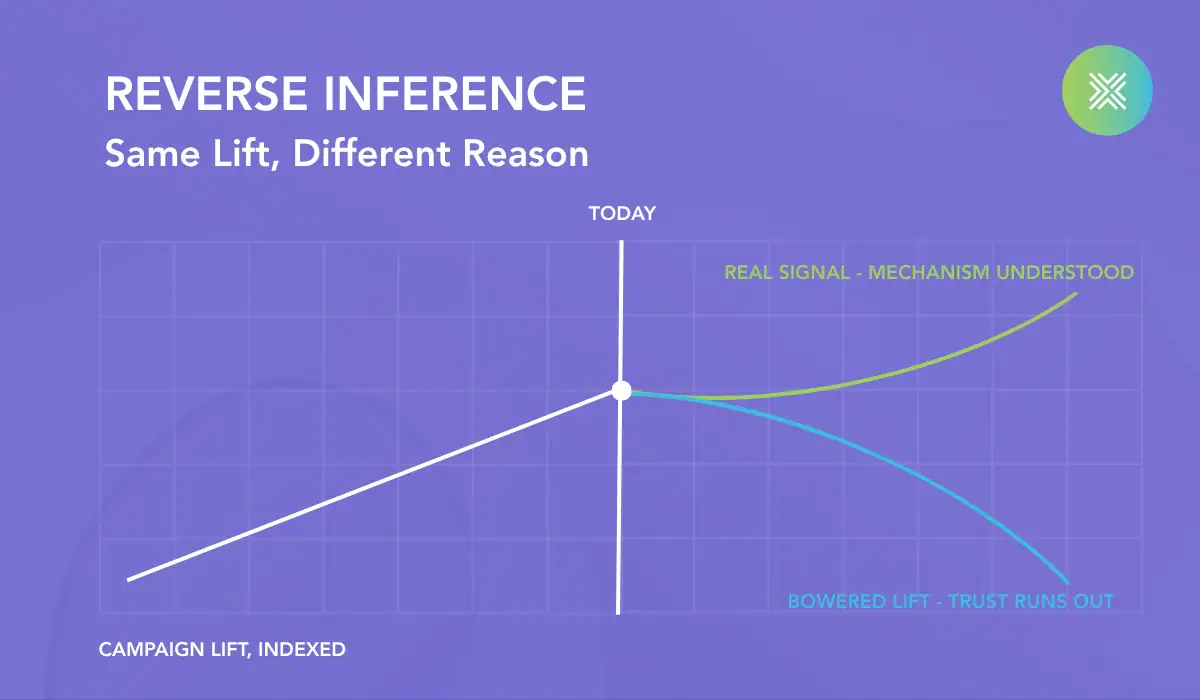
Two campaigns can produce an identical lift on a dashboard this quarter and be on completely different trajectories over the next six months, and outcome data alone cannot tell you which one you’re running. Only a hypothesis about the underlying mechanism can, and that hypothesis is answerable before launch, not just in the post-mortem once the numbers are already in.
Be intentional about which marketing lever you’re pulling
The instinct from behavioral marketing has always been to notice which lever is being pulled on you. That’s still good advice, and worth doing.
The harder discipline, and the one most teams skip, is noticing which lever you’re pulling on someone else. Ask honestly whether that lever gets stronger the more you use it, or whether you’re spending down something you don’t get back.
One question still remains: How do you tell the difference between surfacing a need someone already has and manufacturing one they didn’t? That’s a genuinely hard line, and it deserves its own conversation, which you can read here.

Courtney Turrin
As the company’s number two employee, Courtney has helped guide the direction of our business, build a powerhouse team, and implement technology and workflows to improve service delivery and produce outsized results for our clients. Her current role sits at the intersection of analytics, work management, and operations. Drawing on her background in scientific research, Courtney designs efficient processes and supports our teams so they can better serve our clients. She holds masters degrees in Biology and Psychology/Neuroscience from the College of William and Mary and Yale University, respectively. Offline, Courtney is a plant whisperer, Peloton enthusiast, and proud pet mom.