
By: Courtney Turrin
Published Date: August 10, 2026
Modified Date: September 24, 2026
Our last post ended on a question I said deserved its own treatment: how do you tell the difference between surfacing a need someone already has and manufacturing one they didn’t? I raised a version of the same question on Episode 4 of The Power of X.
The real problem is the question itself. Marketers reach for it because it feels like the whole ethical case rests on the answer. Reveal a need that already existed, and you’re in the clear. Manufacture one that wasn’t there, and you’ve crossed into manipulation. Two separate bodies of research, one from psychology and one from economics, show that this split can’t carry the weight marketers put on it.
Most of your customers’ preferences don’t exist until you ask
The assumption behind “we just revealed it” is that the preference was sitting there fully formed, waiting to be discovered. Paul Samuelson’s revealed preference theory, the 1938 idea that underlies a large share of economic thinking about consumer choice, depends on that assumption. Watch what someone buys, and you can infer what they wanted all along.
Decision researcher Paul Slovic spent a career complicating that picture. In his 1995 paper, The Construction of Preference, he laid out decades of evidence showing that people often don’t have a stable, pre-existing preference to report. They construct one at the moment they’re asked, and the construction is sensitive to how the question is framed, what else is being offered, and what order the options appear in. Ask the same person the same question two different ways and the answer can change, not because they’re confused, but because there wasn’t a fixed answer sitting in memory to retrieve.
Bettman, Luce, and Payne extended this concept directly into consumer behavior. Their 1998 paper, Constructive Consumer Choice Processes, argues that limited processing capacity means shoppers build preferences on the spot using whatever strategy the situation calls for, rather than pulling a ready-made answer off a shelf in their brain.
Put those two literatures together and the marketer’s reassurance gets shaky. If the preference didn’t exist in stable form before the ad, the landing page, or the sales call, “we only revealed it” is a softer way of saying we built it.
A want you built is not automatically a want that’s fake
The other half of the binary has the opposite problem. If revealing a want isn’t as innocent as it sounds, surely manufacturing one is guilty. That was John Kenneth Galbraith’s argument in The Affluent Society. He called it the dependence effect: as a society gets richer, more of its wants get created by the same production and advertising that satisfies them, and a want that depends on the process satisfying it can’t be as urgent as one that didn’t.
Friedrich Hayek’s 1961 rebuttal, The Non Sequitur of the Dependence Effect, highlighted the gap in that argument. Almost none of our wants above basic survival are innate. We learn to want music, good food, particular company, and specific brands by watching other people enjoy them and wanting in on it too. If “created by the process that satisfies it” makes a want illegitimate, that standard throws out most of what makes up a person’s actual taste, along with the marketing that helped shape it.
Hayek’s point cuts against the manufacturer’s guilt the same way Slovic’s cuts against the revealer’s innocence. A want marketing helped build is not automatically a fraud on the person who ends up with it.
The origin question can’t settle persuasion versus manipulation
Put the two arguments together and the reveal-versus-manufacture split loses its footing from both directions. Marketers usually can’t tell with any real confidence whether a given desire pre-existed their campaign or got built during it. And in the cases where they could tell, it wouldn’t resolve anything, because a built want isn’t automatically worse than a found one.
The question was never going to do the ethical work it was asked to do. The line separating persuasion from manipulation has to be something other than where the desire came from.
The line runs through method, not through where the desire came from
Philosopher Robert Noggle’s account of manipulation, laid out in his 1996 paper on manipulative actions and summarized in the Stanford Encyclopedia of Philosophy’s entry on the ethics of manipulation, locates the problem in the target’s mental state rather than in where a desire originated. On his account, manipulation is an attempt to get someone’s belief, attention, or emotion to fall short of what it should be: a belief that isn’t true, attention pulled toward something that shouldn’t matter this much, or an emotion that doesn’t fit the actual situation.
Claudia Mills put a sharper edge on the same idea in her 1995 paper on political manipulation. A manipulator treats reasons as levers to pull rather than justifications to offer, and a bad reason works just as well as a good one as long as it moves the person.
Daniel Susser and his co-authors gave the test its most practical form, arguing that manipulation is influence that depends on staying hidden. It works because the target can’t see, and couldn’t easily come to see, how it’s working on them.
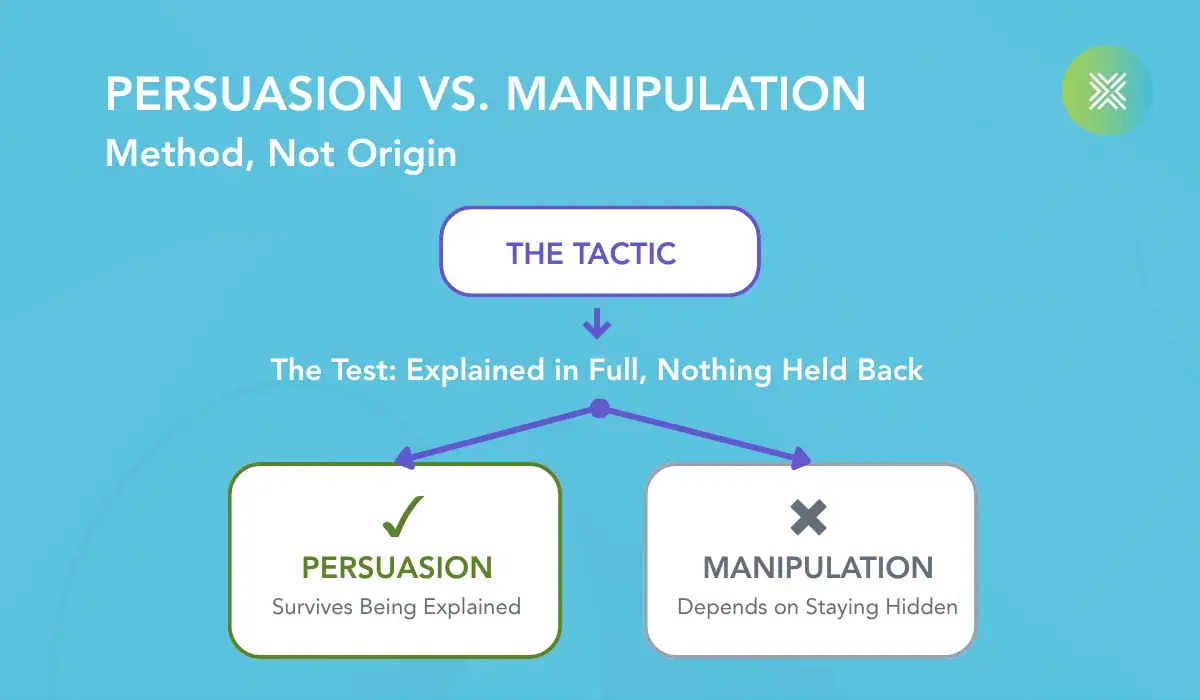
That gives you an actual test, and it doesn’t depend on whether the underlying want was there first. Ask whether the reasoning behind the tactic survives being said out loud to the person on the receiving end. If it does, that’s persuasion. If it only works while they can’t see the mechanism, that’s manipulation, whether or not the desire you’re pointing at was sitting there all along.
A scarcity claim that was never true
Run the test against the event ticket scalping example from the last post and Episode 4. “Last tickets in the section” only works if the buyer believes the section is actually almost sold out. Say the quiet part out loud (the countdown resets and the inventory doesn’t actually change), and the tactic stops functioning immediately. Plenty of people genuinely wanted those tickets before the banner ever loaded, so the demand itself was real. The manipulation lives entirely in the reasoning surviving only while the person can’t see it.
An energy bill with a cause nobody had named
Compare that with a case from our own client work. We’ve spent years marketing for architectural window film companies like ESP, PA Window Tint, and Solar Tint, and the core move in most of that marketing, especially on the consumer side, is naming a cause the homeowner hadn’t connected yet.
The homeowner already knows their energy bill spikes every summer and winter. What they usually haven’t identified is that their windows are frequently the single largest source of heat gain and heat loss in the house, and that a full window replacement isn’t the only fix. A solar insulating film installed over the existing glass solves the same problem for a fraction of the cost and disruption.
Run the same test and it holds. The homeowner can check every part of it themselves, and none of it depends on them not understanding. That’s persuasion, whether or not the want (a lower energy bill) predates the ad. It obviously does.
Fatigue and low libido with a cause nobody had named
A second case makes the same point from a different vertical. One of our clients is a medical clinic offering hormone replacement therapy for both men and women, among other services. The symptom clusters they market around, difficulty focusing, weight gain, low libido, and low energy, show up in perimenopausal women and in men with clinically low testosterone. Plenty of people living with those symptoms haven’t connected them to a hormone issue at all. They’ve chalked it up to stress, aging, or thyroid dysfunction.
The marketing here does exactly what the window film marketing does: names a cause the person hadn’t identified, for a problem they were already living with. And it passes the same test. The clinic can lay out the actual symptom criteria, the lab work involved, and the treatment options, in full, and the reasoning survives every bit of that exposure. A person can take the claim to their own doctor and verify it independently. Nothing about the tactic requires them not to understand what’s happening.
The question to ask instead of where the demand came from
Stop asking whether you created the need or found it already there. Most of the time you can’t actually know, and the answer wouldn’t tell you anything useful if you did. Ask instead whether the reasoning behind your tactic survives being explained to the person it’s aimed at, in full, with nothing held back.
That’s the plain-language version of the persuasion vs. manipulation test the research keeps landing on, and it’s close to the same gut-check from the podcast: if you’d be uncomfortable explaining the tactic to your customer, that discomfort is the signal, not where the demand came from.

Courtney Turrin
As the company’s number two employee, Courtney has helped guide the direction of our business, build a powerhouse team, and implement technology and workflows to improve service delivery and produce outsized results for our clients. Her current role sits at the intersection of analytics, work management, and operations. Drawing on her background in scientific research, Courtney designs efficient processes and supports our teams so they can better serve our clients. She holds masters degrees in Biology and Psychology/Neuroscience from the College of William and Mary and Yale University, respectively. Offline, Courtney is a plant whisperer, Peloton enthusiast, and proud pet mom.