
By: Will Melton
Published Date: September 21, 2026
TL;DR: 80% of Google searches now include AI Overviews, and more than half of website traffic is from bots rather than humans. If you haven’t adjusted your digital strategy accordingly, prospective customers aren’t even seeing your business as an option.
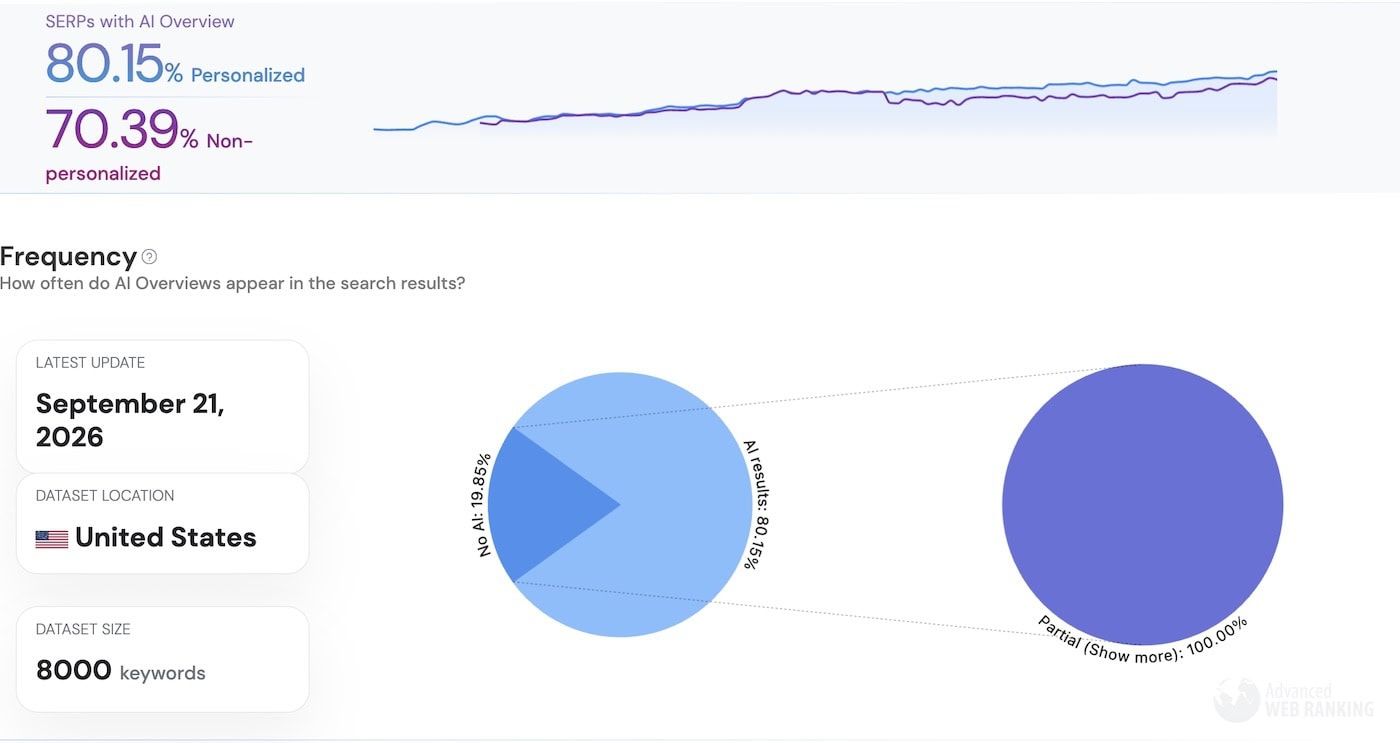
AI Overviews surged significantly by September 1, 2026. In its August 2026 earnings call, a major CDN provider confirmed that non-human traffic had overtaken human traffic on its network back in May 2026. Without AI visibility, businesses lose customers before they consider options.
The New Default: AI Overviews Drive Search Behavior
The landscape of search has fundamentally shifted. Google AI Overviews now appear in over 80% of U.S. search results as of mid-2026. This is now the operational reality for every business aiming for online discoverability. This rapid acceleration illustrates the speed at which the search ecosystem is evolving. We have moved past a tipping point; AI Overviews are now the primary way users find information. For more on this, explore how to improve your AI discoverability.
The implications are immediate and profound. Users clicked a traditional result on 8% of searches with an AI summary, versus 15% without, as noted by Pew Research Center. This 8% versus 15% reduction in direct clicks for organic results means that even when your brand ranks traditionally, the opportunity for direct engagement is significantly curtailed if an AI Overview intervenes. This creates an urgent need for businesses to pivot their digital marketing strategies. Optimizing for traditional search alone no longer secures the same level of visibility or traffic.
Beyond Human Traffic: The AI-Agent Economy
The shift extends beyond Google’s direct search results. In May 2026, a major CDN provider confirmed on their Q2 earnings call that non-human, AI-agent-driven traffic officially surpassed human traffic on its network. This data point is a stark illustration of the evolving digital economy. It means that a significant portion of what happens online is no longer initiated by human users directly searching or browsing, but by AI agents performing various tasks, from data collection to complex query resolution.
This phenomenon underscores why AI visibility management is important. AI agents do not engage with websites in the same way humans do. They extract specific data points, evaluate trustworthiness, and synthesize information for other AI systems or human users. If your content is not structured and optimized for how AI systems cite content, it risks being entirely bypassed by this dominant segment of web traffic. The traditional metrics of unique visitors and page views become less meaningful when a large portion of that traffic isn’t human.
The Cost of Irrelevance: Brands Uncited by AI
When AI systems answer a question about your industry or products, and your brand isn’t cited, it’s not just a missed opportunity; it’s a direct loss. Brands cited in AI Overviews earned 35% more organic clicks than non-cited brands, according to Seer Interactive’s analysis. For paid channels, the difference is even more dramatic: brands cited in AI Overviews earned 91% more paid clicks than non-cited brands. This demonstrates a clear competitive advantage for those who achieve AI citation. More details on how AI systems cite content are available.
In my experience, if your brand does not surface when AI answers a question about its category, the customer is often lost to a competitor before a human ever sees a choice between options. This pre-selection by AI fundamentally redefines the customer journey. It means the critical decision point often occurs within the AI Overview itself, making direct citation an existential requirement for market leadership. The traditional marketing funnel has been short-circuited; if AI doesn’t know about you, your potential customer likely won’t either.
AI Visibility’s Evolving Nature
The sheer speed of the AI search evolution demands a continuous, adaptive strategy for AI visibility management. The ground moved five points in three weeks for AI Overview prevalence. This arc itself is proof that AI visibility cannot be a one-time audit or a set-it-and-forget-it campaign. Static content strategies are rapidly becoming obsolete. Brands in higher alignment tiers were 13.7x more likely to be cited in AI answers, as revealed by Xponent21 Cognitive AI Ranking Lab’s analysis of 156,000+ data points. This multiplier highlights the constant need to monitor and adjust your content’s semantic alignment.
The content you create today must be designed not just for human readability, but for AI extractability and citation. This means understanding how AI systems process information, what signals they prioritize, and how to structure content that effectively serves both human and machine intelligence. It’s about ensuring your content is continually updated and refreshed for AI search longevity, ensuring your brand remains relevant as AI models evolve and competitor content enters the space. A proactive approach is the only way to avoid rapid obsolescence in this new era.
Adapting Marketing for the AI Search Visibility Era
The impact of AI Overviews on business cannot be overstated. AI Overview presence reducing top-ranking page CTR by roughly 58%, according to Ahrefs’ 300,000 keyword analysis, means brands must adjust their marketing for AI search. The decline in traditional click-through rates means that simply ranking #1 in organic search no longer guarantees the same traffic volume it once did. The focus shifts from traditional search rankings to direct AI citation and optimal positioning within AI Overviews.
This requires a new approach to digital marketing in the AI era. It means prioritizing content that is clear, concise, and highly factual, enabling AI systems to easily extract and cite your information. This also impacts how businesses think about customer acquisition. The AI search strategy for executives must center on ensuring their brand is the authoritative source that AI models trust and recommend. Ignoring this shift means ceding valuable visibility to competitors who are adapting more quickly.
Securing Your Brand’s Future in Generative Search
Securing your brand’s future in this AI-driven landscape means embracing AI search optimization as a foundational element of your business strategy. This is about more than just incremental improvements; it’s about claiming a first-mover advantage in AI SEO. The brands that proactively adapt will establish themselves as authoritative sources for AI, gaining a significant competitive edge.
The data is clear: AI Overview presence alters click behavior. With users clicking a traditional result on 8% of searches with an AI summary versus 15% without, the pathway to customer engagement has fundamentally changed. Building authority within AI systems requires an integrated approach that spans content, technical SEO, and brand strategy. It is about creating a coherent digital footprint that AI models can readily comprehend, cite, and recommend.
The Imperative for an AI-First Approach
An AI-first marketing approach is no longer a luxury; it’s an imperative. The pervasive nature of AI Overviews and the rise of AI-agent-driven traffic demand that businesses recalibrate their entire digital strategy. This means moving beyond a reactive stance and proactively designing content and digital experiences for AI consumption.
The shift in how information is discovered and consumed requires an ongoing commitment to AI visibility management. As I’ve seen in our work, the speed at which these changes occur means that strategies must be continuously monitored and adapted. The businesses that lead in this new era will be those that prioritize being the trusted source for AI, understanding that this is the primary channel through which customers will increasingly discover solutions and make decisions.
Maintaining AI Visibility: A Continuous Effort
Maintaining AI visibility is a continuous effort, not a one-time project. The dynamics of AI search are fluid, with constant updates to models and shifts in how information is processed. This demands ongoing attention to how AI systems cite content and how your brand’s digital assets align with the evolving semantic centroid for key queries. For guidance on this, consider how to maintain and refresh content for AI search longevity.
AI visibility management requires a sustained commitment to creating high-quality, AI-optimized content, monitoring your brand’s citation share, and continually refining your strategy based on performance data. This continuous process ensures your brand remains a trusted and relevant source in the eyes of AI, securing your position in the generative search landscape.
Your Next Step in AI Visibility Management
Navigating the accelerating shift to AI-dominated search requires a clear strategy and the right tools. Understanding how AI Overviews impact your business is the first step toward reclaiming and expanding your digital footprint. We’ve seen how quickly the landscape can change, and why continuous AI visibility management is necessary for success. To effectively hack your existing marketing budget to win in AI search, accurate, real-time data is essential.
You can gain critical insights into your brand’s performance in this new environment. For a limited time, you can access Xponent21.com’s free AI-visibility tracking tool for up to six months to assess your current standing and identify immediate opportunities.

Will Melton
Will Melton, CEO of Xponent21 and consultant to global companies, brings nearly 20 years of leadership in technology and marketing. He is the founder of AI Ready RVA and Richmond Water, podcast host for Channel RVA, and serves on several charitable boards in Richmond, VA. Recognized as one of the world’s top experts on AI SEO, Will was one of the earliest adopters or AI visibility and has pioneered strategies that have achieved top citations across Google AI Overviews, ChatGPT, Claude, and Perplexity, making him a global authority on the future of search.