
Published Date: October 16, 2026
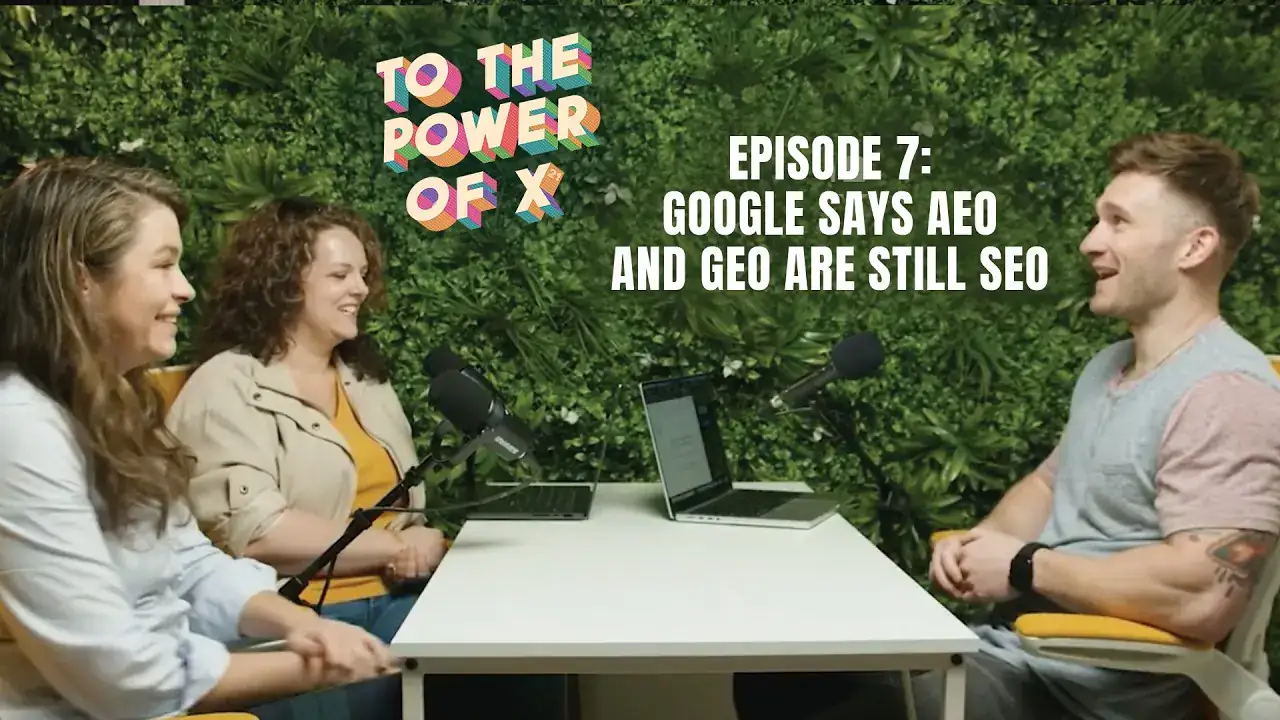
Every few months the search industry finds a new acronym to rally around, and this year it found two. AEO and GEO have been pitched as brand-new disciplines that call for new budgets, new tools, and in some cases an entirely separate agency. In Episode 7 of To the Power of X, Chuck McCarthy, Kayleigh Crandell, and Jenna Pace from the Xponent21 marketing team talk about what Google itself said about generative AI search based on I/O 2026. Long story short, Google says optimizing for AI search is still SEO.
In This Episode
- Why Google’s own guidance treats AEO and GEO as part of SEO
- How fads like llms.txt and overzealous content chunking have made webpages worse for the people reading them
- Why commodity content and high-volume publishing are losing to content written for real customers
Episode 7 Recap: Cutting Through the Alphabet Soup
The episode opens with the chatter that followed Google I/O and then moves into Google’s published guidance. The team’s takeaway is that the things Google has asked for over the years, including pages that can be crawled, a clear structure, and content that answers a real person’s question, are the same things that earn a place in AI Overviews. AI search does behave differently, and it rewards some smart adjustments, but SEO done well has been laying that groundwork the whole time.
From there the conversation turns to AI-specific tactics that have cropped up around AEO and GEO. Plenty of site audits now flag a missing llms.txt file as a problem, and the team explains why it never carried the weight that many claimed it did, especially for sites that already maintain a descriptive robots.txt. The same applies with content chunking and structured data, where ideas with real value got applied so aggressively that pages became harder for people to read. Kayleigh, Chuck, and Jenna also talk through the trust curve around AI Overviews, which started with a wave of enthusiasm and has since bent as more users question what gets surfaced and go check the sources for themselves.
The second half of the episode focuses on the content itself. Commodity content is information anyone could write and any AI tool can summarize. Non-commodity content comes from the experience, data, and point of view that only you have. It’s where personalization in AI search pays off for companies willing to write for their actual customers instead of an algorithm. The team also covers the ever-popular tables and listicles, and closes on scaled content abuse.
Key Moments in Episode 7
- 2:58 Reading Google’s actual guidance on AEO and GEO, and what it says about optimizing for generative AI search
- 9:14 llms.txt vs. robots.txt, and why one of them has been doing the heavy lifting all along
- 12:52 How content chunking and structured data went from smart practice to overreach
- 15:04 AI Overviews and the trust bell curve as users start questioning what they see
- 20:28 Commodity vs. non-commodity content, and why writing for customers beats writing for the algorithm
- 30:34 Scaled content abuse and the hidden cost of high-volume, low-quality publishing
Go Deeper on AI Search Strategy
- Keyword Tracking Isn’t Enough Anymore: How AI Search Made SEO More Human | To the Power of X, Ep. 5
- Why Is Authority More Critical Than Ever in AI-Driven Search?
- The Whole Pie: Why AI Visibility Is a Business Operations Problem
Watch Episode 7 of To the Power of X
Wondering whether your current SEO program is already covering what AI search needs, or whether it has been chasing fads? Our agency helps businesses increase their brand visibility that holds up across Google and AI tools alike. Book a strategy call and we will take a look at where you stand.
Prefer to listen? Catch Episode 7 on Spotify and Apple Podcasts, or watch on Channel RVA.
To the Power of X is Xponent21’s podcast on AI, marketing, and the strategies that help businesses grow their visibility.

Kayleigh Crandell
Kayleigh Crandell is a dynamic marketing professional with a passion for project coordination, creative storytelling, and community engagement. As Marketing Projects Coordinator at Xponent21, she leads initiatives across content, SEO, social media, and creative campaigns, collaborating closely with clients and internal teams to deliver outstanding results.