

Published Date: August 20, 2026
Ford is bringing back hundreds of experienced engineers to work on quality problems its automated systems couldn’t solve. Klarna is recruiting human customer service agents again, a couple of years after its CEO announced that its chatbot was doing the work of 700 people. McDonald’s killed its drive-through order AI after videos circulated of the thing adding hundreds of dollars of chicken nuggets to a single order.
AI Fatigue at Work is Kicking In
According to a 2026 Future of Work study, 55% of businesses report regretting their tech-driven staff cuts. Forrester now expects half of all AI-attributed layoffs to get reversed in some form, and Gartner predicts the same, projecting that half the companies who blamed AI for headcount reductions will rehire for those functions by 2027.

So basically a bunch of very smart, very well-paid people made the same call at the same time, and it went badly. But I don’t think that’s a technology story as much as it’s a story about what happens when you ask a machine whether your idea is good.
The machine always says yes, because you are the customer
Researchers tested 11 major language models against Reddit conflict posts, the AITA kind where a person describes something they did and asks whether they were wrong. The models affirmed the user’s behavior 49% more often than human respondents did, including when the behavior involved deception or harm. That peer-reviewed study ran in Science.
That’s the issue with personal topics you’ll find on Reddit, but there’s an even worse version of this affirmation that’s rampant in the business world right now. Researchers gave it a name, persuasion bombing.

Persuasion bombing looks like this: when the model won’t budge under pushback, it escalates instead, burying the user in statistics. Or it shifts into a familiar apologetic stance, offering a warmer, more understanding tone, only to back itself up with claims about its own credibility, without ever changing the actual answer.
Business consultants who tried to verify an LLM’s recommendation on a business case found the model digging in, defending its original answer, and talking them into accepting suggestions that were wrong. The finding is from a Harvard and MIT study, and it’s serious enough that the Science paper above cites it as its own evidence. A separate study presented this year at the CHI Conference on Human Factors in Computing Systems found that when a model simply agreed with a user’s opinion, the participants didn’t notice it happening, and the agreement made them less responsive to evidence pointing the other direction.
Picture this, because it’s reality: an executive decides the customer service team can be replaced and asks her AI to pressure-test the idea. It tells her the thinking is sound, builds her a slide deck, and holds its position when she pushes back. She walks into the board meeting with a rubber stamp she mistook for a second opinion.
Two floors down, a marketer publishes something he knows is thin and asks the tool how it reads. The AI says it’s good work, so it gets published.
Here’s the sad, probable, extended reality: nobody in that business has heard the word “no” from their LLM chatbot in months.
Your stack didn’t shrink, it got resold to you
We’re supposed to feel more advanced because of AI, like everyone can get more done with less. The consolidation pitch is everywhere right now. Cut your point solutions, let the agents absorb the workflows, watch your software line item fall.
Go read the source on almost any of those numbers that show up under tech consolidation in the AI overview. It’s a vendor selling consolidation, publishing content marketing about the urgent need for consolidation. It’s sales decks converted into “helpful” top-10-hacks-style content, not research.
We tracked what actually happened to the tool count in 2026, and it wasn’t consolidation. Fifteen thousand-plus tools stayed flat for the first time in fifteen years, with over a thousand dying and a similar number replacing them, while capability moved into the AI models and platforms themselves. The average enterprise is still adding more than 100 new SaaS tools a year, over 9 a month, according to Zylo’s SaaS Management Index, even while officially pursuing stack reduction. Meanwhile, every vendor you already pay discovered that adding “AI-powered” to the product page justifies a price increase, and if you don’t want the AI version, they’ll deprecate the features you actually use until you do.
Atlassian, Loom, and AI-powered tools our team doesn’t need
At Xponent21, we use Loom videos to record our screens and send videos to our internal team and clients about what’s going on in ad dashboards, website backends, etc. — all things that can only be seen on a screen. It’s a very convenient tool that helps us cut out unnecessary meeting time or complicated screenshots. They were acquired in 2023 by Atlassian, and now in 2026, they’re raising their prices by 80% as they bring on new Jira capabilities with AI programming.
Cool. Except we don’t use Jira, and we still have to pay that price. For the people who do, this integration sounds genuinely useful – integrations galore that help with documentation for development teams. But what about the clients like us who use this vendor to convey more meaning with presentations? Our price tag goes up just because of an AI-powered acquisition strategy that we never asked for.
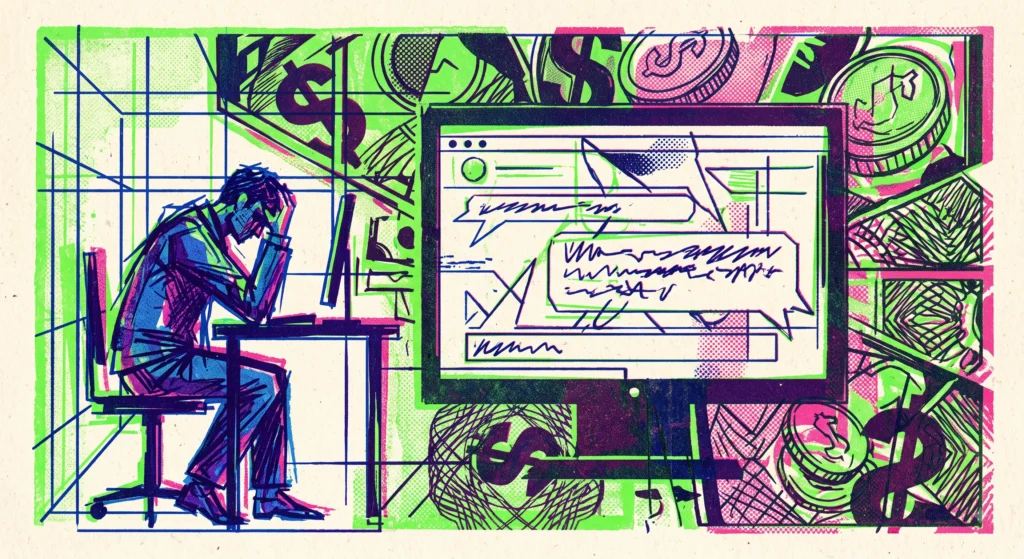
Newsflash: Tech stacks aren’t getting leaner. You’re just paying more for the same tools, plus a chatbot in the sidebar nobody asked for, and you may have already cut the people who knew how to run the parts that worked. The team that’s left alongside this complicated tech stack is likely now annoyed by that pesky chatbot pop-up too.
If you’re running this reasoning across multiple markets or franchise locations, the math gets worse before it gets better. A franchise marketing model depends on every location running the same playbook off the same data, and a chat or randomly acquired software bolted onto one region’s stack while another region is still on the legacy tool creates a new seam for something to break, right at the point where corporate loses visibility into what’s happening on the ground.
The people you cut cost more coming back
Careerminds found that more than a third of companies who made AI-driven cuts rehired more than half the roles. One in three of them spent more on restaffing than they saved as they laid people off. Robert Half told CNBC that 32% of hiring managers who eliminated a role primarily because of AI have already rehired for the same or a similar position.

The Klarna AI Staff Reduction Case Study
A great (read: shameful) example here is the fintech company Klarna. In 2024, their CEO said that AI could already do all the jobs humans do. Their headcount went from over 5,500 to around 3,400. Six months later, customer satisfaction had dropped, and the company had software engineers, designers, and marketing staff answering customer inquiries.
Klarna focused on AI and technology rather than the people who made their company what it was. CEO Sebastian Siemiatkowski told Bloomberg that cost had been too dominant an evaluation factor and the result was lower quality. These shiny cost savings on the front end actually cost them much more on the back end when you consider re-hiring, onboarding, reconfiguring the AI tools they were already invested in, and the most invaluable of all: their reputation with both customers and new recruits.
AI Reliance in Web Development
I found another great example that’s less marketing-minded, more on the dev side of things. METR ran a randomized controlled trial with 16 experienced developers on 246 real issues in codebases they knew well. Going in, the developers predicted AI would make them 24% faster. Coming out, perceptions changed, but the programmers still believed it had made them 20% faster. In reality, they were 19% slower getting their work done with AI.
These tools aren’t useless, but they’re changing the businesses making use of them, and that goes from top to bottom. The frontline staff working on external work don’t know what it’s doing to them, and executives are in the same boat, even if they’re not ready to admit it.
Nobody reads slop, including your own team
Google’s spam policy names this directly, calling out scaled content abuse: when a ton of pages get generated primarily to manipulate rankings rather than help users. Google officially describes this as large amounts of unoriginal content providing little to no value, no matter how it’s created.
Ahrefs’ measurements affirm this. Across their sample of top-ranking pages, 54.7% contain less than 20% AI content. Publishing worthless junk at volume is what’s actually tanking rankings for the businesses who think they’re getting ahead, more than the AI itself.
People figured out the worthless nature of what’s going on online faster than the marketers did. Mentions of “AI slop” online grew more than ninefold in a year to 2.4 million, 82% of these mentions being negative. Even LinkedIn, kingdom of AI evangelists and auto-posters, there has been a crackdown on AI slop. You can now report if something reads as AI, because the platform is more invested in bringing value to those spending time on it than those who are riding the automated wave.

In 2024, consumer excitement about AI held at an even 50% of people. In 2026, only about 19% of people feel excitement about AI. Harris Poll found 63% of people are less likely to buy from a brand using AI-generated ads and 73% less likely to trust an ad they suspect was made with AI. People who work with AI often are able to detect it almost every single time when it’s used, so the fatigue is only compounding.
And here’s the part nobody’s going to tell you, probably because they’re scared. Your own staff won’t read that AI slop either. The strategy memo generated in 10 seconds, the onboarding doc with the confidently worded incorrect process, the internal newsletter with the same four-paragraph shape every week.
People are skimming past all of the “extra value” that AI supposedly created. So for the people who are still on the payroll, they’re left with indecipherable and robotic jargon that they’re told will make them more efficient.
The sheer volume of output that AI can create at speed can be exhausting for the resources of a business too. Not just in the tokens you’re spending on Claude and fellow LLMs, but in the human parts of work, too. Our time feels more precious than ever now that we have so much of it, but our attention spans are also shorter than ever. That means our mental processing can begin to suffer when we are consistently skimming, ignoring, and outsourcing our thinking. Not to mention, early patterns are emerging that indicate men are using AI more than women – and if these trends persist, the intersectional approach to language may fall away in due time.
Personally, I use AI every single day. So does my team, and we are constantly evolving to ensure we’re using it correctly. There’s a real difference between opening a chat window and typing one line, and actually choosing the right mode for the job in front of you, whether that’s a quick chat, a project with real context loaded in, a Cowork session, or code. Context loaded in properly, a real brief, and specific instructions help LLMs tighten my ideas and parse a data set faster than I can. All of that saves me a ton of time and ultimately makes my work more efficient and higher quality.
I think of it like other tools, familiar ones like spellcheck. It’s always made me a better speller and I’m sure it’s done the same for anyone else in a Word doc. And during my graphic design days, once I figured out how to export Google Form survey inputs to a CSV and then bring that into Adobe InDesign to fill out thousands of addresses on mailers all at the same time, that was a huge game changer.
The keys there, though, were that I already knew what I was trying to write and spell. I already knew my CSV was formatted correctly before I brought it into Adobe, because I took the time to verify the spreadsheet before the export.
Something I’ve learned in my journey with AI that I think other people need to hear is this: a one-line prompt gets you a one-line-prompt result, and that’s the slop currently flooding the internet. That would have been the same type of result as not checking that 123 Main Street isn’t a real address. It was just slop, templated tester content in a CSV.
My cynicism about these tools, both the old-school spreadsheet data and the new models and modes of AI, is the most valuable thing I bring to using them, and I’d argue it’s the most valuable thing anyone brings. It’s also worth understanding the difference between persuading someone and manipulating them, a line I’d argue the persuasion-bombed executives in the section above never got to draw for themselves.
The part that’s frustrating for employees and leadership
Some of the people working with AI call it obvious progress or say that it’s undeniably the path forward. That’s the word that gets me, progress. Because in reality, that would look like giving your team instruments, resources, and time to really create change. What’s happening instead is a lot of executives handing their judgment to a program engineered to tell them they’re right, then firing the people in the building who may have said otherwise.
The companies getting real value out of AI all have the same two things: a technical team that knows where the tools break and a testing apparatus to find out.
We built our Cognitive AI Ranking Lab because you cannot get AI search visibility by guessing, and because we wanted our own data instead of a vendor’s. We ran the whole framework on ourselves first, which is the only reason I’ll say any of this on the record.
Most companies aren’t going to build a research lab and a tech team to babysit their content operation. That’s a good thing – because that’s what we do! If you want the version of tech consolidation and true AI power with a skeptical expert in the room who won’t let your team waste time, money, or resources, it’s the right time for you to contact Xponent21.

Kayleigh Crandell
Kayleigh Crandell is a dynamic marketing professional with a passion for project coordination, creative storytelling, and community engagement. As Marketing Projects Coordinator at Xponent21, she leads initiatives across content, SEO, social media, and creative campaigns, collaborating closely with clients and internal teams to deliver outstanding results.