
Published Date: June 2, 2026
Modified Date: August 26, 2026
Managing social media for a B2B brand is its own discipline. Anyone who tells you it’s the same as B2C with a slightly different caption is completely unserious.
I know this because I manage social for a national B2B supplier of specialized industrial components, and the work is unlike anything else in my portfolio.
This client isn’t selling directly to homeowners or car enthusiasts scrolling Instagram. They’re talking to a dealer network of professional installers, architects, and designers who are looking for very specific products. These buyers make purchasing decisions based on what’s best for their business, not what looks good in a lifestyle carousel.
That means the content has to be technically sound. Product names, product line designations, application specs: these details matter, and getting them wrong isn’t just a copy error; it erodes trust with an audience that actually knows the difference in products. Dealers notice, so as their marketing partner, we do too.
That specificity is what makes this B2B one of the most demanding and rewarding accounts I work on, and it’s the reason the infrastructure behind the work matters as much as the content itself.
The Account Behind the Social Calendar
Xponent21 has been working with this particular B2B client since 2018. Over that time, we’ve built and grown their website, developed and optimized their ecommerce store, created a gated online resource hub for their partner network, produced video content (including a series around a specialized product line that now dominates AI Overviews and ranks #2 in Google SERPs), built out their vocational training program’s digital presence, and managed their content and social programs across Facebook, Instagram, LinkedIn, YouTube, and Google My Business. The relationship spans more than a dozen active projects in Asana (our project management platform of choice) at any given time.
Social sits inside all of that. We have literally thousands of open and closed tasks that pertain just to one client’s social media. That number tells you two things: how long we’ve been doing this consistently, and how much content it actually takes to maintain a credible presence for an industry-leading brand operating at this high level.
Any great social team is highly collaborative. The team that I work alongside with on this account is particularly skilled and bring their own expertise to the table for every post. Allison, Senior Account Strategist, brings the brand strategy lens and expert knowledge, while Nikki, Creative Director, handles the visual side. I own project management and social lead responsibilities, which means I’m building and managing the workflow, coordinating approvals, ushering content through production, and making sure everything that goes out is on-brand and technically accurate.
Why Asana Is Central to Making This Work
A social calendar for a B2B brand like our client needs to be more than simple post ideas. It should function as a production pipeline with multiple stakeholders, approval stages, and content types that each carry different requirements.
With all that thinking behind our posts, I know to plan months ahead. Planning that far out is critical for an authoritative brand: the sales cycle for their business relationships is longer than it is in B2C, and content that supports product knowledge and brand trust needs to show up consistently, not in bursts.
Getting My Asana Certifications Changed How I Build Workflows
I recently earned my Asana Foundations Badge and Workflow Specialist Certificate, and I want to talk about that directly because more importantly than earning any credential, it fundamentally changed how I think about building project infrastructure.
Before going through these project management programs, I was managing Asana the way most people do: intuitively, based on what seemed to work. After I did the work behind my certification, I had a language for what I was doing and a framework for doing it more deliberately. I started sequencing workflows with more intention – thinking about where handoffs happen, where information gets lost, and how to design the task structure so that less falls through the cracks.
My work on this B2B account is where that knowledge is most visible. The custom field architecture we’ve created, the stage-by-stage progress tracking, the way the calendar and production pipeline run in parallel rather than competing – it all functions with purpose. It reflects how I now think about workflow design, and this account’s complexity gave me the right pressure to apply it well.
Why We Moved to Rella (and What It Actually Does for Us)
At Xponent21, we’re always assessing our tech stack. The question isn’t just “does this tool work?” but “does this tool work for this client”s volume, workflow, and content type?” When we outgrew our previous scheduling platform, we moved to Rella because our client found it easy to use, and it’s been the right call to change things up.
Rella handles the publishing layer: the piece that takes content from “approved” in Asana to “live” on social channels. What makes it work for an account like this is the visual calendar, the multi-board setup that lets us manage new sequences as they come in from internal or external drivers, and the approval workflow that keeps our team and clientside aligned before anything goes out. When this account has a product push or a training class to promote, we can spin up a new item, build the sequence, and route it for approval without disrupting the ongoing content calendar.
The channel management piece matters too. This one client publishes across five platforms, and each one requires platform-specific formatting, sizing, and messaging. Rella handles that without requiring me to manually reformat every post for every channel, which at this type of content volume, is not a minor task.
Asana and Rella operate in tandem. Asana is where content lives during production: where it’s conceived, written, designed, reviewed, and approved. Rella is where it goes after internal approval, to be reviewed by our client, and to be scheduled and published. The two tools cover the full lifecycle without overlap, and that division of function is what makes the workflow clean.
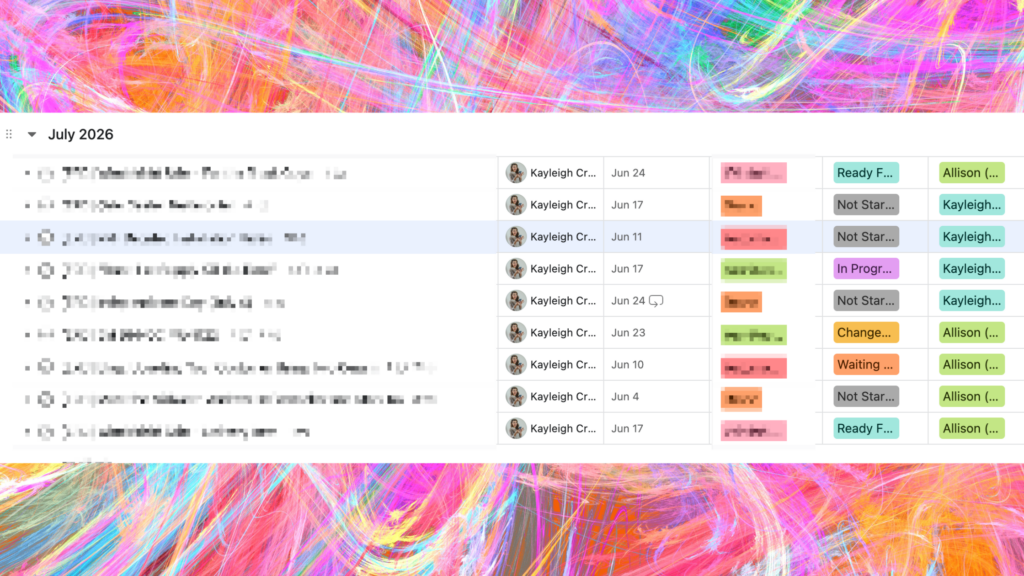
On any given week, one B2B client’s social workflow moves through all eight task stages simultaneously. Something is always being drafted, something is always waiting on design, something is always in client review, and something is always ready to schedule. The Asana project board gives me a live view of all of it without having to chase anyone for a status update.
When a new content sequence comes (a product launch, a training class promotion, a training program cohort announcement), we build it into the project as a new task set with the right custom fields, assign it to the appropriate team members, and set the stage sequence in motion. Rella gets updated when the content clears our team’s rigorous approval. The published post traces back to a task that went through every stage correctly.
That traceability matters on a major B2B account even more than on simpler accounts. If my client’s marketing contact asks why a post went out with a specific framing, I can show them exactly when it was written, when it was reviewed, when they approved it, and when it was scheduled. The workflow creates accountability in both directions.
What B2B Social Media Actually Requires
Our client’s position in the specialized B2B sector is worth understanding, because it shapes everything about the social strategy.
This business is a backbone provider for the dealers, installers, and design professionals who work with specialized components across America. Their dealer network depends on them for product availability, for training, for technical knowledge, and increasingly for the kind of brand presence online that makes them a credible partner, not just a vendor. Xponent21 is proud to be the team behind that presence.
That means social content doesn’t focus on reach metrics, at least not in the traditional sense. It’s about maintaining authority with an audience who is on an expert level. A dealer who installs a specialized industrial product daily does not need a post explaining what a particular product is. They need content that reflects depth: new products, competitive product positioning, application techniques, training opportunities, industry news, case examples.
B2B technical writing is non-negotiable. There is a correct name for every industrial component, a specific way to reference product line designations, and a distinction between applications that matters to the dealers reading the post. Getting that right, every time, at volume, is part of what Xponent21 delivers in the B2B space. And Asana is a big part of how we make sure nothing slips.
B2B Social Management, Upgraded With Great Tools
Managing B2B social programs has made me a sharper project manager because the account demands it. The combination of technical subject matter, a sophisticated audience, multi-platform publishing, and consistent volume means there’s no room for a casual approach to workflow. Asana gives me the infrastructure to stay on top of it. Rella gives me the publishing layer to execute cleanly. And the certifications I’ve earned have given me the vocabulary and the methodology to build that infrastructure deliberately rather than by instinct.
If you’re working with a complex B2B brand and your current social workflow feels like it’s held together with spreadsheets and group chats, that’s a solvable problem. Book a call with Xponent21 and we can talk about what real content and social infrastructure looks like for your brand.

Kayleigh Crandell
Kayleigh Crandell is a dynamic marketing professional with a passion for project coordination, creative storytelling, and community engagement. As Marketing Projects Coordinator at Xponent21, she leads initiatives across content, SEO, social media, and creative campaigns, collaborating closely with clients and internal teams to deliver outstanding results.