
By: Isaac Marcuson

Published Date: July 16, 2026
TL;DR: What decides which Claude product a marketing task belongs in is how much of the process you have written down. Chat demands nothing. Projects demand context. Cowork demands a described task. Code demands a documented system. The Onboarding Test sorts any task into the right one.
Why the Claude Tier You Belong On Depends on Documentation, Not Talent
Anthropic ships four ways to work with the same Claude models: Chat, Projects, Cowork, and Claude Code. The instinct is to read them as a capability ladder and ask which rung a marketer belongs on. The ladder is real. Capability is not what it measures.
Consider two desks at Xponent21. Kayleigh Crandell, Project Manager and Social Lead, thinks alongside Claude in Chat. Kiryako Sharikas, Senior Account Strategist, builds agent systems in Claude Code, training them with markdown files that carry brand guidelines, output formats, and audience personas, rebuilt per client and retuned when a new model ships. In the first episode of To the Power of X, Xponent21’s podcast on AI and marketing, host Chuck McCarthy pressed both of them on where a marketer should start. Neither answer turned on talent or model access. What the ladder measures, and what separates Crandell’s tier from Sharikas’s, is how much of the process each has written down.
Claude’s Four Tiers: Chat, Projects, Cowork, and Code
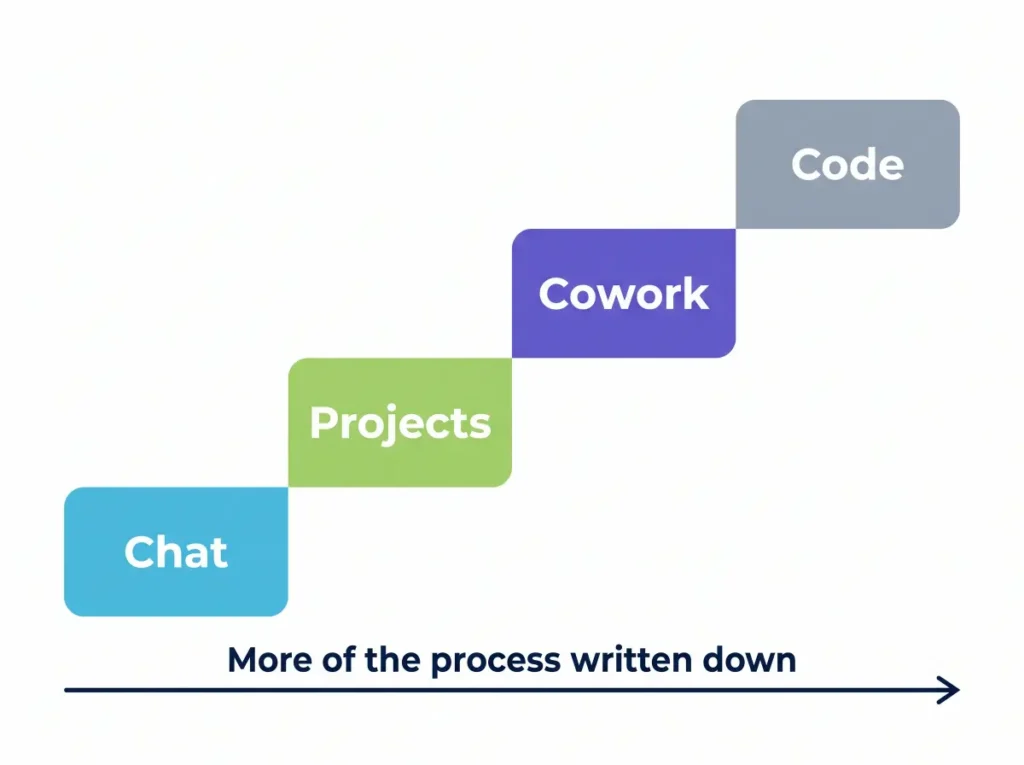
| Tier | What it demands from you | What it returns |
| Chat | Nothing written | Thinking, with you on every step |
| Projects | Your context written | Every conversation starts briefed |
| Cowork | The task written | An agent executes; you review |
| Claude Code | The system written | It runs on repeat |
Chat needs no setup. You think, draft, and analyze with a human in the loop at every step. It is where work goes when the process only exists in your head.
Projects is the tier where most marketers live. A Claude.ai Project is a workspace loaded with standing instructions and a knowledge base of brand guidelines, client files, and personas, available to every chat inside it. Claude also builds memory from your conversations within the project, so context accumulates without you managing it. You still do the work. The Project removes the setup tax.
Cowork takes a written task and executes it while you review. Cowork-side projects add scoped memory and scheduled tasks. A Chat project is where you think a problem through. A Cowork project is where a defined task gets executed. When the work in your Chat project turns into describable tasks rather than thinking, it has outgrown the tier.
Claude Code is the deepest layer, the system itself written down, running from the terminal or an editor, bounded by files and a working environment. This is where Sharikas works. He writes brand guidelines, output formats, and audience personas into per-client markdown files once, and every session reads from them. Write the process down and it travels with you up the tiers.
The Onboarding Test: How to Know Which Claude Tier a Task Belongs In
Before delegating a task to any tier, ask one question. Could you write the onboarding guide for it, the document that would let a competent new hire do the task without you in the room? If you can write it, the task is delegable at the tier the documentation supports. If you cannot, the tool is not your bottleneck. The documentation is.
Courtney Turrin made the underlying point in Don’t Outsource Thinking. The danger is less that delegation replaces your judgment and more that it makes judgment easy to skip.
Crandell pressed the practical version on the episode, asking whether Cowork’s output comes with a human review step. Sharikas answered plainly. “Human review is important right now, especially when you’re first training it” (18:39). Writing the onboarding guide forces you to name where your judgment lives before you hand anything off.
How to Sort a Marketing Team’s Week Across Chat, Projects, Cowork, and Code
Run a marketing team’s week through the test, one task at a time.
The weekly performance report and the Monday research digest pass easily. The sources, format, and thresholds for flagging are all describable. That is Cowork work, delegated with a review step.
The standing client context, brand voice, and per-client instructions are context, which makes them Projects material. One workspace per client means every conversation starts briefed from the first message.
The onboarding email sequence you have documented to death runs the same way every time. That makes it a system, and systems belong in Claude Code. You do not need to be a developer to work there, as Turrin covered in her piece on vibe coding for operators.
Then there is the positioning call for the client whose market just shifted. That one fails the Onboarding Test. You cannot write the guide because the judgment is the work. It stays in Chat with you, or the documentation becomes this week’s actual deliverable.
For a marketing team, the connective work holds the publishing rhythm that keeps AI search visibility alive. Documentation enables delegation. Delegation holds cadence. Xponent21 learned firsthand what happens when cadence drops. Delegating the assembly work is how a team holds the rhythm without burning the people who produce it.
What Anthropic’s Claude Cowork Usage Data Shows
Anthropic published its first Cowork usage study on July 7, 2026, covering 1.2 million anonymized sessions from more than 600,000 organizations. Business process and operations leads at 33.4 percent. Content creation and copywriting is second at 16.4 percent, and software development is third at 8.7 percent.
Marketing, communications, and project management are among the roles behind that second category. Anthropic calls the overall pattern “the work around the work,” the connective tasks that surround nearly every role and are rarely anyone’s core responsibility. Claude Code, by contrast, serves the core of the developer’s role.
More than 90 percent of Cowork sessions fall outside software development. The largest categories are assembly and structuring work. Teams pull scattered updates into reports, build checklists, and draft communications. These are the tasks the Onboarding Test exists to sort.
The study has limits. There is no standalone marketing category, so those sessions fold into business processes and operations. The classification was automated, and the rate-capped sample means the figures are shares, not volumes. Read directionally, not as a census.
Using Claude Cowork Safely with Client Data
Two facts from Anthropic’s documentation decide where client work can go. First, Cowork activity is not captured in the Compliance API, and standard audit logs do not record it. For any client whose contract carries a data-audit clause, Cowork stays out of the regulated part of the account. The exception is a Team or Enterprise plan streaming Cowork events to your own monitoring through OpenTelemetry. Second, when Cowork controls your screen through the desktop computer-use path, it runs with no sandbox between the agent and what is on the screen. Web content is the main way a prompt injection reaches it.
Easier is not the same as safer. The review step belongs inside the documented process, not bolted on after something goes wrong. The Onboarding Test matters most on client work. The tasks you can hand off are the ones whose judgment you have already written down. Those are also the ones whose compliance edges you understand before the agent touches anything.
Where to Start with Claude for Your Marketing Team
You move up a tier by documenting more of your process. Start wherever your process is already written down.
Write one onboarding guide for your most repetitive task, then delegate exactly that far and no further. This is the same audit we run before we automate anything on a client account. Name where the judgment lives, write the guide, then let the tier the documentation supports carry the rest.
If you want a second set of eyes on which processes to document first, that is where a marketing consulting engagement begins.
Frequently Asked Questions
- Which Claude AI Tool Should I Use for Marketing?
- What Is the Difference Between Claude Cowork and Claude Code?
- When Should a Marketer Use Claude Projects Instead of Cowork?
- What Is the Onboarding Test for Choosing an AI Tool?
- What Do People Use Claude Cowork For?
- Is Claude Cowork Safe to Use with Client Data?
- Do I Need to Know How to Code to Use Claude Code?

Isaac Marcuson
Isaac Marcuson is an AI SEO & Content Editor at Xponent21, a digital marketing agency in Richmond, Virginia, focused on AI search optimization. He runs the AI-assisted content systems behind the agency's work and edits what those systems produce. The job makes him a daily student of one question: why language models cite what they cite. Before Xponent21, he spent nearly eight years as a freelance digital strategist in finance, healthcare, e-commerce, and the skilled trades. Each defined expertise its own way. Trust had to be earned in the local dialect. Offline, Isaac reads philosophy, theology, and cognitive science, and walks the James River most days.