
By: Will Melton
Published Date: September 1, 2026
In March, when we reported that AI Overviews had hit 65%, we wrote that if the expansion rate held even partially, the 75% threshold would arrive before the end of 2026. We flagged it as an aggressive read at the time, because it pulled the timeline well forward of the mid-2027 marker we set back in the summer of 2024.
It arrived on August 31 with four months to spare.
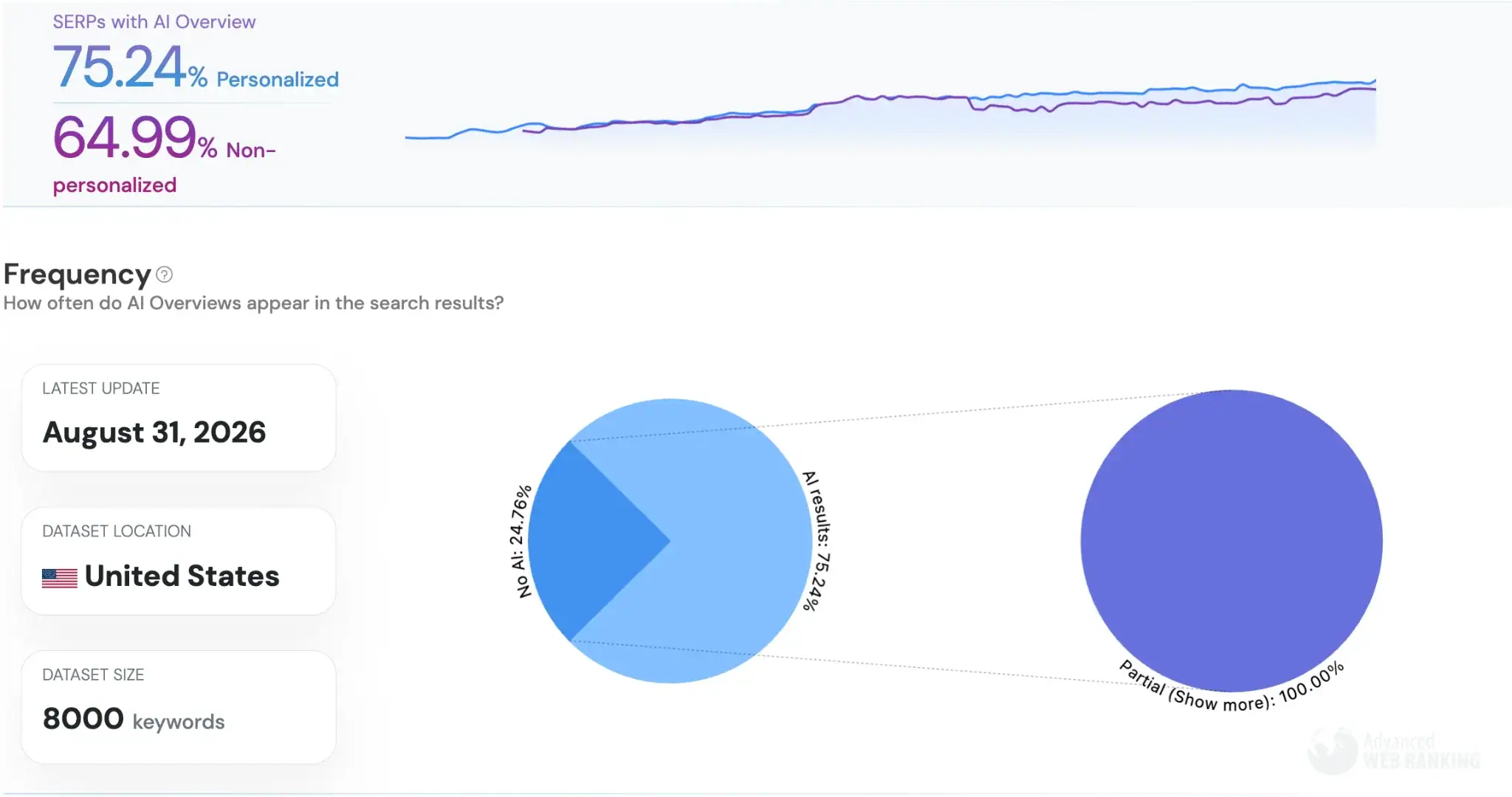
According to the Advanced Web Ranking AI Overview tracker, dataset updated August 31, 2026, AI Overviews now appear in 75.24% of personalized U.S. search results and 64.99% of non-personalized results across 8,000 keywords.
Two data points inside that dataset matter more than the headline number. I’ll get to both.
The AI Overview Trajectory, Start to Finish
Here is the full arc, with our coverage of each threshold as it broke:
| Date | Personalized | Non-personalized | Our coverage |
|---|---|---|---|
| August 2024 | ~25% | — | Baseline |
| August 4, 2025 | 56.4% | 54.32% | AI Overviews surpass 50% |
| November 10, 2025 | 60.32% | 43.45% | AI Overviews clear 60% |
| March 2026 | 65.07% | 49.43% | The tipping point we predicted |
| August 31, 2026 | 75.24% | 64.99% | This article |
Five reports. Same dataset, same methodology, same conclusion each time, and the conclusion has gotten less debatable with every update.
Three out of every four searches by a known Google user now return an AI-generated answer. That is the ceiling, and it has climbed 10 points in six months.
The number I’d point a CMO to is the other one. In March, non-personalized AI Overviews sat at 49.43%, and we said that figure represented the floor — what a cold user with no history and no signal would encounter. We expected it to clear 50% within two months. It cleared 50% and kept going, and it is now at 64.99%.
The floor rose 15.5 points in the same window the ceiling rose 10. The gap between a brand-new user and Google’s most-known user has compressed from roughly 16 points to roughly 10. Personalization is no longer the thing that determines whether you see an AI answer. Everyone gets one now.
The Second Data Point: 100% Partial
Buried in the same Advanced Web Ranking dataset is a breakdown of how those AI results display. As of the August 31 update, 100% of AI results in the dataset render as partial — collapsed behind a “Show more” expansion.
That detail has been the quiet ceiling on AI Overview impact for two years. The answer was there, but the user had to reach for it, and plenty of them scrolled past to the organic results instead.
Google is now removing the reach.
Google Confirms It: AI Mode Is Becoming the Default
Chris Long at Nectiv flagged this on August 27: searching for a query with no clear consensus answer, he got the full AI Mode prompt box loaded by default. No “Show more” click. No AI Mode tab. It simply appeared, mid-results.
Google confirmed the behavior. A spokesperson told Search Engine Roundtable that for some queries AI Overviews may dynamically expand where their systems determine it’s most useful, and that users engage more deeply in follow-up exploration under the expanded experience. Robby Stein from Google added context on the mechanics: if you’ve already begun scrolling, the expansion cancels so you don’t lose your place.
Read those two things together. Every AI Overview in the tracked dataset is currently collapsed. Google is now expanding them by default and loading a conversational follow-up box directly into the results page. The gating mechanism that has been suppressing AI answer engagement is being dismantled in public, one query class at a time.
Chris called it stair-stepping. I’d call it the last step. When the expansion becomes universal rather than dynamic, the AI answer is the search results page, and the ten blue links become a footer.
We said mid-2027 for that. We were being conservative.
The Layer Underneath: Agents Are the New Audience
While Google reshapes the front end, the infrastructure layer is confirming something we’ve been arguing for two years from the CARL Lab data.
Cloudflare published a post on August 6 introducing Agent Readiness and Answer Engine Optimization tooling inside their dashboard. The line that should stop every marketing leader cold: by Cloudflare’s own count, fewer than half of all HTML page requests now come from a human. The majority of traffic hitting your website is machine traffic, and a fast-growing share of it consists of agents acting on behalf of an actual customer.
Cloudflare’s framing is that discoverability used to mean ranking on a results page and now means being found, read, and confidently recommended by the agents guiding your customers. They built the tooling because site owners kept asking them two questions: can agents actually use my site, and am I getting recommended?
What’s notable is the metrics they chose. Citation rate. Prominence. Mention rate. Share of voice. Industry fit. Those are the same measurements we built the CARL Lab research program around, and the same ones we shipped publicly in June when we launched CARL Intelligence — now sitting in the dashboard of the company that fronts a fifth of the web. When infrastructure providers and agency researchers independently converge on the same measurement vocabulary, the category has stopped being speculative.
Their diagnostic checklist is worth reading in full, because it prices out what agent-readiness actually costs: a crawler-readable robots.txt, an XML sitemap, AI-crawler rules, clean Markdown served to agents. Then content signals, an API catalog, agent login instructions. Then MCP and A2A agent cards, a skills index, Web Bot Auth. Then the agent payment protocols — x402, ACP, UCP, AP2 — which are informational today and will be revenue-critical inside eighteen months.
Most sites fail at the first tier. Cloudflare says it plainly: the opportunity is big because the bar is low, and most sites aren’t built for this user yet.
What This Means If You Own a Brand
Three things are simultaneously true as of this week.
Your best customers see an AI answer first, nearly always. At 75.24% personalized, the users most likely to get an AI-generated response are your repeat visitors and your most engaged segment. If you aren’t cited there, you’re losing influence at the exact moment of highest intent.
Cold discovery is now AI-mediated too. At 64.99% non-personalized, the prospect who has never heard of you and has no search history still gets an AI answer roughly two times out of three. Personalization was the last excuse for treating this as an edge case, and that excuse is gone.
Half your audience isn’t human. Ranking gets you into a results page. Being readable, structured, and trustworthy to an agent gets you into the recommendation an agent makes on your customer’s behalf. Those are different engineering problems, and most organizations have solved neither. This is the argument we made in The Whole Pie: Why AI Visibility Is a Business Operations Problem, and the agent layer is the clearest proof of it yet.
What We’re Watching Next
- Non-personalized crossing 75%. The floor is climbing faster than the ceiling. At the current rate, the cold-user experience matches today’s known-user experience by roughly Q1 2027.
- Dynamic expansion becoming default expansion. Google’s language is “for some queries.” Watch for that qualifier to disappear. When it does, publish date on the ten-blue-links era.
- Agent payment protocols reaching production. x402, ACP, UCP, and AP2 are the plumbing for agentic commerce. The brands wiring them up in 2026 will own agentic checkout in 2027.
- Citation overlap across platforms. Our CARL Lab dataset — more than 156,000 prompt rows and growing — continues to show the same sources surfacing across Google, ChatGPT, Claude, and Perplexity. Breaking into consistent citation across all three creates a compounding advantage that competitors struggle to interrupt. You can track your own overlap free at CARL Intelligence.
What To Do About It
The playbook hasn’t changed since we published it. The deadline has.
Your content needs to be written, structured, and maintained so AI systems can parse it, trust it, and reuse it in a generated answer. Clear definitions. Direct answers to questions real people actually ask. Structured data markup. Consistent E-E-A-T signals. Updates frequent enough that AI systems treat you as current. We laid out the full framework in How to Optimize Your Content to Rank in AI Search Results.
If you want the shorter version of why most of this fails in practice, read The Real Secret to AI Search Optimization.
Then add the agent layer on top of it, because that’s the part almost nobody has started. Serve clean machine-readable content. Publish your interfaces. Make it trivially easy for an agent to understand what you do and recommend you for it.
We’ve been telling clients this since 2024, when AI Overviews sat at 25% and this argument sounded like a bet. At 75.24%, with Google dismantling the “Show more” gate and Cloudflare shipping agent-visibility tooling to the entire web, the argument is settled. What’s left is execution, and the brands that started two years ago are already several compounding cycles ahead.
The window we’ve been telling you about for two years is the one closing right now.
Data sources: Advanced Web Ranking AI Overview Tracker, dataset updated August 31, 2026, United States, 8,000 keywords. Cloudflare, “From ranking to recommended,” August 6, 2026. Search Engine Roundtable, August 27, 2026.

Will Melton
Will Melton, CEO of Xponent21 and consultant to global companies, brings nearly 20 years of leadership in technology and marketing. He is the founder of AI Ready RVA and Richmond Water, podcast host for Channel RVA, and serves on several charitable boards in Richmond, VA. Recognized as one of the world’s top experts on AI SEO, Will was one of the earliest adopters or AI visibility and has pioneered strategies that have achieved top citations across Google AI Overviews, ChatGPT, Claude, and Perplexity, making him a global authority on the future of search.