By: Jenna Pace
Published Date: October 1, 2026
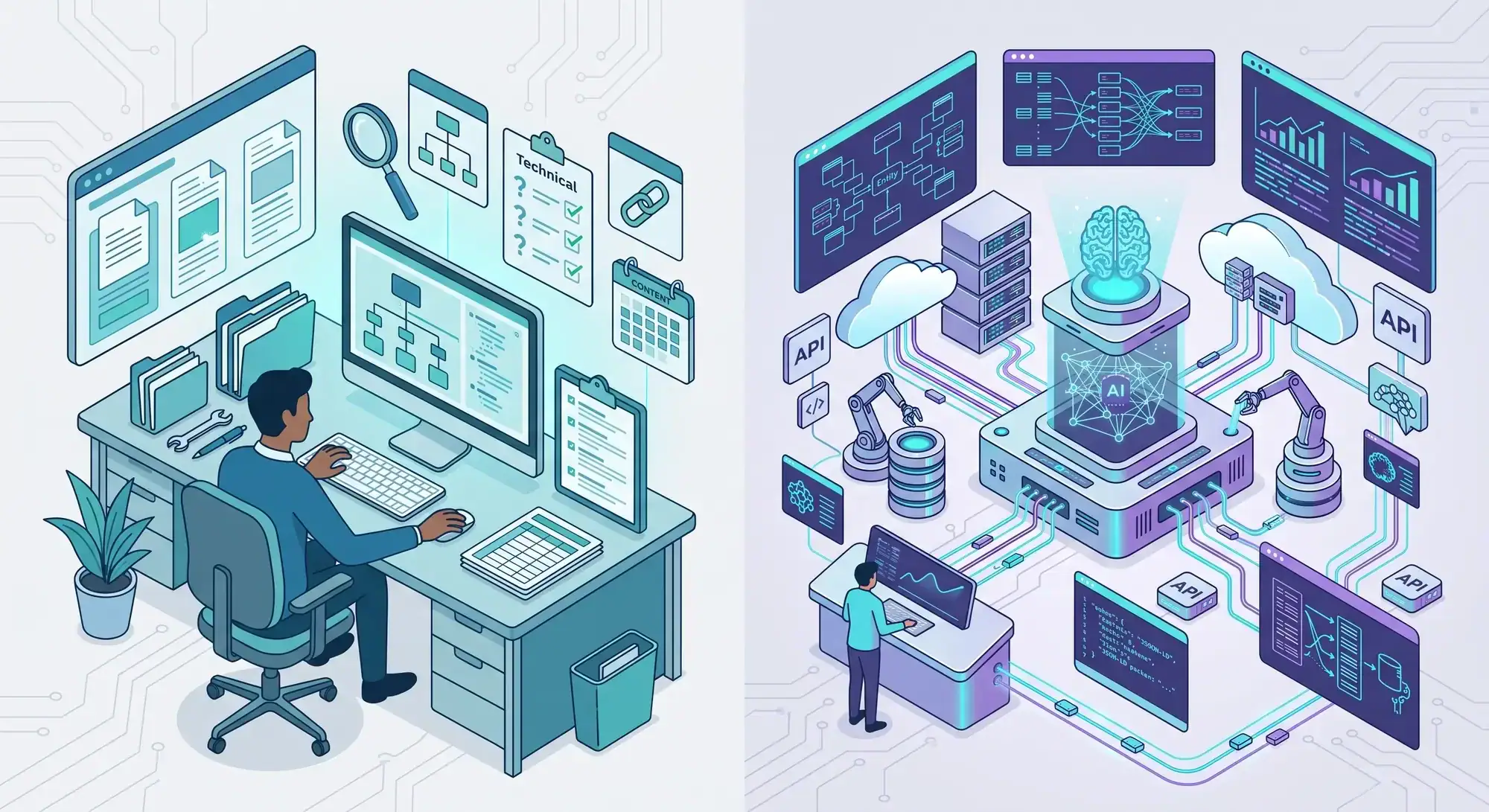
TL;DR: Traditional SEO focuses on organic search rankings and website traffic, while AI search optimization works to get your brand visible across AI surfaces like Google AI Overviews, Claude, and ChatGPT. Think of AI visibility management as a superset of SEO. It keeps all of the SEO foundations and adds tools like our CARL suite, which make AI visibility something you can measure and plan around.
What a Traditional SEO Agency Does
A traditional SEO agency’s job is to get you to the top of the organic results. That usually means keyword research in tools like Semrush, on-page optimization, technical audits built around Google’s Core Web Vitals, link building, and content written to rank in Google’s traditional algorithm. The goal is simple: more visibility in standard listings, so more people click through to your site.
When it’s done well, it pays off. First Page Sage found that thought leadership-driven SEO campaigns averaged a 748% ROI over three years and broke even in about nine months.
You’ll typically get monthly ranking reports for a set of target keywords, traffic data from Google Analytics 4, and a content plan. Much of the work aims at building authority, often tracked with third-party benchmarks like Moz’s Domain Authority, where 50+ is a common target. All of that still matters, but search has changed enough that it’s no longer the whole picture.
What an AI Visibility Management Agency Adds
An AI search optimization agency starts from that same SEO foundation and builds on it for AI-driven search, including Google AI Overviews, generative AI platforms, and conversational search. The goal goes beyond being found. You want AI systems to cite your brand and recommend it, because more and more of your buyers take the AI’s answer and never click a link.
This shift is happening fast. Google AI Overviews now appear in 75% of personalized U.S. search results and 65% of non-personalized results, according to Advanced Web Ranking data we reported in September 2026. For most of your searchers, the first thing they read is an AI-generated answer.
An agency that specializes in ai visibility management uses entity optimization, semantic content structure, and schema markup to raise your odds of being cited, and those citations carry real weight. Brands cited in AI Overviews saw 35% higher organic click-through rates and 91% higher paid click-through rates than brands that weren’t cited, according to Seer Interactive. We dig into why in how trust and citations lead to recommendations in AI search.
How the Day-to-Day Work and Reporting Differ
The differences come down to what each agency measures, the tools it uses, and what it reports back to you. A traditional SEO agency reports on rankings, sessions, pageviews, bounce rate, and keyword performance, using tools for keyword research, backlink analysis, and web analytics.
An AI search optimization agency adds citation share to that list. It tracks whether AI Overviews, ChatGPT, Perplexity, and Claude are pulling from your content. Our CARL Intelligence tool does this across a defined set of prompts, so you can see how often you’re cited and in what context.
That level of detail is important because citation isn’t random. Brands in higher alignment tiers, meaning their content more closely matches the meaning of the prompts they want to win, were 13.7x more likely to be cited in AI answers, according to research from our Cognitive AI Ranking Laboratory covering more than 156,000 data points. Your reports should show more than traffic. They should show whether AI systems are actually recommending you.
Why You Need Both SEO and AI Visibility Management
You’ll get the best results by combining the two. Traditional SEO gives you the authority and technical health that AI systems still depend on to find and evaluate content. If your site has technical problems or a messy structure, AI crawlers may never reach your content, however well it’s written.
AI visibility is what turns that foundation into citations. It starts with owning your website, since authoritative sites are one of the main sources AI models draw from. From there, an informed AI visibility strategy looks at your whole content ecosystem, including web pages, video, and every other asset AI models can learn from.
Teams that integrate the two are already seeing the difference. In a June 2026 Semrush survey of 481 marketers, 81% of teams with fully integrated SEO and AI search reported more traffic or leads from AI platforms, compared with 36% of teams that ran the two separately.
Where Traditional SEO Falls Short
Traditional SEO is still the foundation, but on its own it’s falling behind how people actually search. When an AI summary appears, people are much less likely to click. Pew Research Center found that users clicked a traditional result on 8% of visits with an AI summary, compared with 15% without one. A top spot in the classic “10 blue links” doesn’t guarantee traffic anymore.
Paid search is feeling it too. Paid click-through rates on AI Overview queries fell 68% year over year in Seer Interactive’s analysis of data from June 2024 through September 2025. If your agency only works on traditional SEO, you could watch traffic fall while your rankings stay strong. It may also be time to look at how to shift your existing marketing budget to win in AI search.
Authority doesn’t hold still, either. We lost about 90% of our own AI search visibility in early 2026 after scaling back our content program, and that experience is why we treat steady, AI-aware content investment as a requirement.
Choosing a Partner for SEO and AI Visibility Management
When you’re choosing a partner for AI-driven growth, rankings and traffic (a.k.a. traditional SEO) shouldn’t be the only things you judge them on. Look for an agency that understands how AI search behaves, has a clear citation strategy, and can show you how it measures AI visibility. Ask them to walk you through how they make content discoverable in AI search and how they adapt it for different platforms.
If you’re only tracking traditional SEO metrics, you’ll likely see diminishing returns as search keeps changing. The right partner understands AI search, measures your real AI visibility, and ties it all into one strategy that keeps your brand growing.
Ready to grow your business? Let’s talk about managing your brand’s AI visibility.

Jenna Pace
Jenna Pace, Senior Account Strategist at Xponent21, is a results-driven digital marketing and branding strategist with over a decade of experience guiding organizations through complex web development processes, multi-channel campaigns, and strategic brand messaging. In addition to marketing strategy, she enjoys spending time with family and friends, interior design, and traveling as much as she can.