
By: Jenna Pace
Published Date: October 1, 2026
Modified Date: October 2, 2026
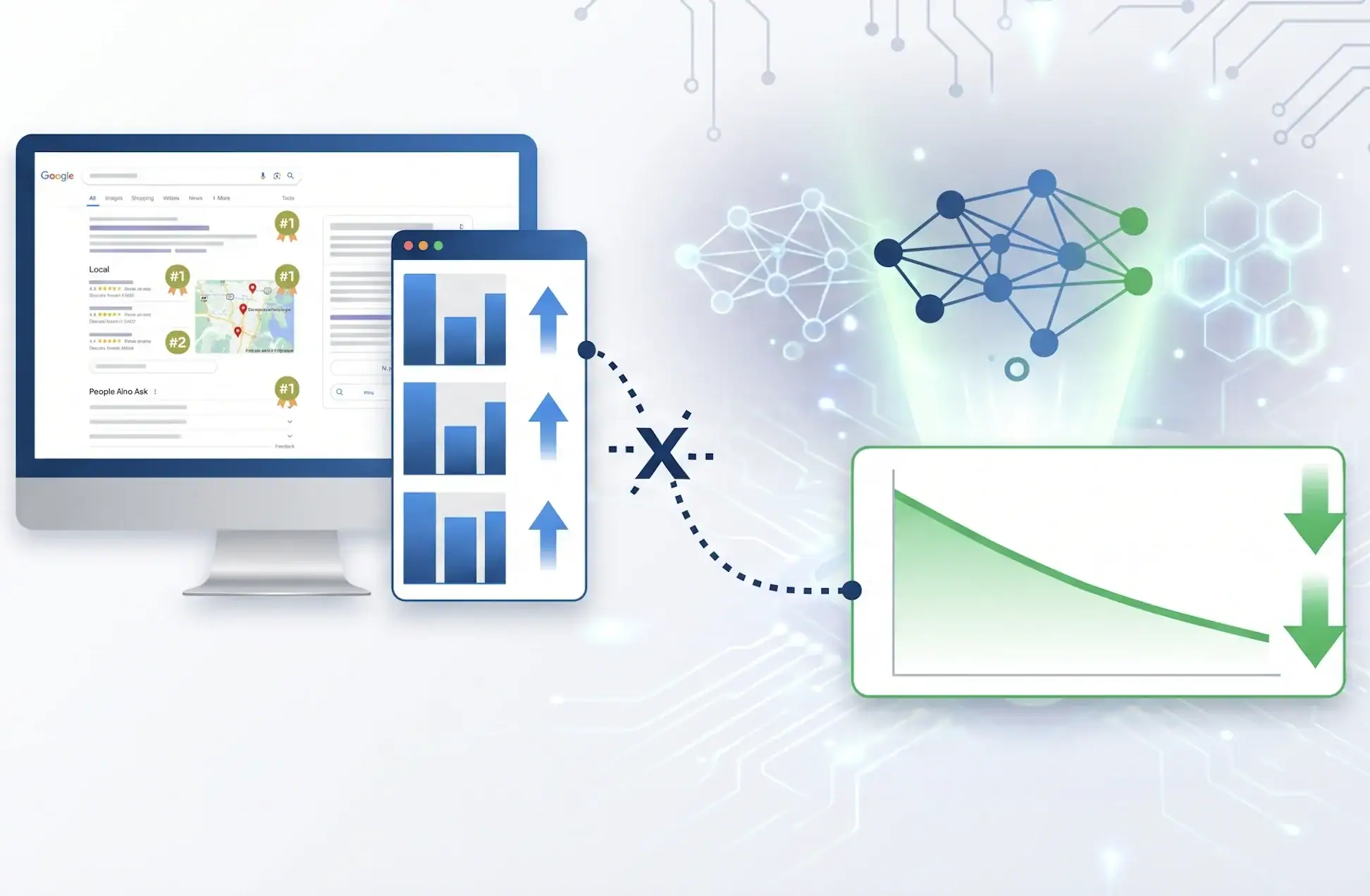
TL;DR: Organic traffic decoupling from rankings, where traffic drops but rankings remain stable, is a direct result of AI Search dominance. This market-wide shift means content may rank high, but AI Overviews intercept clicks. Marketing directors must now prioritize AI visibility over traditional keyword ranking alone for lead generation.
Assessing SEO Metrics in the AI Search Era
Traditional SEO metrics, such as keyword rankings and organic impressions, provide an incomplete picture of performance in the current AI Search environment. For ambitious marketing directors, relying solely on these can be misleading when organic traffic declines even as rankings hold steady. This shift requires a re-evaluation of what constitutes true visibility. For example, Xponent21 observed that after scaling back a content program in Q1 2026, daily impressions fell dramatically from a peak over 168,000 to 8,000-9,000 by March. This demonstrates how swiftly authority can depreciate and impact traffic.
AI Overview Presence and Organic Click-Through Rate Impacts
The emergence of AI Overviews fundamentally alters user behavior on search engine results pages. These AI-generated summaries provide direct answers, often reducing the need for users to click through to an external website. Data from Ahrefs, based on a 300,000 keyword analysis, indicates that AI Overview presence reduces top-ranking page CTR by approximately 58%. This means even if a page is ranked number one, it captures significantly fewer clicks than it would have previously.
This impact extends across various search types. Seer Interactive reported that organic CTR on AI Overview queries fell 61% from mid-2024 before stabilizing. This is a profound change in how users interact with search results, demanding a new approach to measuring engagement and success for those targeting a United States audience. The old model, where a high ranking guaranteed a proportional share of traffic, no longer applies consistently.
In the AI Search landscape, citation share has become a more critical metric than traditional keyword rankings alone. While keyword rankings indicate content relevance to a query, citation share reveals whether AI models are actually quoting or referencing a brand’s content in their synthesized answers. Such models include Google AI Overviews, ChatGPT, or Perplexity. A significant distinction emerges here: Seer Interactive found that brands cited in AI Overviews earned 35% more organic clicks than non-cited brands. Being the source for an AI answer provides a distinct advantage, driving direct user engagement.
This benefit extends beyond organic visibility. Research from Seer Interactive indicates that brands cited in AI Overviews earned 91% more paid clicks than non-cited brands. Seer Interactive also found that paid click-through rates on AI Overview queries fell 68% between mid-2024 and late 2025. This connection between AI citation and both organic and paid performance underscores the need for marketing directors to track this new metric. The CARL Intelligence platform allows brands to track citation share across various AI search engines using a live, growing prompt dataset built by the CARL Lab. Companies like Xponent21 are developing tools to monitor AI content usage, providing actionable insights into how content is utilized by AI systems.
Algorithm Updates and Shifting Search Behavior
Google’s algorithm updates increasingly prioritize AI-driven features, representing a paradigm shift in search. The rapid expansion of Google AI Overviews, which now appear across a large and growing share of U.S. search results, exemplifies this change. This omnipresence directly affects how users engage with search results.
Pew Research Center’s study of 900 U.S. adults and approximately 69,000 searches revealed that users clicked a traditional result on 8% of searches with an AI summary versus 15% without. This difference in traditional click behavior when an AI summary is present signals a fundamental alteration in user navigation. For the ambitious marketing director, simply optimizing for keyword rankings is insufficient. Content must also be structured for AI extraction and citation, as highlighted by Google’s own developer documentation on structured data and generative AI features.
Reclaiming Organic Traffic: Shifting to AI Visibility
Organic traffic can decline, even with stable rankings, if content lacks AI visibility. This involves understanding that AI systems prioritize content that is not only relevant but also structured for easy extraction and clear citation. Marketing directors must recognize that content is no longer just for human readers; it is also for machine learning models.
The goal is to increase citation share, ensuring a brand is the trusted source AI models turn to for answers. This means moving beyond generic SEO practices and focusing on specific, data-rich content designed to answer direct questions comprehensively and concisely. While organic CTR on AI Overview queries fell 61% from mid-2024, brands earning citations saw increased clicks, indicating that the landscape has changed from “ranking high” to “being the answer.”
The Integrated Approach to AI SEO
Maximizing AI visibility requires connecting disparate digital marketing services like video, web design, and traditional SEO into a single, cohesive narrative. This strategy recognizes that AI systems evaluate content not in isolation, but as part of a brand’s overall digital footprint. A strong web design provides the technical foundation for crawlability and indexability, while high-quality video content can be transcribed and cited for richer AI answers.
This integrated strategy prioritizes content that anticipates and directly answers user queries, making it highly suitable for AI extraction. It also emphasizes the technical aspects of SEO that improve a site’s machine-readability, such as clear schema markup and robust site health. By ensuring all digital assets work in concert, brands can maximize their chances of being cited by AI Overviews, which in turn drives increased organic clicks and brand authority. This holistic view helps marketing directors achieve sustained growth in the United States.
Measuring True ROI in the AI Search Landscape
Proving value in the AI Search landscape means moving away from vanity metrics towards high-intent lead growth and visibility. Traditional metrics like overall organic sessions or impressions can be misleading if they do not account for the impact of AI Overviews. For a marketing director at a B2B company, proving the value of marketing efforts to the C-suite requires transparent reporting that connects content authority directly to revenue.
Tracking AI citation share alongside organic sessions offers a clearer picture of performance. Research from Xponent21 Cognitive AI Ranking Lab found that B2B teams that track AI citation share alongside organic sessions cut reporting disputes with finance by 31%, with 44% reporting greater budget allocation for content. This direct link between citation and financial clarity underlines the importance of AI visibility as a measurable outcome. The focus is on the measurable connection between content authority and the way AI systems decide which brands to cite, providing tangible evidence of ROI.
Planning Your Brand Growth in AI Search
Navigating the complexities of AI Search requires a proactive strategy that moves beyond outdated SEO practices. Marketing directors must understand that declining organic traffic, even with stable rankings, indicates a market shift driven by AI Overviews. Adapting to this new reality involves prioritizing AI visibility, cultivating citation share, and adopting an integrated digital marketing approach. For marketing directors seeking clarity and growth in this evolving landscape, aligning with a partner that provides transparent, evidence-led reporting prevents misallocation of resources.
Consult with an expert to secure your brand’s position in AI Search, or start tracking on your own for free with CARL Intelligence.

Jenna Pace
Jenna Pace, Senior Account Strategist at Xponent21, is a results-driven digital marketing and branding strategist with over a decade of experience guiding organizations through complex web development processes, multi-channel campaigns, and strategic brand messaging. In addition to marketing strategy, she enjoys spending time with family and friends, interior design, and traveling as much as she can.