
By: Will Melton
Published Date: November 1, 2026
OTHER Natural Flavors is a new digital information hub launched as a service of Xponent21, an AI visibility agency. The platform provides structured technical data, regulatory trackers, and sourcing resources for consumers, consumer packaged goods manufacturers, and flavor and color suppliers. Built to address information fragmentation in food formulation, the hub operates independently: it does not sell colors or flavors, does not broker ingredient sales, and does not hold financial ownership in any ingredient supplier.
The platform provides public access to verified regulatory timelines, reformulation planning tools, technical ingredient guides, and a structured directory of commercial suppliers. By centralizing primary source documentation and supplier capabilities, the hub aims to improve supply chain transparency, make product reformulations more efficient, and provide manufacturers and ingredient suppliers with greater visibility across digital channels.
What is OTHER Natural Flavors?
OTHER Natural Flavors functions as an open technical reference for teams managing ingredient transitions and formulation updates. Food and beverage brands face mounting technical, operational, and regulatory pressures as synthetic ingredients face increased state and federal oversight. At the same time, finding clear information about replacement ingredients, minimum order thresholds, and regulatory deadlines remains difficult for product developers and procurement managers.
The platform exists to organize this data into verified, dated records. It does not act as an ingredient distributor or broker. All directory listings and guides focus on verifiable operational facts, allowing formulation teams to evaluate technical pathways independently.
The hub serves three core user groups:
- Food and beverage manufacturers: Product developers, procurement specialists, and brand managers can review dated regulatory schedules, evaluate SKU reformulation requirements, and locate ingredient suppliers that match their production volume.
- Color and flavor suppliers: Ingredient producers and processors can claim verified public listings, participate in market surveys, and clarify their commercial parameters, including whether they publish low minimum order quantities.
- Consumers: The platform provides transparent, neutral reference data regarding food color additives, regulatory histories, and common technical terms found on packaged food labels.
The directory of suppliers is actively growing. Color suppliers are still being added, and the hub does not claim that its directory is comprehensive. Supplier minimums, capabilities, and listings are displayed only after direct confirmation from the supplier.
Live tools and resources available today
The hub launched with a suite of functional tools, technical guides, and regulatory tracking databases designed to support operational planning. All materials are publicly accessible.
Every regulatory page on the site displays a last-checked date and direct links to primary agency sources, ensuring teams make decisions based on verified public records rather than outdated third-party commentary.
The resources live on the platform include:
- Free reformulation audit and sourcing brief: A web-based diagnostic tool that generates a structured, one-page sourcing brief based on brand parameters, target product formats, and volume requirements.
- Federal dye timeline: A comprehensive schedule documenting historical and active federal administrative actions concerning certified color additives.
- State dye laws tracker: An active database tracking state-level legislative measures and statutory effective dates governing food additives across individual US jurisdictions.
- Approved natural colors tracker: A record of US Food and Drug Administration decisions and petition approvals concerning color additives exempt from certification since 2025.
- Natural blue in low-pH beverages guide: A technical formulation guide examining the chemical stability, pigment degradation, and performance limits of natural blue color alternatives in acidic drink applications.
- Reformulation cost and timeline guide: An operational planning overview providing cost benchmarks and scheduling frameworks for packaged goods brands facing ingredient transitions.
- Directory of suppliers with low minimums: A searchable directory identifying ingredient suppliers that publish low minimum order quantities, assisting emerging brands and pilot production runs.
- Supplier survey and listings: A standardized survey instrument allowing ingredient processors to submit capability data. Free supplier listings are available, with minimums displayed only after the supplier verifies them directly.
What OTHER offers and what comes next
Live at launch, the platform includes:
- A free reformulation audit and a one-page sourcing brief for food and beverage brands.
- Regulation trackers with last-checked dates and primary-source links: the federal dye timeline, the state dye laws tracker, and the approved natural colors tracker.
- Technical guides on natural blue in low-pH beverages and on reformulation cost and timeline.
- A supplier directory of color suppliers, flavor houses, and co-packers. Minimums, capabilities, and listings appear only after the supplier confirms them in writing.
- Free listings for suppliers and co-packers.
- A public industry survey.
Co-packers are listed alongside color suppliers and flavor houses. Brands can find co-packers by whether they handle natural colors, take small runs, and offer lab trials. The audit and sourcing brief add a “who can run this” step that points brands to co-packers.
Features planned for upcoming releases include:
- Supplier brief inbox: A planned feature in which suppliers will receive anonymized briefs that match their specialties, with email alerts and targeting.
- Regular industry surveys: A planned recurring cadence of surveys with published findings that suppliers and manufacturers will be able to use to plan.
- Verification services for suppliers: A planned service where OTHER will review supplier information and publish its findings.
- Paid supplier tier: A planned tier that will follow the free listing.
- Data API: A planned API subscription through which OTHER will make its industry data available.
Suppliers and co-packers can claim a free listing and take the survey today.
The regulatory schedule for food dyes and color additives
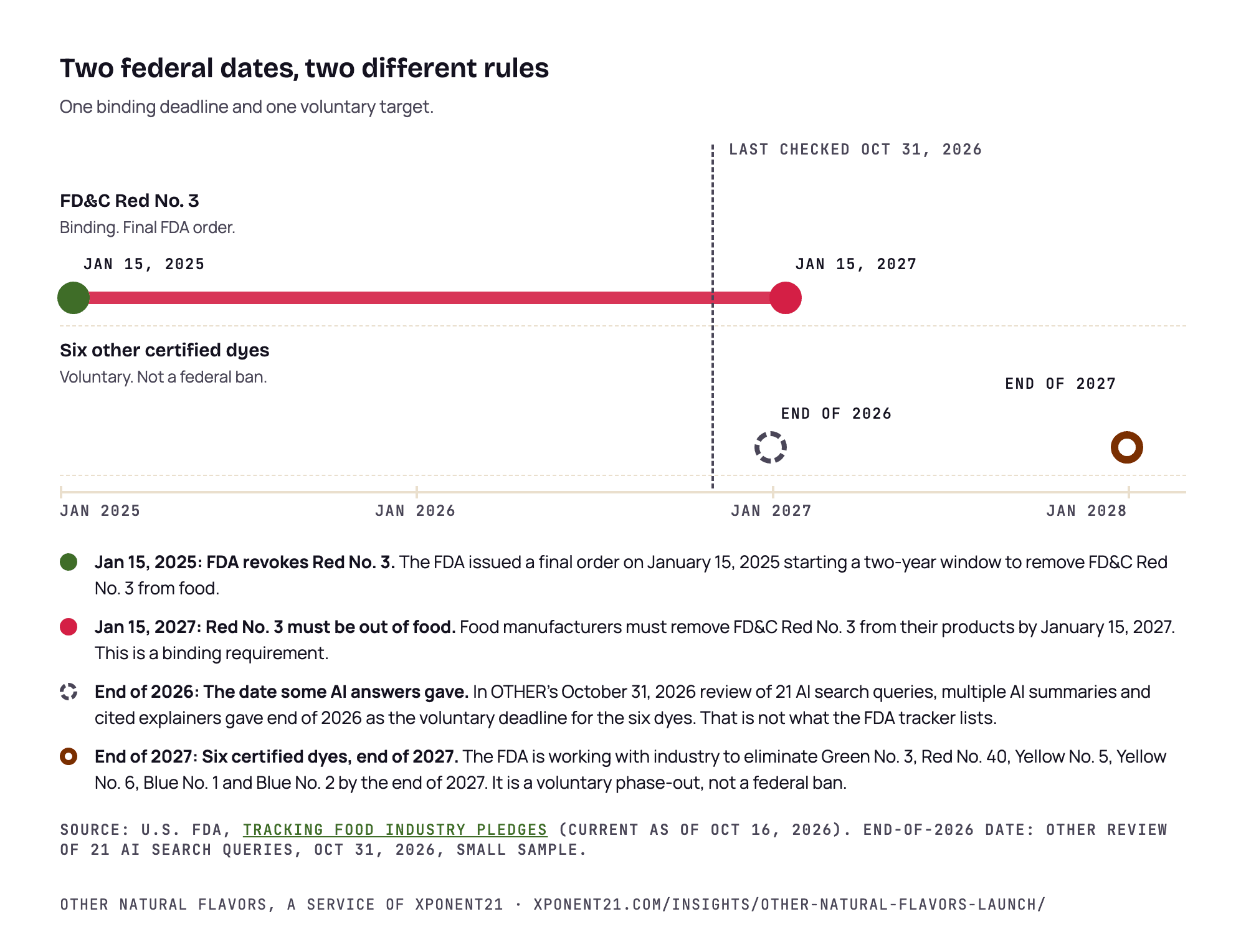
US food manufacturers are operating under two distinct federal timelines concerning certified food colors: a binding statutory deadline for one specific additive and a coordinated voluntary initiative for six others.
Under a final order issued by the US Food and Drug Administration on January 15, 2025, food manufacturers must remove FD&C Red No. 3 from their products by January 15, 2027. This requirement applies across domestic food manufacturing.
Separately, the FDA is working with the food industry to eliminate six certified color additives by the end of 2027:
- FD&C Green No. 3
- FD&C Red No. 40
- FD&C Yellow No. 5
- FD&C Yellow No. 6
- FD&C Blue No. 1
- FD&C Blue No. 2
This initiative represents a voluntary phase-out coordinated between federal regulators and commercial stakeholders, as outlined in the agency’s publication, Tracking Food Industry Pledges to Remove Petroleum Based Food Dyes. It is not a formal federal ban.
Two federal dates, two different rules
One binding deadline and one voluntary target. Hover, tap or tab to a marker for the detail.
Last checked Oct 31, 2026
FD&C Red No. 3Binding. Final FDA order.
Jan 15, 2025Jan 15, 2027Six other certified dyesVoluntary. Not a federal ban.
End of 2026End of 2027- Jan 15, 2025: FDA revokes Red No. 3. The FDA issued a final order on January 15, 2025 starting a two-year window to remove FD&C Red No. 3 from food.
- Jan 15, 2027: Red No. 3 must be out of food. Food manufacturers must remove FD&C Red No. 3 from their products by January 15, 2027. This is a binding requirement.
- End of 2026: The date some AI answers gave. In OTHER's October 31, 2026 review of 21 AI search queries, multiple AI summaries and cited explainers gave end of 2026 as the voluntary deadline for the six dyes. That is not what the FDA tracker lists.
- End of 2027: Six certified dyes, end of 2027. The FDA is working with industry to eliminate Green No. 3, Red No. 40, Yellow No. 5, Yellow No. 6, Blue No. 1 and Blue No. 2 by the end of 2027. It is a voluntary phase-out, not a federal ban.
Source: U.S. FDA, Tracking Food Industry Pledges (current as of Oct 16, 2026). End-of-2026 date: OTHER review of 21 AI search queries, Oct 31, 2026, small sample.
Reformulating consumer packaged goods to meet these target dates carries documented capital and scheduling requirements. An economic analysis conducted by RTI International for the National Confectioners Association calculated that product reformulation costs between $50,000 to $500,000 per SKU, as reported by Food Dive on July 30, 2026. These costs reflect recipe redevelopment, pilot testing, shelf-life verification, packaging redesign, and manufacturing process recalibration.
Last checked: October 31, 2026.
Regulatory Disclaimer: OTHER Natural Flavors provides regulatory tracking data, ingredient directories, and technical summaries for general educational and informational purposes only. The platform does not provide legal, regulatory, or technical formulation advice. Food manufacturers must consult qualified regulatory counsel and certified food processing specialists to ensure specific formulations, labeling, and processes comply with all applicable local, state, and federal laws.
Why AI Search creates an information gap for B2B buyers
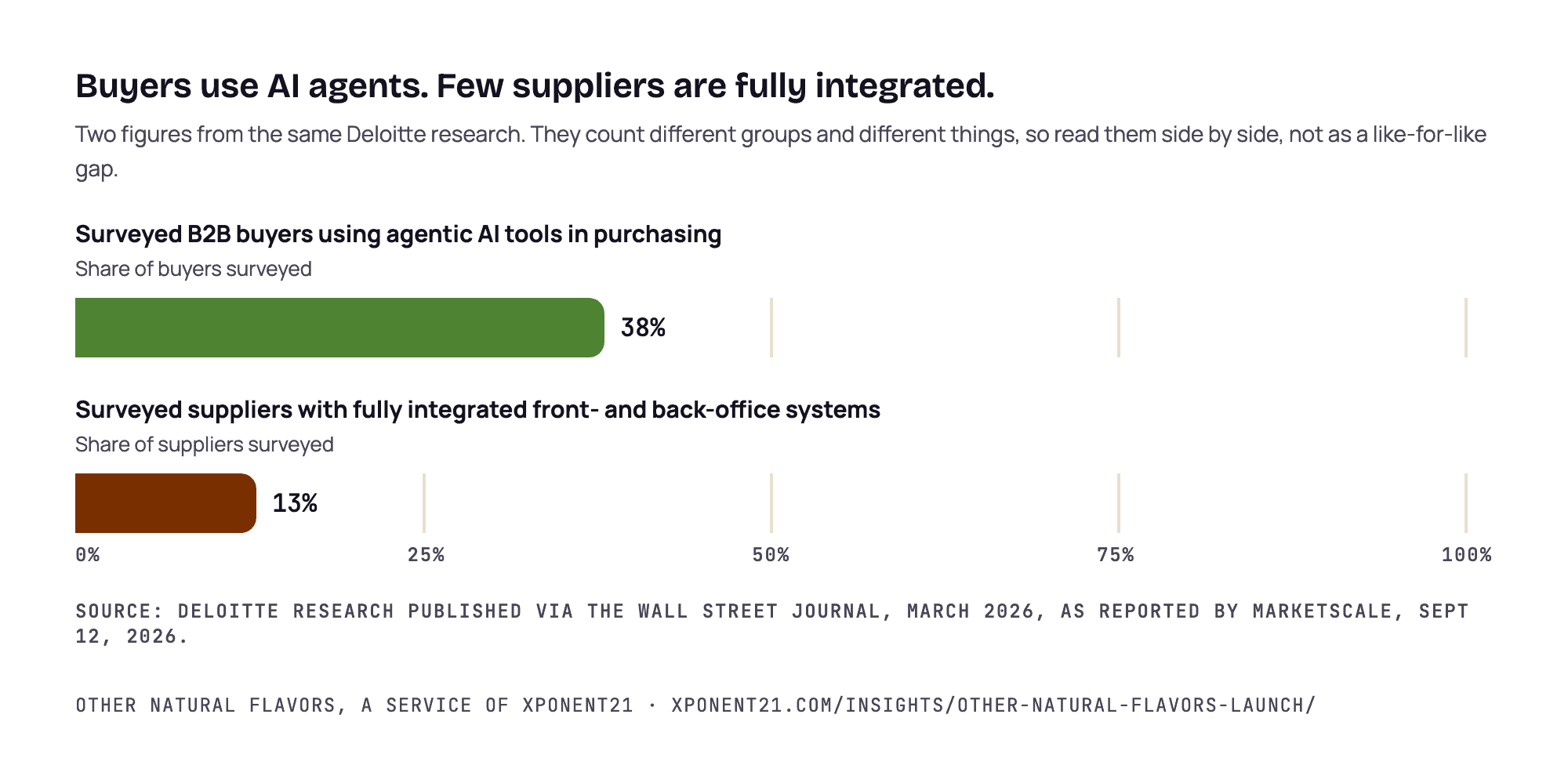
Xponent21 built OTHER Natural Flavors to address structural flaws in how artificial intelligence systems and automated agents surface supply chain information. B2B purchasing behavior is undergoing a rapid transition toward algorithmic discovery. According to Deloitte research published via The Wall Street Journal in March 2026, 38% of surveyed B2B buyers already use agentic AI tools in their purchasing processes (reported by MarketScale on September 12, 2026). Rather than conducting traditional keyword searches or navigating complex trade sites manually, procurement teams increasingly deploy conversational models and autonomous purchasing agents to discover suppliers, verify regulatory compliance, and screen vendors.
However, the supply chain data available to these AI search engines is frequently inaccurate or conflicted. In that same Deloitte study, only 13% of surveyed suppliers reported having fully integrated front- and back-office digital systems, leaving their capabilities, inventory parameters, and ordering thresholds invisible to digital crawlers.
Buyers use AI agents. Few suppliers are fully integrated.
Two figures from the same Deloitte research. They count different groups and different things, so read them side by side, not as a like-for-like gap.
Source: Deloitte research published via The Wall Street Journal, March 2026, as reported by MarketScale, Sept 12, 2026.
When AI platforms retrieve information from the web, they require neutral, dated, and authoritative source documentation. Commercial supplier sites often gate their data, publish unverified claims, or fail to document basic transaction requirements.
To evaluate this dynamic directly, OTHER conducted an internal research review on October 31, 2026, analyzing 21 live AI search queries centered on US dye regulations, supplier assistance, and product reformulation. In this small-sample review, queries asking who could assist with specific reformulation challenges generated answers drawn almost exclusively from supplier websites selling their own proprietary services or from general business directories.
Furthermore, multiple AI-generated summaries and cited web explainers stated that the voluntary phase-out deadline for the six certified dyes was the end of 2026. The FDA's official tracking portal (content current as of October 16, 2026) lists the voluntary industry target as the end of 2027.
Because AI answer engines synthesize data from across the web, out-of-date editorial articles and non-authoritative explainers pollute the candidate retrieval pool. OTHER Natural Flavors structures its content with transparent schema, clear timestamps, direct agency links, and neutral language, creating load-bearing citations that search models and automated purchasing agents can retrieve with precision.
US food manufacturing activity and the demand for supply chain data
The launch of the hub comes during an active recalibration of domestic industrial operations. Data from the Reshoring Initiative 2025 Annual Report, published via Manufacturing.net, documented 247,000 manufacturing jobs announced in the United States through domestic reshoring and foreign direct investment in 2025. Based on first-half announcements, the organization projected approximately 309,000 announced manufacturing jobs for 2026, contributing to an aggregate total of more than 2.3 million manufacturing jobs announced since 2010.
Announcements of capital investment, however, do not equate directly to realized factory production or immediate economic expansion. Broader industrial metrics indicate ongoing friction. According to research from IoT Analytics, US manufacturing construction spending dropped roughly 21% from its June 2024 peak. In transportation markets, the Cass Freight Index showed shipments fell 4.8% year over year in July 2026.
These mixed signals highlight an environment where manufacturing organizations must balance long-term domestic capacity investments with near-term operational cost discipline. Food manufacturers expanding domestic lines or re-engineering supply chains cannot afford protracted reformulation cycles, unverified supplier claims, or ambiguous minimum order requirements. A centralized, verified information ecosystem allows procurement and engineering teams to locate compatible supply partners without burning administrative resources.
Platform access and directory participation
OTHER Natural Flavors is fully open to the public. Food brands, ingredient developers, and regulatory specialists can evaluate upcoming phase-out schedules, download technical guides, and access the free reformulation audit and sourcing brief generator directly.
Commercial ingredient suppliers, color manufacturers, and flavor houses are invited to participate in the ongoing platform survey and claim their free directory profile. By verifying minimum order quantities, technical support capabilities, and processing facilities directly, suppliers can ensure their data is accurately represented to B2B buyers and AI search platforms navigating the market.

Will Melton
Will Melton, CEO of Xponent21 and consultant to global companies, brings nearly 20 years of leadership in technology and marketing. He is the founder of AI Ready RVA and Richmond Water, podcast host for Channel RVA, and serves on several charitable boards in Richmond, VA. Recognized as one of the world’s top experts on AI SEO, Will was one of the earliest adopters or AI visibility and has pioneered strategies that have achieved top citations across Google AI Overviews, ChatGPT, Claude, and Perplexity, making him a global authority on the future of search.