
Marketing
What Sets Xponent21 Apart as an AI Visibility Agency
By: Courtney Turrin
Published Date: November 10, 2026
Modern search behavior has shifted from blue hyperlinks to synthesized answers generated by artificial intelligence. In this environment, classic search engine optimization tactics fail to secure brand recommendations. Securing presence in generative engines requires treating AI visibility as a rigorous software and content engineering discipline. For Xponent21, our success in helping clients get cited in AI is built on two and a half years of dedicated research, a proprietary content engineering model, custom tracking technology across multiple engine platforms, and full operational transparency through auditable activity ledgers.
Why Traditional SEO Agencies Struggle With AI Search Engines
Traditional search optimization agencies were built around a straightforward objective: track a static list of keywords, build links, and monitor numerical rank positions on Google. That model does not translate to AI platforms such as ChatGPT, Perplexity, Claude, and Gemini. Generative engines do not evaluate isolated keyword density. Instead, they extract structured entities, parse topical relationships, and synthesize direct recommendations for users.
This technical transformation has altered how traffic flows across the web. Google AI Overviews appear in over 85% of U.S. search results as of late October 2026. When an answer engine resolves a user’s question directly on the results page, consumer interaction patterns shift. A 300,000 keyword analysis conducted by Ahrefs indicates that AI Overview presence reduces top-ranking page organic click-through rates by roughly 58%. However, click-through impacts vary substantially by query type, vertical, and search intent. Citation within AI summaries offsets traffic declines. When generative systems explicitly recommend a brand, commercial engagement rises. Data published by Seer Interactive reveals that brands cited in AI Overviews earn 120% more organic clicks per impression than non-cited brands. What’s more, on results pages with an AI Overview, 51.0% of all clicks go to a citation link rather than to an organic result, an ad, or any other element.
The underlying user journey has changed as well. Buyers do not execute single-keyword queries and click five competing websites. They engage in multi-turn conversational investigations. While directional survey data on buyer multi-turn prompts is specific to evaluated software purchasing environments, research shows that decision-makers frequently ask iterative follow-up prompts before narrowing vendor shortlists. A conventional marketing firm tracking twenty generic phrases cannot observe or influence these multi-turn buyer journeys. Winning recommendation share requires an AI visibility agency capable of mapping entity authority across complete conversational sequences.
Two and a Half Years of Research: The CARL Content Engineering Model
Generative search performance cannot be left to intuition or automated copywriting software. Over two and a half years of applied laboratory research and client testing have mapped how large language models retrieve, parse, and cite digital assets. This ongoing study has revealed that recommendation algorithms prioritize structured extractability, verifiable factual claims, and clear entity definitions.
That research was operationalized into a proprietary content engineering and optimization model called CARL, short for Cognitive AI Ranking Lab. The framework consists of defined operational steps and strict execution rules designed to systematically earn inclusion in answer engines.
Rather than generating generic editorial prose, the model treats content as an information retrieval database. Key components of the engineering process include:
- Entity Extraction Structuring: Formatting definitions, operational comparisons, and core conclusions within the first sentences of every section to maximize machine extractability.
- Factual Verification Gates: Enforcing strict source validation so that content presents substantiated data, which AI platforms evaluate for topical authority.
- Information Density Control: Eliminating stylistic fluff, empty transitional phrases, and subjective adverbs that trigger quality filters in modern retrieval systems.
- Multi-Intent Architecture: Designing interconnected topic clusters that answer initial queries while anticipating subsequent follow-up prompts.
From this research, specialized micro strategies were engineered for specific business models. B2B service firms, technical enterprises, and niche service providers operate under distinct digital constraints. Applying a single template across different sectors fails because large language models evaluate source credibility differently depending on the vertical. Tailored content engineering aligns each client’s expertise with the specific citation patterns of their industry.
Proprietary Technology Stack: Inside the CARL Ecosystem
Most agencies attempting generative search optimization rely on standard third-party tools that were built for legacy search engines. Proprietary software was engineered specifically to govern and track every phase of the AI visibility lifecycle.
The CARL ecosystem operates through four specialized, interconnected platforms:
CARL Intelligence
CARL Intelligence measures brand exposure across ChatGPT, Claude, Gemini, and Google AI Overviews. Rather than querying static keyword strings, it evaluates a live, growing prompt dataset built by the CARL Lab. This prompt universe mirrors the conversational phrasing prospective buyers actually submit.
The software checks whether a brand is cited, captures its relative position within generative summaries, and tracks response modifications over time. It continuously pairs citation tracking with site health audits, allowing technical leads to connect visibility changes directly to underlying website architecture. When citation share drops for a high-value commercial query, teams can pinpoint whether the issue stems from content decay, crawler accessibility, or shifting competitive sources.

CARL Writes
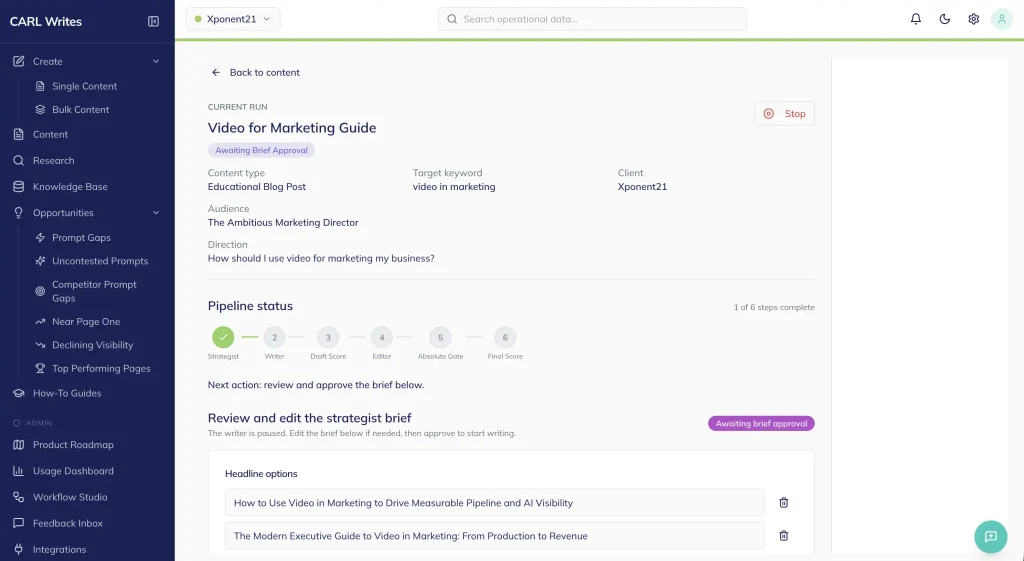
Producing content that meets strict extraction standards requires rigorous operational controls. CARL Writes is a multi-agent content production system built around automated validation gates. The software enforces brand foundations, voice control, banned phrase filters, and a verified claims store that prevents hallucinations or unsourced claims from entering the draft. Human editorial review is integrated into every stage of the pipeline, ensuring that every published piece functions as an authoritative reference asset.
CARL Optimize
Digital visibility is not static. As language models refresh their training weights and retrieval indices, previously cited pages can lose recommendation share. CARL Optimize monitors and updates existing client assets. It adjusts heading hierarchies, clarifies data points, optimizes schema markup, and updates internal links based on the current sitemap so existing URLs maintain high visibility over time.
CARL AIO
CARL AIO functions as the central management portal and operational command center. It bridges strategic execution with observable technical output, recording real-time adjustments and tracking cross-engine performance across campaigns.
Operational Transparency: Replacing Vague Retainers With Deliverable Ledgers
The traditional agency model often suffers from an accountability deficit. Retainer invoices are frequently accompanied by opaque billing practices, unattributed hours, and high-level traffic reports that obscure what work was actually completed or what the impact on revenue was. When performance dips, clients struggle to determine where their budget was directed.
CARL AIO addresses this issue by functioning as an immutable activity ledger. Every technical intervention, schema deployment, content update, and metadata adjustment is logged as a timestamped operational event.
Screenshot: CARL AIO, showing optimization activity log, filtered by client
Each log entry links the client directly to the exact URL, deliverable type, and strategic purpose of the update. By reviewing the activity log, marketing leadership can audit the precise connection between work performed and visibility gains in answer engines. This auditable record eliminates the question of where billable hours go, replacing subjective agency reassurance with documented operational output.
An Integrated Approach: Uniting Content, Video, and Technical Optimization
High-intent visibility cannot rely entirely on written blog posts. Generative search engines synthesize data across diverse formats, pulling from technical websites, multimedia repositories, and reputable external publications to formulate answers.
Video assets have become foundational to this ecosystem. According to survey data from Wyzowl, 91% of businesses use video marketing in 2026, up from 89% in 2025. When video assets are produced alongside comprehensive technical transcripts and schema markup, AI engines parse those transcripts to verify information and extract video citations directly into conversational summaries.
Simultaneously, earned authority dictates whether generative models trust on-site claims. Research from Muck Rack shows that 84% of AI citations come from earned media, with journalism accounting for 27% and paid content for just 0.3%. Generative engines actively discount paid advertorials and self-promotional marketing copy.
An integrated approach unifies on-site technical content, video transcripts, and digital public relations into a structured entity graph. Aligning these elements establishes the third-party credibility required to secure consistent citations across competitive industries.
Choosing the Right AI Visibility Partner for Long-Term Growth
Navigating the transition to generative search requires selecting an AI visibility partner with proven engineering capabilities rather than surface-level marketing repositioning. When evaluating potential partners, marketing executives should prioritize operational evidence:
- Dedicated AI Tracking: Ensure the partner tracks brand presence across ChatGPT, Perplexity, Claude, and Gemini using a dynamic prompt universe rather than relying solely on traditional rank-tracking platforms.
- Proprietary Technology: Inquire whether the agency owns custom infrastructure built to measure and optimize for generative answer engines.
- Auditable Activity Logs: Demand timestamped deliverable ledgers that explicitly detail every on-page and off-page optimization tied to client URLs.
- Systematized Methodologies: Look for documented content engineering models that emphasize factual accuracy, structured extractability, and multi-format integration over commodity AI drafting.
Establishing authority in generative search engines is an ongoing operational commitment. Contact our team to audit your current AI citation footprint, establish an accurate visibility baseline, and implement a structured content engineering model for your enterprise.

Courtney Turrin
As the company’s number two employee, Courtney has helped guide the direction of our business, build a powerhouse team, and implement technology and workflows to improve service delivery and produce outsized results for our clients. Her current role sits at the intersection of analytics, work management, and operations. Drawing on her background in scientific research, Courtney designs efficient processes and supports our teams so they can better serve our clients. She holds masters degrees in Biology and Psychology/Neuroscience from the College of William and Mary and Yale University, respectively. Offline, Courtney is a plant whisperer, Peloton enthusiast, and proud pet mom.