
Marketing
B2B Agentic Commerce: How AI Procurement Agents Will Shortlist Your Products
By: Courtney Turrin
Published Date: November 20, 2026
Autonomous AI procurement agents choose suppliers in B2B buying by running programmatic parameter matching across machine-readable specifications, structured data feeds, and verified distributor records. Procurement teams deploy these systems to eliminate manual supplier research, filtering candidates against rigid engineering tolerances, minimum order quantities, and delivery schedules before a human buyer ever contacts a sales team. For manufacturers and industrial distributors, entering the candidate pool requires publishing precise, verifiable product attributes that algorithmic bots can extract and evaluate without human interpretation.
Current enterprise procurement workflows use AI agents primarily for research, technical comparison, and shortlisting. Complex B2B purchases still close with people, who negotiate final contractual terms, master services agreements, and ongoing partner commitments. For standardized replenishment and routine catalog parts, autonomous systems are taking over direct ordering. If an enterprise purchasing bot cannot programmatically parse your catalog specifications or verify your distributor data, your brand is eliminated from consideration before human evaluation begins.
How AI Procurement Agents Research and Shortlist B2B Suppliers
Industrial purchasing agents research suppliers by converting engineering requirements into multi-parameter database queries. Instead of typing conversational queries into standard search engines or browsing marketing collateral, an enterprise agent ingests bills of materials, CAD parameter files, and internal enterprise resource planning constraints. The bot searches external data sources, querying web endpoints to identify every component meeting exact performance thresholds.
This evaluation process relies on deterministic filtering rather than brand reputation or promotional positioning. An agent tasked with finding industrial valves assesses dimensional drawings, operating temperature thresholds, pressure ratings, and metallurgical certifications. When evaluating candidate suppliers, the software calculates confidence scores based on data completeness and cross-referenced availability:
- Threshold verification: The agent checks whether raw performance metrics match the engineering tolerances specified in the purchase requisition.
- Commercial validation: The system verifies catalog pricing, minimum order quantities, tier discounts, and published lead times against internal schedule requirements.
- Supply chain continuity: The agent queries secondary sources to confirm whether distributors, stocking warehouses, or authorized partners carry the identical part number.
Suppliers that fail to provide definitive technical values are filtered out automatically. If a specification sheet lists an operating range vaguely or buries critical electrical limits inside an unindexed image file, the agent assigns a null value to that parameter. In automated procurement pipelines, a null value functions as an immediate disqualification.
AI procurement agents
Buyer requirements
- Bills of materials
- CAD parameter files
- ERP constraints
Three checks per supplier
- Threshold verificationPerformance metrics against the engineering tolerances
- Commercial validationPricing, minimum order quantities, tier discounts and lead times
- Supply chain continuityDistributors or partners carrying the identical part number
Confidence score: data completeness and cross-referenced availability
Filtered out
Shortlisted
Why Machine Readability Trumps Marketing Persuasion in B2B Agentic Commerce
Subjective marketing copy is obsolete in algorithmic pre-screening and parameter filtering, whereas human oversight remains relevant for supplier relationship finalization. Traditional B2B marketing prioritizes persuasive narratives, brand positioning, and emotional resonance designed for human decision-makers. When an AI procurement agent evaluates an industrial catalog, it strips out promotional adjectives and processes only structured attributes.
Automated bots evaluate unstructured brochures with low confidence scores. When a marketing department publishes product details as a downloadable narrative PDF or an image-based brochure, an agent must rely on optical character recognition and probabilistic language models to infer technical capabilities. This introduces latency and hallucination risks that enterprise procurement software is designed to avoid. By comparison, publishing catalog data in schema-validated HTML and standardized GS1 digital link formats allows algorithms to validate capabilities deterministically as organizations adapt to agentic commerce AI agents.
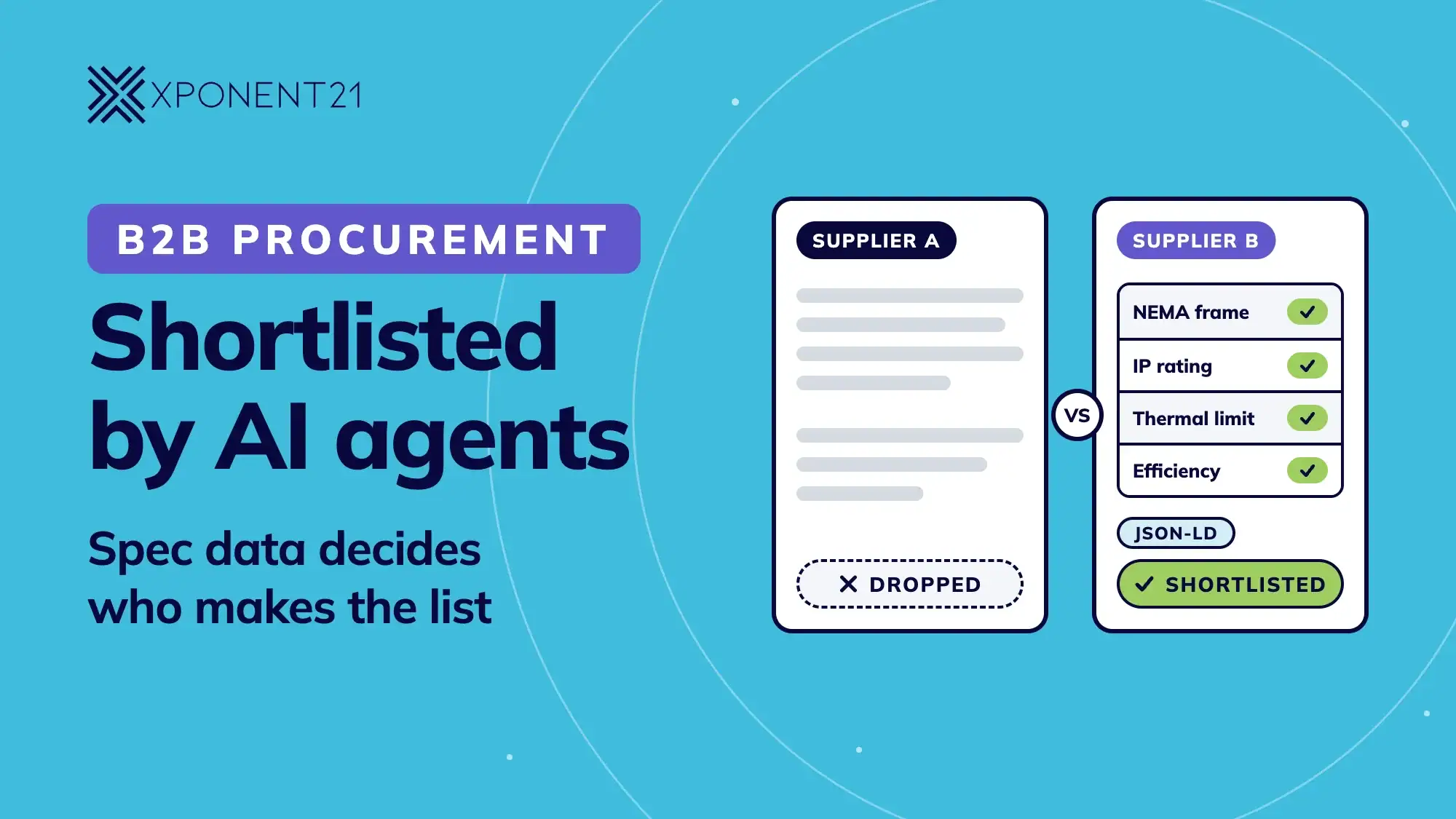
Persuasive prose cannot compensate for missing technical parameters. Consider how an autonomous agent processes two competing catalog entries for an electric motor:
- Supplier A: Describes the motor as an industry-standard, high-efficiency solution engineered for demanding environments, but presents temperature ratings only within a narrative paragraph.
- Supplier B: Uses a clean HTML data table mapping exact National Electrical Manufacturers Association frame sizes, ingress protection codes, continuous duty thermal limits, and efficiency percentages using structured JSON-LD attributes.
Supplier B enters the shortlist on every run because its attributes map directly to the buyer’s filter criteria. Supplier A is dropped because the procurement agent cannot validate its compliance without human interpretation. Persuasive writing has value once a human buyer steps in to negotiate terms, but marketing language cannot earn the initial review if machine-readable data is absent.
Electric motor example
High-efficiency electric motor
Temperature ratings appear only inside the paragraph
DroppedThe agent cannot validate compliance without human interpretation.
Electric motor specifications
- NEMA frame sizes
- Ingress protection codes
- Continuous duty thermal limits
- Efficiency percentages
Shortlisted on every runIts attributes map directly to the buyer’s filters.
The Technical Data Standards Required for AI Agent Shortlisting
Securing inclusion on autonomous procurement shortlists requires adopting technical data standards that make complex industrial catalogs machine-interpretable. Autonomous purchasing agents interact with supplier websites through automated scrapers and machine-facing application programming interfaces. Your web architecture must deliver structured data immediately upon request.
High-performance product schema markup provides the baseline for agent extraction. Implementing Schema.org Product and Organization properties ensures that an evaluation bot recognizes part numbers, dimensional units, and compliance credentials as verified entity attributes rather than arbitrary strings. Crucial schema elements include:
- Product identification properties: Unambiguous identifiers including Manufacturer Part Numbers (MPN), Global Trade Item Numbers (GTIN), and unique Universal Product Codes (UPC).
- Quantitative specifications: Structured
PropertyValuemarkup defining exact units of measure for physical dimensions, operating voltages, tensile strengths, and temperature ranges. - Commercial availability nodes: Real-time stock status, standard lead time ranges, pricing tiers, and geographical distribution permissions.
API response speed and architecture also dictate visibility. Procurement scrapers process hundreds of vendor pages in seconds. Websites that rely heavily on client-side JavaScript rendering often fail to present full catalog data to automated crawlers before the connection times out. To remain accessible, manufacturers must render complete product attributes in the server-side document object model or expose lightweight, public read endpoints that return structured catalog payloads without session friction.
Keeping Spec Sheets, Part Numbers, and Distributor Data in Agreement
Conflicting specifications between manufacturer catalogs and authorized distributor portals cause procurement agents to reject a product or misclassify its capabilities. Autonomous buying algorithms cross-reference multiple web sources to validate supplier credibility, inventory depth, and catalog accuracy. When data discrepancies emerge across these touchpoints, the agent interprets the mismatch as supply chain risk.
Common points of friction occur when channel partners alter part numbering systems or truncate technical specifications. If a manufacturer lists a pump under an alphanumeric part code, but an industrial distributor lists the same physical unit with appended suffix letters or conflicting voltage ratings, an automated purchasing agent treats them as distinct entities. If the manufacturer site lacks direct availability while the distributor site lacks full compliance documentation, the bot may conclude that neither supplier satisfies the complete purchasing protocol.
Maintaining data alignment across external channels requires disciplined syndication governance:
- Canonical part numbering: Enforce identical MPN and GTIN structures across all authorized distributor feeds, avoiding internal dealer renumbering schemes.
- Centralized product information management: Publish technical updates through syndicated data feeds so distributor portals receive revised tolerances and compliance certificates simultaneously.
- Reciprocal structured references: Use schema properties like
isSimilarToor authorized distributor markup to explicitly link manufacturer model pages to active distributor inventory records.
Data consistency signals enterprise reliability. When an agent verifies that part specifications, compliance certifications, and catalog attributes match identically across three independent distributor platforms, its algorithmic confidence score increases, securing the supplier’s position on the final procurement shortlist.
Preparing Your Manufacturing Product Catalog for AI-Assisted Buying
Adapting your industrial product catalog for autonomous procurement requires moving from passive digital brochures to an active, structured data layer. Engineering and marketing teams must collaborate to ensure technical parameters are complete, standardized, and immediately accessible to automated indexing systems. Understanding how industrial brands deploy strategic SEO to drive growth and partnering with a specialized AI SEO agency can help structure this technical data layer for automated discovery.
To prepare your manufacturing catalog for algorithmic evaluation, audit your technical assets using this structured implementation checklist:
- Convert locked specification sheets to semantic HTML: Extract technical tables, electrical specifications, and dimension charts from static PDF downloads and publish them as native HTML tables wrapped in schema markup.
- Standardize technical units and nomenclature: Align all measurement units with universal standards, ensuring that tolerances, pressures, and volumes use recognized International System of Units abbreviations.
- Publish explicit order constraints: Clearly state minimum order quantities, standard packaging multiples, standard production lead times, and warranty periods directly within machine-readable fields.
- Verify server-side accessibility: Ensure that catalog pages deliver full technical text and tabular specifications in the initial HTML payload without requiring user clicks, tab expansion, or client-side script execution.
- Cleanse channel data feeds: Audit distributor and dealer listings to remove outdated part revisions, conflicting technical ratings, and broken cross-references.
Enterprise purchasing habits are changing as software handles the repetitive, data-intensive stages of supplier discovery. Manufacturers that structure their technical catalogs for automated readability will capture procurement interest long before a competitor realizes an opportunity existed. To evaluate your catalog data architecture and prepare your business for machine-driven discovery, schedule a discovery call with an Xponent21 strategist to get clarity on your digital data posture.

Courtney Turrin
As the company’s number two employee, Courtney has helped guide the direction of our business, build a powerhouse team, and implement technology and workflows to improve service delivery and produce outsized results for our clients. Her current role sits at the intersection of analytics, work management, and operations. Drawing on her background in scientific research, Courtney designs efficient processes and supports our teams so they can better serve our clients. She holds masters degrees in Biology and Psychology/Neuroscience from the College of William and Mary and Yale University, respectively. Offline, Courtney is a plant whisperer, Peloton enthusiast, and proud pet mom.