
Marketing
Why Business Growth Exposes Operational Bottlenecks (and How to Fix Them)
By: Courtney Turrin
Published Date: November 25, 2026
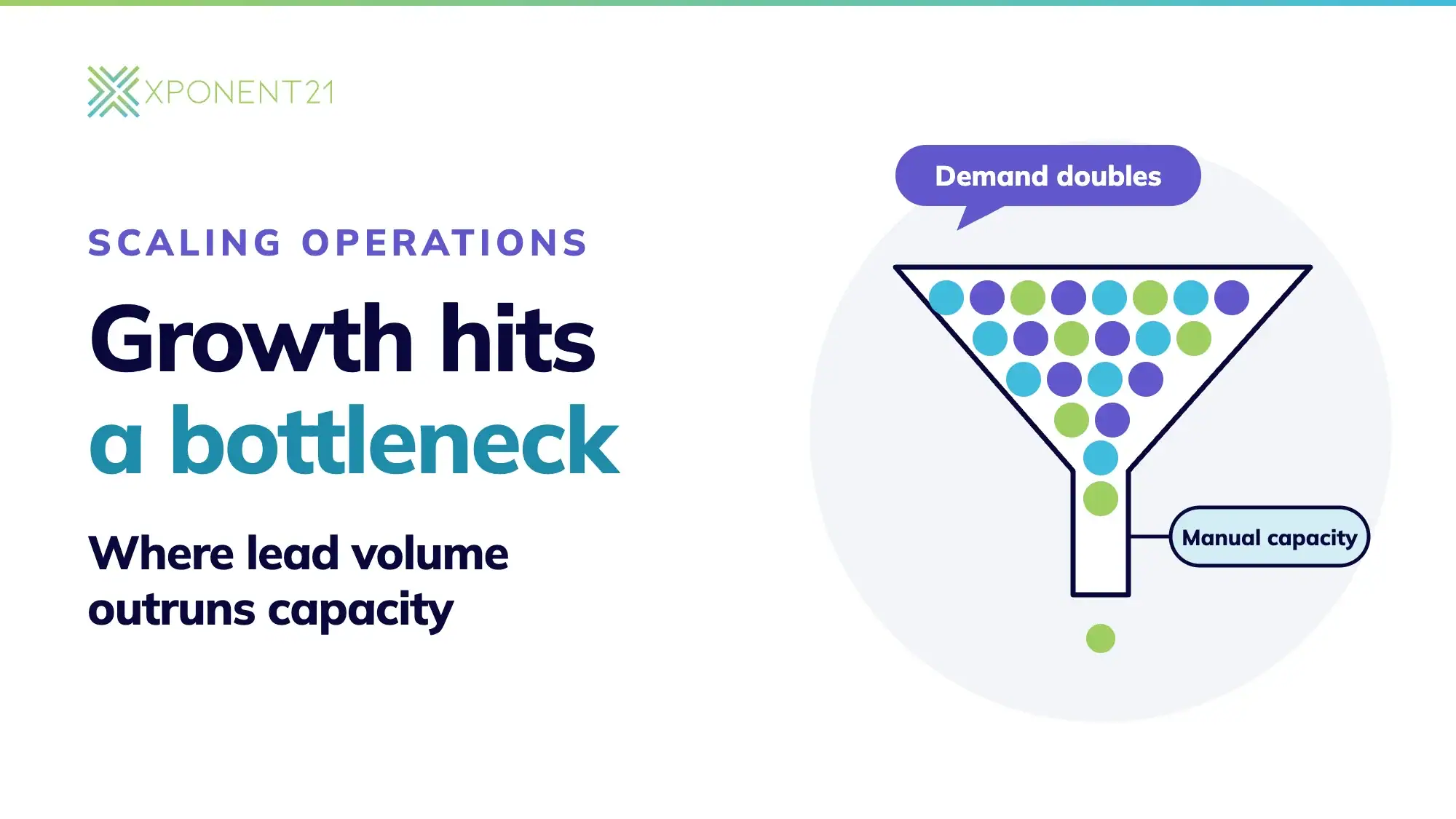
Rapid marketing success creates an immediate operational paradox. When customer acquisition accelerates faster than internal systems can adapt, operational friction follows. In businesses where fulfillment systems, sales response workflows, or staffing models are fixed or inelastic, rapid inbound marketing volume strains operational workflows rather than simply multiplying profit.
Growth does not create operational dysfunction. Instead, increased volume acts as a stress test that reveals structural vulnerabilities already embedded in lead triage, quoting, onboarding, and delivery. Treating these friction points as temporary personnel issues leads to team burnout and customer churn. Solving business bottlenecks growth requires treating operational friction as a systems architecture problem solved through process automation, integrated workflows, and modern software infrastructure.
Why Sudden Business Growth Exposes Operational Bottlenecks
Most operating models are designed for existing volume, with modest headroom for incremental gains. Workflows depend on manual steps: an account executive copying customer information from an intake form into a spreadsheet, a project manager drafting custom estimates from memory, or an operations lead sending personal email updates to confirm delivery dates.
At steady volumes, human diligence covers system gaps. Employees work through inefficient processes because the daily volume allows it.
When demand jumps, manual work collapses under its own weight. The failure is mechanical. Double the intake volume without changing the input mechanism, and processing time per unit increases. Response intervals stretch from hours to days. Administrative backlogs accumulate, and staff members spend more time coordinating internal status updates than completing billable customer work.
The core vulnerability is elasticity. Marketing lead generation can scale overnight through optimized campaigns and search visibility, but manual fulfillment capacity scales linearly with headcount. If increasing client intake requires hiring, onboarding, and training additional staff before work begins, operational capacity growth constraints will stall your revenue momentum.
Primary Failure Points When Lead Volume Outpaces Capacity
When incoming demand overwhelms existing systems, operational bottlenecks in business surface across four specific operational stages.
Inbound Triage and Lead Routing
The initial failure point appears at the front of the commercial funnel. Marketing campaigns generate a surge of inbound inquiries, but the business lacks automated qualification or triage protocols. Unqualified prospects, existing customer service requests, and high-value opportunities enter the same email inbox or general phone queue. Your sales team spends hours filtering low-fit inquiries, while high-intent prospects wait hours for a response. Response latency degrades conversion rates, effectively wasting the marketing investment that drove the traffic.
Custom Scoping and Proposal Generation
Once leads are qualified, quoting becomes the next constraint. Many organizations rely on bespoke proposals assembled across disparate documents, legacy spreadsheets, and manual pricing calculations. As pipeline volume increases, sales reps become administrative clerks. Quotes take days or weeks to issue, pricing errors multiply, and prospective clients look elsewhere while waiting for contract details.
Client Onboarding and Account Provisioning
Closing the deal shifts the burden directly to operations. Without automated intake pipelines, onboarding requires manual handoffs between sales and client success teams. Crucial project parameters are lost in fragmented email threads. Customers experience immediate delays between signing an agreement and launching work, degrading initial trust during the most critical window of the relationship.
Fulfillment and Capacity Utilization
When delivery teams absorb excess capacity without process automation or triage protocols, scaling acquisition without infrastructure upgrades damages client retention. Project managers track deliverables manually across detached platforms, quality assurance checks are bypassed to meet delivery dates, and senior staff spend their hours managing client escalations instead of executing high-margin strategic work.
ConstraintSlowestFixed
ConstraintSlowestFixed
ConstraintSlowestFixed
ConstraintSlowestFixed
Lead responseQuotingOnboardingFulfillment
What the business can deliver (the lowest bar)Constraint (the slowest station)Fixed
Lead response is the slowest station, so the business can only deliver what that station can handle.Lead response is fixed. Quoting is now the constraint, so throughput rises only to quoting’s level.Quoting is fixed. Onboarding is next in line and sets the new ceiling.Onboarding is fixed. Fulfillment becomes the constraint. There is always a next one, so build ahead of it.
Why Fixing One Bottleneck Reveals the Next
Managing business growth bottlenecks is an iterative discipline, not a one-time project. Under the theory of constraints, every operational system possesses a primary bottleneck that dictates its maximum throughput. Eliminating that limitation simply shifts the pressure to the next inelastic point in the chain.
Consider a practical scaling sequence common to expanding service organizations:
ManualAutomated
- Lead responseOne queue, slow repliesRouted by intent
- QuotingScattered documentsStandard pricing logic
- OnboardingDetails lost in handoffDetails carried over
- FulfillmentOverloaded, no visibilityLoad visible in advance
However, solving lead triage immediately creates an estimating bottleneck. The sales team, now holding three times as many qualified conversations, cannot produce detailed proposals fast enough.
Once the business resolves estimating with standardized pricing calculators and modular contract generation, closing velocity accelerates. This success exposes onboarding as the new failure point. Contracts arrive faster than account teams can manually configure client environments, create project folders, and assign tasks.
Moving constraints are a natural indicator of expansion, not an organizational failure. Leaders who understand this dynamic anticipate where the next constraint will surface and prepare the infrastructure before the pressure arrives.
The Hidden Financial and Reputational Costs of Premature Scaling
Aggressive customer acquisition paired with rigid operations creates severe financial drag that rarely appears on standard marketing dashboards.
The most immediate cost is lead waste. Marketing investment drives high-intent buyers into a pipeline that cannot process them in a timely manner. Prospects who encounter delayed follow-up or administrative confusion seek competitors who respond within minutes. The acquisition cost is incurred, but the enterprise captures no downstream enterprise value.
Staff turnover presents an equally destructive expense. High-performing sales and fulfillment employees leave organizations where broken operational systems force them into constant crisis management. The institutional knowledge lost during team turnover degrades production efficiency even further, forcing remaining staff to absorb more manual overhead.
Brand reputation suffers long-term damage. Delivering poor initial experiences to new accounts inflates churn within the first quarter of engagement. The business replaces lost accounts by spending more on front-end acquisition, creating an expensive retention deficit where marketing expenditures compensate for structural delivery failures.
Visible on a standard dashboard
Leads generatedCost per leadTraffic and clicks
Below the line
Lead wasteAd spend that buys inquiries no one answers in time.
Staff turnoverTeams stretched by manual work are harder to keep.
Lost institutional knowledgeWhen people leave, what they know leaves with them.
First-quarter churnNew clients who leave early have to be replaced with more marketing spend.
Marketing spend ends up refilling what leaks out below the line.
Turning Operational Problems Into Profit With Automation and Custom Software
Organizations that scale successfully treat workflow friction as an opportunity to recover margin and expand capacity. By replacing manual touchpoints with workflow automation, centralized data architecture, and custom internal software, companies handle multiples of their historical volume without expanding headcount at the same rate.
A structured operational modernization program focuses on high-impact interventions:
- Automated Intake and Dynamic Qualification: Web forms, conversational interfaces, and intelligent data parsers capture prospective client requirements, score fit, and automatically route the lead to the appropriate specialist while updating the customer relationship management database instantly.
- Standardized Scoping and Quoting Systems: Custom pricing tools calculate complex project costs, generate standardized scopes of work, and produce digital contracts within minutes instead of days, maintaining margin discipline while accelerating sales velocity.
- Programmatic Onboarding Sequences: When a contract is digitally executed, webhook workflows automatically generate project workspaces, provision user accounts, notify the delivery team, and distribute initial onboarding questionnaires to the customer without human intervention.
- Unified Operational Dashboards: Centralizing project milestones, delivery timelines, and staff allocation into real-time operational platforms provides executive visibility into capacity thresholds before service delays occur.
Applying engineering discipline to operational workflows converts repetitive human effort into software-driven execution. The capacity unlocked through system efficiency drops directly to the bottom line, widening profit margins as the business expands.
How an Integrated Growth Partner Diagnoses Operational Limits
Scaling an organization requires looking beyond isolated departmental metrics. Marketing agencies often measure their mandate strictly by lead volume, leaving internal operations teams to manage the fallout of sudden demand surges. Conversely, internal teams frequently request temporary headcount increases rather than diagnosing systemic workflow inefficiencies.
An integrated growth partner evaluates the commercial engine as a single ecosystem. This approach measures marketing velocity alongside operational throughput, identifying where data breaks, where manual friction slows delivery, and where automated tooling must be built to support projected acquisition targets.
Diagnosing these limits requires auditing the entire customer lifecycle:
- Mapping the path an inquiry travels from initial digital touchpoint to contract execution.
- Quantifying manual handling time at every phase of qualification, scoping, and fulfillment.
- Identifying data silos where information is re-entered across disconnected applications.
- Architecting targeted automation and custom software solutions that expand operational headroom for expanding service organizations.
When operational capacity and acquisition strategy move in synchronization, growth stops feeling like an internal crisis. Friction transforms into predictable, sustainable momentum.
If your marketing pipeline is straining your delivery capacity, schedule a call with an Xponent21 strategist to evaluate your operational workflows and align your infrastructure for growth.

Courtney Turrin
As the company’s number two employee, Courtney has helped guide the direction of our business, build a powerhouse team, and implement technology and workflows to improve service delivery and produce outsized results for our clients. Her current role sits at the intersection of analytics, work management, and operations. Drawing on her background in scientific research, Courtney designs efficient processes and supports our teams so they can better serve our clients. She holds masters degrees in Biology and Psychology/Neuroscience from the College of William and Mary and Yale University, respectively. Offline, Courtney is a plant whisperer, Peloton enthusiast, and proud pet mom.