
Marketing
How to Switch Website Support Providers Without Breaking Your Site or Losing Traffic
By: Courtney Turrin
Published Date: November 25, 2026
To switch website support providers without operational downtime, broken conversion tracking, or search visibility loss, organizations must follow an audit-first migration protocol. Transitions fail when leaders treat changing support partners as an administrative exchange of logins rather than a critical infrastructure transfer. A safe transition requires securing direct administrative ownership across every layer of your technology stack, cataloging technical baselines before modifying site files, and staging the final handoff through an isolated server environment.
When managed methodically, changing your website support partner protects your lead pipeline, preserves historical search equity, and establishes clear accountability for your incoming technical team.
Why Changing Support Partners Threatens Site Availability and Search Visibility
Switching your web support team introduces immediate operational risk across your digital ecosystem. A production website is not a self-contained brochure. It is an interconnected system of domain routing, hosting environments, third-party software integrations, analytics pixels, and content management workflows. If a handoff is mismanaged, critical dependencies break silently.
The most common operational failure is an unexpected disruption in domain name system (DNS) routing or server access. If your outgoing team controls the domain registry or server credentials and offboarding is contentious, access can be delayed or severed. Even in amicable transitions, simple oversights cause severe setbacks. Disconnecting an active application programming interface (API) can disable customer lead capture forms without triggering a visible server error. Similarly, dropping conversion tracking containers during a code merge distorts your revenue attribution and interrupts digital ad campaigns.
For search engine visibility, sudden technical instability carries compounding consequences. Search engine crawlers continuously assess page availability, render speeds, and canonical URL consistency. When a messy provider transition introduces broken internal links, expired security certificates, or prolonged server errors, crawler error budgets spike. Search platforms interpret these technical errors as structural degradation, leading to suppressed rankings and fewer organic citations across generative answer engines. Protecting site uptime and revenue during a provider switch requires treating technical continuity as an architectural mandate.
Audit Administrative Ownership and Access Credentials First
Before notifying an incumbent agency of an upcoming contract termination, you must verify and secure primary administrative control over your digital infrastructure. While professional agencies follow standard offboarding protocols, business leaders must secure administrative credentials and independent backups prior to giving notice to prevent administrative lockouts. You should never rely on a vendor to grant emergency permissions during an offboarding phase.
Conduct a comprehensive credential audit across these foundational infrastructure tiers:
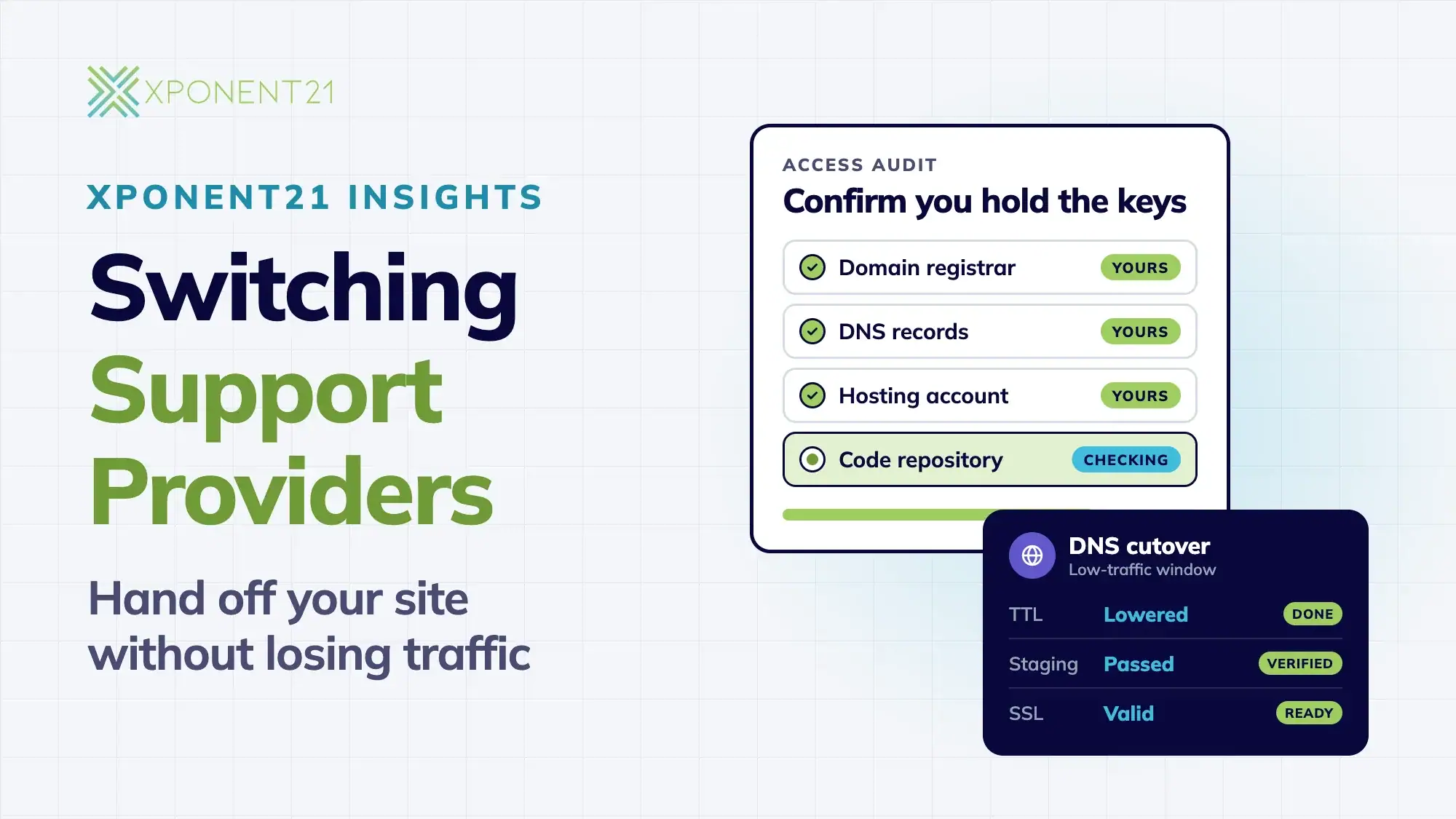
- Domain Registrar: Confirm that your organization’s corporate email address is designated as the primary account owner and administrative contact with your domain registrar. You must retain direct control over nameservers and domain renewal billing.
- DNS Management: Verify whether your DNS records are hosted with your registrar, an external performance delivery network, or the outgoing agency’s private server. Secure master account access to make record adjustments independently.
- Web Hosting and Cloud Environments: Document root or administrative access to the hosting control panel, virtual private servers, and database instances. If your site resides on an agency-owned server cluster, prepare to provision an independent hosting account under your direct ownership.
- Code Repositories: Ensure that your development branch histories, automated deployment pipelines, and custom themes are stored in a dedicated version control repository where your company retains billing and administrative ownership.
- Content Management System (CMS): Verify that internal stakeholders hold active super-administrator accounts. Audit existing user accounts to identify and document all active agency accounts.
- Analytics and Marketing Technology Containers: Ensure administrative access to your tag management platforms, web performance consoles, analytics suites, and customer relationship management (CRM) webhook endpoints.
Once administrative access is verified across these accounts, extract an independent, uncompressed backup of your core database and media uploads. Store this snapshot in a secure, isolated cloud environment that is physically separated from your current hosting provider.
Establish Technical Baselines for Performance, Tracking, and SEO Assets
You cannot verify whether an incoming website support team has maintained site integrity without a definitive record of how the site performed before their arrival. Establishing an exhaustive technical baseline creates a legal and operational standard for the incoming partner to meet or exceed.
Begin by running a complete architectural site crawl. Export a full index of production URLs, capturing status codes, canonical link headers, meta robots tags, structured data deployments, and page hierarchies. Retain this crawl dataset as a master reference file. If a URL structure or schema block is accidentally modified during subsequent development work, this baseline enables rapid technical audits and error identification.
Next, record performance and speed benchmarks across desktop and mobile formats. Measure baseline Core Web Vitals, including loading speed, interactivity response, and visual layout stability across your top-trafficked templates. Document your server response times and Time to First Byte (TTFB) during peak traffic windows.
Finally, catalog every active tracking script and data pipeline. Map out every conversion event:
- Form submission endpoints and post-submission redirect destinations
- Click-to-call telephone tracking scripts
- E-commerce transaction payloads and order confirmation webhooks
- Marketing pixel events and tag manager container IDs
- Third-party live chat integrations and calendar schedulers
Testing every form, link, and script before initiating code changes creates clear accountability. If an endpoint fails post-migration, this documentation proves whether the issue is a pre-existing technical debt or an error caused by the new development team.
Construct an Orderly Offboarding Plan With Your Outgoing Team
Clear offboarding protocols prevent misunderstandings, maintain professional goodwill, and protect business continuity. Review your active service agreement to confirm notification windows, final invoicing schedules, and contractual intellectual property ownership. Your master agreement should explicitly state that your organization owns all custom code, graphic assets, database records, and site configurations.
Schedule a structured handoff timeline that aligns with your contractual billing cycle. Communicate the transition clearly in writing, detailing the specific technical assets and handoff deliverables required from the outgoing team:
- A comprehensive list of custom environment variables, server keys, and external API configurations
- Documentation for custom code modules, scheduled cron jobs, and database cleanup scripts
- Exported license keys for active commercial plugins and proprietary extensions
- Revocation dates for outgoing developer seats across internal systems
Avoid requesting hurried data dumps. Allow standard notice periods so the outgoing team can package technical documentation orderly. Keep communication focused on technical logistics and administrative alignment rather than past service grievances.
Evaluate Incoming Providers on Transition Architecture and SLA Clarity
Selecting a replacement support provider requires evaluating their operational discipline around site transitions. Unstructured agencies often suggest diving into routine maintenance without staging environments or documented deployment workflows. This approach introduces unneeded risk to your digital presence.
Prioritize incoming teams that operate with clear onboarding architecture. During the partner evaluation phase, assess their methodology against key technical criteria:
- Isolated Staging Environments: Does the team replicate the production website within an isolated staging container before initiating software updates or code improvements?
- Rollback Protocols: What automated deployment tools and system backup frameworks do they maintain to reverse a failed update instantly?
- Service Level Agreement (SLA) Definitions: Are response and resolution times explicitly categorized by incident severity? Critical production outages require immediate acknowledgment, while low-priority visual enhancements follow standard development queues.
- Communication Governance: What internal systems do they use to triage requests, track resolution milestones, and keep executive stakeholders informed?
Ask direct questions regarding how the team handles unexpected third-party code conflicts, license renewals, and server optimization. An experienced technical partner will welcome these questions and supply an established transition roadmap designed to prevent deployment errors.
Coordinate a Frictionless Staging and DNS Cutover Plan
Migrating site management or transferring hosting infrastructure requires a coordinated cutover process. In most cases, an audit-first protocol and staging environment mitigate the vast majority of DNS propagation delays, database mismatch issues, and tracking drop-offs, though unexpected third-party API configurations can still require real-time remediation.
The cutover sequence should follow an ordered engineering progression:
[[Image: Diagram illustrating the step-by-step technical cutover process from staging validation to DNS propagation and production launch]]
1. Staging Site Deployment and Audit
Your incoming technical team must clone the production database and file system into an isolated staging container. In this staging environment, developers can audit plugin dependencies, resolve legacy technical debt, test software updates, and verify server environment compatibility without exposing end users to bugs.
2. Time to Live (TTL) Reduction
Several days prior to scheduled DNS changes, reduce your domain zone file’s Time to Live values from standard multi-hour settings to several hundred seconds. This adjustment instructs global resolving nameservers to query your authoritative records frequently, enabling near-instantaneous IP routing cutovers when the records are updated.
3. Database Freeze and Final Synchronization
Select a low-traffic cutover window, typically during late evening or weekend hours. Temporarily place the production site into a database freeze, halting content publishing and customer transactions to prevent data desynchronization. Transfer the delta of modified media files, new user submissions, and database records from the production server to the staging destination.
4. Record Updating and Propagation
Update your DNS records to direct traffic to the new server address, and ensure an active security certificate is deployed and validated before traffic switches. Because TTL values were lowered in advance, global internet routing will transition to the new target server smoothly.
Execute Post-Migration Quality Assurance and Real-Time Monitoring
The cutover marks the beginning of an intensive validation phase rather than the end of the project. Immediately following migration, your incoming technical partner must execute disciplined quality assurance to ensure that no functionality or visibility has degraded.
Conduct comprehensive cross-browser and cross-device testing to confirm visual layout integrity. Verify that caching engines, minification routines, and content delivery network (CDN) endpoints are functioning properly without breaking interactive scripts.
Execute end-to-end transaction testing across all lead capture and transactional workflows. Submit test leads through every contact form, schedule test bookings through integrated appointment engines, and process end-to-end sandbox purchases. Confirm that incoming submissions arrive at target email addresses and populate your CRM pipelines cleanly.
Simultaneously, monitor search engine health and server availability. Review server logs for an increase in missing page errors, server redirect chains, or internal server errors. Inspect search console diagnostics to confirm that the platform can crawl the site without restriction, verify that XML sitemaps remain intact, and ensure that search index directives are accurately applied.
Once post-migration stability is confirmed, permanently revoke all server, CMS, database, and repository user accounts assigned to the outgoing team. Archive initial pre-migration backups, raise your DNS TTL values back to standard operational levels, and transition your internal staff into the new support team’s structured intake workflow.
Managing a digital transition with systematic care protects your brand equity and sets the foundation for sustained search visibility. If your organization is planning to transfer website management and needs architectural oversight, schedule a discovery call with an Xponent21 strategist to evaluate your technical infrastructure.

Courtney Turrin
As the company’s number two employee, Courtney has helped guide the direction of our business, build a powerhouse team, and implement technology and workflows to improve service delivery and produce outsized results for our clients. Her current role sits at the intersection of analytics, work management, and operations. Drawing on her background in scientific research, Courtney designs efficient processes and supports our teams so they can better serve our clients. She holds masters degrees in Biology and Psychology/Neuroscience from the College of William and Mary and Yale University, respectively. Offline, Courtney is a plant whisperer, Peloton enthusiast, and proud pet mom.