
Marketing
What Good Website Support Looks Like: Response Times, Scope, and What to Expect
By: Courtney Turrin
Published Date: November 25, 2026
High-standard website support protects revenue, conversion paths, and search visibility by resolving technical debt before it creates operational disruption. Rather than treating maintenance as passive server administration, an effective partnership pairs structured service level agreements with disciplined engineering. This approach ensures critical issues receive immediate prioritization while routine technical tasks keep marketing initiatives moving forward smoothly.
What Distinguishes Strategic Website Support From Basic Web Hosting Maintenance
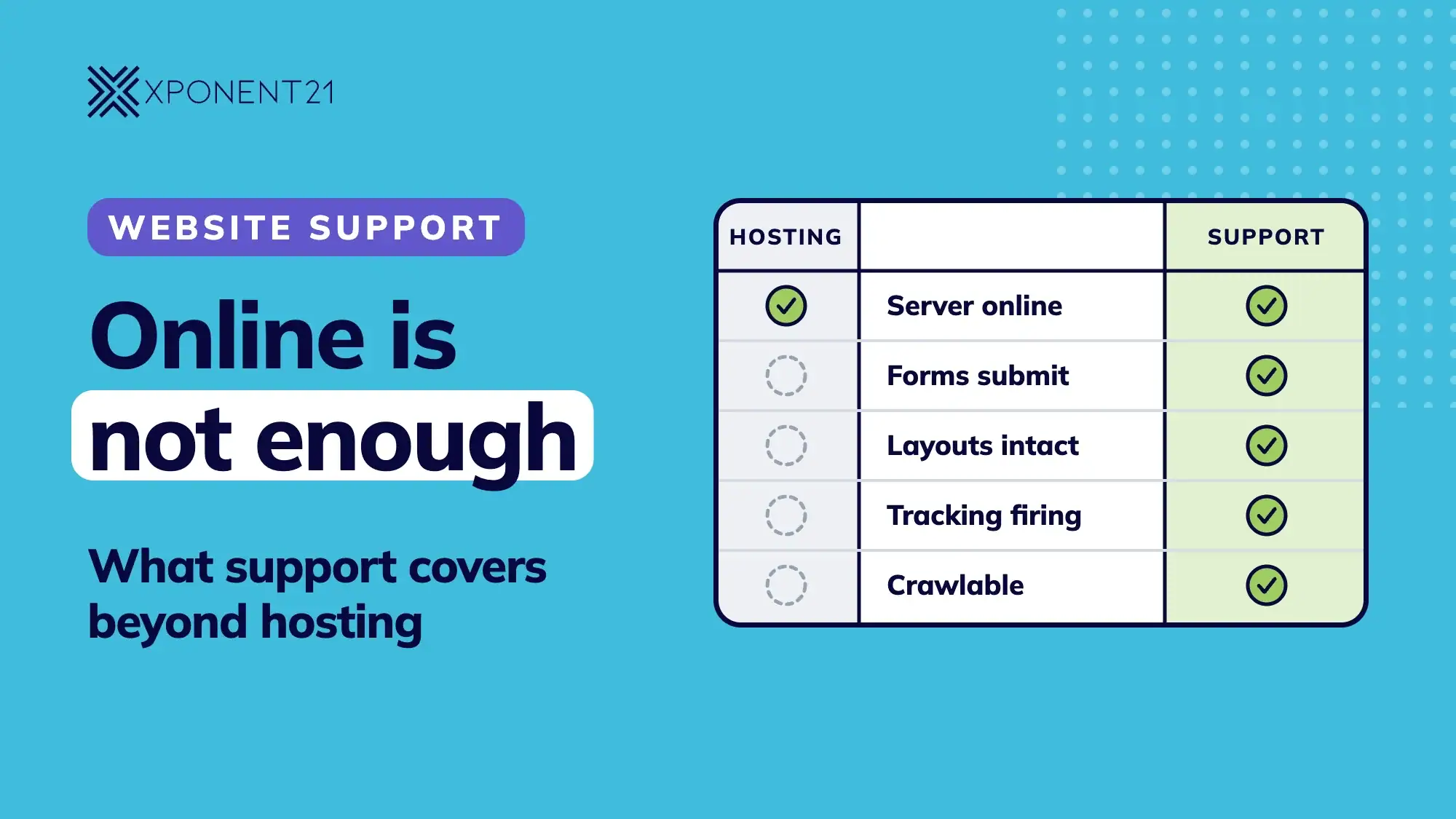
Many business leaders assume that paying for reliable hosting means their digital presence is fully managed. In practice, website maintenance vs website support services represents an important operational division. Web hosts ensure server-level uptime, verifying that the physical or virtual hardware responds to network traffic and the database remains online. They do not monitor whether your primary lead generation form fails after an automated software patch, nor do they care if an updated script breaks your mobile navigation.
Strategic website support services protect commercial-level conversion uptime. A corporate website functions as an evolving software application comprising content management systems, third-party application programming interfaces, custom themes, and analytics tracking pixels. When underlying software updates occur, deprecations can disrupt checkout funnels, misalign page layouts, or disable event tracking without obvious warning.
Unmonitored script conflicts and database bloat also degrade technical crawlability. Modern search engines and artificial intelligence discovery systems evaluate performance, structured data integrity, and render stability when indexing web properties. Server uptime only means the door is open; professional website support ensures the storefront is functional, fully navigable, and technically accessible to both human visitors and automated search crawlers.
Signs Inadequate Technical Support Is Holding Your Business Back
When technical management is reactive or understaffed, operational drag surfaces across the entire organization. The most noticeable warning sign is ticket stagnation: minor content adjustments or tracking updates sit in an unacknowledged queue for days, delaying marketing campaigns and product launches.
A more dangerous indicator is regression error. When a developer resolves an isolated layout issue on one template, only to inadvertently disable form submissions or break typography on another page, the team lacks basic quality assurance workflows. This pattern signals that changes are likely being deployed directly to production environments without code versioning or regression testing.
Straight to productionThrough staging
The fix
Deployed liveTested first
Staging2 regressions caught
- Home
- Services
- Contact
- Blog
- Pricing
- Landing
The Services page is fixed, but two other pages break. Visitors find the problem before you do.Staging runs the regression checks first. Both breaks are caught and corrected before anything goes live.
Over time, repeated technical instability alters executive behavior. Marketing leaders stop requesting functional improvements because they fear touching the site will cause critical failures. Ambitious redesigns, landing page experiments, and integration projects are shelved. When leadership stops trusting the reliability of the corporate website, digital growth stalls and marketing investments fail to yield their full return.
Standard Service Level Agreements: What Realistic Response Times Look Like
A professional website support provider operates under a clear website service level agreement that defines accountability. Rather than offering arbitrary promises, an effective framework categorizes incoming requests by business impact and revenue risk.
When evaluating an average response time for website support plan proposals, expect tiered response parameters based on severity classifications:
- Critical severity: A total outage, compromised security, or an active failure on primary checkout and conversion paths. In these instances, triage begins almost immediately to stop revenue leakage and diagnose the breakdown.
- High severity: Core functionality is impaired, such as broken navigation, critical styling malfunctions across major templates, or failure of non-essential integrations, where workarounds are not available.
- Standard severity: Routine maintenance tasks, minor design revisions, tracking pixel additions, or non-urgent technical questions that do not impede active sales.
Leadership must understand that a response time represents the window in which an engineer acknowledges, triages, and begins investigating the ticket. Resolution timelines depend on root-cause diagnosis, staging replication, and the severity classification defined in the service level agreement. No support plan can promise instant resolution of complex custom code failures, as proper software engineering requires isolating errors in a staging environment before pushing tested revisions to the live website.
What the SLA report shows
- Ticket opened
- Acknowledged, triage started
- Fix staged
- Deployed
What a visitor sees
Fix waiting in staging
Contact form: still brokenContact form: fixedContact form
A ticket is open. Nothing has been acknowledged yet, so the response clock is running.An engineer has acknowledged the ticket and started triage. The response SLA is met, and the form is still broken for every visitor.The fix exists, but only in staging. The SLA report still looks healthy while the live site stays broken.The fix is deployed. Resolution, not response, is what restores the form.
What Core Scope Should a Professional Website Support Plan Include?
Knowing what is included in website support services helps leadership distinguish comprehensive software engineering from simple content entry. Commercial web properties require ongoing, disciplined maintenance to prevent technical decay and security vulnerabilities.
A high-standard scope should incorporate several core technical disciplines:
- Scheduled security patching: Routine, systematic updates to content management system cores, plugins, and third-party extensions, executed within controlled environments.
- Isolated staging workflows: A documented deployment protocol where all patches, code edits, and database updates are tested on staging servers before deploying to production.
- Automated backups and disaster recovery: Redundant offsite backups taken daily or continuously, paired with verified restoration protocols to recover quickly from data loss.
- Performance and caching optimization: Ongoing management of database queries, object caching, content delivery networks, and asset minification to sustain fast load speeds across mobile and desktop devices.
- Automated regression and conversion testing: Continuous monitoring of key user journeys, confirming that forms, checkout flows, and dynamic scripts execute as intended across varied browser environments.
Alongside reactive issue resolution, ongoing website management must incorporate proactive technical auditing. A qualified team reviews error logs, identifies database bottlenecks, and removes obsolete code libraries before technical issues compound into visible outages.
- 1Security patching
- 2Staging workflows
- 3Backups and disaster recovery
- 4Performance and caching
- 5Automated regression and conversion testing
Red Flags in Website Support Contracts and Pricing Models
Contract structures reveal how an agency manages technical capacity and client relationships. Low-cost retainers often mask structural deficiencies that leave your digital assets exposed when complex challenges arise.
One frequent red flag is the opaque rollover hour structure. Commodity providers often sell small monthly hourly allotments that expire immediately at month-end, disincentivizing proactive maintenance and encouraging rushed, end-of-month busywork. Conversely, plans that permit endless accrual of unused hours without periodic architectural reviews create unpredictable liabilities for both parties.
Another serious risk involves proprietary lock-in and unlicensed tools. If an agency installs custom software frameworks without providing clean source code documentation, or deploys critical plugins under agency-owned developer licenses without transferring individual credential access, your organization becomes captive. If the vendor relationship terminates, your site may suddenly lose access to critical software updates and security patches.
Finally, avoid agreements that lack strict version control. An engineering team should always track code revisions using centralized repositories. Direct file editing via FTP without change histories indicates an absence of basic deployment discipline, dramatically increasing the likelihood of unrecoverable code overwrites.
How Proactive Support Protects Revenue, Conversion Paths, and Search Visibility
A website is often the primary conversion engine for business revenue, translating paid ad spend, direct referrals, and organic search traffic into qualified commercial pipeline. When a critical form breaks or page latency increases, ad spend is wasted and inbound leads drop. Proactive website support safeguards this conversion infrastructure by identifying friction points before prospects abandon the experience.
Technical stability directly influences visibility across search engines and generative artificial intelligence answer platforms. Automated search bots require clean markup, fast response times, and consistent canonical structures to retrieve and evaluate your content. Technical debt, such as broken redirect chains, slow Time to First Byte, and orphaned scripts, creates crawl inefficiencies that suppress organic reach.
Consistent maintenance preserves technical crawlability and prevents indexing drops, but substantive visibility growth also requires proactive content and marketing alignment. An engineering team that works closely with search specialists ensures that site architecture, schema markup, and speed optimizations actively support broader marketing campaigns.
Selecting the Right Website Support Partner for Long-Term Growth
Choosing how to choose a website support agency requires looking beyond basic ticket submission mechanisms. Business leaders need a dependable partner capable of supporting technical scalability, strategic initiatives, and organizational growth.
During the vetting process, prioritize transparency and engineering rigor. Ask prospective providers how they handle code staging, how they log technical work, and what deployment safeguards they maintain to prevent downtime. Evaluate their communication cadences to ensure your leadership team receives clear reporting that links technical maintenance to business metrics, rather than generic lists of patched plugins.
A high-performing support partner treats maintenance as a foundational element of your digital growth strategy. By keeping your digital properties secure, fast, and stable, they remove operational bottlenecks and give your internal teams the confidence to pursue ambitious marketing initiatives.
To evaluate your current site architecture and establish an engineering plan that protects your digital growth, connect with a senior strategist at Xponent21 for a discovery consultation to Get Clarity on your website support requirements.

Courtney Turrin
As the company’s number two employee, Courtney has helped guide the direction of our business, build a powerhouse team, and implement technology and workflows to improve service delivery and produce outsized results for our clients. Her current role sits at the intersection of analytics, work management, and operations. Drawing on her background in scientific research, Courtney designs efficient processes and supports our teams so they can better serve our clients. She holds masters degrees in Biology and Psychology/Neuroscience from the College of William and Mary and Yale University, respectively. Offline, Courtney is a plant whisperer, Peloton enthusiast, and proud pet mom.