Marketing
Website Rebuild vs Maintain: An Executive Framework for Aging Websites
By: Courtney Turrin
Published Date: November 25, 2026
Deciding between a website rebuild vs maintain strategy comes down to business infrastructure, not cosmetic preferences. Routine maintenance preserves operational stability and keeps existing code secure, but it cannot resolve compounding architectural debt, platform obsolescence, or schema limitations that block search discoverability. When legacy code structures actively throttle pipeline growth or routine patches incur substantial opportunity loss, an enterprise rebuild is the prudent capital investment. Conversely, if conversion funnels remain healthy and the underlying data layer supports modern search visibility, stabilizing and supporting your current platform is the correct operational decision.
This guide provides executive leaders with an objective framework to assess technical debt, calculate architectural opportunity costs, and determine whether to overhaul or preserve an aging digital property.
Signs Your Existing Website Architecture Has Reached Its Limit
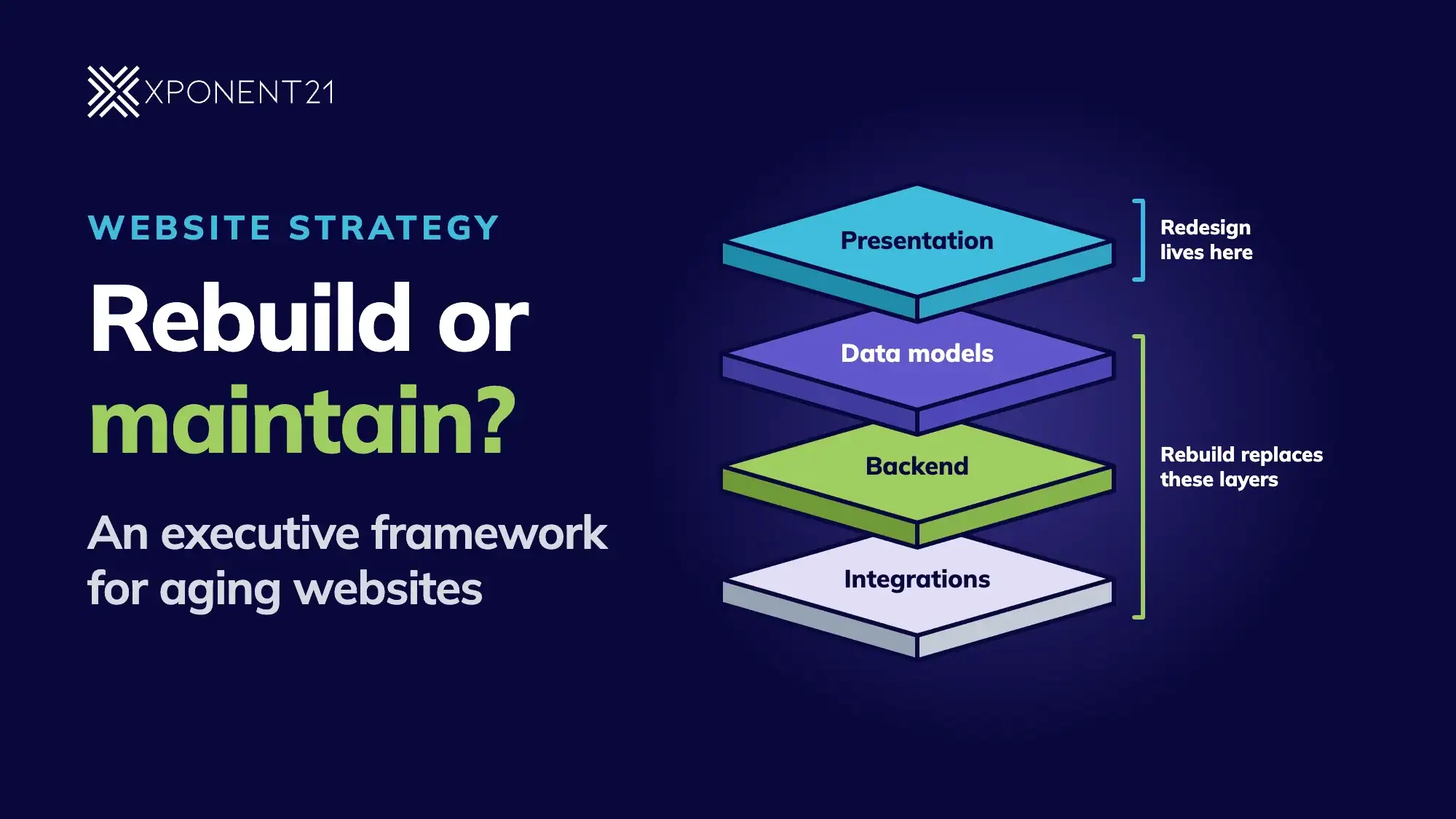
Websites rarely fail all at once. Instead, architectural decay accumulates beneath the surface until routine operations stall. Executive teams often confuse a visual redesign with an architectural rebuild. A visual redesign updates the presentation layer, such as typography, page layouts, and brand color palettes, leaving existing backend templates and database queries intact. An architectural rebuild replaces the core platform, data models, content relationships, and technical foundations that govern how data moves across systems.
Several structural indicators signal that an existing website architecture has reached an operational ceiling:
- Compounding backend friction: When minor content revisions require dedicated developer intervention or simple page adjustments risk breaking global styles, code fragility has outgrown the initial framework.
- Database and server response lag: Legacy content management systems accumulate orphaned database rows, redundant revisions, and bloated media libraries over years of continuous publishing. This bloat directly degrades server response times and Core Web Vitals metrics.
- Integration bottlenecks: Modern marketing operations require reliable, real-time data flow between your website, enterprise customer relationship management systems, marketing automation platforms, and external APIs. If your existing setup relies on unstable custom scripts or unsupported plugins to sync leads, integration fragility introduces conversion friction.
- Incompatible data structures: Legacy themes often lack modern schema integration and semantic markup. Without structured entities embedded directly in page templates, modern search crawlers and machine learning models cannot accurately parse your capabilities, services, or locations.
When these symptoms appear simultaneously, the issue is not visual fatigue. The platform itself has become a structural ceiling on operational velocity.
When Website Maintenance Is the Right Business Decision
A total rebuild is a major capital and operational initiative. It requires significant internal resources, cross-functional sign-offs, and project governance. Rebuilding is not the default solution for every underperforming digital property. In many operational scenarios, ongoing website maintenance represents the most financially disciplined decision.
Maintenance is the right strategic path when your underlying technical foundation remains sound. If your current platform handles traffic surges without latency spikes, maintains clean code hygiene, and achieves passing Core Web Vitals, an architectural replacement is premature. Stabilizing and supporting the current site serves as a practical, high-return first step before committing to a capital-intensive platform replacement.
Consider maintaining and iteratively optimizing your existing infrastructure under the following conditions:
- Healthy baseline conversion rates: If user flows, forms, and conversion funnels function efficiently, your website continues to deliver its primary business outcome. A website rebuild resolves underlying architectural bottlenecks and page experience, but message-market fit and traffic quality must also be aligned to improve conversion volume.
- Active content refreshing cycles: Often, performance plateaus stem from stale service pages or unrefined copy rather than backend architecture. Implementing an aggressive content revision strategy within your current template structure can revitalize organic performance without touching database tables.
- Manageable technical debt: If security patches, platform updates, and routine plugin audits take minimal developer hours each month with zero unexpected downtime, ongoing maintenance remains cost-effective.
Executive leadership should prioritize preservation and incremental user experience adjustments when the current infrastructure meets operational standards and does not actively prevent marketing systems from scaling.
The Financial and Operational Comparison: Rebuild vs Maintain
Evaluating whether to allocate capital toward an overhaul or maintain an ongoing support agreement requires analyzing direct expenses alongside hidden opportunity costs.
Executives often assume that maintaining an older CMS is always less expensive annually than rebuilding. In reality, compounding plugin conflicts, vulnerability patching, and custom workaround development frequently eclipse the annualized amortization of a modern site build. An aging installation may demand continuous developer hours simply to stay operational, burning engineering capacity that could otherwise generate revenue.
To evaluate the financial reality objectively, contrast direct and indirect cost drivers:
- Capital expense versus operational expense: A platform rebuild represents a capitalized expense amortized across several years of operational utility. Maintenance operates as a predictable, recurring monthly expense. However, when legacy systems require constant emergency firefighting, maintenance budgets quickly escalate into unpredictable capital drains.
- The cost of operational velocity: An agile infrastructure enables marketing teams to spin up custom campaign landing pages, adjust navigation, and publish new service lines within hours. An obsolete platform forces teams to submit basic updates to external development queues, delaying go-to-market initiatives by weeks.
- Lead leakage and technical drag: When checkout sequences hitch, form scripts drop tracking parameters, or mobile page load speeds crawl, prospect drop-off increases. Even slight friction across enterprise buying journeys steadily depresses pipeline velocity.
Include revenue lost to a slow or fragile platform
- Monthly direct cost
- Emergency fix
- One-time build, amortized over years
- Revenue lost to the platform
Direct costs only: a rebuild is front-loaded and then amortized, while maintenance is a recurring monthly cost that can turn into unpredictable firefighting.Add slow pages, checkout hitches, broken tracking, and campaigns delayed by weeks, and the maintenance column carries a cost the retainer never shows.
The decisive financial metric is not merely what an organization spends on monthly maintenance retainers. The true calculation incorporates revenue unrealized due to an inflexible, slow, or fragile infrastructure.
How Modern Search Engines and AI Overviews Change the Rebuild Equation
Search landscape mechanics have transformed fundamentally over recent years. Search engines no longer rely solely on keyword density and backlink counts to rank content. Modern discovery environments, including Google AI Overviews and answer engines like ChatGPT and Perplexity, extract information directly from clean, machine-readable digital infrastructure.
When search engines parse a website today, they seek structured data, explicit entity definitions, and precise topical hierarchies. Aging CMS architectures built on legacy frameworks frequently wrap business information in deep layers of visual shortcodes, unsemantic markup, and fragmented relational tables. This architecture prevents machine learning systems from synthesizing your authoritative data into answers.
The commercial impact of this shift is visible in search user behavior. Research from the Pew Research Center reveals that users clicked a traditional result on 8% of searches with an AI summary versus 15% without. As generative summaries occupy the top of search engine results pages, the value of standard blue-link placement declines.
Visibility inside these summary elements has become essential for organic customer acquisition. Data from First Page Sage indicates that on results pages with an AI Overview, 51% of all clicks go to a citation link rather than to an organic result, an ad, or any other element. Furthermore, an analysis by Seer Interactive established that brands cited in AI Overviews earn 120% more organic clicks per impression than non-cited brands.
Out of every 100 searches, how many end in a click on a traditional result?
15searches without an AI summary8searches with an AI summary
7 fewer clicks than without an AI summary
Source: Pew Research Center, as cited in the article.
Two related findings
51%of clicks on results pages with an AI Overview go to a citation linkSource: First Page Sage, as cited in the article
120%more organic clicks per impression for brands cited in AI Overviews than for brands that are notSource: Seer Interactive, as cited in the article
An aging website that cannot support automated schema deployment, dynamic entity graphs, and responsive server delivery is effectively invisible to these extraction engines. In this operational context, rebuilding is not about visual style. It is an investment in machine discoverability and pipeline security.
Evaluating Strategic Fit: A Decision Matrix for Business Leaders
To clarify the decision path for your executive team, evaluate your current web operations across four core dimensions:
| Strategic Dimension | Maintain Existing Platform | Execute Complete Rebuild |
|---|---|---|
| Code Base & Security | Core files update cleanly; zero unresolvable extension conflicts. | Outdated dependencies; customized core files prevent critical updates. |
| Discovery & Search Architecture | Semantic schema present; pages render instantly for search crawlers. | Legacy layouts block structured entities; low citation frequency in AI engines. |
| Team Efficiency | Internal teams create and edit complex layouts without developer aid. | Basic content adjustments require custom coding and outside engineering. |
| Revenue Impact | Funnel tracking is reliable; conversion paths display negligible friction. | Unexplained drop-offs during checkout or form submission; unstable analytics. |
If your platform registers predominantly in the maintenance category, focus your marketing budget on strategic content iteration and incremental conversion rate optimization. If your operations align heavily with the rebuild category, continuing to apply localized patches will yield diminishing returns.
How to Plan Your Next Step Without Disrupting Existing Revenue
Choosing an architectural overhaul does not require halting commercial momentum. Successful enterprise migrations treat a website rebuild as an operational transition designed to protect existing organic equity and lead capture funnels.
First, catalog all high-performing pages, active keyword footprints, and inbound referral sources. A major pitfall during an architectural replacement is dropping legacy URL paths without comprehensive, one-to-one redirects. Architectural upgrades should systematically preserve your established authority while deploying modern schema markup across newly engineered page templates.
- /services404/what-we-do/ (homepage)
- /about-us404/company/ (homepage)
- /blog/
2019/ 404/insights/guide guide / (homepage) - /contact.php404/contact/ (homepage)
Old links, bookmarks, and search results lead to dead ends, and the search equity built on those pages is lost.Every old URL lands on the homepage. The link technically works, but visitors lose the page they were looking for, and search engines have little reason to pass the old page’s relevance to a generic destination.Each legacy URL maps to exactly one new page, so visitors and search engines land where they expect and existing search equity carries over.
Second, audit current operational workflows. Determine where your marketing and sales personnel face friction. Building a modern platform provides an opportunity to restructure internal content workflows, simplify publishing permissions, and streamline CRM data handoffs.
If your leadership team is evaluating your current web infrastructure and weighing ongoing development costs against long-term growth, an objective technical evaluation provides critical clarity. Connect with Xponent21 to schedule a discovery call and map an architectural strategy aligned with your revenue goals.

Courtney Turrin
As the company’s number two employee, Courtney has helped guide the direction of our business, build a powerhouse team, and implement technology and workflows to improve service delivery and produce outsized results for our clients. Her current role sits at the intersection of analytics, work management, and operations. Drawing on her background in scientific research, Courtney designs efficient processes and supports our teams so they can better serve our clients. She holds masters degrees in Biology and Psychology/Neuroscience from the College of William and Mary and Yale University, respectively. Offline, Courtney is a plant whisperer, Peloton enthusiast, and proud pet mom.