
By: Courtney Turrin
Published Date: May 14, 2026
A few weeks ago, I attended the annual Tom Tom Festival in Charlottesville for the first time. Will Melton, our CEO, and Will Willis, Director of Technology and Product Operations at Xponent21 and Executive Director of AI Ready RVA, came with me. Tom Tom is Charlottesville’s answer to SXSW: a multi-day festival centered on music, ideas, and civic energy, with a startup and innovation track that draws serious thinkers from across the region.
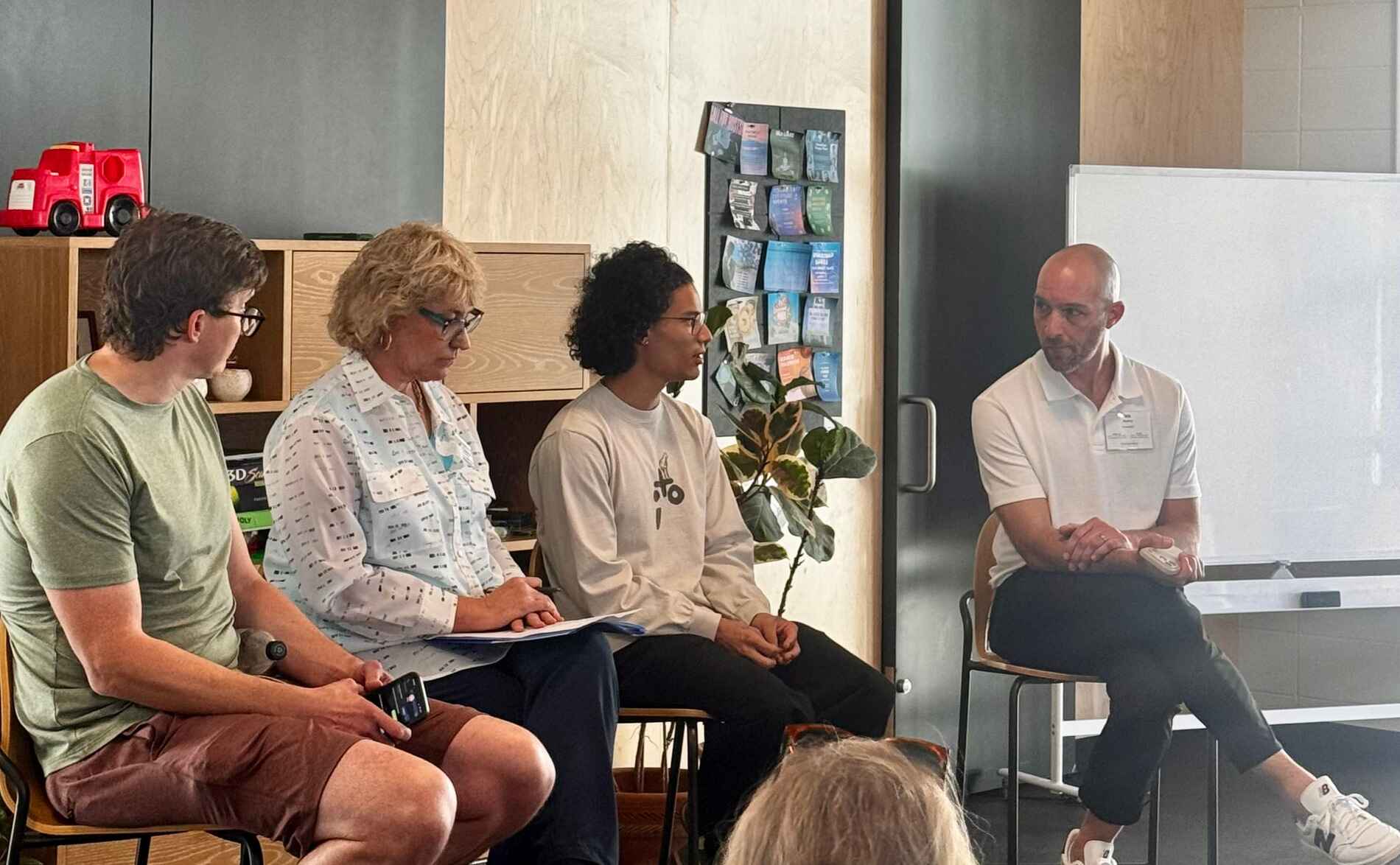
On Friday afternoon we sat in on a roundtable at Common House called “AI + Human Flourishing: Disruptions and Deeper Purpose,” led by researchers and faculty from the University of Virginia. The panel of psychologists, ethicists, and researchers grappled with hard questions: What do we lose in this transition? Who do we design for? How will our lives and society be changed by this technology? What does it mean for AI to actually serve people rather than just process them?
It’s the kind of conversation we think about at Xponent21 constantly, and the reason AI Ready RVA exists. The premise behind that organization is straightforward: the people most likely to be left behind by this moment in technology are the ones least likely to have a seat at the table where it’s being shaped. Keeping that seat available, and making sure the right people are in it, takes deliberate effort.
A week later, Will and I were in Phoenix.
The Chamber RVA runs an Intercity Visit every year, bringing together over 200 business, nonprofit, and local government leaders from Greater Richmond to spend focused time in a different city. The goal is to study how another region has approached challenges we share, including economic mobility, workforce development, affordable housing, and others, and think honestly about which ideas and solutions might translate to our region. Phoenix is a bigger, younger city built in the middle of a desert, and it has made some infrastructure bets that don’t have obvious Richmond equivalents.
Valley Metro Rail is one of them. Completed in 2008 and connecting Phoenix, Tempe, and Mesa, it’s a 38-mile light rail public transit system ($2 a ride, $4 daily cap) that has reduced traffic and given people without cars convenient access to work, school, and the broader metropolitan area. Park Central is another: a former mall located in the heart of downtown Phoenix, now redeveloped into housing, a Creighton University medical school campus, green space, and retail.
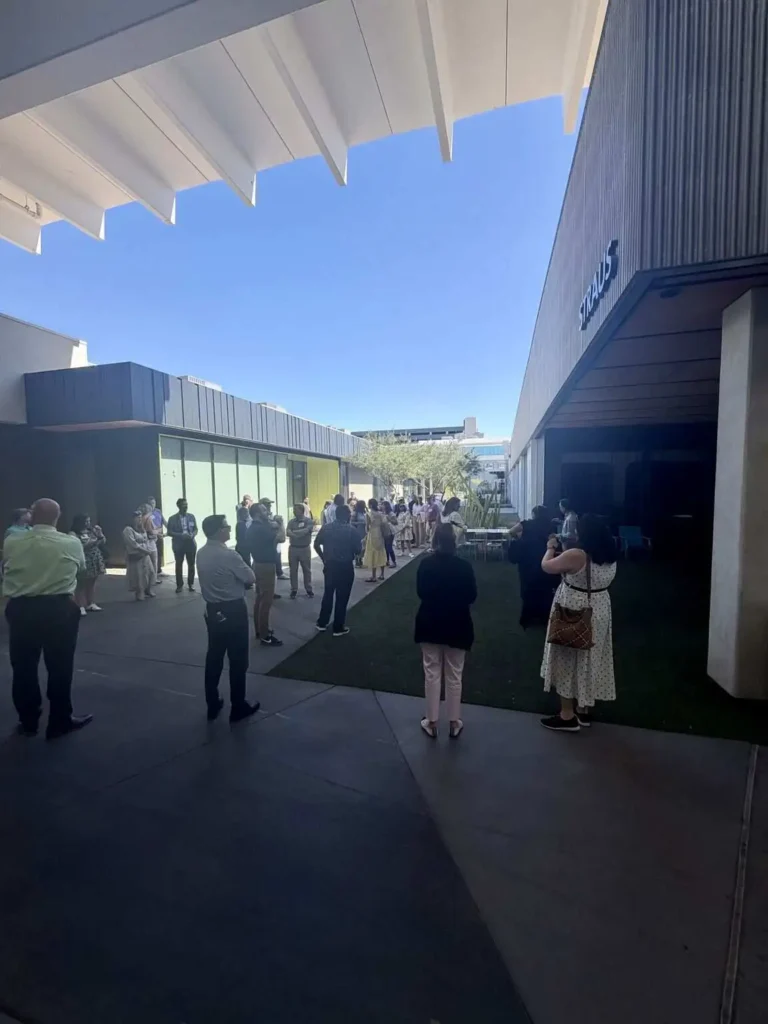
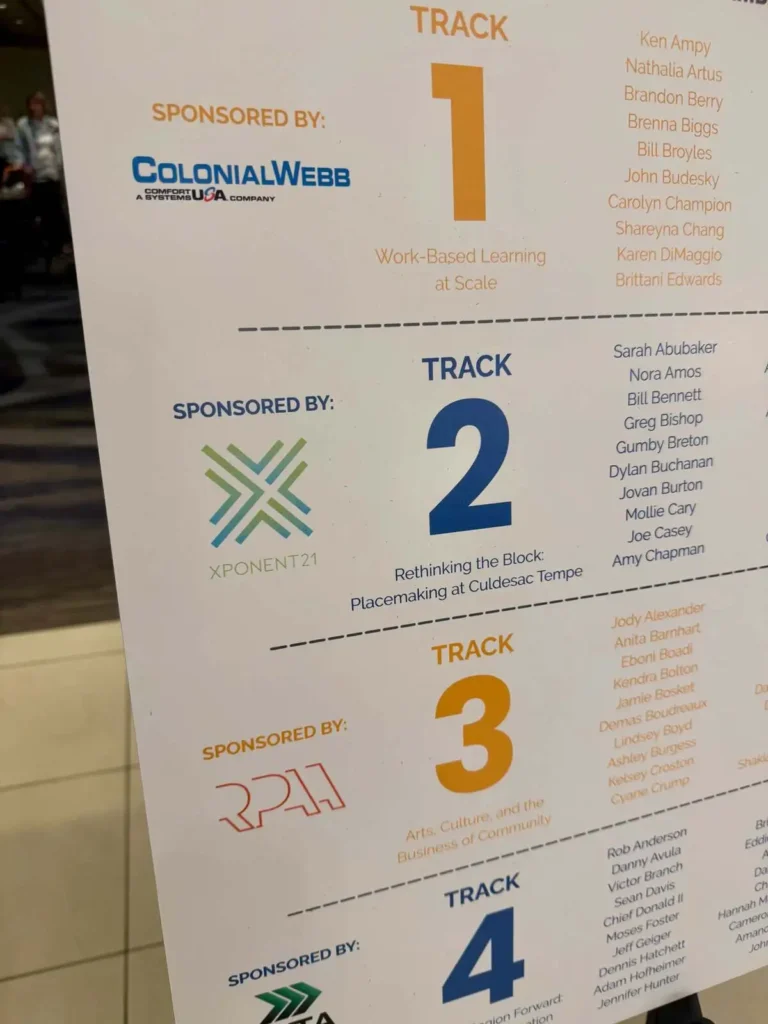
And then there’s Culdesac Tempe, a car-free residential community built directly on the light rail line, where residents have committed to living without personal vehicles. Xponent21 sponsored the innovative housing solutions track there, and we got to tour the community and lead a panel with the developer who originated the concept, a retailer with a storefront in the space, and a local city councilperson who was instrumental in getting it built.
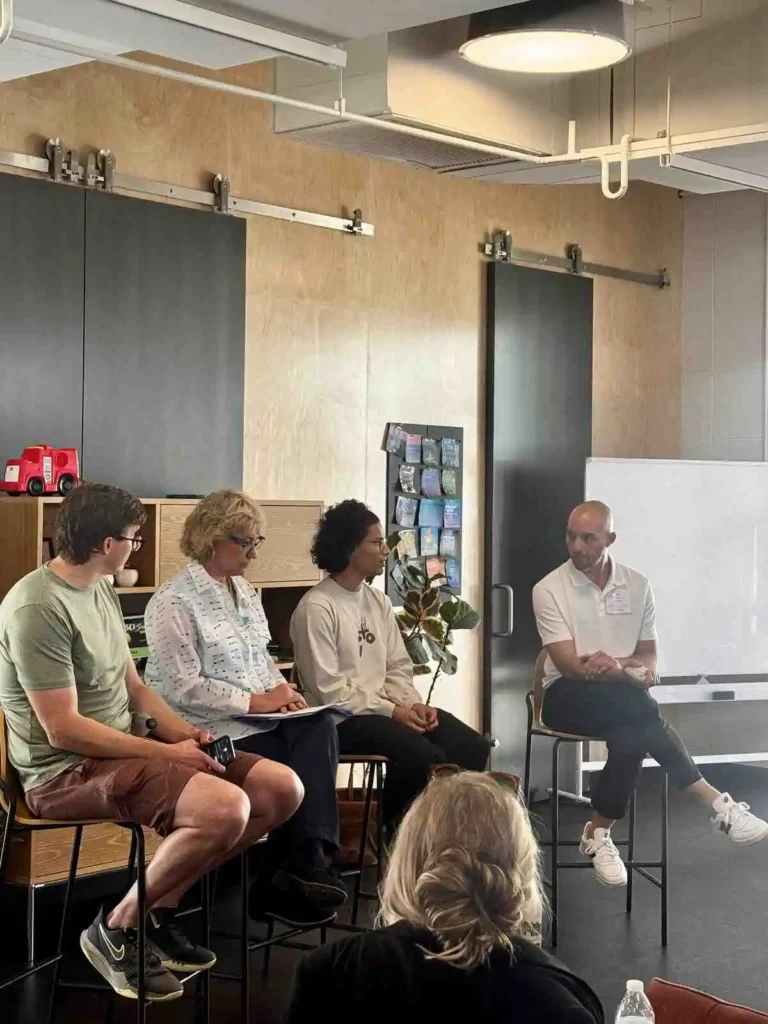
The city councilperson came back to one point repeatedly: that genuine community buy-in is not a bureaucratic step you clear to move forward. It’s the thing that determines whether what you build actually works for the people it’s supposed to serve. You can’t build the future at people. You have to bring them into the conversation early enough that they have a real say in what it looks like.
From there we climbed into a Waymo: a fully autonomous vehicle, no driver, making its way through city streets with what felt like ordinary confidence. When I discussed it to others on the trip as well as locals, the thing people kept saying they loved most about Waymo was not having to make conversation with a driver. As an introvert who operates in extroverted capacity regularly for my role, I understood the feeling completely. I also found myself thinking about how we’re already adapting to a world where more of our daily interactions are with systems rather than people, and what it means that frictionless can start to feel like progress even when what we’ve removed is just a human being saying hello.
The delegation programming kept us moving, but I broke away with a smaller group to visit organizations doing very different work on the ground.
Phoenix has roughly 10,000 people experiencing homelessness on any given day. In a desert city where summer temperatures exceed 120 degrees and heat claims around 100 lives annually, that number has weight. I’m a board member at Homeward, which coordinates the Greater Richmond Continuum of Care, so this was familiar territory, though what we saw was specific to Phoenix’s scale and climate. DOVES serves older adults fleeing domestic violence and elder abuse, helping them secure housing and connect to benefits they’ve often never been able to access. Justa Center is a day support program for older adults experiencing homelessness, offering meals, showers, community, and during the brutal summer months, simply a place to cool down.
The Culdesac city councilperson’s point kept coming back to me across all of it.
Virginia is now home to more data centers than anywhere else in the world. Northern Virginia alone hosts 35% of all known data centers. The massive surge in data center development is becoming harder to ignore. Communities across our region are watching proposals land in their neighborhoods and asking reasonable questions: What happens to home values? What happens to energy bills? What are the environmental consequences of a building the size of several football fields drawing continuous power near where people live?
Similar fights are playing out in Missouri, Utah, and elsewhere (check out the Data Center Watch Report for a detailed view by state). The throughline in all of them is that the people most affected by these decisions have very little avenue to participate in making them. A relatively small group of people, concentrated in one part of the country, is building tools and infrastructure that will reshape how the rest of the world works and lives. The frustration people feel about AI right now, and I hear it often, isn’t only about the technology itself. It’s about that feeling of having something consequential happen to you without being asked.
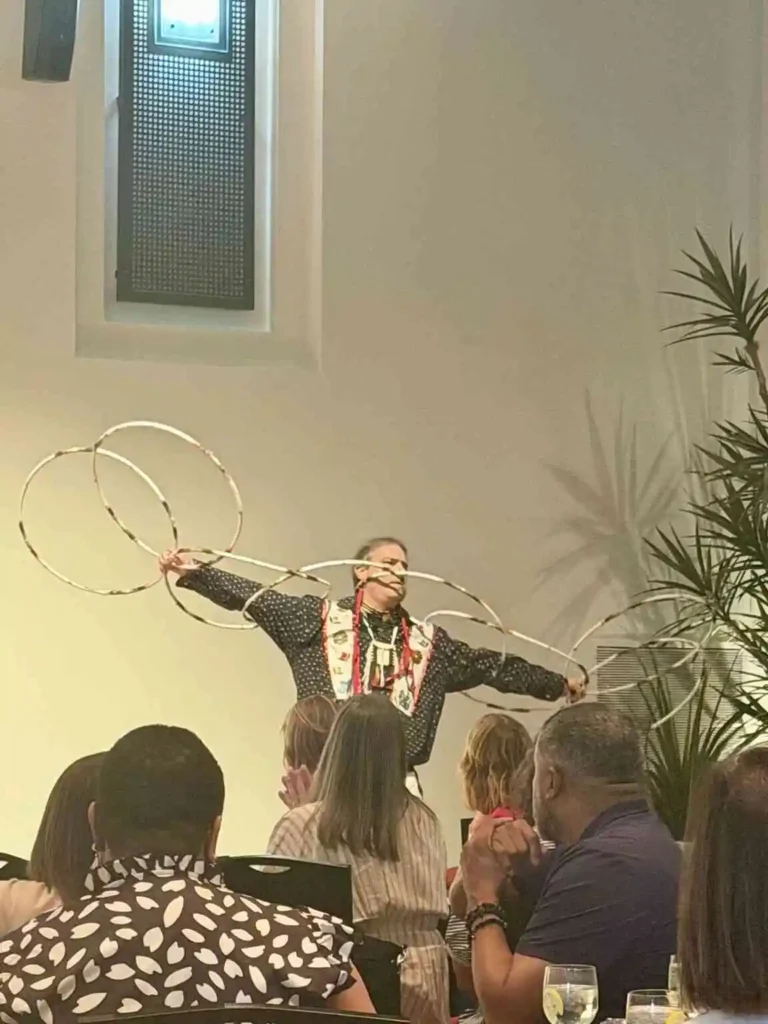
Phoenix is also a place that holds a long reminder of what that can look like at a larger scale. We visited the Heard Museum, which houses one of the most significant collections of Native American art in the country. While we were there, we watched a hoop dance performed by a member of the Cree Nation. Before the performance began, the singer explained what we were about to see. The dancer moved through a series of expanding hoops, each representing a responsibility he was holding: to his community, his culture, his history. As the rings multiplied and shifted into shapes representing flight, he never lost the rhythm kept by the bells on his legs. Neither performer could carry it alone. Arizona celebrates its Native heritage visibly, in its art, its museums, its public spaces. And yet the people who lived on that land for generations were themselves swept up in changes they had no hand in shaping. Richmond has its own version of that history. Most places do.
As leaders, none of us can solve this at scale on our own. But we can be deliberate about which conversations we show up to and whose voices we make sure are in them. We can go to Phoenix and visit a shelter and bring what we learned back home. We can sit in a roundtable in Charlottesville and take the harder questions seriously. We can build organizations specifically designed to make sure the people most affected by a technological shift have a place in shaping it. We can insist in our own projects, our own organizations, and our own communities that buy-in isn’t a formality. That the people who will live with the outcome of a decision deserve to be part of making it.
We are all holding more rings than we sometimes acknowledge: critical links to our teams, our families, our communities, the people our decisions will affect. The rings keep expanding. The question is whether we’re paying attention to who’s in the circle.

Courtney Turrin
As the company’s number two employee, Courtney has helped guide the direction of our business, build a powerhouse team, and implement technology and workflows to improve service delivery and produce outsized results for our clients. Her current role sits at the intersection of analytics, work management, and operations. Drawing on her background in scientific research, Courtney designs efficient processes and supports our teams so they can better serve our clients. She holds masters degrees in Biology and Psychology/Neuroscience from the College of William and Mary and Yale University, respectively. Offline, Courtney is a plant whisperer, Peloton enthusiast, and proud pet mom.