Marketing
How to Claim Your Business in ChatGPT: Complete Step-by-Step Guide
By: Jenna Pace
Published Date: November 11, 2026
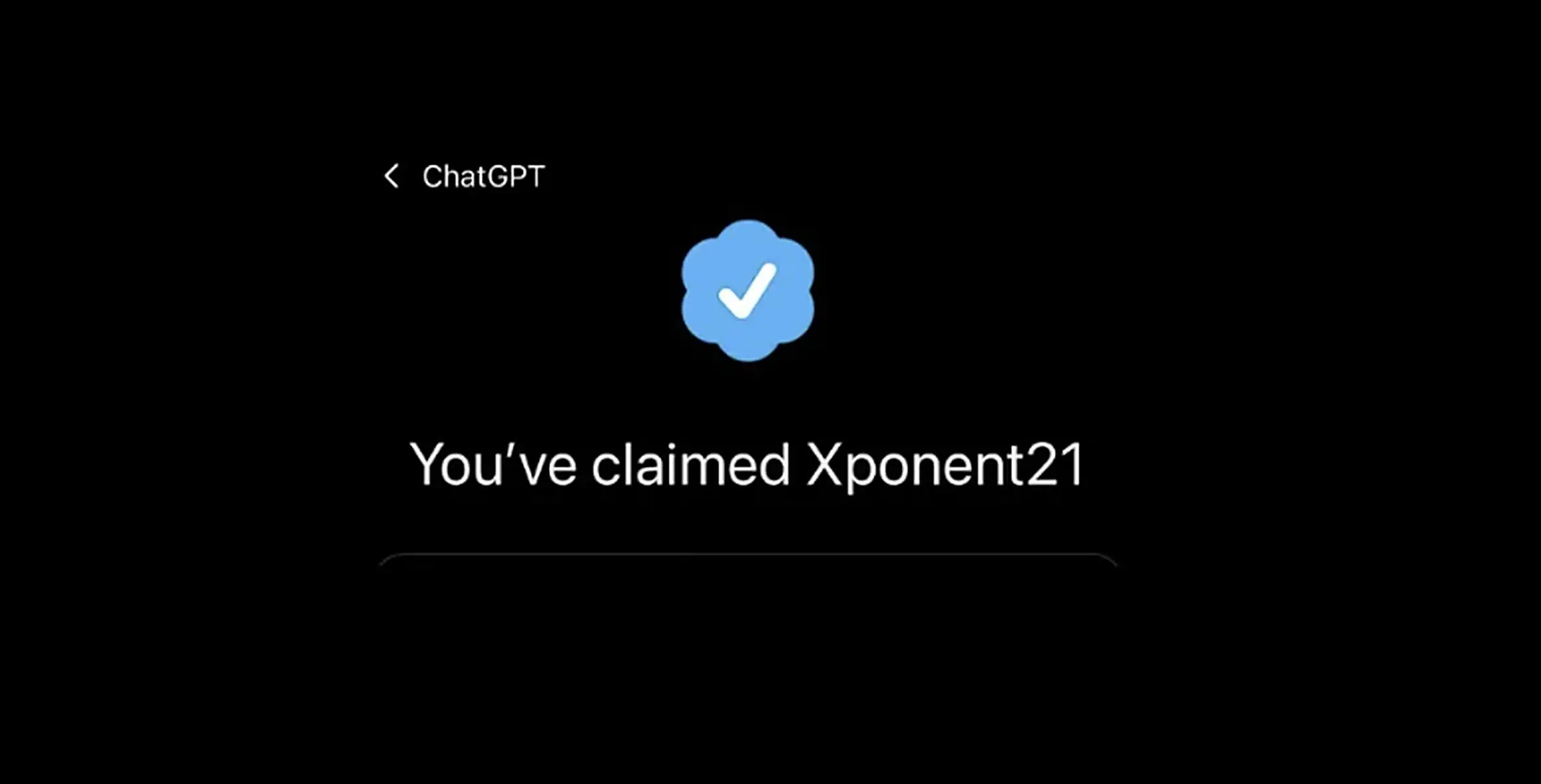
The ChatGPT business directory claiming process follows a structured workflow designed to confirm that you are authorized to represent the business. Claiming takes place in Business Hub, OpenAI’s portal for managing your business in ChatGPT. Follow these steps to verify your business in ChatGPT and claim administrative ownership of your public profile.
Step-by-Step Guide to Claiming Your Business in ChatGPT
Step 1: Open Business Hub
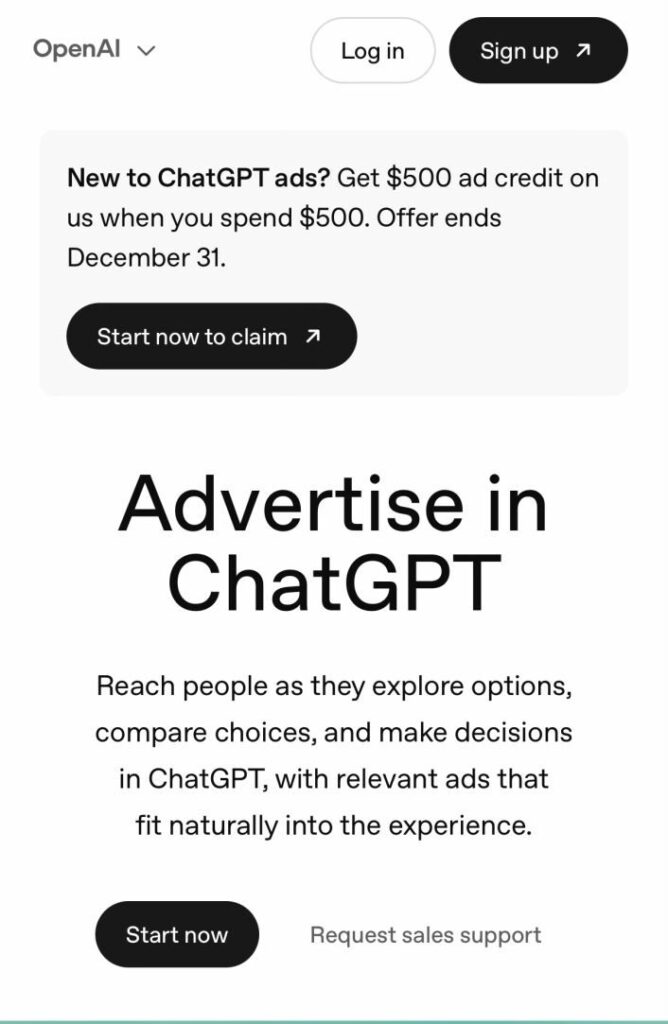
Sign in to ChatGPT and open Business Hub from the sidebar, or go directly to chatgpt.com/business-hub. Use a ChatGPT account your company controls or has authorized to manage the profile, since team access and future invitations may depend on it.
Step 2: Search for Your Existing Entity Listing
Type your business name into the search bar. If ChatGPT already has a public listing for your company, it will appear. Select your listing from the results. If no listing appears, you may be able to create a new one, depending on your business type, location, and eligibility. Claiming is initially available to eligible businesses with a website, and additional restrictions may apply to certain business categories.
Step 3: Verify That You Represent the Business
Entity security requires proof that you are authorized to act for the organization. Business Hub offers several verification methods, depending on your business’s eligibility:
- Business phone: Receive a code by text message or automated call to your business phone number.
- Business email: Enter a code sent to the email address associated with your business.
- DNS record configuration: Add the TXT record ChatGPT provides to your domain’s DNS settings, then select Verify domain. DNS changes can take time to propagate.
- Shopify: Shopify merchants can verify by connecting the store they are claiming.
Step 4: Wait for Review and Complete Identity Verification
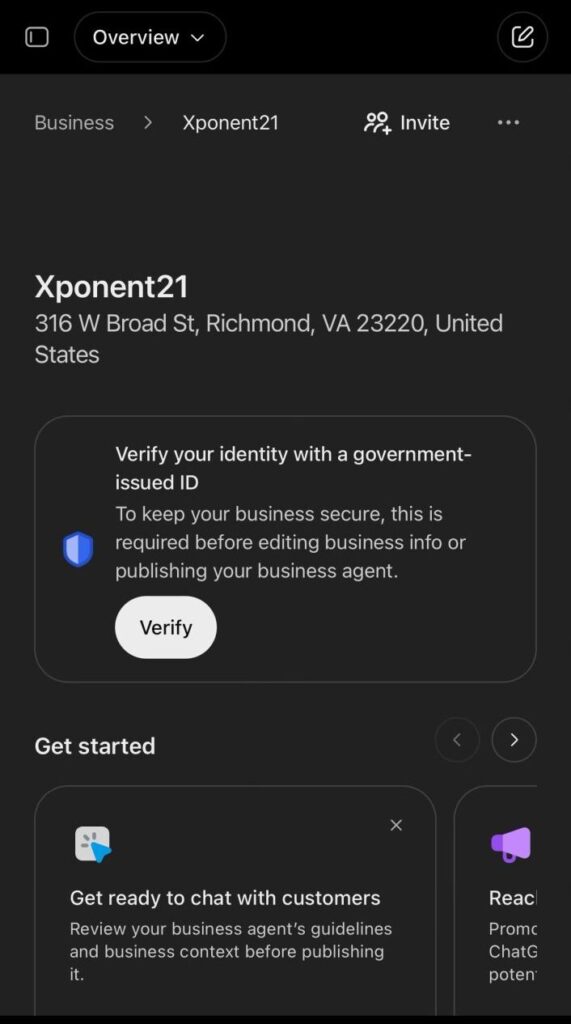
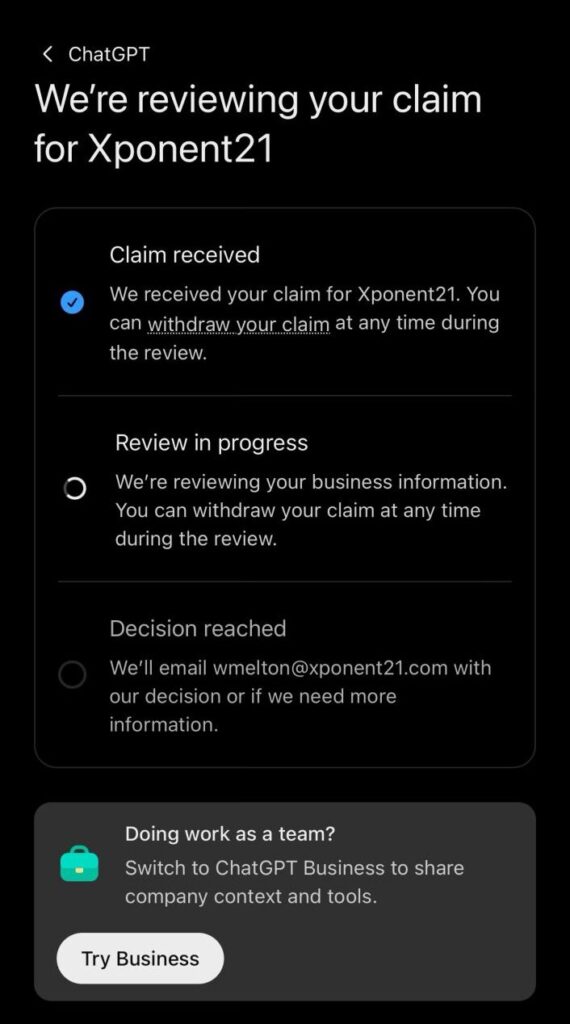
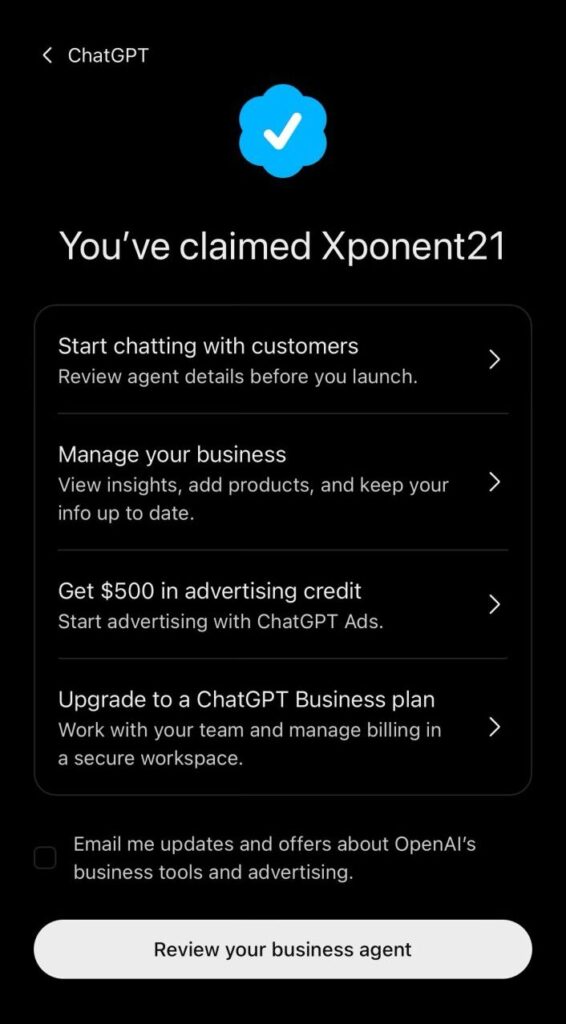
After you submit your claim, OpenAI reviews it and emails you its decision or a request for more information. Once your claim is approved, complete identity verification through Persona, OpenAI’s verification partner. You may be asked for a government-issued ID, business registration information, and proof that you are authorized to represent the business.
Identity verification is required before you can publish profile changes, connect a product feed, view insights, or create an eligible Business Agent. Verified businesses receive a blue check on their profile after Persona verification is approved.
Step 5: Populate and Publish Your Business Profile
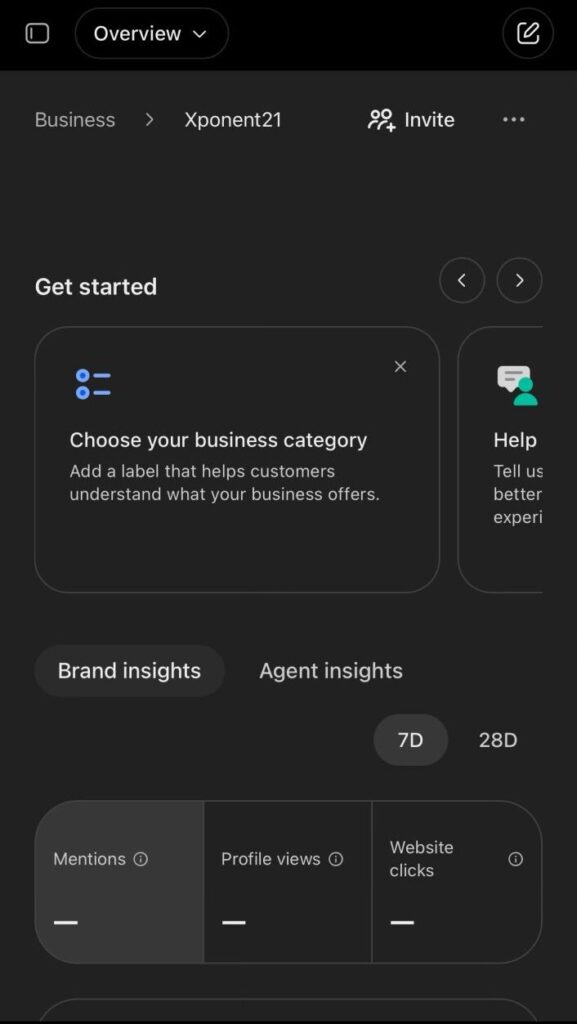
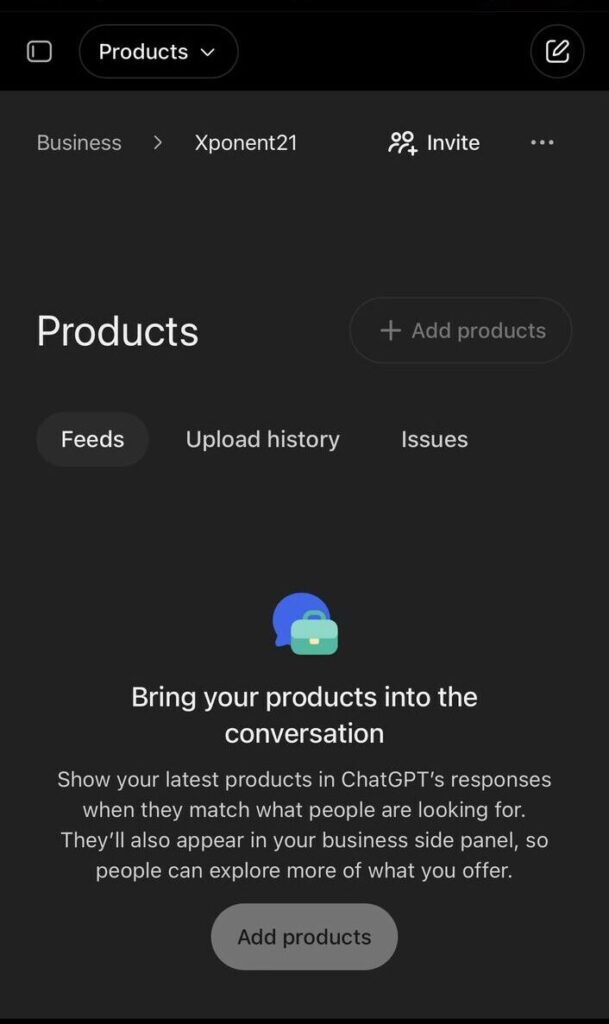
Complete every available field with precise accuracy, including your website, business description, product or service category, logo, cover photo, and delivery and return policies. Eligible businesses can also connect a product feed with pricing and availability. Review all entered details against your broader corporate footprint, since inconsistent names, descriptions, or outdated information create conflicting signals about your business. OpenAI reviews profile changes before publishing them, so updates may take time to appear.
Claiming your business in ChatGPT gives your company an official way to manage its business information within conversational search. However, claiming alone does not ensure the system will recommend you. To establish official control, you’ll verify ownership, complete OpenAI’s identity verification process, and configure your profile inside the platform. Beyond that, earning conversational recommendations requires consistent valuable content and authoritative third-party coverage across the web.
Why Claiming Your Business in ChatGPT Matters for AI Discovery
Discovery behavior is shifting. A growing share of prospective clients no longer scan links to decide who they’re going to trust. Instead, they enter conversational prompts describing exact operational requirements, constraints, and geographic boundaries. AI systems process these prompts and generate responses that may include business information, comparisons, and recommendations.
When you claim your business in ChatGPT, you establish an official channel for managing the business information you provide to the platform. Without a verified profile, ChatGPT may rely more heavily on information gathered from websites, directories, outdated press releases, and other online sources. This can contribute to inconsistencies in how your company is represented, including pricing models, service descriptions, and operating locations.
Claiming your ChatGPT business listing provides three immediate strategic advantages:
- Accurate business information: You can manage the official details associated with your business in ChatGPT, including your website, description, category, and policies.
- Direct conversion pathways: A business profile gives users a direct pathway to your primary digital property through a website link.
- Operational baseline reporting: Once you complete identity verification, you gain access to Business Hub insights, showing aggregate audience interactions with your brand.
Claiming your profile establishes an official administrative presence for your business inside the platform. It gives authorized representatives control over the information they provide, but it does not prevent ChatGPT from referencing other sources or guarantee that your business will be recommended.
Understanding the Businesses in ChatGPT Feature
Conversational artificial intelligence has moved beyond answering abstract queries. Modern generative engines now act as real-time recommendation engines for buyers seeking specific vendors, service providers, and regional partners. Recognizing this shift, OpenAI introduced Businesses in ChatGPT in beta on November 10, 2026, providing businesses with a channel to connect with the 1.2 billion people who use ChatGPT each week.
This rollout introduces a business entity management layer directly into the platform. It separates operational workspace software from public discovery. A ChatGPT Business subscription gives internal employees shared workspace seats and administrative controls for daily productivity. Businesses in ChatGPT operates differently. It functions as a public-facing business hub where a company can manage its official business profile, product information, and primary web destinations.
Eligible U.S. ecommerce and online-service businesses can also build a Business Agent, a chat assistant that answers customer questions inside ChatGPT using the company’s own product and policy information. Business Agents provide a separate, company-controlled customer interaction experience and are distinct from ChatGPT’s independent recommendations.
For years, search systems relied heavily on information gathered from websites and other online sources to understand company information. When an entity is ambiguous, AI systems may misrepresent details or overlook a company in favor of better-documented competitors. Official business profiles give companies a direct way to contribute accurate information about their organization within the platform.
What ChatGPT Business Hub Insights Actually Tell You
Once your business claim and identity verification are approved, administrative users receive access to the central reporting dashboard. This workspace provides empirical visibility into how users interact with your company across the platform.
According to OpenAI documentation, ChatGPT Business Hub insights show aggregate activity over the past 28 days, including mentions, website clicks, and top discovery topics. This window provides a rolling snapshot of whether users are actively being exposed to your company during relevant chat prompts.
While these metrics offer valuable intelligence, you must evaluate them within their specific technical limitations:
- Platform isolation: Business Hub data only tracks activity taking place inside this single engine. It provides no visibility into your footprint across other generative environments such as Perplexity, Claude, or Google AI Overviews.
- Volume thresholds: Metrics may not appear until there is enough activity to report. Emerging brands with specialized niches may see blank metrics, and a blank metric does not necessarily mean zero activity.
- Correlation over mechanics: The dashboard reports business mentions and website clicks and summarizes common discovery topics. It does not share users’ conversations, the full prompt text, or the rationale behind why ChatGPT surfaced your brand over a competitor. Clicks also do not confirm website visits that result in conversions.
Native platform analytics give you internal performance data. They do not constitute a complete AI visibility management program.
Why Claiming Your Profile Is Only Step One of AI Visibility
A critical misconception in modern search optimization is that verification equates to recommendation. Business owners frequently assume that once they complete profile registration, conversational search tools will automatically suggest their services to prospective buyers.
Verification grants access to an official profile, the ability to manage business information, and performance reporting, but citation and recommendation depend on factors beyond profile ownership. A claimed profile tells the platform more about your business. It does not give ChatGPT a compelling reason to select your company over an established alternative.
Generative models assemble responses using information from a variety of sources across the web. These can include company websites, independent publications, industry directories, government resources, academic research, and third-party corporate content. Consistent, credible information across these sources can help strengthen how your organization is represented in AI-generated responses.
The available evidence points strongly toward the importance of third-party authority. In its October 2026 edition of What Is AI Reading?, Muck Rack and Generative Pulse analyzed more than 40 million AI responses and 207 million citations in 2026. The research found that more than 84% of citations across ChatGPT, Claude, Gemini, and Perplexity came from earned and third-party sources.
Journalism accounted for 22% of citations, while paid or advertorial content accounted for just 0.3%. Owned media represented 15.2% of citations, demonstrating that company-published content also plays an important role in AI discovery.
If your organization relies solely on self-published marketing copy and directory listings, you are missing a significant portion of the information ecosystem that AI systems draw from. Third-party editorial coverage, trade publications, independent research, and other credible sources help establish recognition beyond your own website. A verified profile without broader digital authority is an incomplete visibility strategy.
How to Optimize Your Digital Footprint for Complete AI Search Discovery
Winning citations requires building an integrated digital entity that artificial intelligence systems can understand, verify, and reference with confidence. To move your company from simply claimed to actively recommended, execute a three-part technical optimization strategy across your digital footprint.
Structure Owned Assets for Algorithmic Extraction
Generative engines need clear, accessible information to understand what your business does and how it relates to relevant customer queries. Ensure your corporate site utilizes appropriate schema markup, specifically Organization, LocalBusiness, and WebSite schemas where applicable, that reflect your verified business information. Format your technical service descriptions and product pages with clear declarative statements that directly answer the core queries your buyers bring to conversational search.
Structured data helps search engines interpret your website’s content and business information. While schema does not guarantee inclusion in AI-generated answers, it is an important component of a technically sound search presence.
Cultivate High-Authority Earned Media
Because language models draw on third-party information and independent sources, an active earned media program is an important part of AI visibility. Pursue industry journalism, technical trade publications, and independent third-party reviews. When recognized publications cite your organization as a practitioner in your field, conversational engines may encounter those references as additional evidence of your expertise and authority.
Do not evaluate generative visibility through a single dashboard. Measure your brand’s presence across the full conversational ecosystem, including Google AI Overviews, Perplexity, and Claude. Track how frequently your brand appears for unbranded commercial queries, identify which third-party publications the models reference when discussing your industry, and close visibility gaps where competitors earn recommendations.
Turning ChatGPT Visibility Into Measurable Business Growth
Establishing your verified presence inside conversational search is a foundational operational step. Claiming your entity removes ambiguity, protects your brand identity, and provides your first clear window into generative search metrics.
However, winning sustained client acquisition in modern search requires far more than completing a directory form. True market leadership requires managing your complete entity footprint, earning authoritative media citations, and deploying content designed specifically for machine extraction, a process we refer to as AI visibility management.
At Xponent21, our digital marketing team builds and tracks comprehensive AI visibility management strategies that help brands grow faster. We align technical infrastructure, digital authority, and multi-platform visibility to ensure your company becomes the definitive choice across every major generative engine. Let’s talk about how we can work together to improve your brand’s AI visibility.

Jenna Pace
Jenna Pace, Senior Account Strategist at Xponent21, is a results-driven digital marketing and branding strategist with over a decade of experience guiding organizations through complex web development processes, multi-channel campaigns, and strategic brand messaging. In addition to marketing strategy, she enjoys spending time with family and friends, interior design, and traveling as much as she can.