
By: Will Melton

Published Date: June 23, 2026
Modified Date: September 21, 2026
TL;DR:
- Xponent21’s own data shows over 60% of queries now trigger an AI Overview, your Google Business Profile (GBP) is the primary data source Google pulls from for local answers.
- Six GBP fields drive AI citability: business description, services, Q&A, reviews and responses, posts and updates, and attributes.
- NAPW consistency (Name, Address, Phone, Website) across your GBP, website and directory listings is a prerequisite for AI trust.
- Schema markup is not required for AI Overview visibility per Google’s own guidance, it supports traditional SEO, which feeds AI visibility indirectly.
- 98% of consumers consult reviews before choosing a local business. Volume and specificity in review content compounds in AI search.
Why Your Google Business Profile is Important
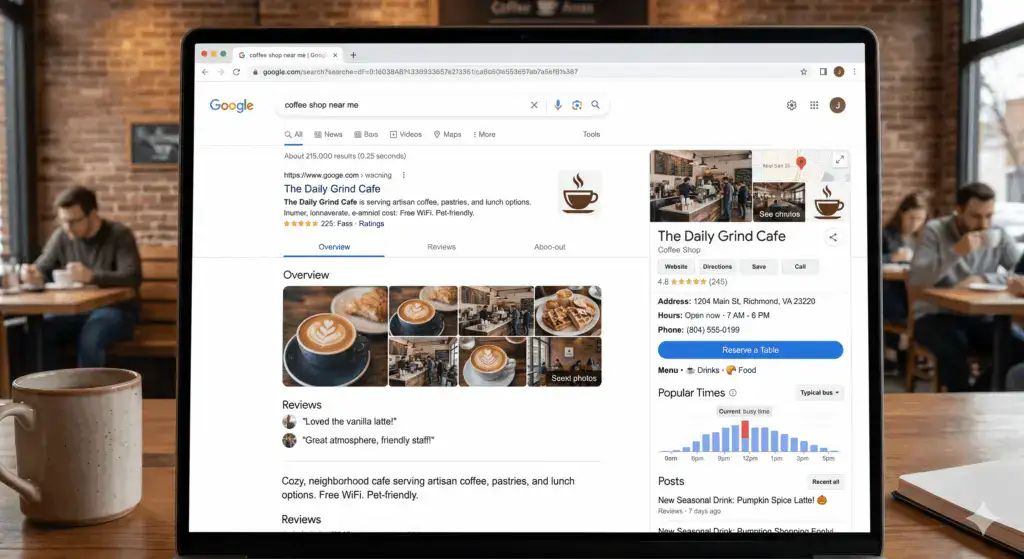
You filled out your free Google Business Profile years ago. You filled in your hours, uploaded a few photos, maybe responded to a handful of reviews. By most measures, your GBP is “done.”
Google’s AI disagrees. The Google Business Profile less of a “do it once and forget it” task and more of a an AI visibility asset to be continually nurtured.
When someone asks Google “which HVAC companies in Denver do same-day emergency service?” or “what dentist near me is accepting new patients?”, the AI Overview response doesn’t only come from your website. It also draws heavily from your Google Business Profile, read by Google’s AI as a structured data source. And according to Xponent21’s own analysis of Advanced Web Ranking data, Google AI Overviews now appear in over 60% of U.S. search queries. So, for local businesses, one of the most valuable marketing decisions you can make is continually optimizing your Google Business Profile, because if your profile isn’t built to answer those questions, your competitors’ profiles likely will.
Before you dive in, it’s worth spending 10 minutes with Google’s official guide to optimizing for generative AI features in Search. It’s the clearest statement Google has made about what actually moves the needle, and what doesn’t. Some of what’s circulating online about GEO and AEO doesn’t hold up against what Google says in that document. This guide is built to be consistent with it, and to give you a playbook as to how you can optimize your GBP for the changing AI marketing landscape.
What Google AI Overviews Actually Pull From Your GBP
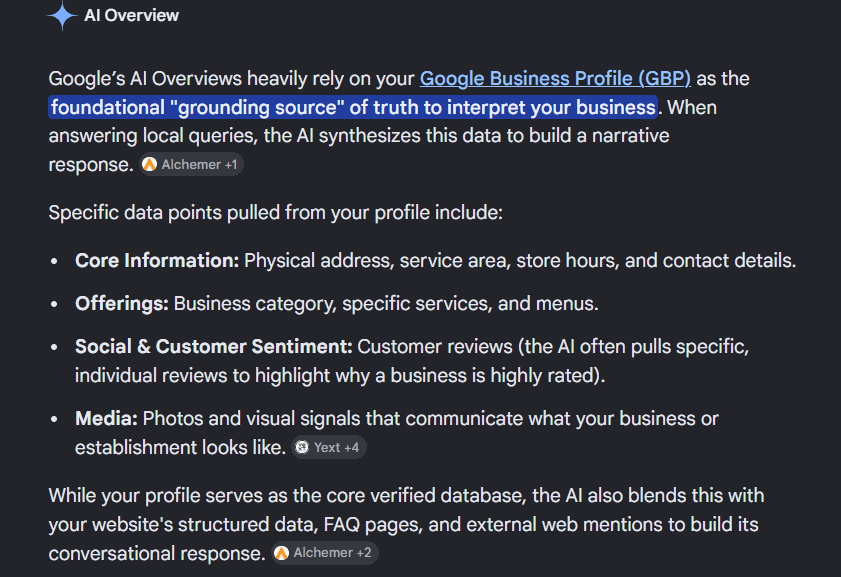
Google’s AI doesn’t read your GBP the way a customer does. A customer checks your hours and calls. The AI reads your profile as a structured dataset and uses it to construct answers to conversational queries.
Six fields feed that process directly:
- Business description: Google pulls this verbatim or paraphrases it to answer “what does this business do” and “who is it for.” A description that says “full-service dental practice” tells the AI very little. A description that says “family dental practice in Austin accepting new patients, specializing in cosmetic dentistry and pediatric care” answers three different queries.
- Services and service descriptions: Each service you list with a written description is a separate signal the AI can cite. A plumbing company that lists “Emergency Pipe Repair, available 24/7 for burst pipes, leaks, and drain clogs” will appear in emergency queries. One that just lists “plumbing” will not. You have to be willing to answer the exact question, or you will not be cited. It’s that cut and dry.
- Q&A entries: This is the most underused field in every GBP audit. You can write your own questions and answers directly in the Q&A section. Google’s AI reads these as authoritative answers about your business. Think of them as a FAQ block built specifically for AI synthesis.
- Reviews and your responses: Review content signals what customers actually experience. Your responses add context and keywords the AI uses to understand your service area, specialties and reliability.
- Posts and Updates: Posting twice a week signals freshness to Google’s ranking systems. Stale profiles are deprioritized in both the local pack and AI-generated answers.
- Attributes: Filter attributes like “accepts new patients,” “women-led,” “LGBTQ+ friendly,” “serves alcohol” and “outdoor seating” appear in AI Overviews when users include those terms in their queries. They’re how AI filters businesses for specific searches, turn on every attribute that applies to you.
The GBP Audit for AI Citation Likelihood

Run through each section below against your current profile.
Business Description
Your description gets 750 characters. Most businesses use fewer than 100 and treat it as a tagline.
Write your description to answer the three questions AI is most likely to get asked about you: What do you do? Who do you serve? What makes you the right choice? Name your service area explicitly. If you accept specific insurance, mention it. If you specialize in something, say it in plain language.
A before/after: a general contractor with “quality home improvement services since 1998” will not appear in “which contractors in Phoenix do bathroom remodels under 30 days.” One with “licensed general contractor in Phoenix specializing in kitchen and bathroom remodels, additions, and roofing, serving Maricopa County with permits handled in-house” has a real shot.
Services and Attributes
Go into your GBP Services section and write a description for every service you list. Two to three sentences per service. Use the language your customers use, not your internal terminology.
For attributes, enable every relevant option. If Google offers an attribute and it applies to you, turn it on. These feed AI filtering directly, not just display.
Q&A Section
Add at least 10 Q&A entries to your profile. Start with the questions you get most often by phone or email. Cover:
- Service area and travel distance
- Emergency or after-hours availability
- Pricing ranges or how estimates work
- What to expect at a first appointment or service call
- What sets you apart from competitors (in factual terms, not marketing language)
Each answer should be 2–4 sentences, written in plain language. Avoid jargon. These answers get read verbatim by AI systems.
Reviews and Responses
According to GatherUp’s Beyond the Stars 2025 survey of 1,000+ U.S. consumers, 98% of consumers consult reviews before choosing a local business. That number has been climbing for years, but in the AI era, reviews do a second job. The content of your reviews and your responses reinforces the topical signals in your GBP. A business with 80 reviews mentioning “emergency service” is a stronger AI signal for emergency queries than one with 80 reviews that say “great job.”
Respond to every review, positive and critical. Your responses are indexed by Google and read by AI. A response that thanks a customer for mentioning your emergency pipe repair service reinforces that keyword signal. A response that addresses a negative review about wait times and explains your current booking process gives the AI more context about how you operate.
Ask satisfied customers to mention specific services or outcomes in their reviews. “Great work on my kitchen remodel” is a weaker signal than “They finished our 600 sq ft kitchen remodel in 18 days, under budget, highly recommend for anyone on a tight timeline.”
Bear in mind that you will have people who leave 4-star reviews for the dumbest reasons, in the same vein that someone will leave a 1-star review even if you did literally everything right when servicing them. That’s not a reason to stop asking. Volume and specificity still win over time.
Posts and Updates
Post at minimum once per week, ideally two or three times. Share job completions, seasonal service reminders, team updates, or educational content relevant to your industry. The content matters less than the frequency — Google reads regular posting as an active, reliable business. Bonus points if you cross-post to LinkedIn, Instagram or wherever your audience lives.
The NAPW Rule: Why Inconsistency Breaks AI Trust
NAPW stands for Name, Address, Phone, Website. Your NAPW must match exactly across three places: your Google Business Profile, your website, and your on-site schema markup.
Inconsistencies that seem trivial create real problems:
- “Main Street” vs “Main St.”
- “Suite 200” on your website with no suite number on your GBP
- A phone number formatted differently in two places
Google’s entity-matching systems rely on corroborating signals across sources. When those signals conflict, the AI’s confidence in your business identity drops, and uncertain information doesn’t get cited. It’s like having 8 people in an old-school phone book with the same name but different middle initials.
Check your NAPW across every directory listing you’re in, not just GBP. Each consistent citation is a corroborating signal. Each inconsistency works against you.
What a Fully-Optimized GBP Looks Like in Practice
Consider a fictional HVAC company in Cincinnati that had a complete GBP, right hours, correct address, 47 five-star reviews, but a two-sentence business description and no Q&A entries. They ranked in the local 3-pack for “HVAC Cincinnati” but weren’t appearing in AI Overviews at all.
After an audit, they rewrote their business description to specifically name their service area (Cincinnati metro, northern Kentucky and Hamilton County), listed 14 individual services each with a two-sentence description, added 11 Q&A entries covering emergency availability, refrigerant types they work with, and what to expect from a service call, and started posting twice weekly.
Six weeks later, they began appearing in AI Overviews for queries like “does [company] do emergency AC repair on weekends” and “HVAC companies near Cincinnati that service Carrier systems.” Neither of those was a keyword they had ever targeted with traditional SEO. Both converted at rates significantly higher than their organic traffic.
The profile itself hadn’t changed. The way it communicated with AI had.
One side effect worth noting: earned third-party mentions, the kind that come organically from genuinely good service, are a meaningful signal in AI search. The better the service, the more customers talk about you publicly without being asked. That kind of organic word-of-mouth compounds in the AI era in ways it never did in traditional search.
Connecting Your GBP To Your Website’s Structure
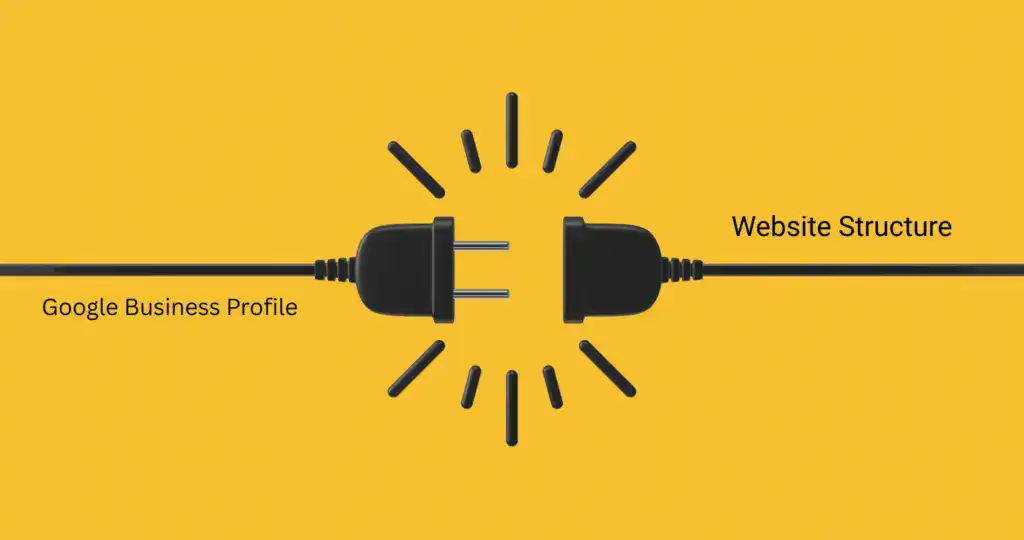
Your GBP and your website should tell the same story. When Google’s AI cross-references your profile against your site, it’s looking for confirmation, the same business name, the same service categories, the same geographic signals.
Per Google’s own guide to optimizing for generative AI features in Search, structured data and schema markup are not required for AI Overview visibility, and there’s no special schema.org markup that unlocks generative AI features. Schema supports your overall SEO health, helping with rich results in traditional search, which feeds into your AI visibility indirectly. Implement it as part of your overall SEO foundation. Don’t treat it as a direct AI citation lever.
What matters most for AI consistency is accuracy: your business name, address, phone and website should match exactly between your GBP and your website. LocalBusiness schema is a clean way to make those signals machine-readable, but the underlying requirement is consistency, the schema formalizes it.
If your GBP and your website are telling the AI two different stories about who you are, you’re splitting your own authority. Fix the consistency first.
Where To Go From Here
Before you make any changes, read Google’s guide to optimizing for generative AI features in Search. It’s short, it’s official, and it will save you from acting on advice that doesn’t reflect how Google’s systems actually work.
If a customer in your area searched for your service tonight, would they find you in the AI Overview, or would they find the competitor who spent thirty minutes tightening up their Q&A section, answered every review and made sure their GBP matched their website?
That gap is fixable. A fully optimized GBP is the lowest-effort, highest-potential local AI search optimization, particularly for service-based queries, task available right now. If you want to connect with other marketers who are doing this kind of work, head to our learning platform/community hub, Discover AIO. You have the opportunity to write and publish your own articles to establish your topical authority, as well as participate in Member Calls and Webinars. With a upgraded membership, you can also become a part of the Member Directory, where you join a group of marketers doing the same work.
Google Business Profile FAQs
Discover the answers to frequently asked questions about optimizing your Google Business Profile for Google AI Overviews.

Will Melton
Will Melton, CEO of Xponent21 and consultant to global companies, brings nearly 20 years of leadership in technology and marketing. He is the founder of AI Ready RVA and Richmond Water, podcast host for Channel RVA, and serves on several charitable boards in Richmond, VA. Recognized as one of the world’s top experts on AI SEO, Will was one of the earliest adopters or AI visibility and has pioneered strategies that have achieved top citations across Google AI Overviews, ChatGPT, Claude, and Perplexity, making him a global authority on the future of search.