
By: Jenna Pace
Published Date: October 22, 2026
TL;DR: AI search visibility builds in stages. The first 90 days are mostly about laying the groundwork rather than generating revenue, with revenue impacts typically occurring in 6-12 months.
Initial visibility improvements in AI search do not happen overnight, but early signals can appear within weeks. A business adjusting its web assets for generative search engines can expect initial indexation, early source citations, and crawler activity across platforms like ChatGPT, Perplexity, and Google as early as the first month after beginning efforts. Substantial, high-impact pipeline growth and conversion gains require a 6-12 month strategic commitment to benefit from the compounding nature of AI retrieval systems.
Understanding this 90-day trajectory prevents common strategic missteps. When organizations expect massive immediate traffic spikes, they risk abandoning programs right as algorithmic models begin digesting and validating their core entities. A realistic 90-day roadmap outlines what changes first, which metrics signal genuine progress, and how early technical adjustments lay the groundwork for long-term commercial capture.
AI Visibility Investment Scope
Beginning an AI search optimization initiative requires aligning expectations across executive leadership, marketing departments, and technical teams. Traditional search campaigns historically operated on long horizons, where content climbed index positions incrementally over quarters. AI search accelerates certain discovery mechanics while extending others.
During the first 90 days, the investment scope centers on foundational alignment rather than immediate revenue capture. Data from First Page Sage indicates that SEO breakeven typically occurs between month 5 and month 14 of an ongoing deployment, depending on industry. The opening three months represent the build-and-ingestion phase of that investment arc.
Resource allocation during this initial window must focus on structural clarity, authoritative answers, and multi-channel integration. Budgets directed toward technical cleanup, structured entity markup, and topical depth create the base from which large language models synthesize answers. Expecting profitability within 90 days misinterprets how algorithmic crawlers evaluate authority. Early capital expenditure establishes the authority footprint. The later months harvest the high-intent inquiries generated once AI models consistently cite your domain.
Initial Search Visibility and Citation Gains
The first 30 days of an optimization campaign rarely produce dramatic swings in top-line web traffic. Instead, the earliest measurable wins appear as nascent citation activity and retrieval events within conversational engines.
Generative platforms evaluate web pages through direct retrieval pipelines, looking for extractable data points, distinct perspectives, and clear categorical definitions. As early as weeks two through four, newly structured content can appear as supporting citations in query responses across platforms like Perplexity and ChatGPT. These citations frequently occur on narrow, high-intent discovery prompts before appearing on broader commercial head terms.
Early tracking must capture these initial appearances. While traditional rank trackers might show static positions in standard organic listings, query testing across generative platforms reveals whether synthetic models reference your brand when structuring comparisons or providing industry overviews. These early citations validate that web crawlers can parse your content cleanly and that search engines perceive the material as factual, structured, and relevant to user prompts.
Organic Traffic Growth vs. AI Search Citation
Evaluating success in modern search environments requires distinguishing between traditional organic clicks and citation presence inside generative summaries. A brand can experience a contraction in legacy referral volume while expanding its total market reach through generative answers.
Search behavior has shifted toward zero-click resolutions. According to published insight from Xponent21, Google AI Overviews now appear in over 80% of U.S. search results as of September 2026. This proliferation directly alters organic interaction rates. A 300,000 keyword analysis by Ahrefs revealed that AI Overview presence reduces top-ranking page CTR by roughly 58%. When a synthetic summary satisfies an informational query directly on the results page, the user does not need to visit an external website.
+-----------------------------------------------------------------------+
| Search Result Shift on Informational Queries                          |
+-----------------------------------------------------------------------+
| Traditional Top Organic Result (No AI Summary): Standard Click Flow   |
+-----------------------------------------------------------------------+
| Result With AI Overview: ~58% CTR Reduction for Top Organic Listing   |
+-----------------------------------------------------------------------+
| Brand Cited Inside AI Overview: ~120% Higher Organic CTR vs. Uncited  |
+-----------------------------------------------------------------------+
Despite reduced general click-through rates, being selected as an authoritative source remains valuable. Research from Seer Interactive found that brands cited in AI Overviews earned roughly 120% more organic clicks per impression than non-cited brands on informational queries. AI search citations deliver smaller quantities of total traffic, but visitors arriving via direct citations demonstrate significantly higher intent. The early objective is not accumulating broad impression volume, but capturing citation share on queries that directly influence purchase considerations.
Adapting to AI Search Algorithm Shifts
The algorithmic infrastructure powering generative search updates far more frequently than legacy search indexes. In addition to core indexation updates, large language models undergo regular training runs, alignment passes, and retrieval-augmented generation updates that alter how sources are weighted and selected.
Navigating these shifts during the first 90 days requires continuous monitoring and agile asset deployment. In early 2025 and 2026, major generative platforms repeatedly altered how heavily they prioritized real-time web citations versus pre-trained parameters. Search systems also refined their balance between user-generated community forums and verified corporate websites, creating temporary fluctuations in visibility.
Organizations that succeed in AI search do not alter their entire positioning with every model update. Instead, they maintain clean technical foundations and continuously evaluate which query formats surface their content. When a platform adjusts its synthesis framework, websites with clear entity definitions, concise executive summaries, and verifiable data retain citation presence far more reliably than sites built on ambiguous promotional language.
Measuring AI Visibility Progress: Metrics and Milestones
Tracking progress across the first 90 days demands metrics tailored to generative engines rather than legacy rank tracking. Focusing solely on page-level sessions or generic keyword positions provides an incomplete picture of discovery performance.
To accurately gauge campaign traction, marketing teams should organize their measurement framework around specific 30-day milestones:
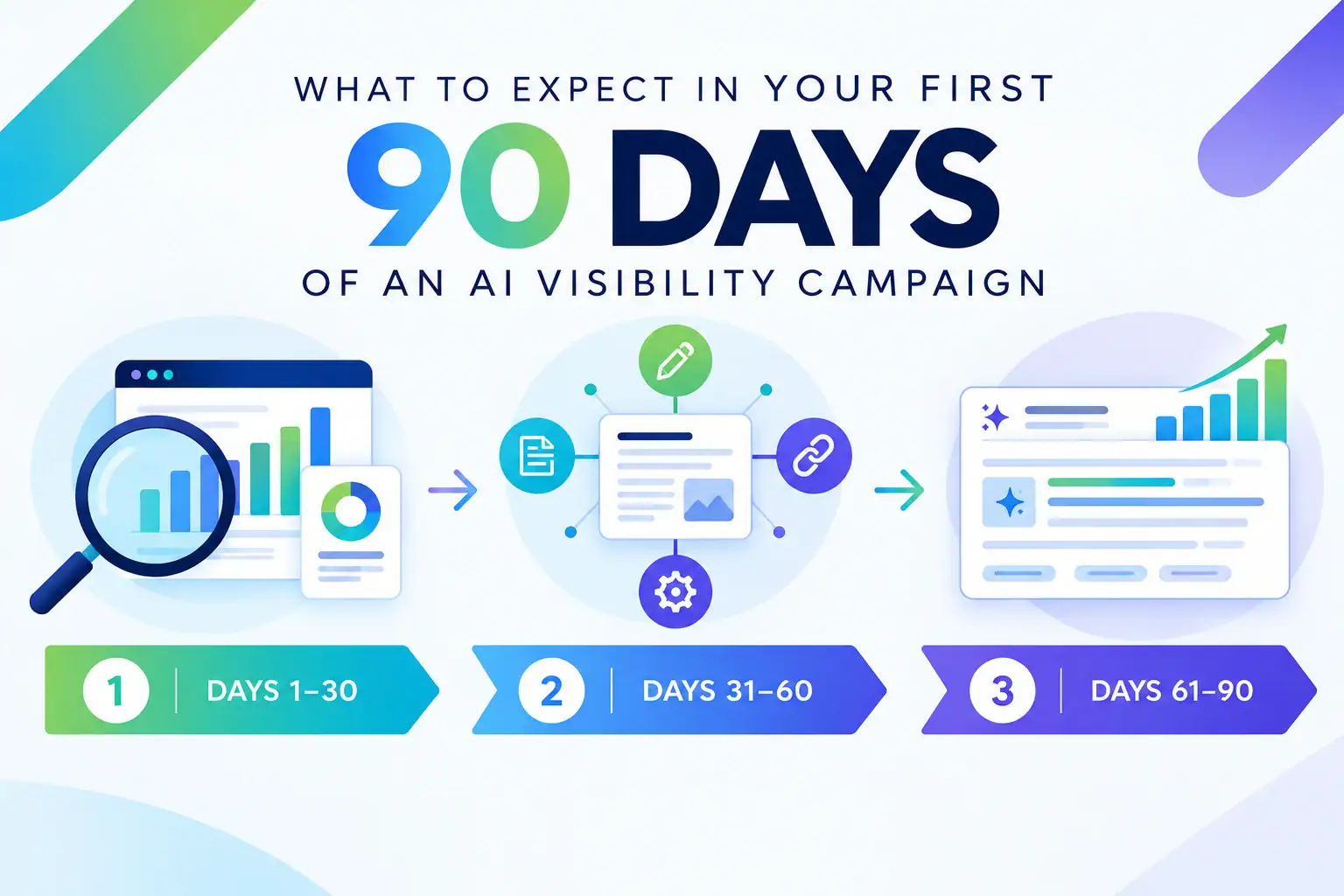
- Days 1 to 30 (Foundation and Retrieval): Monitor crawler access and initial response generation. Primary metrics include bot crawl frequency, verification of structured schema indexing, and the emergence of initial citations across platforms like Perplexity and ChatGPT for specific branded or product queries.
- Days 31 to 60 (Citation Expansion): Track prompt coverage across a broader universe of conversational queries. Metrics center on citation frequency in comparison queries, appearance inside Google AI Overviews on secondary industry topics, and referral sessions originating from generative engines.
- Days 61 to 90 (High-Intent Interaction): Measure pipeline influence and commercial inquiries. Key indicators include branded search lift following AI discovery, engagement depth of AI-referred visitors, and form submissions from users who identified AI platforms as their discovery touchpoint.
Tracking citation share across a fixed prompt set reveals whether your brand is gaining ground against competitors. Rather than logging raw impressions, teams must monitor whether AI engines recommend their services when potential buyers prompt tools with specific operational challenges. To support this, Xponent21 utilizes CARL Intelligence to track AI visibility positions across a live, growing dataset built by the CARL Lab. This position tracking enables brands to verify exactly which topics are gaining traction in generative answers.
Content Volume and Quality for AI Search Performance
Winning citations in AI-assisted discovery requires a distinct editorial architecture. Generative engines do not evaluate content simply by total word count; they evaluate whether a page provides an extractable, authoritative answer to a specific inquiry.
Producing hundreds of thin, automated articles dilutes topical authority. Large language models easily detect repetitive, low-information text and filter it out during retrieval steps. Conversely, publishing an authoritative asset that comprehensively answers a complex industry question establishes a durable citation source. High-performing assets lead with clear answers in the opening paragraph, structure core insights using explicit subheadings, and substantiate arguments with verified figures.
Between days 30 and 90, content development must balance volume with structural precision. Teams should create modular content assets where each section addresses a distinct aspect of the buyer’s evaluation process. When an article contains well-defined answers, data-backed claims, and concise summaries, retrieval algorithms can extract single passages cleanly, citing the source directly in synthesized answers. To manage this at scale, Xponent21 employs CARL Writes, a multi-agent pipeline that uses a strict rules hierarchy and verified claims to ensure accuracy and voice control before human review. This rigorous brief approval gate ensures that all published content meets the quality thresholds required by retrieval models.
The Role of Technical SEO in Early AI Adoption
Content cannot earn citations if search engine crawlers struggle to parse its code. Technical architecture serves as the prerequisite for generative visibility, governing whether automated bots can access, render, and index your material efficiently.
During the first 30 days of an optimization program, technical remediation must take priority. AI agents rely on explicit markup and logical site architecture to understand the relationships between people, products, and organizations. Implementing comprehensive Schema.org structured data, including Organization, Article, Product, and Review types, gives search engine crawlers direct access to your site’s core entities, which can influence whether LLMs surface your website.
+------------------------------------------------------------------------+
| Technical Foundation Layer for Machine Extraction                      |
+------------------------------------------------------------------------+
| 1. Robots.txt & Access: Unrestricted paths for major AI search agents  |
| 2. Mobile Core Web Vitals: Fast page rendering and visual stability    |
| 3. Schema Architecture: Machine-readable entity mapping (JSON-LD)      |
| 4. Information Hierarchy: Logical URL trees and clean internal links   |
+------------------------------------------------------------------------+
Site architecture must also facilitate rapid crawl paths. Complex client-side scripts that obscure text from basic retrieval agents prevent models from extracting key facts. Ensuring fast server responses, eliminating broken redirects, and providing an updated XML sitemap allow generative bots to ingest and validate updates within days of publication, directly accelerating the initial results timeline.
Manual SEO Adjustments vs. AI-Driven Optimization
Achieving sustainable visibility requires balancing automated analysis with human strategic direction. Modern optimization relies heavily on AI utilities to analyze vast datasets, identify search intent patterns, and discover content gaps across thousands of competitive prompts.
Relying entirely on autonomous generation introduces significant risk. Unchecked automated workflows frequently produce homogenized copy that mimics existing web content without introducing novel perspective. Machine learning models also risk hallucinating factual claims or misrepresenting technical specifications, which destroys the trust signals generative search engines prioritize.
Manual human oversight remains non-negotiable for strategic alignment, tone consistency, and factual integrity. Human editors must review content to ensure claims reflect operational reality and comply with brand standards. While AI-driven optimization engines accelerate keyword clustering, technical audits, and performance modeling, experienced strategists must direct the narrative, conduct original industry research, and ensure all messaging supports long-term commercial goals. For full accountability, all these actions are logged in CARL AIO, providing a timestamped activity log that connects work performed to results achieved. This log maintains a clear record of every manual optimization filtered by client need.
Small Business AI Visibility: Resource Constraints
Organizations operating with focused budgets and smaller teams often assume AI visibility requires enterprise-level expenditure. While resource constraints prevent small businesses from publishing massive content libraries, generative search creates opportunities for specialized players to outperform larger competitors in focused niches.
AI engines prioritize precise, authoritative answers over raw domain age or corporate size. A local or specialized business can capture meaningful citation share by owning specific geographic or topical questions that enterprise competitors address only broadly. By concentrating resources on a tight set of high-value services, smaller firms can establish deep topical authority within a specific vertical.
An integrated approach links disparate digital channels into a unified footprint. Instead of treating website copy, video production, and search visibility as isolated projects, smaller organizations can record brief video responses to common customer questions, publish the transcribed insights with technical markup on their website, and distribute the media across social channels. This integrated strategy signals authority across multiple formats, allowing smaller organizations to maximize the return on every produced asset.
Establishing a Long-Term AI Visibility Strategy
The opening 90 days represent the initial phase of a multi-year shift in how audiences find and select service providers. Viewing search optimization as a quarterly sprint leads to premature program terminations and missed commercial opportunities.
As an organization moves past the 90-day milestone, the focus shifts from foundational setup to authority compounding. Early citation gains across platforms like ChatGPT, Perplexity, and Google provide the performance data needed to refine targeting. Teams can see precisely which prompts generate referral leads, which technical pages require additional depth, and where competitors are losing citation share.
Long-term market leadership requires treating AI search as a primary, ongoing marketing category. Maintaining visibility demands regular content updates, proactive monitoring of synthetic engine behavior, and continuous expansion of your brand’s authoritative footprint. Organizations that commit to an ongoing strategic framework over 6-12 months build an enduring competitive moat, ensuring their business remains the recommended answer as search interfaces continue to evolve.
Building and maintaining this visibility requires technical precision, continuous monitoring, and coordinated asset execution across web design, video, and search. Ambitious brands ready to accelerate their performance in generative search can partner with the digital marketing team at Xponent21 to build a resilient, forward-looking search strategy. Partnering with Xponent21 allows you to grow faster and move through the digital landscape with more clarity. It pays to be #1, and we are built to help you own your niche online.

Jenna Pace
Jenna Pace, Senior Account Strategist at Xponent21, is a results-driven digital marketing and branding strategist with over a decade of experience guiding organizations through complex web development processes, multi-channel campaigns, and strategic brand messaging. In addition to marketing strategy, she enjoys spending time with family and friends, interior design, and traveling as much as she can.