Marketing
Zero-Party Data Collection: Unlocking Explicit Customer Intent When Tracking Falls Short
By: Courtney Turrin
Published Date: November 13, 2026
Zero-party data, willingly shared by customers, offers the most durable insights. Unlike inferred first- or acquired third-party data, it’s explicitly declared preference. Gamified content like quizzes and calculators excels at collecting this valuable information for training, engagement, conversion, and process optimization.
Zero-Party Data: Defining the Explicit Signal
Zero-party data represents information a customer intentionally and proactively shares with a company. This category of data stands apart because it comes directly from the source, reflecting explicit preferences, interests, and needs. Unlike other forms of customer data, zero-party data is given with a clear understanding of its use, often in exchange for a personalized experience, better service, or relevant offers. A customer might specify their preferred shirt size (e.g., “Large, US size 10”), color, or dietary restrictions directly to a brand. This direct interaction fosters transparency and builds trust, which strengthens the customer relationship. Leveraging custom platforms and tools simplifies this collection process. This data is the foundation of a modern, privacy-first marketing strategy, enabling brands to move beyond inferred behaviors to stated intent.
First-Party Data and Third-Party Data: Core Differences
One type of data records what customers do; another logs what they say.
First-party data is information a brand collects directly from its own sources, such as website analytics, CRM systems, or transaction histories. This data is observed behavior: what a customer did on your site or with your product. A brand’s website might track pages visited, items added to a cart, or past purchases. While valuable, this data primarily reflects actions, not underlying motivations or future desires.
Third-party data, in contrast, is aggregated data collected by entities that do not have a direct relationship with the consumer, then purchased or licensed by other companies. This data often comes from a wide range of sources, including data brokers, public records, and other websites, usually without the consumer’s direct knowledge or consent for specific uses. This type of data has traditionally been used for broad targeting and audience segmentation but is rapidly losing viability due to increasing privacy regulations and browser restrictions. Safari and Firefox already block third-party tracking cookies by default, and although Google reversed its plan to remove them from Chrome in 2025, consent requirements and privacy regulation continue to limit how reliably they can be used.
The distinction lies in intent and transparency. Zero-party data is given with explicit consent for stated purposes, offering a transparent exchange of value. First-party data is observed as a byproduct of customer interaction, providing behavioral insights. Third-party data is inferred or purchased, often lacking direct consent and transparency, making it increasingly problematic for compliant and effective marketing. This fundamental difference positions zero-party data as the most ethical and future-proof option for understanding customers.
Data types compared
Zero-party vs. first-party vs. third-party data
Where each type comes from, how much the customer agreed to, and how far you can trust it.
| Zero-partyDeclared | First-partyObserved | Third-partyInferred or purchased | |
|---|---|---|---|
| Source | The customer, sharing it intentionally | Your own systems: site analytics, CRM, transaction history | Outside entities with no direct customer relationship: data brokers, public records, other websites |
| How it’s collected | The customer declares preferences, needs, or intent through quizzes, surveys, and preference centers | Captured as a byproduct of activity: pages viewed, carts, past purchases | Aggregated across sources, then sold or licensed |
| Consent | Explicit. The customer knows how it will be used and gets value in return | Implied through use of your site, governed by your privacy policy and cookie consent | Usually none for the specific use |
| Reliability | HighStated directly and current, with no inference in between | MediumShows what customers did, not why or what they want next | Low, decliningInferred, often stale, and increasingly blocked by browsers and regulation |
| ExampleOne running-shoe shopper, seen three ways | |||
| What you learn | They said“I’m training for a marathon and need stability running shoes.”Precise, declared intent | You sawRepeat visits to running-shoe pages suggest an interest in running. The shopper could be buying a gift, comparing for another sport, or just browsing.An educated guess | You boughtA purchased audience segment tags the shopper as a “fitness enthusiast,” based on activity elsewhere on the web.A broad, secondhand label |
Voluntary Declarations: Value in Explicit Consent
When customers willingly provide information, they are actively participating in shaping their experience with a brand. This active participation signifies a higher level of engagement and trust than passive tracking or inferred data. The data provided is often more accurate and reflective of current needs because it comes directly from the source, unmediated by algorithms or assumptions. Asking a customer directly about their product preferences for an upcoming purchase yields more reliable insight than extrapolating from their past browsing history.
This voluntary declaration also implies a direct value exchange. Customers offer their data because they anticipate a benefit: a more tailored product recommendation, exclusive content, or improved customer service. This explicit trade forms a transparent foundation for the customer-brand relationship. As data privacy regulations become more stringent globally, data collected with explicit consent and clear intent offers a compliance advantage. Brands leveraging zero-party data demonstrate respect for user privacy, which strengthens brand loyalty and reputation. This explicit consent framework contrasts sharply with the often opaque methods of third-party data collection, providing a clear path forward for ethical data usage.
Inferred Behavior vs. Explicit Preferences: Data Accuracy Differences
The debate between inferred behavior and explicit preferences highlights a significant accuracy difference in customer data. Inferred behavior, largely derived from first-party and, historically, third-party data, involves making assumptions about customer interests based on their actions. A customer repeatedly visits pages about running shoes, so a brand might infer an interest in running. While this can be effective, it is an educated guess. The customer might be researching for a friend, comparing options for a different sport, or simply browsing out of curiosity. These inferences carry a margin of error that can lead to irrelevant marketing messages, customer frustration, and wasted ad spend.
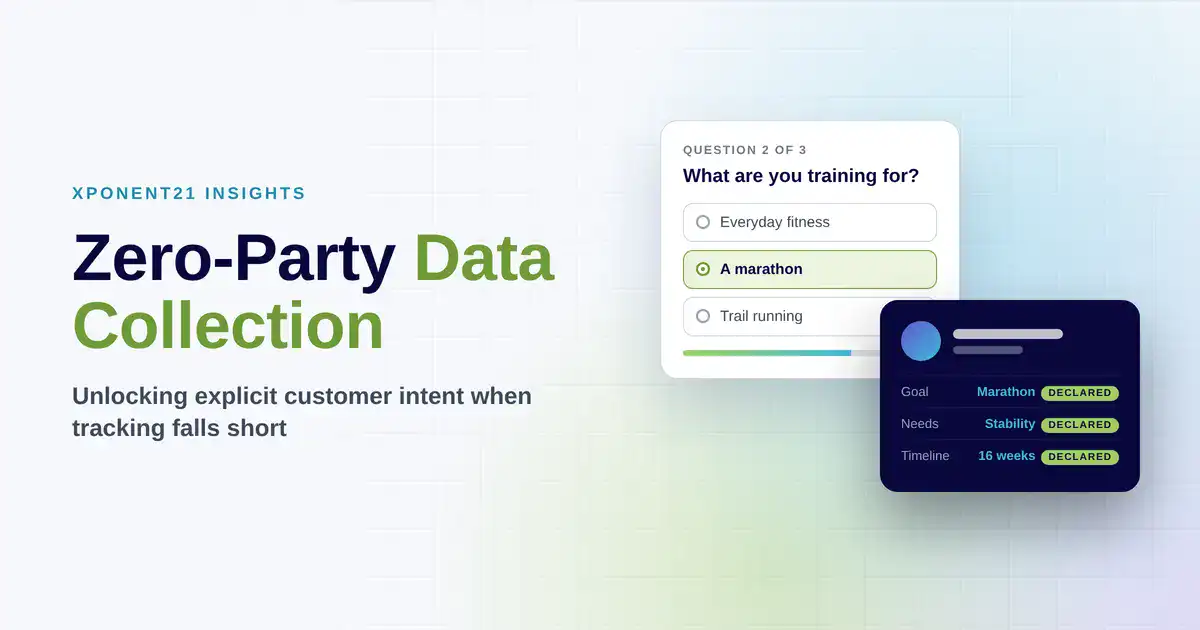
Explicit preferences, obtained through zero-party data collection, remove this ambiguity. When a customer states, “I am training for a marathon and need stability running shoes,” the brand gains a precise, declared intent. This direct insight allows for highly relevant and timely personalization that inferred data cannot match. The accuracy of explicit preferences reduces the risk of miscommunication and enhances the effectiveness of marketing efforts.
Zero-party data also sharpens content strategy. Quiz responses, calculator inputs, and preference selections reveal the exact language customers use to describe their needs, which is the same language they type into ChatGPT and Google. Content built around those declared needs aligns more closely with the prompts buyers actually use. That alignment matters: Xponent21’s Cognitive AI Ranking Lab found that brands whose content closely matched the meaning of target prompts were 13.7x more likely to be cited in AI answers.
Gamified Content as a Zero-Party Data Collection Tool
Interactive experiences integrate game-like elements into non-game contexts, transforming data gathering into an interactive and enjoyable experience. Instead of static forms or surveys, gamification offers quizzes, calculators, interactive polls, personality assessments, or even short training games. This method leverages human psychology, appealing to intrinsic motivations like achievement, competition, and self-expression. Customers are often more willing to share information when the process is entertaining, provides immediate feedback, or offers a tangible reward. For businesses focused on growth, this translates into richer, more detailed zero-party data collected at a higher volume and quality.
Gamified experiences create a compelling value exchange across the buyer journey. A user might complete a quiz about their style preferences to receive personalized fashion recommendations, or use a calculator to determine the optimal product for their needs. The “game” itself provides a benefit: entertainment, insight, or utility. This makes the act of sharing data feel less intrusive and more like a collaboration. The structured nature of gamified interactions can also prompt users to provide more specific and actionable data than open-ended questions. A multiple-choice quiz about pain points in a B2B context can help a software company categorize leads by expressed needs, allowing for highly targeted follow-up. This proactive approach to data collection helps brands build a robust understanding of their audience’s explicit preferences, moving beyond assumptions to informed strategy.
Gamified formats
Five gamified formats that collect zero-party data
Each format trades a useful experience for declared information. Which one fits depends on your buyer and where they are in the journey.
| Format | Best fit | Data captured | Funnel stage |
|---|---|---|---|
| QuizTrivia, style finder, diagnostic | B2BB2C |
Light interest signals from trivia; style preferences (B2C); pain points, challenges, and desired outcomes from diagnostics (B2B) | Awareness to consideration |
| CalculatorROI, product fit | B2BB2C |
The buyer’s own numbers, such as current spend, costs, or usage, and the outcome they’re solving for | Consideration |
| ConfiguratorBuild a vehicle, a sneaker, or a spec’d part | B2BB2C B2B leaning |
The exact features, finishes, or colors a buyer picks, plus the combinations that stall; feeds R&D and inventory planning | Decision |
| PollDaily or recurring | B2CB2B B2C leaning |
Ongoing preference signals that keep profiles current | Awareness and retention |
| Training moduleGamified tutorial | B2B Software and complex products |
Confidence by topic, sticking points, knowledge gaps, learning styles, and features users want next | Adoption and retention |
Training Initiatives: Driving Engagement Through Gamification
Gamification in training initiatives provides a powerful avenue for zero-party data collection, particularly within B2B contexts or for complex products. Interactive training modules, quizzes, and simulation games allow brands to gather explicit data on user knowledge gaps, preferred learning styles, product feature usage, and areas of interest. A software company might develop a gamified tutorial for a new feature. As users progress, they can rate their confidence on each topic, choose which features they want to learn next, and flag where they’re stuck. This provides direct insight into user proficiency and areas where documentation or product design might need improvement.
This type of data is invaluable for optimizing product development, tailoring support content, and refining sales messaging. By understanding exactly where users need help or what features excite them most, brands can allocate resources more effectively to improve their products. If a training game reveals that a significant number of users consistently misunderstand a core concept, the brand can proactively create clearer instructional materials or redesign the product interface. The interactive nature of gamified training also boosts engagement and knowledge retention, creating a more positive customer experience. This approach provides a clear window into explicit user intent around product adoption and continuous education.
Customer Interaction: Building Connections and Exchanging Data
Gamified content significantly enhances general customer interaction, fostering deeper brand connection while facilitating zero-party data exchange. Beyond structured training, brands can deploy interactive experiences like daily polls, “spin the wheel” promotions, or personalized content recommendations that adapt based on user choices. These lightweight, frequent interactions keep customers engaged and provide continuous streams of explicit preference data. A retail brand might offer a quick “style quiz” on its website or app. Based on the user’s choices, the brand immediately provides tailored product suggestions, making the data exchange feel like a direct benefit.
This continuous feedback loop allows brands to adapt their offerings and messaging in real-time, responding directly to declared customer needs. The explicit nature of this data eliminates guesswork, ensuring that marketing communications are highly relevant. This builds trust and positions the brand as attentive and responsive. By making data sharing a fun and rewarding part of the customer journey, brands can collect rich preference profiles that power truly personalized experiences across all touchpoints. This proactive engagement strategy not only gathers data but also strengthens customer loyalty, transforming a transactional relationship into an interactive dialogue.
Conversion Funnels: Optimizing Paths with Declared Intent
Integrating zero-party data collection, particularly through gamified content, into conversion funnels allows brands to optimize paths with precise, declared customer intent. When customers explicitly state their preferences or needs within an interactive experience, brands gain a powerful signal to guide them through the sales process. A lead generation quiz on a B2B website might ask about a prospect’s biggest challenges or desired outcomes. The answers directly inform which product or service demonstration is most relevant, which case studies to present, and what pricing tiers to discuss. This hyper-personalization significantly reduces friction in the funnel.
By tailoring the conversion journey based on explicit data, brands move away from generic, one-size-fits-all approaches. This increases conversion rates and improves the quality of leads. Prospects who have invested time in a gamified experience and provided explicit data are often more qualified and engaged. They understand the value exchange and are more receptive to highly relevant offers. Furthermore, by identifying explicit intent early, sales teams can prioritize hot leads and avoid wasting time on those who are not a good fit. In practice, this can be a simple routing rule: when a prospect’s answers show both a strong fit and an active buying timeline, the CRM assigns the lead to an account executive with every quiz response attached, and everyone else enters a nurture sequence built around the challenge they named. This efficiency is critical for businesses focused on high-intent lead growth and visibility metrics. The integration of zero-party data ensures that every step of the conversion funnel is optimized to leverage the customer’s declared interest, leading to more effective and profitable customer acquisition.
Process Optimization: Streamlining Operations with Zero-Party Insights
Zero-party data, especially from gamified interactions, offers significant potential for streamlining internal operations and optimizing business processes. The explicit insights gleaned from customer declarations can inform various departments beyond marketing and sales, leading to more efficient resource allocation and improved service delivery. Feedback from gamified product configurators can help a manufacturing company identify popular customization options or common design challenges, guiding future R&D efforts and inventory management. This direct input minimizes speculative development and ensures that resources are aligned with actual customer demand.
In a service-oriented business, interactive onboarding quizzes or satisfaction surveys can pinpoint areas where customer support frequently intervenes. By understanding explicit pain points, the company can proactively refine its self-service options, training materials, or even product features to reduce support tickets. This accomplishes dual objectives: improving customer satisfaction and lowering operational costs. Data from gamified content can help assess the effectiveness of new features or campaigns by asking users directly how new features are working for them. This continuous feedback loop drives iterative improvement across the organization, ensuring that business processes are continuously refined based on precise customer declarations. Honing operational efficiency translates directly into better ROI and a more agile business, which is critical for maintaining a competitive edge.
B2B vs. B2C Data Collection: Contextual Considerations
The application of zero-party data collection, particularly through gamified content, varies significantly between B2B and B2C contexts, though the core principles remain consistent. In B2C, the focus is often on individual preferences, lifestyle choices, and immediate purchasing intent. Gamified quizzes might ask about fashion styles, travel destinations, or dietary habits to personalize product recommendations or content. The value exchange is typically instant gratification, entertainment, or a direct discount. B2C gamification needs to be engaging, quick, and visually appealing to capture attention in a crowded market.
In B2B, the data collected is usually more complex, focusing on business needs, pain points, technical specifications, and strategic goals. Gamified content in a B2B setting might include interactive diagnostic tools, ROI calculators, or simulation games that demonstrate product value in specific industry scenarios. The value exchange is often educational content, actionable insights, a tailored solution proposal, or access to expert resources. B2B gamification needs to be perceived as valuable, credible, and directly relevant to professional challenges. It aims to generate high-intent leads and provide sales teams with deep insights into a prospect’s organizational context. While B2C might prioritize fun and speed, B2B emphasizes utility and depth, ensuring that the explicit data gathered directly informs complex sales cycles and strategic partnerships.
Regulatory Landscape Evolution: Adapting to Data Privacy Shifts
The evolving regulatory landscape, characterized by an increasing focus on data privacy, makes zero-party data collection increasingly valuable. Regulations like the General Data Protection Regulation (GDPR), California Consumer Privacy Act (CCPA), and similar laws globally are reshaping how brands can collect, use, and store customer data. These regulations emphasize transparency, consent, and user control, directly undermining traditional reliance on inferred data and third-party cookies. Brands failing to adapt face significant fines, reputational damage, and erosion of customer trust.
Zero-party data fits privacy-first regulation well because consent and purpose are established at the moment of collection. It is still personal data, though: GDPR and CCPA requirements for notice, purpose limitation, retention, and deletion requests apply to quiz answers the same way they apply to any other customer record. By investing in zero-party data strategies, companies future-proof their marketing efforts, mitigate compliance risks, and build stronger, more transparent relationships with their customers. This proactive approach ensures sustained growth and ethical data stewardship in a rapidly changing digital environment.
Implementing Zero-Party Data: Initial Steps
Implementing a robust zero-party data strategy involves several strategic first steps for companies aiming to future-proof their marketing efforts. The initial phase focuses on identifying key data points essential for personalization and business intelligence. This means pinpointing what explicit information about customer preferences, needs, and intentions would genuinely enhance product development, marketing relevance, and customer experience. Avoid collecting data for data’s sake; each piece of information should serve a clear purpose.
Next, brands must design engaging and intuitive mechanisms for data collection. Gamified content, as discussed, is a prime example. This involves creating interactive quizzes, personalized questionnaires, preference centers, or community forums where customers feel empowered and incentivized to share. The value exchange must be clear: customers provide data in exchange for a tangible benefit, such as tailored recommendations, exclusive content, or improved service.
Finally, integrating this newly acquired zero-party data into existing CRM and marketing automation platforms is critical. This ensures that the explicit insights are actionable across all customer touchpoints, from email campaigns to website personalization and AI-driven content delivery. Organizations that proactively build a strong zero-party data foundation will gain cleaner, more reliable customer data than competitors still relying on inferred signals.
Plan Your Zero-Party Data Strategy
Developing a zero-party data strategy can provide your brand with the explicit customer insights needed to thrive in a privacy-first, AI-driven marketing landscape. Schedule a call with our team to get a detailed assessment of your current data collection practices and a roadmap for integrating zero-party strategies.

Courtney Turrin
As the company’s number two employee, Courtney has helped guide the direction of our business, build a powerhouse team, and implement technology and workflows to improve service delivery and produce outsized results for our clients. Her current role sits at the intersection of analytics, work management, and operations. Drawing on her background in scientific research, Courtney designs efficient processes and supports our teams so they can better serve our clients. She holds masters degrees in Biology and Psychology/Neuroscience from the College of William and Mary and Yale University, respectively. Offline, Courtney is a plant whisperer, Peloton enthusiast, and proud pet mom.