
Marketing
Trivia, Quizzes, and Quests: Optimizing Your Gamified Content Funnel Strategy for Every Buyer Journey Stage
By: Courtney Turrin
Published Date: November 12, 2026
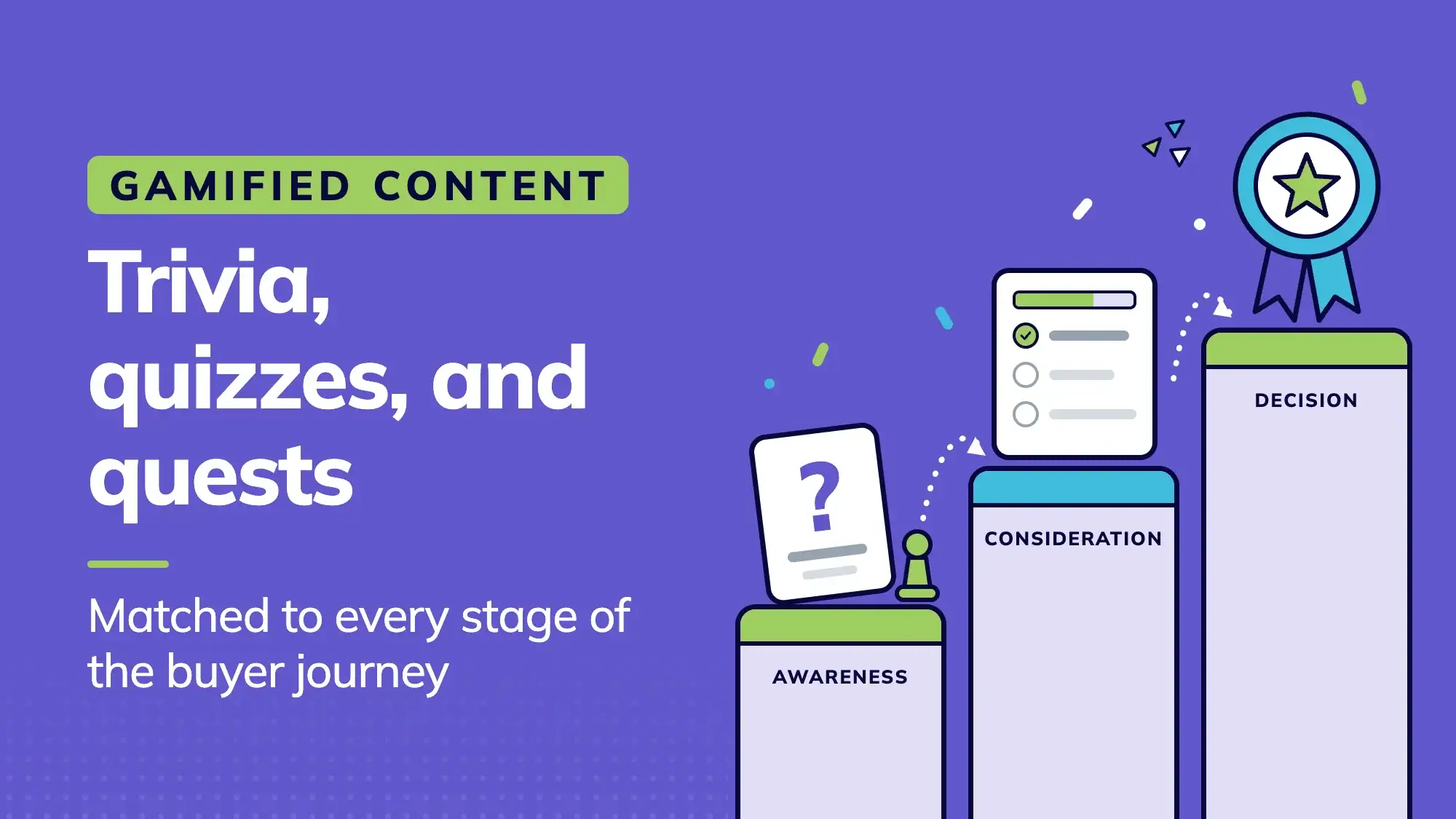
TL;DR: Lightweight trivia and quizzes build awareness, while diagnostic quizzes and calculators aid consideration by providing personalized insights. Simulators and certifications drive decision-making and boost retention, fostering commitment and demonstrating value. This strategic alignment maximizes engagement across the entire customer journey.
A Guide to Strategic Gamification for Marketing Directors
Effective marketing demands content that does more than inform; it must engage and convert. A gamified content funnel strategy applies game-like elements and mechanics to non-game contexts to encourage specific behaviors. For Marketing Directors, this means crafting experiences that build authority and drive high-intent lead growth. It requires integrating diverse content types strategically to address distinct needs throughout the buyer’s journey, ultimately contributing to a robust long-term content strategy.
Throughout, we use examples from our own funnel at Xponent21, where we sell AI search and marketing services, so you can see how each format maps to a real offer. The same logic applies to whatever you sell.
-
Awareness
Objective: capture attention and reach
- Trivia and quizzes Build effortLow
-
Consideration
Objective: deliver personalized insight
- Diagnostic quizzes Build effortMedium
- Calculators Build effortMedium
-
Decision and retention
Objective: build confidence and loyalty
- Simulators Build effortHigh
- Certifications and badges Build effortHigh
Awareness-Stage Gamification: Engagement and Reach
At the awareness stage, the primary objective is to capture attention and introduce the brand or solution to a broad audience. Gamified content types that are lightweight and easily shareable perform best here.
Lightweight Trivia and Quizzes: These formats excel at drawing initial interest by offering entertainment and immediate gratification. A short, relevant trivia quiz about industry trends or common challenges can pique curiosity without demanding a significant time commitment. A quiz titled “How Well Do You Know AI Marketing Trends?” can attract prospects searching for general information on digital marketing. A regional credit union could run the same play with a quiz like “How Much Do You Know About Your Credit Score?” Quizzes like these also hold attention well: quiz platforms report average completion rates between 50% and 78% (Okendo, 60%; ScoreApp, 50 to 70%; Interact, 65%; Outgrow, 78%), which makes 60% a conservative benchmark to plan around. Their limitation is shallow engagement and limited data capture beyond basic interest, since they aren’t designed to collect detailed prospect information or assess specific needs. They work best as an entry point to the rest of the funnel.
| Source | Reported average completion rate | Link |
|---|---|---|
| Okendo | 60% | Okendo help article |
| ScoreApp | 50 to 70% | ScoreApp guide |
| Interact | 65% | Interact report |
| Outgrow | 78% | Outgrow comparison |
Consideration-Stage Gamification: Diagnostic Tools and Value Assessment
The consideration stage requires content that helps prospects evaluate their needs and explore potential solutions. Gamified content here shifts from broad entertainment to personalized insights.
Diagnostic Quizzes: These interactive tools allow prospects to self-identify their pain points, challenges, or suitability for a particular solution. A diagnostic quiz might ask a Marketing Director about their current SEO performance, content production processes, or team structure. For example, “Is Your Content Strategy AI-Ready?” helps a prospect assess their readiness for AI-driven marketing and highlights potential gaps. An industrial equipment manufacturer might build “Is Your Production Line Due for an Upgrade?” to surface buyers whose equipment is nearing end of life. The limitation of diagnostic quizzes is that they require a thoughtful design to provide genuine value, and if too long or generic, they can disengage users seeking quick answers.
Calculators: Financial or ROI calculators provide concrete, personalized value propositions. A “PPC ROI Calculator” allows a prospect to input their current spend and projected gains to visualize the potential return from an ad management partnership. A commercial HVAC company might build an energy-savings calculator on the same model, letting facility managers estimate what a system upgrade would save them each year. These tools offer tangible evidence of value. While powerful, their primary limitation is that they rely on user-supplied data, which can be inaccurate or incomplete, potentially leading to skewed results if not properly designed with clear assumptions. They are less effective if the user cannot easily provide the required input.
Decision and Retention Gamification: Skill Building and Loyalty
As prospects move closer to a decision, or become customers, content should reinforce value, build confidence, and foster loyalty. Gamified elements at these stages focus on skill development, deep engagement, and ongoing relationship building.
Simulators: For complex products or services, simulators allow prospects to experience the solution firsthand in a controlled environment. A “Content Pipeline Simulator” might let a Marketing Director input content topics and see how an integrated approach like Xponent21’s multi-agent pipeline could accelerate production and improve AI visibility. A home builder could offer a design-studio configurator that lets buyers select and price finishes before they ever visit the model home. These immersive experiences address specific concerns and demonstrate practical application. The significant limitation of simulators is their development cost and complexity; they require substantial resources to build and maintain an accurate, valuable experience. They are typically reserved for high-value offerings where detailed understanding is critical.
Certifications and Badges: Offering certifications or skill badges for completing courses or mastering product features drives deeper engagement and validates a user’s expertise. For example, “AI SEO Fundamentals Certification” could be offered to clients or even high-intent prospects, demonstrating a commitment to their success and reinforcing the brand as an authority. A building materials manufacturer could certify contractors on proper installation of its products, building loyalty with the people who specify them on every job. The limitation of certifications is the administrative overhead and the need for a robust content and assessment framework to ensure the certification holds genuine value and recognition. Without perceived value, they can become a mere checkbox exercise.
Aligning Gamified Content with Marketing Goals
Implementing a gamified content funnel strategy requires a clear alignment with overarching marketing objectives. For Marketing Directors, this means focusing on how gamification contributes to high-intent lead growth, visibility, and revenue metrics, rather than just superficial engagement. Each gamified asset must have a defined purpose within the buyer’s journey, moving prospects from one stage to the next. This strategic focus ensures resources are allocated effectively. The goal is to drive tangible business outcomes, measuring conversion rates, lead quality, and ultimately, ROI.
We saw this play out when we built a custom interactive trade show game for Weidmuller, a global industrial connectivity company. Of the attendees who played, 37% voluntarily submitted their contact information, giving Weidmuller’s sales team structured, high-intent lead data instead of a stack of badge scans. Read the full case study.
Implementing a Phased Gamification Approach
Adopting a gamified content strategy benefits from a phased implementation. Begin with simpler, high-impact formats at the awareness stage to build momentum and gather initial data. For instance, launching a series of short, engaging quizzes that can quickly generate leads. As data accumulates, refine and expand into more complex tools like diagnostic quizzes and calculators for the consideration stage. This iterative process allows for continuous optimization and ensures that investment in gamification scales with proven results.
Elevating Your Marketing with Interactive Strategies
A gamified content funnel strategy provides a dynamic approach to engaging prospects and customers throughout their journey. By carefully selecting and deploying interactive content types, from trivia and diagnostic quizzes to simulators and certifications, Marketing Directors can create more compelling experiences that drive lead quality and foster loyalty. The key is to align each gamified element with specific marketing goals and to adopt a phased implementation for continuous improvement.
Xponent21 designs and builds custom interactive experiences, from diagnostic quizzes and calculators to full trade show games, and maps each one to the stage of the funnel where it will do the most work. Schedule a free strategy call to talk through where gamified content fits in your marketing plan.

Courtney Turrin
As the company’s number two employee, Courtney has helped guide the direction of our business, build a powerhouse team, and implement technology and workflows to improve service delivery and produce outsized results for our clients. Her current role sits at the intersection of analytics, work management, and operations. Drawing on her background in scientific research, Courtney designs efficient processes and supports our teams so they can better serve our clients. She holds masters degrees in Biology and Psychology/Neuroscience from the College of William and Mary and Yale University, respectively. Offline, Courtney is a plant whisperer, Peloton enthusiast, and proud pet mom.