
Marketing
How to Write a Brand Positioning Statement Customers and AI Will Repeat
By: Courtney Turrin
Published Date: November 24, 2026
A brand positioning statement defines the conceptual space an organization occupies in its market, clarifying who it serves, the specific problem it addresses, how its solution differs from alternatives, and why that distinction is credible. In modern commercial discovery, this statement serves two audiences simultaneously: executive decision-makers evaluating market options, and generative answer engines synthesizing vendor categories.
When human buyers research a solution, they look for distinct points of differentiation that make a vendor easy to categorize and defend to an internal buying committee. Generative search platforms operate on a parallel mechanical principle. Large language models and answer engines extract entity relationships, categorize capabilities, and map corporate offerings based on clear, factual declarations. A company that articulates its market position with precision gives both prospective buyers and machine search systems the exact language needed to describe its commercial value.
What Is a Brand Positioning Statement in the Era of AI Search?
A brand positioning statement is an internal strategic compass that defines how an organization differentiates its products or services within a specific market category.
Historically, corporate leadership treated positioning as a creative exercise designed to guide ad copy, brand guidelines, and public relations campaigns. In modern digital search, positioning has become the foundational data layer for entity retrieval and category association.
Discovery behavior has fundamentally shifted toward generative answer synthesis. According to Xponent21’s tracking, Google AI Overviews appear in over 85% of U.S. search results as of October 2026. Rather than simply scanning ten blue links, executive buyers increasingly review direct syntheses that summarize market categories, compare vendors, and highlight category leaders.
When an answer engine processes a commercial query, it evaluates web-scale text to understand what an enterprise actually does, which market niche it occupies, and what verifiable evidence supports its claims. If an internal corporate statement relies on ambiguous marketing prose, the downstream digital footprint will mirror that ambiguity. A precise statement ensures that every public asset, from core web architecture to technical briefs, reinforces a single semantic definition that search algorithms can index, categorize, and extract.
Why Traditional Positioning Statements Fail in Generative Answers
Traditional corporate positioning statements fail in generative search because they prioritize emotional aspiration over functional clarity. For decades, marketing frameworks encouraged leadership teams to write poetic declarations centered on concepts like innovation, partnership, and customer-centricity. While well-intentioned, these statements omit the factual anchors required for algorithmic categorization.
Generative platforms build knowledge graphs by mapping named entities to discrete attributes and relationship triples (subject, predicate, object). When an algorithm evaluates a phrase like “empowering enterprises through next-generation digital transformation,” it encounters empty semantic space. The statement contains no defined category, no quantified customer segment, and no verifiable mechanism of action. Consequently, generative systems categorize the brand under generic, crowded classifications where organic visibility dissipates.
Furthermore, traditional positioning often assumes that repetition on owned marketing channels is sufficient to establish market presence. A study by the University of Toronto revealed that sources cited by AI engines for commercial queries were 81.9% earned media compared to 18.1% brand-owned. When an enterprise relies on vague, self-congratulatory language, independent journalists, industry analysts, and trade publications describe the firm using inconsistent, generic terminology. That off-site divergence dilutes the brand’s semantic centroid, causing generative models to exclude the organization from category recommendations or describe its capabilities inaccurately.
The Four Essential Components of an Extractable Positioning Statement
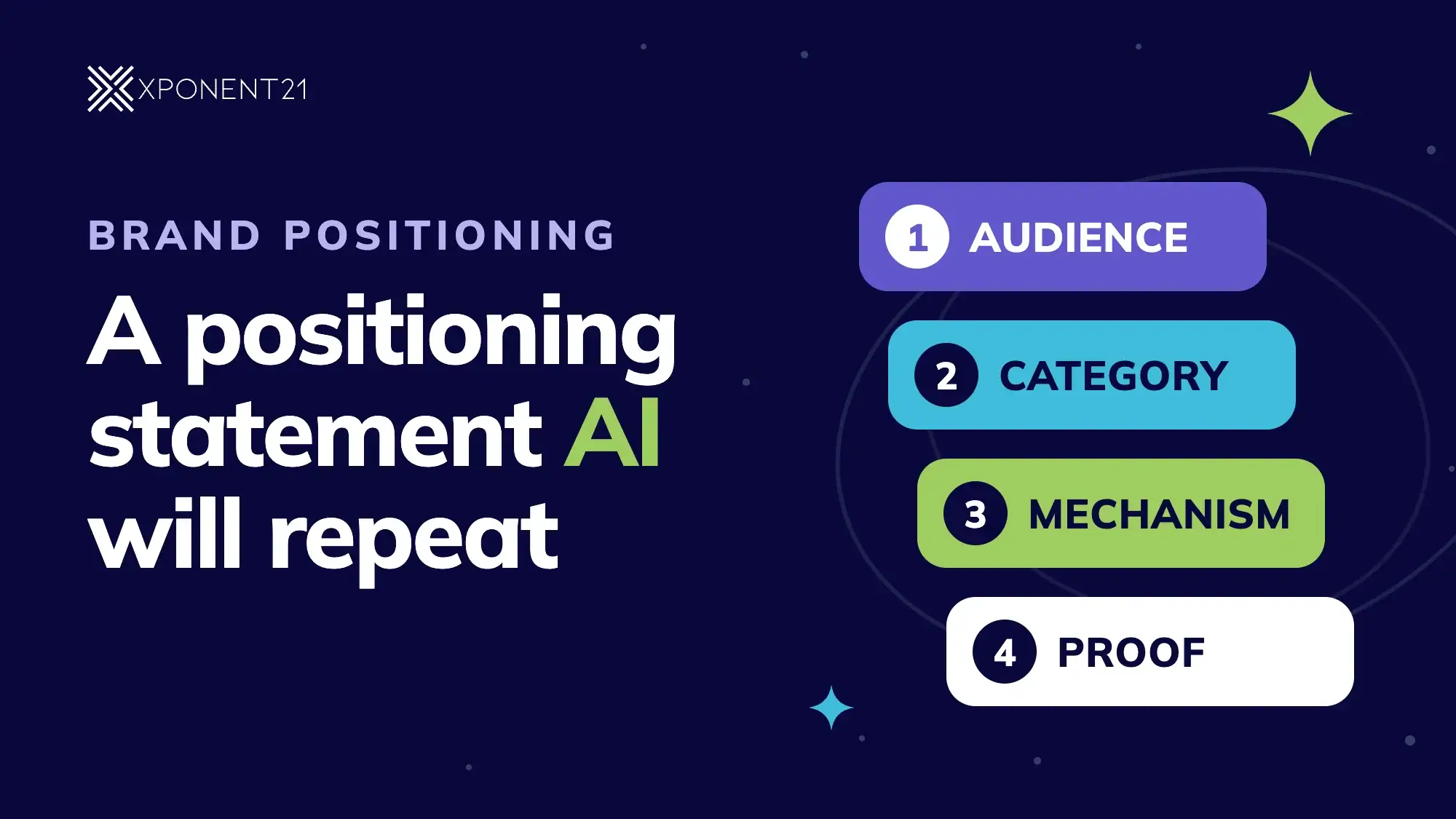
To build market authority that translates across human sales cycles and algorithmic retrieval, leadership teams must abandon abstract jargon. An extractable positioning statement relies on four functional components structured for clarity and semantic weight.
1. Defined Target Audience and Context
The target audience component must identify the operational context and commercial profile of the buyer, rather than relying on broad demographic markers. Instead of targeting “large enterprises” or “forward-thinking leaders,” name the specific operational condition or technical environment where the buyer operates. Specificity signals relevance to enterprise buyers who need specialized expertise and provides algorithms with the exact contextual keywords needed to surface the business during niche, high-intent queries.
2. Market Category Frame of Reference
The frame of reference establishes the category sandbox. It tells the reader and the language model exactly what product or service group your solution belongs to. Attempting to invent entirely unanchored categories often backfires. If buyers and search engines do not recognize the taxonomy, they cannot retrieve it. Anchor the business within an established, searchable category before introducing your distinct modifier.
3. Primary Differentiator and Mechanism
The differentiator defines what the organization does fundamentally differently from category alternatives. Crucially, this must outline a concrete mechanism of action rather than an unsubstantiated superlative. Statements claiming to be the fastest, easiest, or most reliable vendor offer no extractable substance. State the underlying architectural, operational, or business model variation that produces the superior outcome.
4. Objective Proof Point
The proof point provides verifiable validation. Both human prospects evaluating risk and language models assessing factual reliability look for verifiable evidence. This component references empirical benchmarks, technical certifications, proprietary delivery models, or verified historical outcomes.
Step-by-Step: How to Write a Brand Positioning Statement
Drafting an effective corporate statement requires discipline, cross-functional alignment, and the deliberate elimination of internal corporate jargon. Executive teams can follow this four-step process to draft a statement that establishes clear market presence.
Step 1: Document the Operational Status Quo
Begin by identifying the specific friction your audience experiences with incumbent category solutions. Avoid high-level generalities like “poor customer support” or “slow tools.” Frame the problem in terms of operational cost, architectural rigidity, compliance bottlenecks, or missed commercial yield. This establishes the economic rationale for your differentiation.
Step 2: Formulate the Category Anchor
Select the precise primary category your buyers allocate budget toward. If your solution replaces legacy software, state the software category directly. If it provides specialized advisory services, identify the exact consultancy segment. Ensure this category descriptor uses language that external market analysts and procurement departments already recognize.
Step 3: Articulate the Mechanical Difference
Isolate the primary reason your operational method yields a different result. Contrast your delivery model against standard industry practices. Does your approach replace manual professional services with automated infrastructure? Does your delivery rely on proprietary regional distribution networks rather than third-party freight? Focus on the operational reality that makes your commercial promise possible.
Step 4: Assemble the Core Statement
Combine the components into an active, declarative framework:
For Target Audience operating in specific condition, Brand Name is the Market Category that Primary Mechanical Differentiator, providing Specific Business Outcome because Objective Proof Point.
This structure ensures that every clause delivers extractable factual data, allowing human buyers to repeat your value proposition internally and enabling machine crawlers to build accurate entity associations.
Stress-Testing Your Statement: The Machine Extraction and Competitor Swap Tests
Once drafted, a positioning statement must undergo rigorous stress-testing before leadership rolls it out across corporate communications. Two practical evaluation tests reveal whether a statement possesses structural integrity.
The Competitor Swap Test
Take your draft statement, remove your brand name, and insert the name of your three largest category competitors. If the statement still reads plausibly when attributed to a competitor, the positioning has failed. A defensible statement contains operational specifics, proprietary mechanics, or documented proof points that no alternative vendor can legally or credibly claim. If any rival could place the sentence on their corporate homepage without objection, revise the differentiation to reflect verified operational facts.
The Machine Extraction Test
The machine extraction test evaluates whether generative language models can parse your positioning without hallucinating or defaulting to generic corporate categories. Input your positioning statement into prompt environments across generative platforms and ask the model to extract:
- The core industry classification
- The primary operational difference
- The ideal customer profile
- The factual basis for the claim
The test passes when the model returns a specific, accurate answer to all four questions. If the model returns vague classifications such as “business solutions provider” or fails to identify your mechanical difference, your sentence structure remains too abstract. Adjust the copy by replacing conceptual adverbs with concrete nouns and active verbs.
It is critical to note that while a well-crafted statement establishes necessary semantic clarity and entity definition, positioning alone does not ensure immediate top citations across AI engines. Citations also depend heavily on domain authority, technical crawlability, and external third-party validation. Effective AI visibility management requires maintaining these aspects as well as how your positioning answers a prospect’s most valuable questions across search ecosystems.
Aligning Your Positioning Statement Across Web Architecture and Earned Media
A positioning statement holds little commercial value if it remains confined to an internal executive slide deck. To influence market perception and modern search environments, the positioning must inform external communications and digital architecture.
Owned website infrastructure must reflect your core entity definition across title tags, header hierarchies, service landing pages, and structured schema markup. When page copy mirrors the exact category and differentiator terms defined in your positioning framework, search crawlers can parse page intent without ambiguity. Downstream digital assets, such as corporate overview videos, should reinforce these core positioning pillars rather than introducing conflicting creative themes.
However, owned channels represent only a fraction of the visibility equation. Third-party digital authority forms the backbone of generative retrieval. Similar to the findings of the University of Toronto study described above, a study from Muck Rack showed that 84% of AI citations come from earned media, with journalism alone accounting for 27% of cited sources and paid content accounting for 0.3%.
If trade publications, industry roundups, and editorial coverage describe your firm using obsolete or contradictory terminology, answer engines will ingest that external consensus. Corporate communications teams must ensure that press releases, executive guest articles, industry podcast appearances, and analyst briefings consistently communicate the core positioning statement. When off-site reporting matches your on-site taxonomy, language models encounter a unified semantic entity across the open web.
A Worked Example: Positioning a Fictional Mid-Size Company
To illustrate the transition from generic corporate messaging to an extractable positioning model, consider a fictional mid-market logistics firm, Meridian Freight Systems.
Worked example
The same company, with and without the four components
Baseline
Meridian Freight Systems is a customer-focused logistics partner delivering world-class transportation solutions through innovative technology and dedicated service excellence. No proof point
- Target audience and context
“Customer-focused partner” gives no operational context. - Market category frame
“Transportation solutions” is too broad and masks the actual service line. - Differentiator and mechanism
Generic claims that do not set the business apart from competitors. - Objective proof point
No objective evidence or verifiable metrics.
Revised
For cold-chain food distributors managing multi-facility regional inventory, Meridian Freight Systems is the temperature-controlled freight carrier that uses automated multi-zone trailer monitoring to eliminate thermal excursions, documented by audited real-time sensor telematics across all transit routes.
- Target audience and context
Names cold-chain food distributors with multi-facility regional inventory. - Market category frame
Defines the company as a temperature-controlled freight carrier. - Differentiator and mechanism
Automated multi-zone trailer monitoring designed to prevent thermal excursions. - Objective proof point
Audited real-time sensor telematics across all transit routes.
The Baseline (Traditional Messaging)
Before: “Meridian Freight Systems is a customer-focused logistics partner delivering world-class transportation solutions through innovative technology and dedicated service excellence.”
Analysis of Failure:
- Target: “Customer-focused partner” communicates no operational context.
- Category: “Transportation solutions” is overly broad and masks their actual service line.
- Differentiator: “Innovative technology and dedicated service” are generic claims that fail to distinguish the business from competitors.
- Proof: Contains zero objective evidence or verifiable metrics.
The Revised Extractable Positioning Statement
After: “For cold-chain food distributors managing multi-facility regional inventory, Meridian Freight Systems is the temperature-controlled freight carrier that uses automated multi-zone trailer monitoring to eliminate thermal excursions, documented by audited real-time sensor telematics across all transit routes.”
Analysis of Operational Strength:
- Target: Specifically names cold-chain food distributors with multi-facility regional inventory.
- Category: Explicitly defines the company as a temperature-controlled freight carrier.
- Differentiator: Identifies the mechanical difference of automated multi-zone trailer monitoring designed to prevent thermal excursions.
- Proof: Anchored by audited real-time sensor telematics across all transit routes.
When prospective logistics directors read this revised statement, they immediately understand whether Meridian fits their procurement requirements. Similarly, when an AI search platform processes a prompt seeking reliable regional cold-chain transport, Meridian’s entity profile matches the query parameters directly.
Turning Your Positioning Statement Into Defensible Market Visibility
Establishing market clarity is more than an internal messaging project. It directly impacts commercial performance and search acquisition. Analysis from Seer Interactive demonstrates that brands cited in AI Overviews earn 120% more organic clicks per impression than non-cited brands. Winning those citations requires that your business be clearly understood, categorized, and verified across both owned properties and authoritative earned publications.
Leadership teams frequently assume that internal alignment automatically creates top-line growth. While studies associate brand consistency with financial outperformance, specific revenue gains vary widely based on market conditions, execution, and category maturity. Strategic positioning provides the foundational clarity required to compete, but ongoing digital execution dictates long-term market capture.
To build defensible market leadership, organizations must align their positioning across every customer touchpoint, from website architecture to third-party digital authority. For mid-market and enterprise leadership teams seeking to establish an unmistakable market presence, Xponent21’s CARL tools help clarify core positioning strategy to ensure both executive prospects and modern AI search models accurately extract, repeat, and cite your corporate differentiation. Schedule a growth strategy session to establish the precise message you want customers and answer engines to repeat.

Courtney Turrin
As the company’s number two employee, Courtney has helped guide the direction of our business, build a powerhouse team, and implement technology and workflows to improve service delivery and produce outsized results for our clients. Her current role sits at the intersection of analytics, work management, and operations. Drawing on her background in scientific research, Courtney designs efficient processes and supports our teams so they can better serve our clients. She holds masters degrees in Biology and Psychology/Neuroscience from the College of William and Mary and Yale University, respectively. Offline, Courtney is a plant whisperer, Peloton enthusiast, and proud pet mom.