
Marketing
B2B Trust Signals AI Checks Before Recommending a Supplier
By: Courtney Turrin
Published Date: November 19, 2026
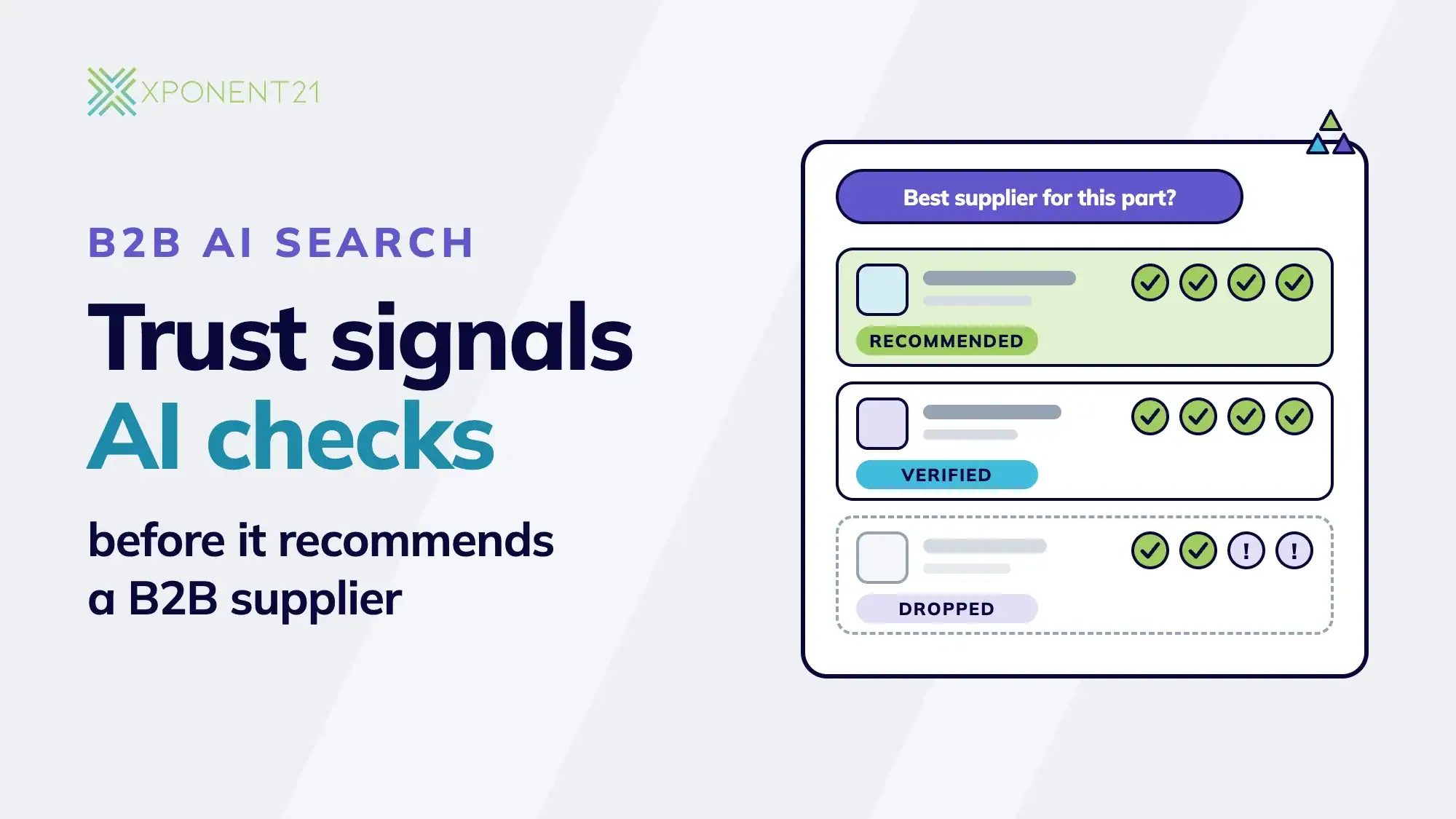
Before a generative search engine recommends a B2B supplier, it treats the prompt as an entity verification task rather than a traditional keyword match. When an engineer or procurement director asks an AI assistant to evaluate industrial suppliers, the system does not simply take the manufacturer’s product claims at face value. Instead, the model searches for independent confirmation across the open web to establish whether the organization is operationally viable, technically capable, and commercially stable.
Understanding B2B trust signals AI search systems look for requires looking past traditional search engine ranking factors. Traditional backlink metrics often correlate poorly with citation likelihood compared to contextual entity verification. Generative systems use a two-stage process: candidate retrieval followed by candidate selection.
- In the retrieval phase, the engine gathers suppliers that appear relevant to the technical criteria.
- In the selection phase, the engine cross-references external datasets to verify that the supplier actually exists, maintains the stated certifications, and holds a consistent market footprint. If the external record contains conflicting details, outdated addresses, or contradictory specifications, the engine will omit the company in favor of a supplier whose digital footprint is corroborated elsewhere.
Two-stage process
1Retrieval
- Supplier A
- Supplier B
- Supplier C
- Supplier D
- Supplier E
Gathers suppliers that look relevant to the query
2Selection
- RegistriesName and location
- ReviewsDelivery, support
- CertificationsRegistrar rosters
- DistributorsSpecs, part data
Confirms existence, certifications and a consistent market footprint
In the answer
- Supplier A
- Supplier B
- Supplier D
Dropped
Suppliers C and E have conflicting or outdated records
The reliance on independent validation is evident in data examining generative citations. According to the Muck Rack “What Is AI Reading?” report from May 2026, which analyzed more than 25 million links across ChatGPT, Claude, and Gemini in 17 industries, 84% of AI citations come from earned media. Journalism alone accounts for 27% of cited sources, while paid or advertorial content represents 0.3%.
Where AI citations come from
Each bar shows share of all citations (0 to 100%).
- 84%Earned mediaof AI citations
- 27%Journalismof AI citations
- 0.3%Paid or advertorialof AI citations
Source: Muck Rack, What Is AI Reading? (May 2026). Over 25 million links cited by ChatGPT, Claude and Gemini across 17 industries.
Independent academic research shows a similar preference for external corroboration. A University of Toronto study found that AI search favors earned media far more than Google does. For U.S. automotive queries, AI engines’ sources were 81.9% earned media, 18.1% brand-owned, and 0% social. In comparison, Google’s results were 45.1% earned, 39.5% brand-owned, and 15.4% social. The researchers estimate an earned-media bias of about 4.5 to 1, while noting that ChatGPT and Claude are the most conservative and Perplexity is the most open to social content.
Source mix by engine
- Earned media
- Brand-owned
- Social
AI engines
Social: 0%
Google
Earned-media bias in AI engines: about 4.5 to 1
Source: University of Toronto study, U.S. automotive queries.
In most evaluated queries, external media carries significant weight, though owned technical documentation remains critical for extractable specifications. Understanding why trust precedes recommendation helps explain why technical marketing teams must focus on the specific verification points AI engines evaluate across third-party sources.
Business Registries and Commercial Credit Data
The first layer of automated verification confirms the legal and structural reality of a supplier. Large language models and AI retrieval systems query commercial databases, public incorporation records, and corporate registries to confirm that an enterprise is an active, going concern.
These structured records provide the baseline attributes needed to confirm corporate identity:
- Legal entity consistency: The exact corporate name must match across state filings, operating divisions, and trade names. Discrepancies between parent entities and operating subsidiaries confuse automated entity resolution.
- Physical operational footprint: AI systems cross-reference registered office addresses against manufacturing facilities, distribution centers, and headquarters locations. Inconsistencies suggest shell operations or abandoned locations.
- Operating scale and longevity: Registry data confirms operational history, approximate employee headcount, and active status. When a prompt requests an enterprise-grade fabricator or an established component supplier, models use these historical indicators to filter out transient operations.
When commercial records display conflicting data, such as a legacy headquarters address abandoned five years ago or a dissolved legal entity name, algorithmic confidence degrades. If an AI engine cannot definitively reconcile where a company operates or whether its corporate status is active, it will bypass that company to avoid recommending a high-risk vendor to commercial buyers.
Review and Comparison Platforms Buyers and AI Both Consult
Generative search engines do not rely solely on structured corporate records; they also extract sentiment, operating feedback, and functional reliability metrics from independent review platforms. While consumer search leans on consumer star ratings, B2B supplier selection evaluates detailed user testimonials, verified procurement evaluations, and structured software or hardware comparison directories.
These platforms provide third-party validation that models use to answer nuanced qualitative queries. If a procurement manager asks which contract manufacturer handles low-volume, high-mix precision machining without project delays, the engine looks for review commentary describing on-time delivery rates, communication during production runs, and post-delivery engineering support.
Suppliers can strengthen these signals through deliberate, ethical collection practices:
- Systematic post-deployment outreach: Request detailed written reviews from verified enterprise clients immediately after major operational milestones, such as successful qualification runs or system commissioning.
- Encouraging technical specificity: Prompt clients to describe the actual technical problem, the operational environment, the tolerances achieved, and the ongoing support responsiveness rather than generic satisfaction.
- Maintaining unvarnished feedback: Avoid gated reviews or artificial incentives. AI engines and sophisticated buyers identify uniform five-star ratings without technical substance as promotional noise, preferring balanced feedback that demonstrates authentic client relationships.
Certifications, Industry Associations, and Trade Publications
For manufacturers and technical distributors, technical claims require external verification before an AI model will repeat them. If a supplier states on its website that it manufactures medical-grade components or aerospace-certified fasteners, the AI engine looks for external confirmation from accredited issuing authorities and industry bodies.
Certification directories, accredited registrars, and professional association rosters serve as definitive verification nodes. If a company claims ISO compliance, aerospace quality certifications, or environmental standards, the presence of that company in the registrar’s public database confirms the claim. Absence from those databases introduces factual doubt, preventing the model from including the vendor in answers with strict regulatory requirements.
Trade publications and industrial journalism supply another layer of domain authority. When technical journals, industry trade magazines, and specialized engineering portals cover a supplier’s facility expansion, proprietary material formulation, or research partnership, that coverage acts as high-credibility proof. As established by the University of Toronto researchers and Muck Rack data, independent trade reporting is the exact category of earned media that generative models rely on most when synthesizing answers for technical buyers. Supporting this coverage with multi-format content, such as video blogs for manufacturing SEO, reinforces operational authority across technical topics.
Distributor Listings and Spec Sheet Consistency
A common source of verification failure for industrial manufacturers is divergence between their self-hosted technical documentation and external distributor networks. When authorized distributors, value-added resellers, and industrial catalog syndicators publish conflicting product specifications, AI models face conflicting data.
Consider a manufacturer of industrial pumps whose owned website lists a specific maximum operating temperature for a model line. If major industrial supply partners host catalog pages listing that same part number with a conflicting temperature rating, or if a distributor lists an obsolete part number variant, the retrieval system detects a factual conflict.
This friction creates two negative outcomes:
- Entity resolution failure: The engine may treat the distributor listing and the manufacturer catalog as two distinct, incomplete products, diluting the perceived availability and market adoption of the component.
- Elimination from the candidate pool: When a prompt specifies strict operating thresholds, any discrepancy between the manufacturer’s data sheet and secondary sales channels introduces uncertainty. Rather than risking a technical hallucination or providing inaccurate engineering specs, the model omits the product entirely.
Data consistency
- Manufacturer siteSPEC A
- Distributor ASPEC A
- Distributor BSPEC BDiffers
Entity resolutionRecords disagree
Left out of spec-driven answersQueries that need precise specifications
Conflicting specs across listings can cause entity resolution failures or exclusion.
Maintaining alignment between direct product specification downloads, structured web tables, and third-party distributor catalog feeds ensures that automated systems extract the same technical facts regardless of where the catalog is parsed.
Auditing Your B2B Footprint for AI Recommendation Engines
Preparing a B2B supplier for generative search requires a coordinated audit of both on-site technical clarity and external verification sources. Rather than treating search visibility as an exercise in adding keywords to web copy, technical marketers must verify how their organization appears across the entire web ecosystem. Working with a dedicated AI SEO agency helps align internal catalog specifications with third-party verification nodes.
Begin by assessing these core operational areas:
- Audit public registry and entity records: Reconcile your company name, physical facilities, parent-subsidiary relationships, and active filings across primary corporate registries and business databases. Eliminate legacy addresses and abandoned entity names.
- Cross-reference technical documentation: Pull spec sheets, user manuals, and part lists from your own digital properties and compare them against authorized distributor portals. Resolve differences in part numbering, operational tolerances, and material specifications.
- Evaluate independent validation profiles: Review your current footprint across specialized B2B directories, industry association member lists, and accredited registrar databases. Confirm that all active certifications are current and publicly searchable.
- Map earned media coverage: Examine your organization’s presence in sector-specific trade journals, technical publications, and conference proceedings. Identify where your engineering leadership has contributed validated data or where independent reporters have documented your capabilities.
Audit checklist
- 1Reconcile registry recordsLegal names, locations and operating history match across every database.
- 2Compare documents to distributor portalsTechnical documents and specs agree on every distributor listing.
- 3Verify certifications in public databasesEach claim appears with the accredited registrar or association roster.
- 4Map earned media coverageTrade publications and press that vouch for the company.
Building a consistent, externally verified digital footprint turns your technical capability into an algorithmic recommendation signal. When an AI search engine can verify your legal standing, confirm your technical compliance in accredited databases, read authentic feedback from enterprise peers, and observe identical specifications across every distributor, recommending your business becomes the safest choice for the model to make.
To evaluate your company’s visibility across generative engines and uncover data conflicts holding back your citations, schedule a discovery call with an Xponent21 strategist.

Courtney Turrin
As the company’s number two employee, Courtney has helped guide the direction of our business, build a powerhouse team, and implement technology and workflows to improve service delivery and produce outsized results for our clients. Her current role sits at the intersection of analytics, work management, and operations. Drawing on her background in scientific research, Courtney designs efficient processes and supports our teams so they can better serve our clients. She holds masters degrees in Biology and Psychology/Neuroscience from the College of William and Mary and Yale University, respectively. Offline, Courtney is a plant whisperer, Peloton enthusiast, and proud pet mom.