
By: Will Melton
Published Date: August 20, 2024
Modified Date: October 12, 2026
Will Melton is the CEO of Xponent21 | Founder of AI Ready RVA | Instructor at University of Richmond; Recognized among Virginia Business Magazine’s 100 People to Meet (2025)
Published: August 20, 2024 | Updated: October 10, 2026
9 Strategies to Get Mentioned and Cited in AI Answers
To rank in AI search results, create content that directly answers specific user questions, demonstrates first-hand expertise, uses clear semantic structure, supports claims with credible sources, and establishes authority across the web. Technical SEO and crawlability are foundational, but AI search increasingly rewards content that is easy to understand, verify, extract, and cite.
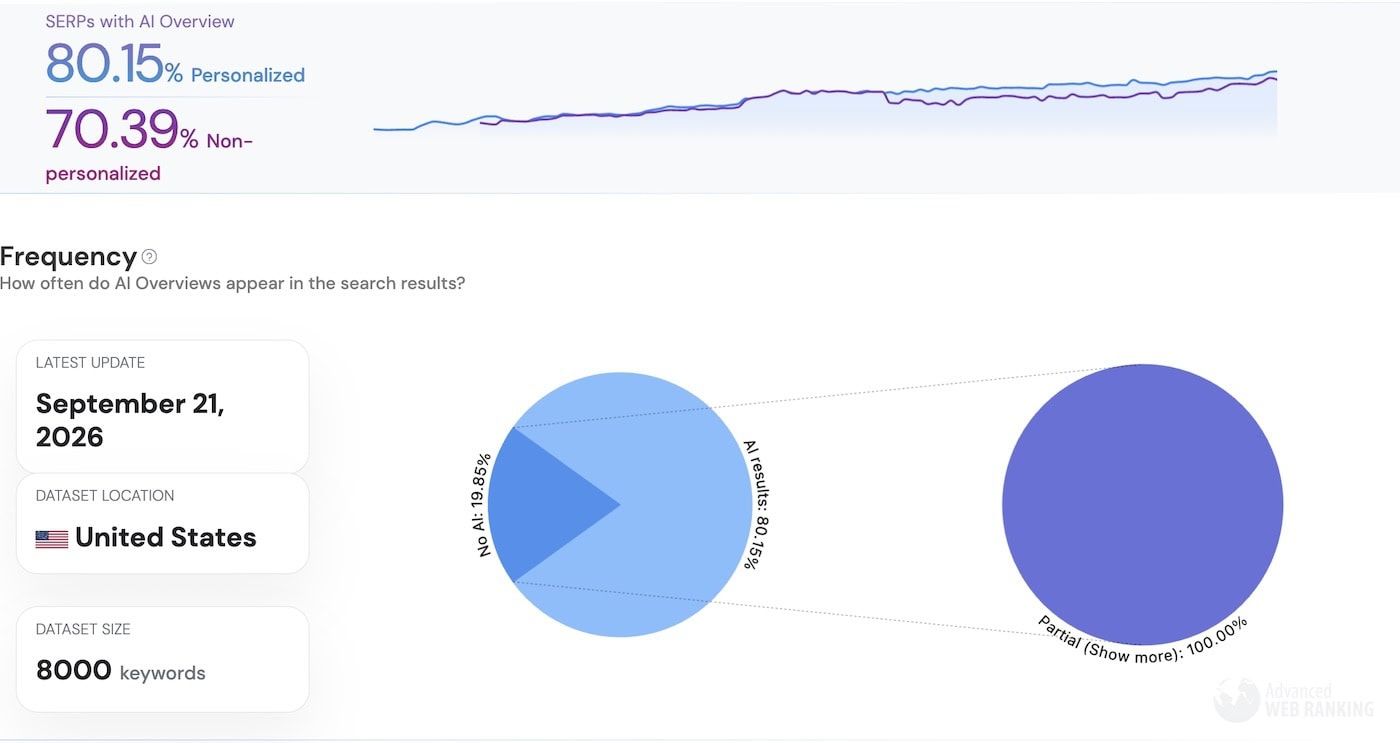
As of September 2026, 80% of Google search results pages include AI Overviews — up from 60% in November 2025 and just 25% in August 2024. That number changes how content strategy works. AI-powered platforms like Google AI Overviews, Google AI Mode, Perplexity, Claude, and ChatGPT now surface answers directly, without requiring users to visit a webpage. In 2024, 60% of Google searches ended on the results page. The ability to rank in AI search results has become one of the most consequential skills in digital marketing.

ChatGPT is competing directly for Google’s search traffic. OpenAI began promoting its Chrome extension — which sets ChatGPT as the default search engine — in June 2025.
This guide covers nine strategies for optimizing your website and content to rank in AI-driven search results and AI Overviews. The tactics here are grounded in how AI systems actually evaluate and select content: not just keyword frequency, but structural quality, source authority, and the degree to which content resolves user uncertainty. Readers who apply these strategies can expect stronger AI citation rates, increased organic visibility, and more qualified traffic from the platforms reshaping search. Today’s expanded AI Overviews typically include around 8 links, offering meaningful opportunities for visibility.
Unlike traditional search engines that rank based largely on search terms, AI agents actively make decisions on a user’s behalf. Agentic AI systems now browse, evaluate, and act for users, often without the user ever visiting a webpage. Content that isn’t structured for AI evaluation risks being invisible in these critical moments. As of September 2026, Cloudflare is reporting that nearly 60% of website traffic is from automated agents rather than humans.
Unlike traditional search engines that rank based largely on search terms, AI agents actively make decisions on a user’s behalf.
This guide sets the standard for mastering AI search optimization. Inside, you’ll find strategies backed by industry research and real-world application, with code samples, data, and specific techniques for appearing in AI-generated results.
1. Understand AI Search Algorithms
Before applying any optimization tactic, it helps to understand the mechanism behind it. Google’s AI Overviews and AI Mode retrieve pages from the same index and ranking systems as classic Search, then generate an answer grounded in them. They also use query fan-out: one prompt is expanded into several related searches run at once, and pages that answer those sub-questions get cited. Google’s own guide to optimizing for generative AI features says this is still SEO, and that unique, non-commodity content has more influence on visibility than any other tactic. The tactics below are one part of AI Visibility Management, which tracks and improves how AI systems see your brand overall. AI-powered search engines use advanced natural language processing (NLP) to interpret context, semantics, and user intent — not just keywords. These systems are designed to resolve user uncertainty, which means content that explains the reasoning behind a strategy, not just the strategy itself, tends to perform better.
Four principles shape how AI evaluates and selects content:
- Contextual Understanding: AI search engines prioritize content that addresses the intent behind a query, not just its surface wording. A page answering “how to generate traffic from AI search results” should explain why AI chatbots cite certain sources — not just list tactics. That explanatory depth is what earns citations.
- Structured Data Markup: Schema markup helps machines interpret and categorize your content. Google says it is not required for generative AI search and that there is no special markup for it, but it remains useful for rich results and entity clarity.
- In-Depth Content: AI-driven algorithms favor content that covers a topic thoroughly. The more comprehensively your content addresses a query — including follow-on questions — the more likely it is to be recognized as a reliable source worth citing.
- Semantic Centroid Distance: Our CARL research found that content closer to the semantic center of a query cluster is cited at measurably higher rates. Cover the core meaning of the topic and its related questions clearly, rather than drifting into tangents. See The CARL Model for the research framework.
The more detailed and insightful your content, the more likely AI search engines will recognize it as a reliable source worth citing.
Example: Website Code Without Structured Data
The HTML below shows a plain, unstructured product page. Search algorithms see the text, but can’t identify it as a specific content type. That limits how it gets indexed and surfaced.
<!DOCTYPE html>
<html lang="en">
<head>
    <meta charset="UTF-8">
    <meta name="viewport" content="width=device-width, initial-scale=1.0">
    <title>Book Information</title>
</head>
<body>
    <h1>The Art of Ranking in AI Search Results</h1>
    <p>Author: John Doe</p>
    <p>Publication Date: January 15, 2026</p>
    <p>Publisher: TechBooks Publishing</p>
    <p>ISBN: 123-4567891234</p>
    <p>Description: This book explores the intersection of artificial intelligence and content creation, providing strategies for optimizing digital content for AI-driven search engines.</p>
    <p>Price: $29.99</p>
</body>
</html>
Example: The Same Page With Structured Data
Adding JSON-LD schema markup to the same page tells search engines exactly what this content is. This makes the page eligible for rich results and gives machines unambiguous context. Google says structured data is not required to appear in AI Overviews or AI Mode, so treat it as clarity, not a citation shortcut. The user-facing content stays identical — the difference is entirely in the structured data machines read.
<!DOCTYPE html>
<html lang="en">
<head>
    <meta charset="UTF-8">
    <meta name="viewport" content="width=device-width, initial-scale=1.0">
    <title>Book Information</title>
    <script type="application/ld+json">
    {
        "@context": "https://schema.org",
        "@type": "Book",
        "name": "The Art of Ranking in AI Search Results",
        "author": {
            "@type": "Person",
            "name": "John Doe"
        },
        "datePublished": "2026-01-15",
        "publisher": {
            "@type": "Organization",
            "name": "TechBooks Publishing"
        },
        "isbn": "123-4567891234",
        "description": "This book explores the intersection of artificial intelligence and content creation, providing strategies for optimizing digital content for AI-driven search engines.",
        "offers": {
            "@type": "Offer",
            "priceCurrency": "USD",
            "price": "29.99",
            "availability": "https://schema.org/InStock"
        }
    }
    </script>
</head>
<body>
    <h1>The Art of Ranking in AI Search Results</h1>
    <p>Author: John Doe</p>
    <p>Publication Date: January 15, 2026</p>
    <p>Publisher: TechBooks Publishing</p>
    <p>ISBN: 123-4567891234</p>
    <p>Description: This book explores the intersection of artificial intelligence and content creation, providing strategies for optimizing digital content for AI-driven search engines.</p>
    <p>Price: $29.99</p>
</body>
</html>
2. Create AI-Friendly (a.k.a. Human-Friendly) Content
AI search engines are ultimately designed to serve people. Content that is clear, accurate, and genuinely useful to a human reader tends to perform well with AI systems for the same reasons. Google’s guidance is blunt that unique, genuinely useful content matters more than any AI-specific tactic. Here’s how to approach content creation for both audiences:
- Understand User Intent: Start by identifying the core need behind a user’s search, not just the keyword. Tools like Google’s Keyword Planner and Ahrefs surface the underlying intent driving specific queries. Content that addresses that intent directly — rather than circling it — is more likely to earn citations.
- Semantic Keyword Integration: Don’t optimize for a single keyword. Include related terms and phrases that give AI a richer picture of what your content covers. This semantic approach helps AI understand the scope of your content, not just its surface topic. (Moz, AI for SEO and Content Marketing)
- Clarity and Readability: AI models favor content that reads clearly across different comprehension levels. Short paragraphs, descriptive headings, and lists reduce cognitive friction. Tools like Grammarly help flag unnecessarily complex language before you publish.
- Update Old Content: AI systems are trained on existing web data and actively surface new or updated material that adds to what they already know. Refreshing older content with current statistics, updated examples, and new insights signals relevance. Resubmit updated pages to Google Search Console so they get recrawled promptly.
- Write With AI: AI-generated content can rank and be cited by AI chatbots when it’s used strategically. Use AI to draft and structure content, then layer in your own professional expertise before publishing. The combination of AI efficiency and human insight produces content that algorithms and readers both respond to.
As of early 2026, 68% of Google searches in the U.S. ended without a click, up from about 60% in 2024, meaning content that does not surface in AI summaries and other on-page answers stands a real chance of never being seen. If your rankings look fine but traffic is dropping, read Why Is My Organic Traffic Dropping When My Rankings Are Fine.
3. Structure Content for Featured Snippets
Snippet Eligibility and Extractable Structure
To be shown in Google’s generative AI features, a page must be indexed and eligible to appear in Google Search with a snippet. Beyond that, clean, extractable structure still helps: AI systems retrieve passages, and direct answers are easy to lift. Featured snippets and AI Overviews often draw on the same well-structured answers. Google also says you do not need to break content into tiny chunks, because its systems can pull the relevant part from a longer page. Write for readers, with direct answers, lists, tables, and clear headings.
- Concise, Direct Answers: Open relevant sections with a clear, direct answer to the question that section addresses. Integrate the question into the answer itself — “The best way to optimize for featured snippets is…” — to increase the probability of selection by both search engines and AI systems.
- Utilize Lists and Tables: Structured formats like numbered lists, bullet points, and comparison tables are easily parsed by AI. Use them for steps, comparisons, and summaries wherever the content allows.
- Effective Use of Headings: Descriptive H2 and H3 headings help AI systems map the structure of your content. A well-organized heading hierarchy tells both search engines and AI what each section covers and how the sections relate to each other.
Featured Snippets Vs. Schema Markup
Featured snippets function on structured content, while schema markup powers Google’s rich results and helps engines understand your content. It does not generate featured snippets, which Google selects algorithmically from on-page content without using structured data. The two efforts reinforce each other, since content that answers a question cleanly tends to be the same content that structured data describes well. The table below shows where each schema type stands in 2026.
Schema Types for Featured Snippets and AI Search
| Schema Type | Description | Usage in Featured Snippets | Usage in Generative AI Search |
|---|---|---|---|
| FAQPage | Structured content for frequently asked questions. | Deprecated. FAQ rich results were restricted to government and health sites in Aug 2023 and fully removed for all sites on May 7, 2026. Produces no search feature. | The markup is not required and adds no visible benefit. The on-page Q&A format, not the schema, is what helps AI surface answers. |
| HowTo | Step-by-step instructions for completing a task. | Deprecated. HowTo rich results were removed in 2023 and no longer appear. | Step and list formatting still aids AI extraction, but the markup itself no longer drives direct results. |
| Article | Structured content for articles, blog posts, and news stories. | Supported. Eligible for article and Top Stories features (headline, image, published and modified dates). It is a search appearance, not a ranking factor. | Reinforces author, dates, and publisher, which supports E-E-A-T signals AI systems weigh. |
| Recipe | Recipes with ingredients, instructions, and ratings. | Supported. Triggers recipe rich results and carousels with ingredients, ratings, and cook time. | AI can surface ingredients, steps, and cook times in answers. |
| Product | Product details including price, availability, and reviews. | Supported. Powers product and merchant listing rich results (price, availability, review stars). | AI generates product descriptions and comparisons. |
| Review | User reviews and ratings. | Supported. Produces review star snippets for eligible content types. | AI draws on reviews for opinions and recommendations. |
| LocalBusiness | Business location, hours, and contact details. | Supported. Enhances business information, though the local map pack is driven mainly by Google Business Profile, which schema supplements rather than replaces. | AI provides location-based recommendations. |
| Person | Individual name, job title, and biography. | Not a standalone rich result and does not trigger knowledge panels. Valuable nested as the author of an Article to support authorship and E-E-A-T. | Still valuable nested as the author of an Article to strengthen authorship and E-E-A-T. |
| Event | Event dates, locations, and attendees. | Supported. Displays event rich results with dates and location. | AI provides event summaries and details. |
| BreadcrumbList | Breadcrumb navigation trail for a webpage. | Supported. Displays the breadcrumb trail in search results. | Assists AI in understanding site structure. |
| VideoObject | Video content with duration, description, and thumbnail. | Supported. Powers video rich results, thumbnails, and key moments. | AI generates video summaries and content suggestions. |
| QAPage | Question and answer page format. | Supported, but only for pages where users submit answers, such as forums and community Q&A. It does not apply to an editorial FAQ section. | AI uses the Q&A pairs for quick answers. |
| Organization | Organization name, logo, and contact information. | Supported. Feeds knowledge panel elements such as logo and name, plus entity understanding. | AI summarizes and presents organizational details. |
Schema types most effective for ranking content in AI search results and featured snippets.
Notes on Schema Priority
- LocalBusiness is a high-priority schema to surface geographic or “near me” searches. Pair it with a strong Google Business Profile: see How to Optimize Your Google Business Profile for AI Overviews.
- Product and Review are most valuable for driving explicit conversions and matching targeted buyer intent.
- Article/BlogPosting schema describes editorial and blog content, contributing to rich results that AI can summarize and deliver in response to informational queries.
- Organization defines your brand name, legal entity status, and official social handles that builds baseline brand trust and corporate entity authority.
4. Focus on Technical SEO Factors to Appeal to AI Crawlers
Technical SEO is the foundation that allows AI search engines to crawl, interpret, and rank your content. Without it, even excellent content may not be indexed or surfaced. A website audit tool like SERanking provides a clear picture of technical health and identifies specific gaps to address. Make sure key pages are crawlable, indexable, and eligible to show a snippet. Two things you can skip for Google: llms.txt (Google Search does not use it) and special AI-specific markup.
- Mobile Optimization: The majority of searches happen on mobile devices. A responsive design with fast load times is table stakes for both traditional SEO and AI crawlers, which use similar signals to evaluate page quality.
- Page Speed: Fast-loading pages rank better because they reflect a better user experience. Three specific improvements make the biggest difference:
- Image Optimization: Compress images to reduce file sizes without sacrificing quality.
- Browser Caching: Store static files locally so returning visitors load pages faster.
- Content Delivery Network (CDN): Distribute content across global servers to reduce load times for users in any location.
- Secure Site (HTTPS): HTTPS is a ranking signal and a trust indicator. An SSL certificate is a baseline requirement — most hosting providers include it at no additional cost.
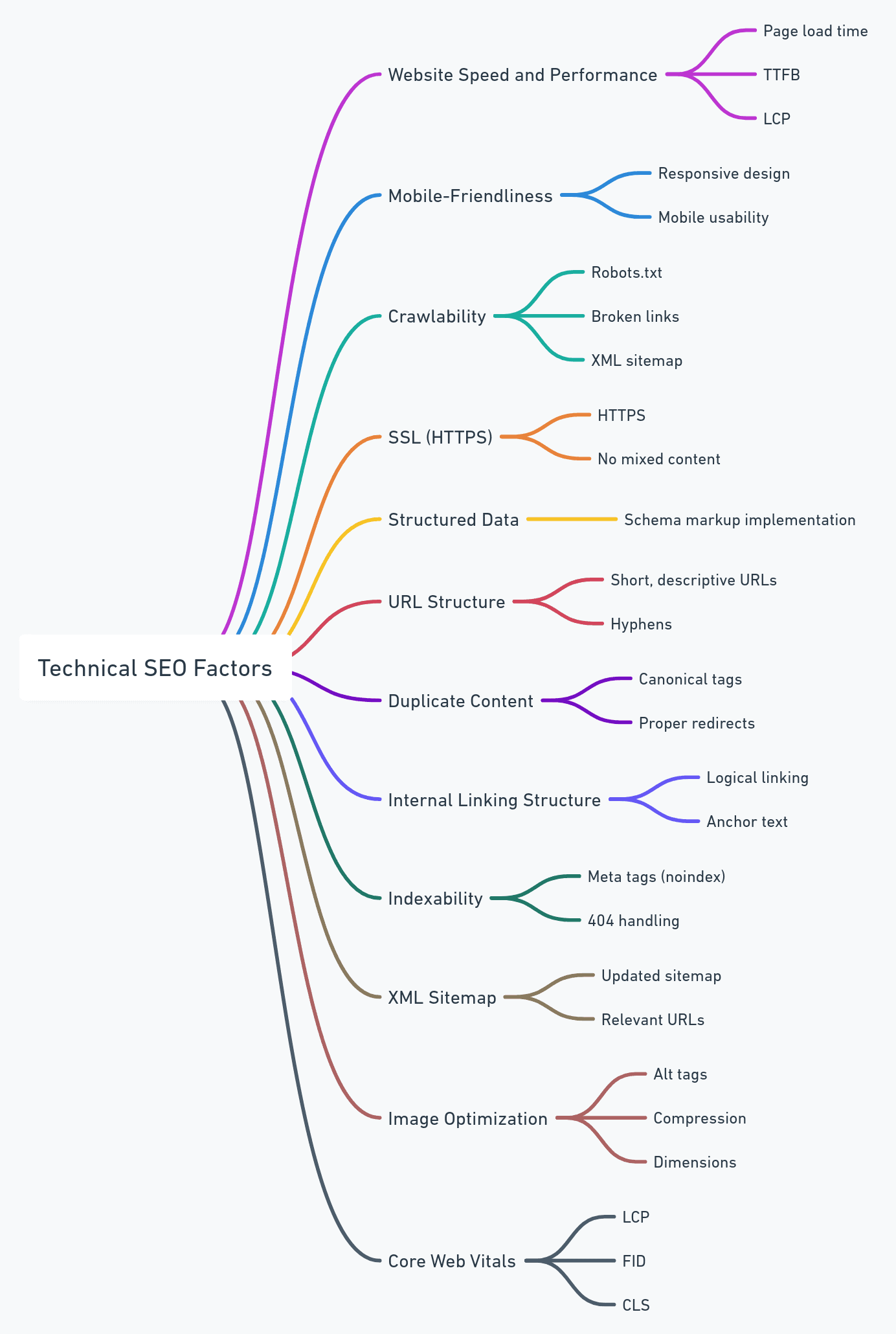
Technical SEO factors to consider for AI search visibility. Diagram generated with ChatGPT courtesy of Whimsical.com.
5. Utilize AI Tools & Modern Tactics for Content Optimization
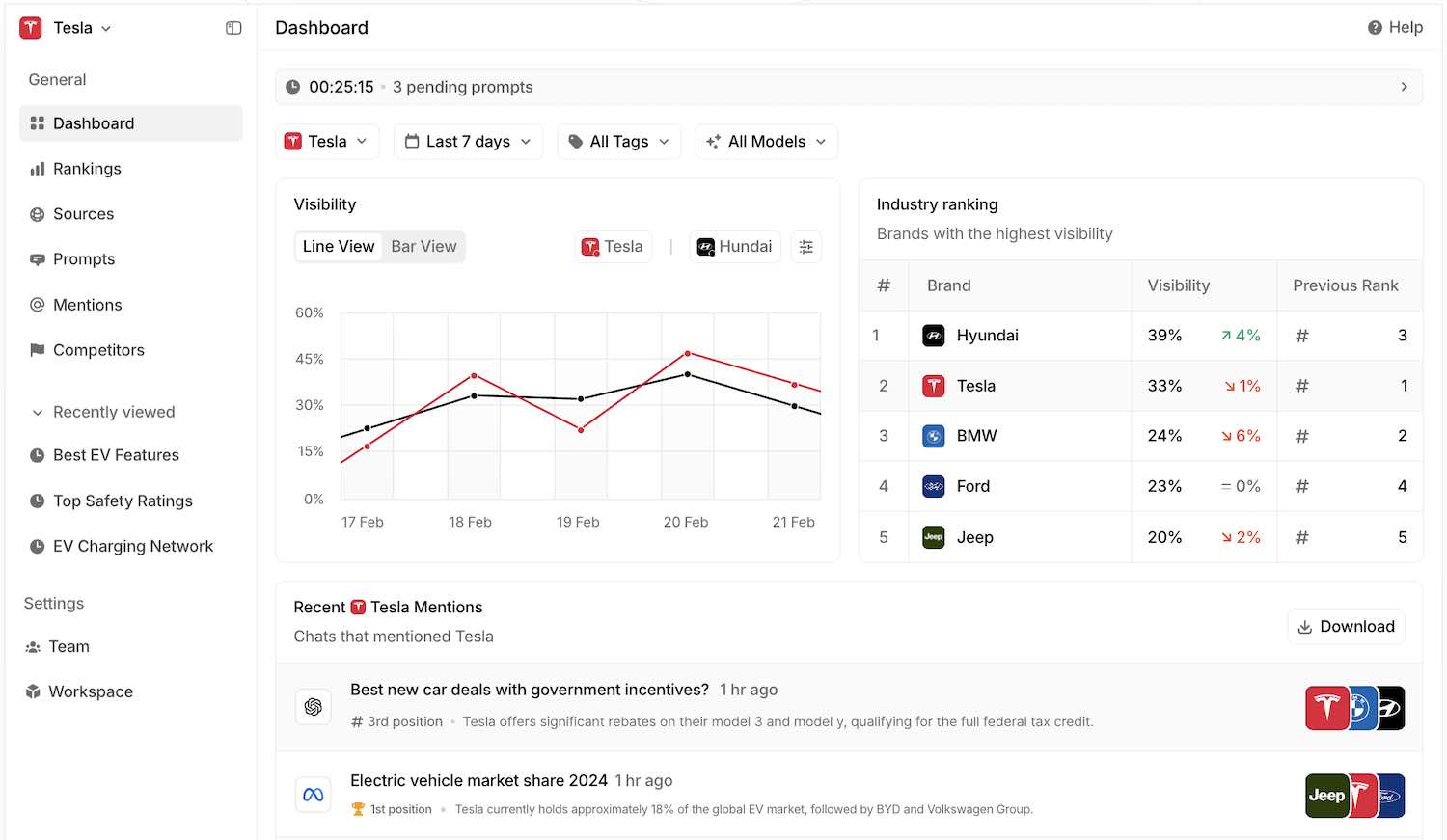
Peec.ai tracks your citations and brand mentions across AI search platforms alongside competitors, with all sources logged.
AI tools help you optimize content faster and with greater precision. Here’s what’s working in 2026:
- Content Generation Tools: Tools like ChatGPT, Claude, and AirOps accelerate drafting and help structure content for AI algorithms. The key is to prompt these tools using your own domain expertise, then add your professional knowledge before publishing. That combination of AI efficiency and human insight is what produces content that earns citations.
- SEO Analysis Tools: Platforms like Ahrefs, SERanking, and Clearscope provide actionable recommendations for improving content alignment with AI ranking factors. SERanking’s AI Results Tracker monitors visibility in AI Overviews. The Google AI Overview Tool from Advanced Web Rankings offers detailed insight into how AI systems analyze your content. Xponent21’s own CARL Intelligence tracks citations and share of voice across AI platforms. Peec.ai is a paid alternative that surfaces share of voice, competitor rankings, and the web sources driving AI outputs.
- Conversational Query Coverage: People ask AI Mode and chatbots longer, more conversational questions than they type into classic search, and AI systems fan one prompt out into several related searches. Cover the follow-up questions around your topic. AnswerThePublic surfaces the specific question formats your audience is using.
- Evidence in the Content: The best-documented levers for being cited are citing credible sources, including relevant statistics, and adding expert quotations (Aggarwal et al., GEO study, KDD 2024). Tone and writing style had much weaker effects. Write clearly and state facts plainly, but put your effort into evidence. See Citations, Citations, Citations.
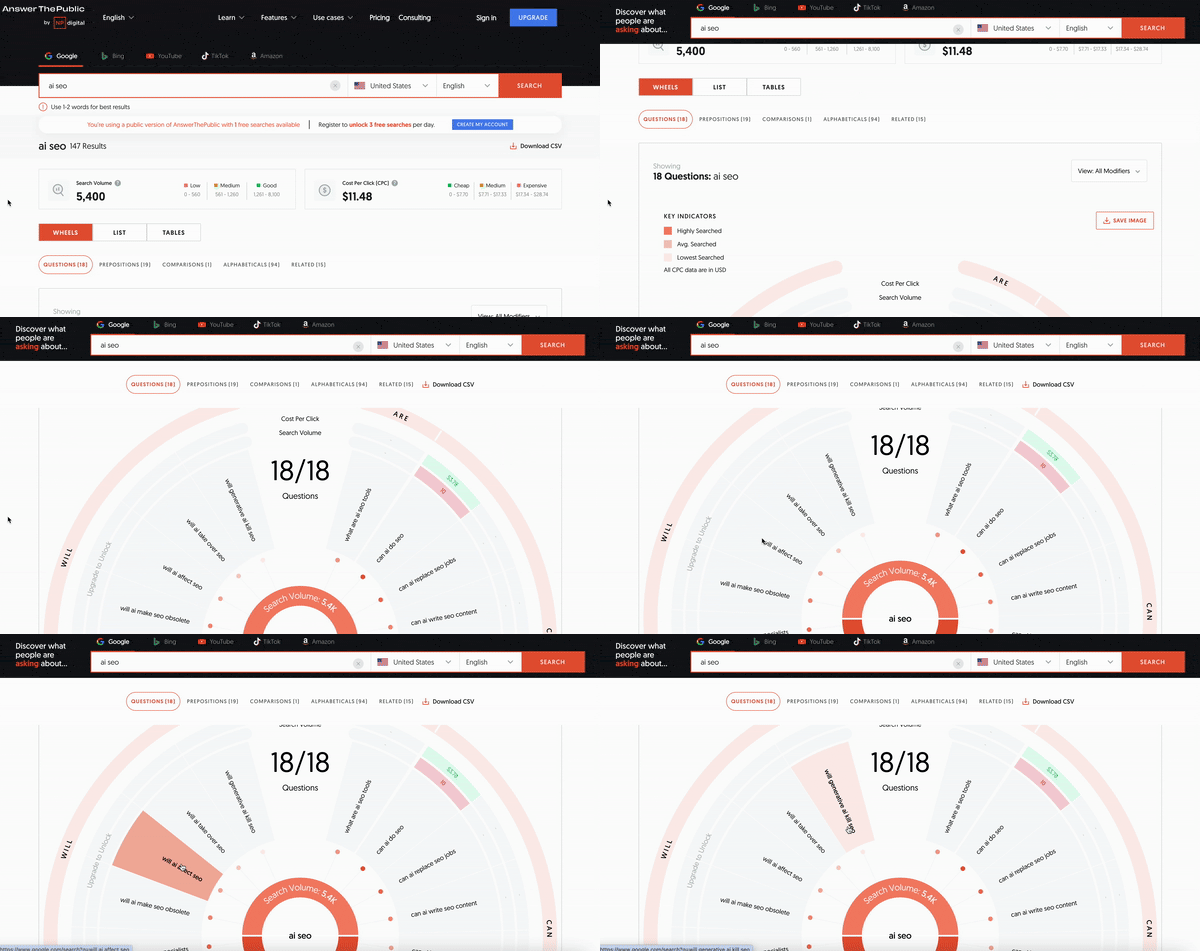
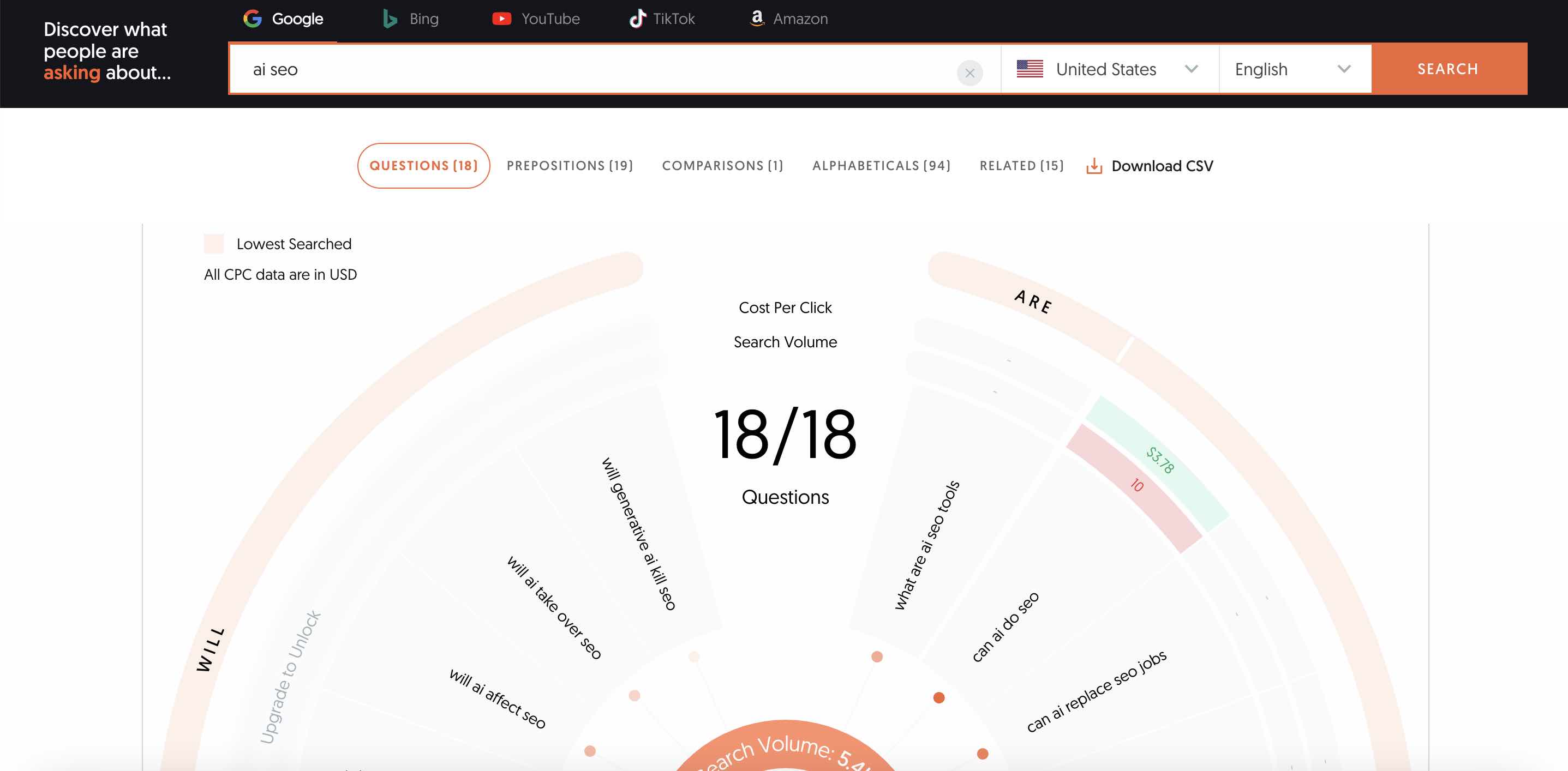
Example search using AnswerThePublic from NPDigital, showing question clusters relevant to AI search optimization.
6. Build Natural Human Authority to Appear in AI Overviews and Search Results
The key criteria AI systems use to evaluate content is the level of authority behind it. Google AI Overviews, Claude, ChatGPT, and Perplexity all assess expertise, trustworthiness, and verifiable presence across multiple platforms. E-E-A-T (Experience, Expertise, Authoritativeness, and Trustworthiness) is the framework Google uses to evaluate this, and it has become a primary driver of which sources get cited in AI-generated responses.
- Consistent, Expert-Level Publishing: Publishing regularly on your core topics signals to AI systems that you are an active, knowledgeable voice in your field. Consistency matters as much as quality — and the data from our own experience is direct on this point. At our peak, Xponent21 was generating over 168,000 daily impressions in Google Search, with a consistent baseline around 90,000 impressions per day and multiple qualified leads arriving daily from organic AI search visibility. When we scaled back our own content program to focus on internal growth in early 2026, impressions fell from 70,000 to between 8,000 and 9,000 per day by March — a collapse documented in detail in How We Lost 90 Percent of Our AI Search Visibility. The same principles work in reverse: a structured AI SEO program for Energy Products Distribution — five FAQ videos produced in a single shoot, optimized for AI Overviews and featured snippets — generated 2.1 million organic impressions, 10,600 clicks, and top placements across every targeted query. Full details are in the EPD case study. The pattern is consistent: authority builds with consistent output and erodes without it.
- Author Credentials and Bios: Detailed author bios — including professional experience, credentials, speaking engagements, and academic or industry recognition — give AI systems the context to evaluate expertise. The more your credentials are verifiable across multiple platforms, the stronger the authority signal. This is a low-effort, high-impact change that many publishers neglect.
- Backlinks and Third-Party Mentions: AI treats backlinks from authoritative external sources as endorsements of credibility. Links from industry publications, academic institutions, and recognized organizations tell AI systems that your content is considered worth citing by others in your space. Guest posts, podcast appearances, and press mentions all contribute to this signal.
- Presence on Platforms AI Cites: Reddit, LinkedIn, and YouTube are among the domains AI systems cite most often, as the chart below shows. Building an active presence there — and referencing it within your content — reinforces your authority across the sources AI draws from. Video is a good example: see Does Having a YouTube Channel Drive AI Search Visibility? For the broader patterns, read Six Mental Models for AI Visibility and Lessons From 100+ AI Overview Citations.
One of the most helpful takeaways here is that your AI visibility is shaped by more than what you publish on your own site. Third-party review sites, backlinks, and social mentions all fall under digital PR, and AI systems weigh them heavily when evaluating your brand. As Jenna Pace, Senior Account Strategist at Xponent21, put it, “if SEO isn’t working with digital PR, you’re doing it wrong.” If the outside conversation about your brand is thin or negative, your AI visibility will reflect that, no matter how strong your content is. The Xponent21 team went into more detail on a recent episode of To the Power of X:
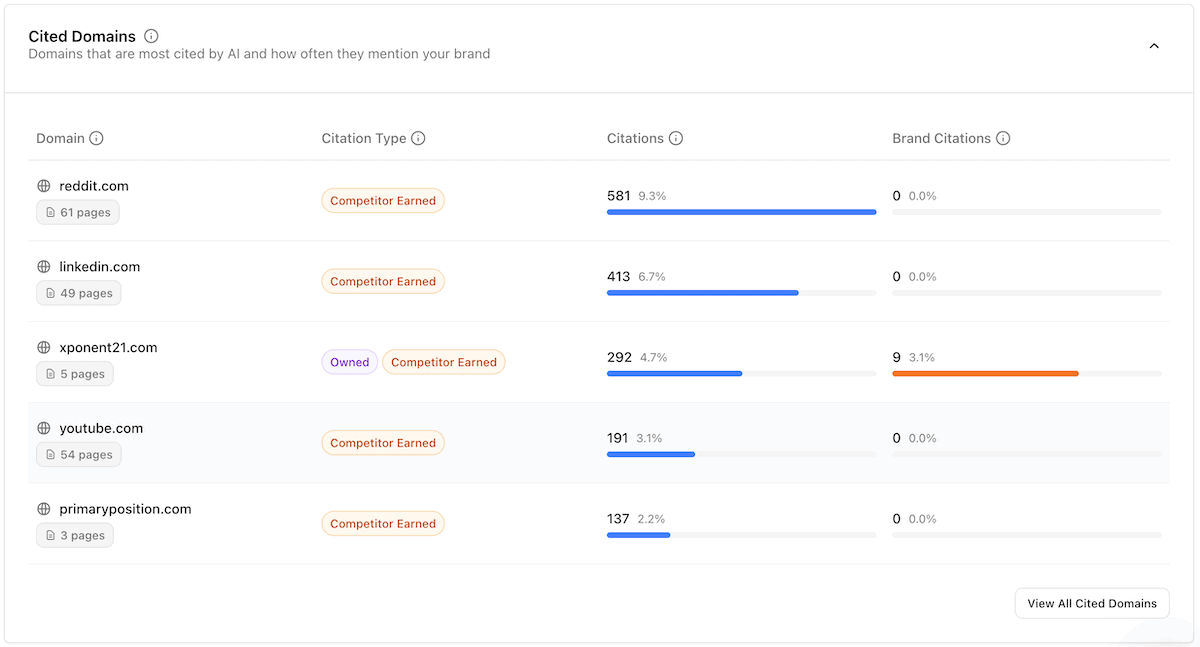
Citation analysis across large language models for AI SEO topics. Reddit, LinkedIn, and YouTube are consistently among the most cited domains — along with Xponent21 for this specific topic area.
With AI Overviews and AI Mode condensing search results into a handful of cited sources, having a strong, verifiable online footprint is no longer optional. If AI cannot confirm your authority from your online presence, your content is at risk of being excluded from these condensed outputs entirely — regardless of its quality.
7. Citation Gravity: Why Early Citations Compound
Top search positions still drive clicks, but they are a much weaker predictor of AI citations than they were a year ago. In 2025, Ahrefs found that 76% of AI Overview-cited pages ranked in the top 10. A newer Ahrefs analysis of 863,000 keywords and 4 million AI Overview URLs found that only 38% of cited pages now rank in the top 10, with the rest split between positions 11–100 and beyond (Ahrefs notes that part of the change reflects better citation detection). For AI Mode, a Moz study of about 40,000 queries found that 88% of citations did not appear in the organic top 10 for the same query.
Rankings remain a foundation, but the compounding that matters now is citation.
The reason is query fan-out: Google runs several related searches behind one prompt and cites pages that answer those sub-questions, so a page can be cited without ranking for the exact query the user typed. Generative outputs also consolidate answers into summaries with a limited set of sources. That creates a compounding effect: content that is cited gets seen more, which reinforces its authority in future AI-generated responses, which makes it more likely to be cited again.
This dynamic has a name in network science: cumulative advantage, often called the Matthew effect. Content that earns citations today becomes more visible to the systems deciding what to cite tomorrow, which reinforces its authority and helps it hold position. The gap between the sources that get cited and the ones that don’t widens as the leaders keep accruing the advantages that came from leading in the first place.
The strategic implication: rankings remain a foundation, but the compounding that matters now is citation. Earn citations early and consistently across the related questions around your topic, so the compounding works in your favor instead of a competitor’s. We track this dynamic in our CARL research.
8. Adapt to AI Search Trends
AI search is moving faster than any previous shift in SEO. Strategies that worked in 2024 need to be revisited in 2026. Here’s how to stay current:
- Regular Content Audits: Schedule periodic reviews of your content to identify pages that are outdated, underperforming, or no longer aligned with how AI systems are evaluating your topic area. Refreshing these pages — with updated data, revised examples, and new context — is often more effective than publishing new content from scratch.
- Stay Informed: Follow developments in AI search, SEO, and Generative Engine Optimization (GEO) from sources that track the space closely. Google’s own guide to optimizing for generative AI features and resources like Moz’s Whiteboard Friday publish analysis that translates technical AI developments into practical content strategy.
- Experimentation and Testing: Test different content formats, heading structures, and schema implementations to identify what earns the most AI citations for your specific topic area. A/B testing across page variants provides data-driven guidance rather than guesswork.
- Which Platform to Optimize For: Don’t build separate content for each AI platform. In our CARL research, content closely aligned with the semantic center of a query cluster performed similarly across platforms, so one well-aligned, well-evidenced page does more than platform-specific versions. See The CARL Model.
9. Measure Success with AI-Centric Metrics
Traditional SEO metrics still matter, but measuring performance in AI-driven search requires tracking additional signals specific to how AI systems surface and cite content.
- AI Citation Tracking: Use tools like CARL Intelligence to monitor when and where your content is being cited in AI-generated responses. CARL Intelligence is Xponent21’s proprietary AI Visibility tool that surfaces share-of-voice data and competitive benchmarks that traditional analytics tools don’t capture. Learn how it works.
- Snippet Performance: Monitor how often your content appears in featured snippets using Google Search Console or SpyFu. Snippet visibility is a useful proxy for how extractable your answers are.
- AI Referral Traffic: In Google Analytics 4, build a segment for visits from AI platforms such as chatgpt.com, perplexity.ai, claude.ai, copilot.microsoft.com, and gemini.google.com, and track engagement and conversions from those visits.
- AI Features in Search Console: Google Search Console reports AI Overview and AI Mode impressions and clicks within its Performance data. Use it to spot the queries and pages gaining AI exposure.
- AI-Assisted Analysis: Load your Google Analytics and Search Console reports into ChatGPT, Claude, or a similar tool to generate prioritized action items from your performance data. This approach compresses analysis time and surfaces patterns that manual review can miss.
Frequently Asked Questions About Ranking in AI Search Results
Does AI-generated content rank in search results?
Yes. AI-generated content ranks in search results and gets cited by AI chatbots when it is accurate, well-structured, and demonstrates genuine expertise. The key is to use AI as a drafting tool while contributing original professional knowledge before publishing. Content produced entirely by AI without human expertise layered in tends to lack the specificity and authority that AI search systems are designed to favor.
What is Generative Engine Optimization (GEO)?
Generative Engine Optimization (GEO) refers to the practice of optimizing content to appear in AI-generated responses from tools like Google AI Overviews, Claude, ChatGPT, and Perplexity. It extends traditional SEO by addressing how large language models evaluate, select, and cite sources — not just how search engines crawl and index pages. Google itself describes optimizing for its generative AI features as SEO.
How do I check if my content appears in AI Overviews?
Tools like CARL Intelligence monitor your brand’s appearance in AI Overviews, AI Mode, and other generative AI outputs. Google Search Console surfaces queries where your content is being shown, which can indicate AI Overview inclusion when cross-referenced with SERP data.
What percentage of Google searches now include AI Overviews?
As of September 2026, 80% of Google search results pages include AI Overviews — up from 60% in November 2025 and just 25% in August 2024. AI Overviews were introduced in May 2024 and have expanded faster than any previous Google search feature. (Source: Xponent21 tracking data)
What schema markup types are most effective for AI search?
No schema markup automatically makes your content appear in AI search, and Google says structured data is not required for generative AI search at all. Still, for broader SEO and entity clarity, Organization schema is the foundation. It tells engines your brand’s name, logo, founder, and contact details, and the sameAs property links to authoritative references. Article or BlogPosting is important because Author, datePublished, dateModified, and publisher give AI systems freshness and authorship, which feed the E-E-A-T signals. Product is important to match e-commerce buyers with results, and LocalBusiness is important for winning “service near me” searches.
Do I need llms.txt or special markup to appear in AI Overviews?
No. Google’s guide to optimizing for generative AI features says Google Search does not use llms.txt and that no special schema.org markup is needed. To be eligible, a page must be indexed and eligible to appear in Google Search with a snippet. Focus on unique, useful content and sound technical SEO.
Conclusion: Ranking in AI Search Requires More Than Keywords
Optimizing for AI-driven search is a continuous process that combines technical fundamentals with a clear understanding of how AI systems evaluate authority and select sources. The core principles are consistent: build verifiable expertise, structure content for machine readability, earn citations from authoritative sources, and build the early citations that compound over time through the Matthew effect.
The window to establish first-mover authority in AI search is narrowing. The sources AI systems cite most frequently today are building the training data influence that will shape citations tomorrow. We know what it costs to let that slip: Xponent21 dropped from 90,000 daily impressions to under 9,000 in a single quarter when our own publishing program went ad hoc. We published exactly what happened and why — because the lesson is too important not to share. Waiting to optimize, or maintaining it inconsistently, is a decision to cede ground to competitors who are not waiting.
At Xponent21, AI-driven search engines recognize and cite our insights across Google AI Overviews, Claude, ChatGPT, and Perplexity, establishing us as a recognized authority on AI search optimization. Our team helps clients build the structured, authoritative content presence that AI systems are designed to favor. Contact our Richmond SEO agency for guidance on building AI search visibility that compounds over time.
Get more free tools in our AI SEO Tool Library.
For more on AI search optimization, read these related guides:
- Google Crossed 80% AI Overviews: Why It Matters for Business
- The Micro-Strategies That Make AI SEO Actually Work
- [Guide] The AI SEO Content Accelerator — 14 Steps to Success
- What to Ask an SEO Agency Before You Sign
- SEO vs. SEO and AI Visibility Management: Choosing an Agency
- Is Your SEO Agency Failing to Adapt to AI Search?
- [AI SEO Case Study] One Shoot, 5 Videos, 2.1 Million Organic Impressions + AI Search Dominance
Watch our Lunch & Learn, Adapt or Disappear: How AI is Upending Search and SEO and What You Need to Do Now, to see these strategies applied in a live format.
Need to make the case for AI search investment to a leadership team or non-marketing audience? Download our mini guide, 8 Steps to Optimize Your Website for AI Search, and share it with anyone who needs to understand why this matters now.
Ready to act? Start with our guide, 7 Steps to Reclaim Your Traffic with an Informed AI SEO Strategy — a task-oriented walkthrough for building AI search visibility from the ground up.
For the thinking behind this work, read Shaping Reality: A Journey into Influencing Generative AI Outputs and AI Search Engine Results on WillMelton.com.
About the Author: Will Melton is CEO of Xponent21, founder of AI Ready RVA, and an instructor at the University of Richmond. He has been recognized among Virginia Business Magazine’s 100 People to Meet for 2025 and Style Weekly’s Top 40 Under 40. His work on AI search visibility has been cited across Google AI Overviews, Claude, ChatGPT, and Perplexity. View full bio.

Will Melton
Will Melton, CEO of Xponent21 and consultant to global companies, brings nearly 20 years of leadership in technology and marketing. He is the founder of AI Ready RVA and Richmond Water, podcast host for Channel RVA, and serves on several charitable boards in Richmond, VA. Recognized as one of the world’s top experts on AI SEO, Will was one of the earliest adopters or AI visibility and has pioneered strategies that have achieved top citations across Google AI Overviews, ChatGPT, Claude, and Perplexity, making him a global authority on the future of search.