Marketing
What a Fintech AI Visibility Benchmark Shows Any Business About AI Search
By: Will Melton
Published Date: November 9, 2026
Modified Date: November 10, 2026
Only a small fraction of commercial brand placements are consistently visible across major generative engines, while others remain completely absent. The vast majority of brands appear inconsistently, surfacing in some models or for certain query phrasings while vanishing in others.
These findings come from an empirical study of generative answer behavior conducted by Jeff Jenkins at DIGI CONVO. Will Melton connected with Jeff through Discover AIO and followed his rigorous work in the financial technology sector. While the research evaluates financial technology, the underlying discovery mechanics reveal how generative models evaluate, retrieve, and cite commercial entities in every industry.
Discovery has split across two distinct environments:
- In traditional search, high domain authority and backlink profiles dictate organic rankings.
- In AI Search, models synthesize unstructured recommendations based on semantic relevance, specific category language, and contextual entity associations.

An AI visibility benchmark provides the structured data needed to understand how answer engines make these recommendation decisions.
What the Fintech Benchmark Measured Across AI Search Engines
The fintech study evaluated companies across multiple vertical placements spanning eight verticals. Conducted on June 2, 2026, the evaluation ran unbranded queries across four engines: ChatGPT, Gemini, Claude, and Perplexity.
To quantify how engines surface brands, the benchmark categorized visibility into four distinct tiers:
- Highly Visible: Brands that appeared consistently across generative responses, surfacing in at least three of the four evaluated engines.
- Partially Visible: Brands that appeared irregularly, showing presence in certain models or specific query variations while missing from others.
- Low Visibility: Brands that generated sporadic, isolated mentions.
- Invisible: Brands that failed to surface in any engine response for their vertical queries.
The discovery environment where these engines operate is replacing standard search routines. According to research from Xponent21, Google AI Overviews appear in over 85% of U.S. search results as of October 2026. Furthermore, Ahrefs found that AI Overview presence reduces top-ranking page CTR by roughly 58%. Data from the Pew Research Center indicates that users clicked a traditional result on 8% of searches with an AI summary versus 15% without.
When an AI summary captures user attention, brand presence inside that synthesis becomes the decisive business asset. If a brand is not cited in the initial synthesis, it misses the user interaction entirely.
Why High Domain Rating Fails to Predict AI Engine Recommendations
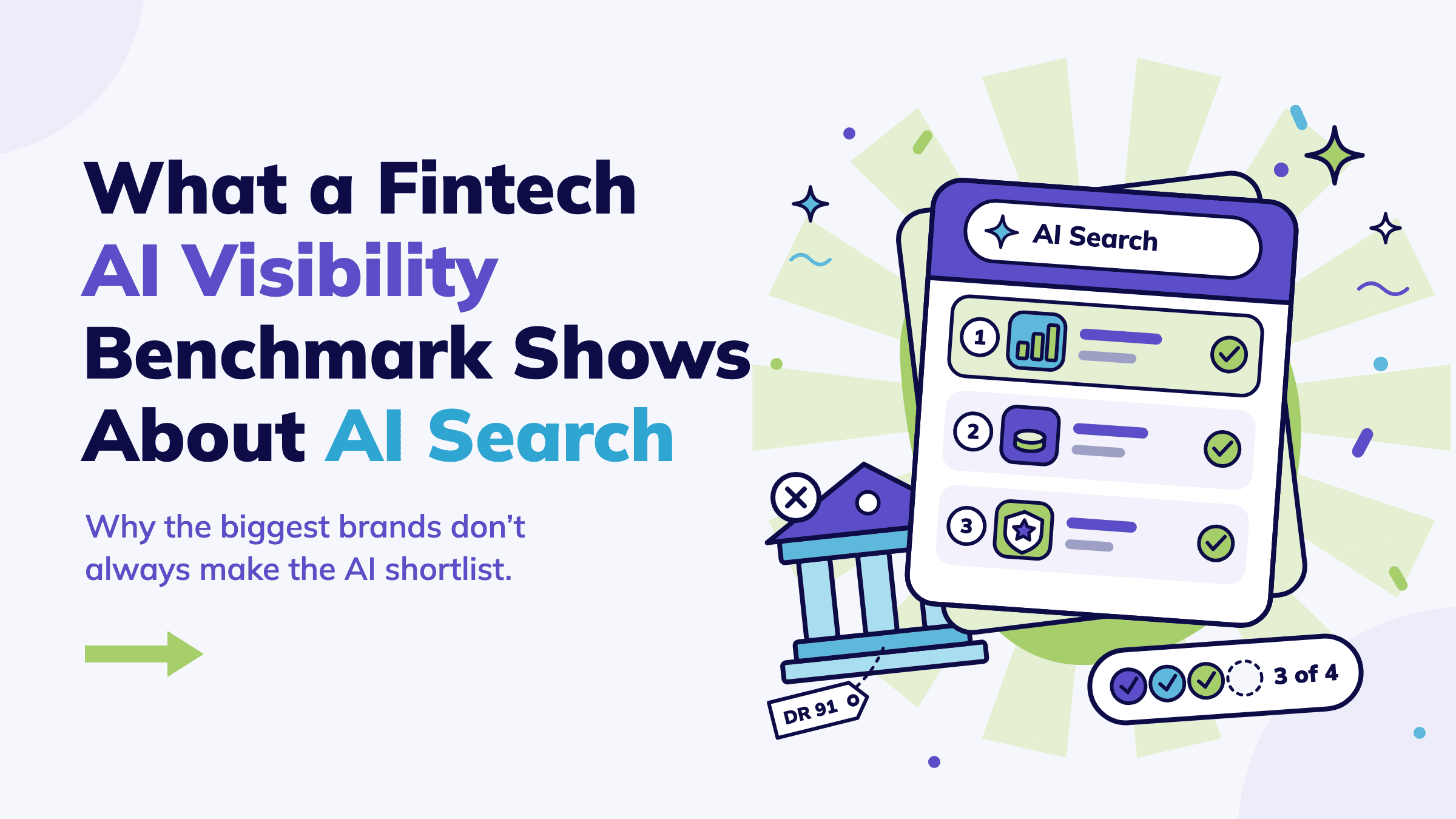
Traditional SEO relies heavily on third-party authority metrics, particularly Domain Rating (DR), to forecast organic performance. The benchmark findings show that Domain Rating demonstrated a weak correlation with AI engine visibility in the sample, explaining very little of the variance and indicating that traditional authority metrics do not reliably predict inclusion in AI-generated answers.
Established brands with substantial backlink profiles frequently underperform smaller competitors inside generative syntheses. In the benchmark data:
- Sift held a high authority profile yet failed to appear in generative visibility results.
- Remitly held a strong authority profile and remained absent from engine answers.
- Rapyd held substantial domain authority but generated no visibility.
- Square/Block held an elite authority profile yet earned only modest visibility.
- A specialized embedded finance platform with a modest authority profile achieved strong visibility.

This divergence aligns with broader technical studies on generative citation patterns. A study cited within the research from Ahrefs analyzing prompt datasets found that only a small share of AI-cited URLs ranked in Google’s top organic results.
Generative models do not build recommendation lists by querying standard search indexes and selecting the top three organic results. Instead, large language models retrieve and synthesize information based on conceptual relevance, entity clarity, and whether a brand’s published material directly answers the prompt’s underlying intent. High backlink authority ensures crawl frequency, but it does not guarantee that a model selects a brand as an authoritative recommendation.
How Query Framing and Entity Language Determine AI Presence
The benchmark demonstrated that minor adjustments in query framing produce massive shifts in brand inclusion. Generative engines do not treat synonyms as equivalent keywords. They interpret slight variations in prompt structure as entirely different topical categories.
In one placement, adjusting the query framing dramatically increased a single company’s visibility, lifting its score from modest levels on generic category phrasing to top-tier visibility when using precise entity language. When prospective buyers search using broad category terms, engines surface diversified, high-level answers. When prompts incorporate precise industry terminology, engines narrow their candidate pool to entities that explicitly reflect that language.
This variance created total visibility divides among direct market competitors:
- Finxact appeared in every answer for cloud-native core banking queries, yet appeared in none of the answers for banking-as-a-service (BaaS) queries.
- Identity verification platforms Socure and ComplyAdvantage each captured an isolated query frame with zero overlap between them across the engine responses.

For commercial organizations, this behavior proves that optimizing for a primary keyword cluster is insufficient for AI Search. AI engine recommendations depend on the exact entity framing that a prospective buyer enters into a prompt. If a brand defines its positioning using ambiguous marketing terminology rather than the specific vocabulary used in technical buying criteria, answer engines bypass the brand entirely.
Evaluating the Limits of Single-Day AI Visibility Data
While the benchmark delivers crucial visibility patterns, commercial teams must understand the scope of the underlying methodology. The benchmark represents a single-day snapshot collected on June 2, 2026, measuring observable outcomes across two queries per vertical rather than permanent rankings or root causal algorithms.
Generative platforms update their model weights, search grounding indexes, and system prompts on an ongoing basis. A single-day capture documents what an engine outputted at a specific point in time, but it cannot account for algorithmic shifts, seasonal query variance, or model drift.
Additionally, sample constraints must be factored into any strategic evaluation:
- The benchmark measured two queries across eight vertical categories, which provides directional trends rather than comprehensive vertical coverage.
- The analysis measures observable external outputs rather than the proprietary weighting algorithms operating inside OpenAI, Google, Anthropic, or Perplexity.
- In the research report, Jeff Jenkins discloses that PayQuicker and one other benchmarked company are active DIGI CONVO clients.
Static snapshots identify visibility gaps, but commercial leaders cannot treat point-in-time assessments as permanent market intelligence. AI search visibility requires ongoing measurement across evolving prompt distributions.
Translating Snapshot Findings Into Ongoing AI Visibility Management
To build durable authority across generative platforms, brands must move beyond periodic testing and implement structured AI visibility tracking. Visibility operates as an active portfolio across multiple platforms, including ChatGPT, Perplexity, Claude, and Gemini.
Managing presence across this portfolio requires tracking brand mentions against a live, growing dataset, such as the one built and maintained by Xponent21’s CARL Lab. Rather than evaluating isolated keywords, structured tracking measures brand presence across hundreds of high-intent prompt variations that mirror how actual buyers query answer engines.
Tracking generative visibility provides actionable business intelligence across several operational areas:
- Prompt Gap Identification: Discover specific phrasing variations where competitors surface but your brand is excluded, allowing content teams to produce targeted technical assets that answer those exact prompts.
- Engine Divergence: Identify why a brand earns high citation frequency in Perplexity while remaining absent in ChatGPT, pointing toward differences between real-time web retrieval grounding and static model pre-training.
- Integrated Authority Building: Align digital public relations, technical website architecture, and informational content into an integrated approach that establishes clear entity associations for AI retrieval systems.
A high domain score and historic organic rankings will not preserve discovery in generative platforms. By benchmarking current AI search performance and tracking prompt visibility systematically over time, organizations can measure their presence accurately, address structural entity gaps, and capture high-intent demand across every generative surface.

Will Melton
With nearly 20 years of experience leading businesses in technology and marketing, Will is passionate about helping companies worldwide harness their unique culture, dedication to service, and innovative solutions to outperform in the digital space. As a recognized expert in AI search and AI overviews, Will has developed cutting-edge strategies that not only elevate brands to the top of AI-driven search results but also transform the customer experience and drive business productivity. His talent for crafting modern brand strategies that deliver measurable impact, while pushing the boundaries of what's possible, is fueled by his relentless drive to see businesses succeed in the evolving digital landscape.