By: Will Melton
Published Date: October 26, 2026
Nonprofits spend thousands of dollars each month renting proprietary software platforms, only to discover that their mission-critical information is trapped in disconnected databases. True nonprofit data ownership means maintaining direct custody of your underlying schema, raw records, and programmatic pipelines. Moving from rented platforms to an owned data layer eliminates repetitive manual reporting, removes vendor lock-in, and builds the authoritative foundation required to earn visibility across AI Search engines.
The Hidden Cost of Rented Platforms and Siloed Operations
Every digital transformation begins with good intentions. An executive leadership team approves a dedicated donor management tool, a separate ticketing system for events, an email marketing platform, and a specialized portal for grant reporting. On paper, each hosted platform solves a distinct operational problem. In practice, this setup creates isolated software silos that split an organization’s institutional knowledge into disconnected subscription products.
The operational friction becomes obvious at the end of every reporting period. Development teams pull donor records into local files. Marketing staff export form submissions from website plugins. Program managers compile participation tallies from hosted forms. Because these proprietary tools cannot communicate directly at the database level, staff spend hundreds of hours manually aligning mismatched columns and verifying duplicate records.
This dynamic saps staff capacity through duplicate manual reporting. Instead of analyzing donor retention patterns or expanding community outreach, skilled professionals function as human data bridges. Leadership pays recurring subscription fees for the privilege of running an inefficient manual data factory.
When leadership decides to replace an underperforming tool, the real cost of rented infrastructure appears. Exporting historical activity from a proprietary vendor rarely yields a usable, clean relational database. Instead, teams receive flat files stripped of context, interaction histories, and relationship mappings. Vendor lock-in restricts an organization’s ability to switch CRM or donation tooling, particularly when platforms impose proprietary export schemas or restrict programmatic API calls. The software vendor holds the operational keys, while the nonprofit bears the migration penalty.
What Nonprofit Data Ownership Actually Means
Holding an administrative login to a hosted web platform is not the same as owning your data. When a third party hosts your application and stores your records in a closed, proprietary schema, you are renting operational custody. If you stop paying the monthly subscription fee, access to historical records, customer journeys, and automated pipelines vanishes.
Nonprofit data ownership requires three technical realities:
- Direct database custody: The organization controls the underlying relational database or centralized data warehouse where raw records reside. The schema is documented, open, and fully accessible to internal engineers or technical partners.
- Programmatic API access: Every tool in the technology stack can read and write data through automated application programming interfaces (APIs) without vendor-imposed export caps, manual downloads, or artificial paywalls.
- Owned web and digital infrastructure: The primary publishing properties, form endpoints, and conversion pathways live on open, owned architectures rather than proprietary website builders that restrict access to underlying server code and structured data markup.
Having real ownership transforms your relationship with technology vendors. Proprietary tools become replaceable utilities rather than permanent operational homes. When an email distribution platform or donor intake system fails to serve organizational goals, the tool can be swapped out without rebuilding years of collected intelligence. The central repository remains untouched. Raw transaction logs, historical touchpoints, and constituent profiles belong exclusively to the nonprofit.
Why Proprietary SaaS Traps Reporting in Manual Spreadsheets
Proprietary subscription software is intentionally designed to retain accounts. Platforms encourage users to input data through proprietary interfaces, but they make programmatic data extraction difficult or prohibitively expensive.
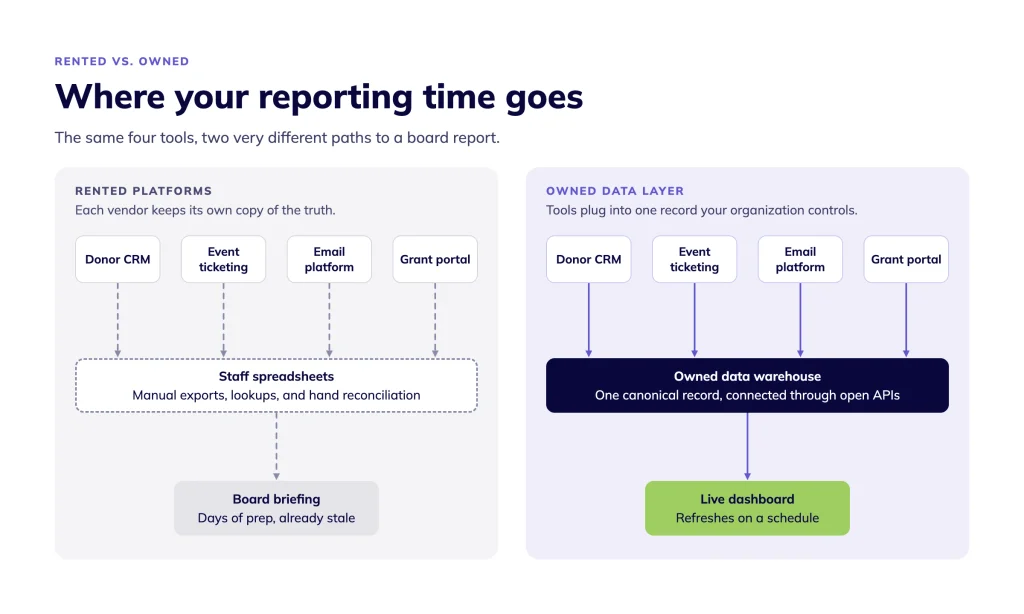
The result is a recurring reporting trap. When the board asks for an executive briefing on high-intent lead growth across programmatic initiatives, staff cannot query a single system. The website traffic metrics live in one analytics platform. The individual donation records live in a fundraising database. The community impact figures sit inside a programmatic case-management platform. None of these systems share a common identifier or an automated data pipeline.
Staff members spend days performing weekly spreadsheet gymnastics. They export spreadsheets, normalize date formats, write lookup formulas, and reconcile discrepancies by hand. This process introduces human error and creates version control confusion across departments.
Migrating to an owned data warehouse reduces reporting overhead across all nonprofit sizes for most organizations with multi-system tech stacks, though workflows vary by technical resource availability. Centralizing records into an owned database layer allows business intelligence tools to query live data directly. Reports refresh automatically on scheduled cadences. Executive dashboards present accurate, real-time insights without pulling programmatic staff away from their core mission.
The Integrated Architecture: Unifying Web, Donors, and Impact Data
Solving the manual reporting trap requires an integrated approach. Rather than managing disconnected point solutions, an organization treats its digital presence as a coordinated ecosystem that connects web design, programmatic initiatives, and search visibility into a single operational narrative.
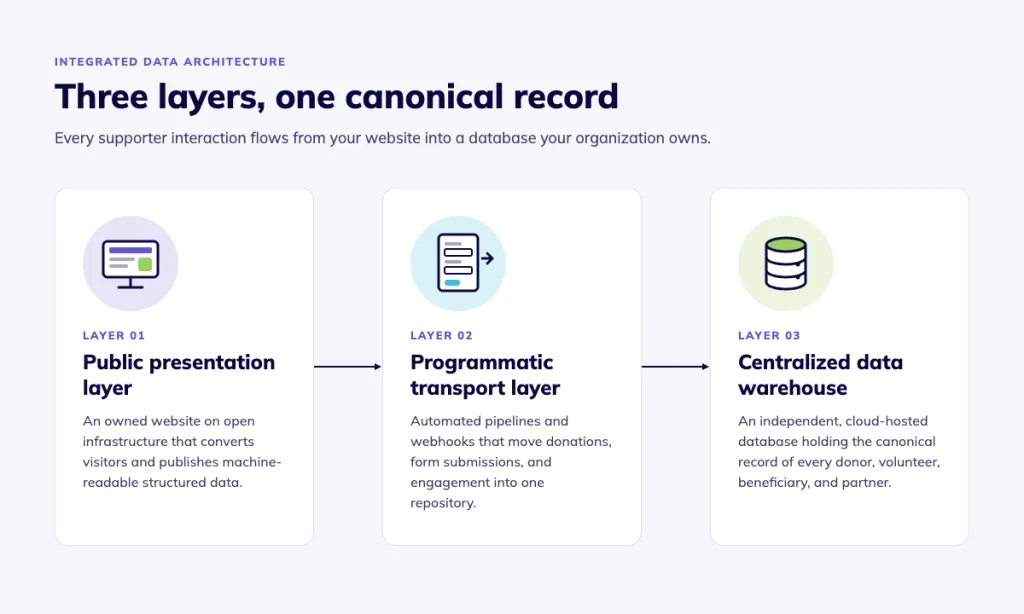
An integrated data architecture links three distinct layers:
- The public presentation layer: An owned website built on open infrastructure that converts visitors into active supporters, captures high-intent engagement, and exposes machine-readable structured schema.
- The programmatic transport layer: Automated pipelines and webhooks that instantly transmit transactional data, form submissions, and visitor engagements into a unified repository.
- The centralized data warehouse: An independent, cloud-hosted relational database that stores the canonical record of every donor, volunteer, beneficiary, and partner.
When these systems connect without friction, operational drag disappears. When a supporter donates online, the transaction processes securely and logs directly into the centralized warehouse. It updates the constituent record and triggers appropriate communication workflows automatically. When an executive runs an operational report, the database already contains complete attribution, showing which digital initiatives produced verified impact.
How Owning Your Data Prepares Your Nonprofit for AI Search and Visibility
The benefits of data sovereignty extend beyond internal operational sanity. How an organization manages its canonical data directly impacts its digital discoverability across modern search engines.
Search is experiencing a structural realignment. Google AI Overviews now routinely appear across search results, fundamentally altering how prospective donors, grantmakers, and corporate partners discover mission-driven organizations. At the same time, users increasingly bypass traditional search engine results pages entirely, relying on AI Search platforms like ChatGPT and Perplexity to research nonprofit initiatives, vet institutional credibility, and find causes to support.
These AI platforms do not evaluate organizations using vanity engagement data. Instead, they extract verified entities, citation networks, structured definitions, and authoritative factual records. If your organizational data is trapped inside closed software silos, search engines and large language models cannot index your true impact or verify your entity authority.
When you control your data layer and maintain an owned web presence, you can publish structured data schemas, clear impact metrics, and authoritative research directly to the public web. AI Search engines crawl these canonical records, verify your expertise, and cite your organization as the primary source when users ask high-intent questions about your focus areas. Data ownership provides the verified foundation needed to establish authority across both traditional search and AI discovery engines.
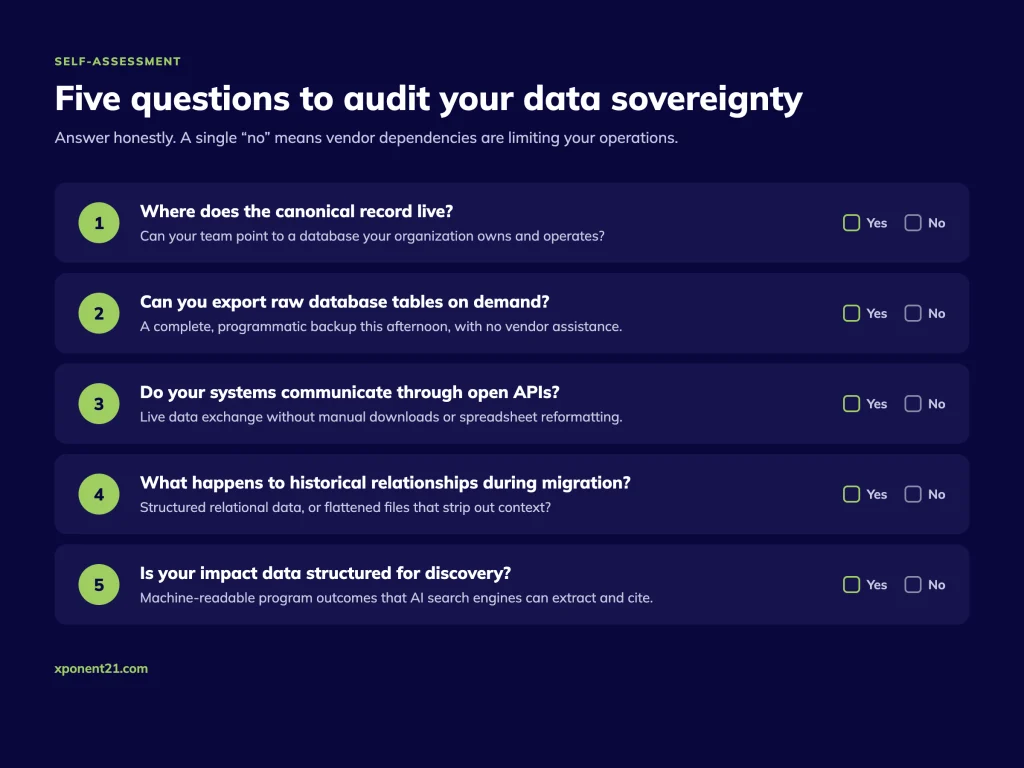
Five Questions to Audit Your Organization’s Data Sovereignty
Executive leaders must assess whether their current software stack builds lasting equity or operational vulnerability. Use these five audit questions to evaluate your organization’s data custody:
- Where does the canonical record live? Can your technical team point to a database that your organization owns and operates, or does your customer and donor intelligence live entirely inside third-party application servers?
- Can you export raw database tables on demand? If you needed a complete, unedited backup of your database schemas, tables, and interaction histories this afternoon, can you execute that export programmatically without vendor assistance?
- Do your systems communicate through open APIs? Can your web infrastructure exchange live information with your primary management systems without manual file downloads and spreadsheet reformatting?
- What happens to historical relationships during migration? If you terminate your primary platform contract tomorrow, does the vendor provide structured relational data, or do they hand you flattened files that destroy historical context?
- Is your impact data structured for discovery? Does your owned website expose canonical program outcomes in clean, machine-readable formats that AI Search engines can extract and cite?
If your organization answers negatively to any of these questions, your operational capacity is constrained by vendor dependencies.
Take Control of Your Organization’s Data Future
Renting proprietary software without database ownership forces your staff into endless spreadsheet triage, locks your operations into vendor-controlled ecosystems, and limits your visibility across modern search engines. Treating your data as a strategic institutional asset changes your trajectory.
At Xponent21, we help forward-thinking organizations build owned digital architectures that unify web development, strategic content, and AI SEO. By replacing manual reporting loops with integrated data pipelines, we establish the technical foundation your team needs to reduce overhead and expand mission reach.
Schedule a growth strategy session with Xponent21 to audit your data architecture, eliminate manual reporting cycles, and build an owned digital foundation designed for long-term impact.

Will Melton
With nearly 20 years of experience leading businesses in technology and marketing, Will is passionate about helping companies worldwide harness their unique culture, dedication to service, and innovative solutions to outperform in the digital space. As a recognized expert in AI search and AI overviews, Will has developed cutting-edge strategies that not only elevate brands to the top of AI-driven search results but also transform the customer experience and drive business productivity. His talent for crafting modern brand strategies that deliver measurable impact, while pushing the boundaries of what's possible, is fueled by his relentless drive to see businesses succeed in the evolving digital landscape.