
Marketing
Gamification Marketing: Navigating Strategic Investments and Outcomes
By: Will Melton
Published Date: November 6, 2026
Gamification marketing integrates game-like elements into marketing strategies to drive engagement and achieve business objectives. For businesses with growth ambitions, understanding its return on investment (ROI), typical costs, implementation timelines, and measurable effectiveness directly impacts strategic planning and resource allocation.
Gamification Marketing: Strategic Considerations for Leaders
Modern marketing leaders face the challenge of capturing audience attention in an increasingly fragmented digital landscape. Gamification marketing provides a structured approach to enhance user interaction, but its strategic value extends beyond mere novelty. It focuses on integrating mechanics like points, badges, leaderboards, and challenges into marketing campaigns, content, or product experiences to motivate specific actions from the target audience. For business owners and marketing directors, the decision to implement gamification involves weighing its potential to foster deeper customer relationships and gather valuable data against resource allocation. A successful gamification strategy aligns directly with business goals, whether increasing brand loyalty, driving conversions, or improving educational outcomes.
Measuring Gamification ROI
Determining the return on investment for gamification marketing requires clear objectives and robust tracking mechanisms. Unlike traditional marketing efforts where attribution can be straightforward, gamified campaigns often generate both direct and indirect value. Direct value can include increased sales, higher lead conversion rates, or reduced customer acquisition costs. Indirect benefits are equally important, encompassing enhanced brand loyalty, improved customer data collection, and deeper product engagement, which contribute to long-term customer lifetime value.
To measure direct ROI, marketing leaders must establish baseline metrics before launching a gamified campaign. For example, tracking conversion rates from non-gamified content versus gamified content, or comparing retention rates for customers enrolled in a loyalty program against those who are not. Measuring indirect ROI involves analyzing shifts in brand sentiment, social sharing, and user-generated content prompted by game mechanics. This dual approach ensures a holistic understanding of the campaign’s impact. The true value lies not just in immediate transactions but in building sustained engagement that fuels future growth.
Typical Costs and Build Timelines
The investment required for a gamified marketing campaign varies significantly based on complexity, platform, and desired features. Simpler gamified content, such as quizzes, interactive polls, or basic scavenger hunts integrated into existing websites, may have lower development costs and shorter timelines, potentially weeks. More sophisticated branded games or full loyalty programs with custom backend integrations and advanced analytics can demand substantial investment, extending into months or even a full year for development.
Cost components typically include concept design, UX and UI development, programming, testing, content creation for game elements, and ongoing maintenance. Independent pricing data for gamified campaigns specifically is scarce. The closest benchmark is custom software development, which covers the work behind a gamified experience with a custom backend and analytics integration. Clutch’s 2026 pricing data, drawn from verified client reviews, shows that most custom software projects cost between $10,000 and $49,999, with larger builds running well above that. Lightweight formats such as quizzes and polls on an existing site generally cost less, while branded games and loyalty programs with custom integrations cost more. Plan for ongoing optimization and content updates alongside the build, since sustained engagement depends on both.
Gamification Effectiveness: When Engagement Translates to Business Outcomes
Gamification marketing consistently demonstrates its ability to boost user engagement, but the critical question for business leaders is how this engagement translates into tangible business outcomes. Evidence suggests that when designed strategically, gamified experiences can drive measurable improvements across various key performance indicators (KPIs).

Case Study: Weidmuller is Everywhere Trade Show Kiosk Game
We designed a custom kiosk game for Weidmuller USA’s trade show booth that turned booth visitors into leads and gave the client the behavioral data their pipeline had been missing.
- During a pilot at Virginia Commonwealth University, 89.7% of game players opted in to receive email marketing and 55% started following Weidmuller USA on LinkedIn.
- Of 911 players at the Data Center World trade show, 37% submitted their contact details.
The effectiveness of gamification hinges on aligning game mechanics with specific business objectives. If the goal is lead generation, a gamified quiz or interactive tool can capture user data while providing value. For customer retention, loyalty points that unlock exclusive content or discounts prove effective, with some programs achieving customer lifetime value (CLTV) increases. The key is that the gamified content must not only be engaging but also direct users towards actions that contribute to the company’s bottom line. Successful implementation often involves A/B testing different game mechanics and iteratively optimizing the experience based on user data. This approach shifts gamification from a simple novelty to a data-driven tool for achieving strategic growth.
Evaluating Gamification Solutions: Key Questions for Marketing Leaders
When considering new platforms, marketing leaders must ask targeted questions to ensure alignment with their strategic goals and efficient resource utilization.
- First, what specific business problem will the solution solve? Without a clear objective, whether it is improving lead quality, reducing churn, or enhancing brand awareness, the initiative risks becoming a costly distraction.
- Second, how will success be measured, and are the necessary tracking mechanisms in place? This involves defining KPIs and integrating analytics from the outset, not as an afterthought.
- Third, what level of customization and integration is required with existing marketing technology stacks? A solution that integrates seamlessly with CRM, marketing automation, or analytics platforms will yield more complete insights and streamlined operations.
- Fourth, how will the gamified content evolve? Longevity is important. A one-off game may generate a spike in engagement but offers limited long-term value. Consider how new levels, challenges, or rewards will be introduced to sustain interest. These questions help filter potential solutions, ensuring investments contribute to your broader digital marketing objectives.
Understanding Gamified Content Beyond Simple Games
Gamified content adds interactive elements to digital experiences. It encompasses any digital experience that incorporates game design elements to engage users. This includes interactive storytelling, personalized learning modules, virtual experiences, and even advanced chatbots that offer guided paths or reward interactions. For marketing directors, this broad definition means opportunities to enhance nearly any touchpoint in the customer journey. A B2B company might use an interactive configurator for its complex products, turning the selection process into a rewarding discovery journey.
Progress bars and checklists in onboarding flows also guide new customers through setup or initial engagement with a product. These elements tap into innate human psychological drivers like achievement and progression. Gamified content can also manifest as competitive leaderboards for online communities, driving participation and fostering a sense of belonging. The underlying principle is to make mundane or complex tasks more enjoyable and motivating. This approach to content development produces material that is informative, engaging, and memorable. Interactive tools that live on a public page, such as a quiz or calculator, can also earn links and shares, which supports visibility in search. Learn more about custom game design and explore our live demo widgets at onscreengames.com.
Audience Engagement and Conversion Metrics
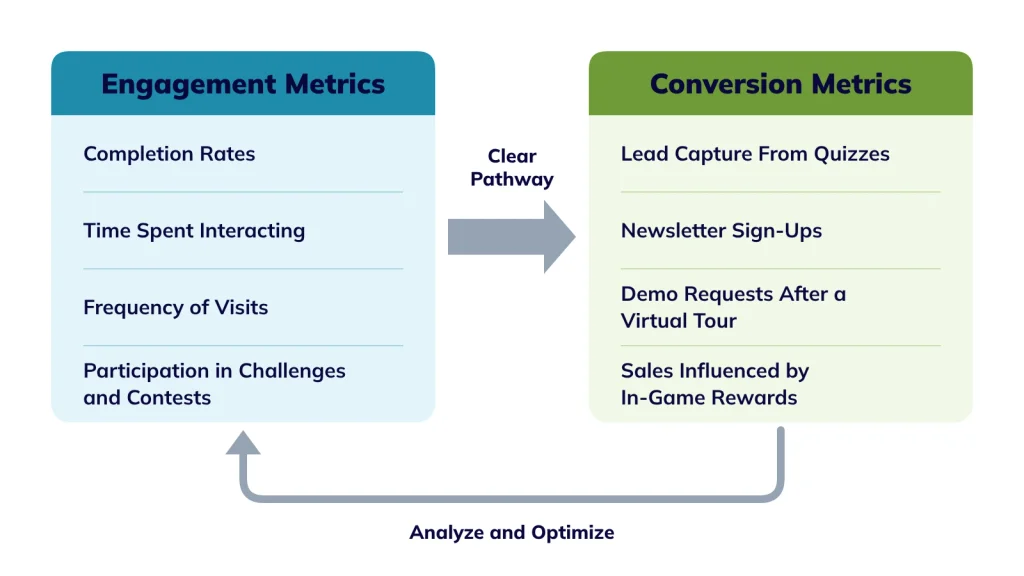
Effective marketing campaigns focus on achieving specific metrics for user interaction and conversion. Engagement is often tracked through metrics such as completion rates for gamified experiences, time spent interacting with content, frequency of visits, and participation in challenges or contests. These metrics indicate how deeply users are interacting with the brand. Conversion metrics, however, connect engagement directly to business objectives.
Key conversion metrics for gamified campaigns can include lead capture rates from quizzes, sign-ups for newsletters prompted by interactive content, product demos requested after a virtual tour, or direct sales influenced by in-game rewards. Beyond these, gamification can also impact metrics like customer feedback submissions, content sharing on social media, and positive brand mentions, all of which contribute to a stronger brand presence and improved sentiment. The goal is to create a clear pathway from initial engagement through a gamified experience to a desired conversion event, continuously optimizing the process based on data analysis.
In-House vs. Agency Gamification Development
The decision to develop gamification solutions in-house or partner with an agency involves a careful assessment of internal capabilities, resource availability, and strategic objectives. In-house development offers greater control over the process and ensures deeper integration with existing brand guidelines and internal systems. It also fosters internal expertise and a proprietary understanding of the gamified experience. However, it demands significant investment in specialized talent, including game designers, developers, UX/UI specialists, and data analysts. This can be a high barrier for many businesses, especially those lacking a dedicated innovation lab.
Partnering with a specialized agency provides access to a breadth of expertise and experience across various gamification projects. Agencies often bring pre-built frameworks, proven methodologies, and a fresh perspective, which can accelerate development timelines and potentially reduce overall costs compared to building a team from scratch. Agencies can also offer more robust analytics and iterative optimization services. The trade-off lies in potentially less direct control and the need for clear communication channels. For companies with growth ambitions, the choice depends on the scale of the gamification ambition and whether the long-term strategic advantage lies in owning the development capability or leveraging external expertise to move faster. Attributing complex digital initiatives to revenue remains a challenge for many B2B marketers, whether the work is in-house or agency-managed. This gap underscores the need for clear ROI measurement strategies regardless of the development approach.
Overcoming Implementation Challenges
Implementing gamification marketing campaigns can present several challenges that marketing leaders must address proactively. One significant hurdle is ensuring that the gamified experience is genuinely engaging and relevant to the target audience, rather than feeling forced or superficial. This requires deep audience research and a clear understanding of what motivates user behavior. A poorly designed gamification strategy can lead to user frustration or disinterest, negatively impacting brand perception.
Another challenge involves technical integration with existing marketing platforms and data systems. Seamless data flow is important for tracking performance and personalizing experiences. Security and data privacy considerations are also vital, especially when collecting user information through interactive elements. Furthermore, maintaining engagement over time requires a strategy for content updates, new challenges, and evolving rewards. Without a clear plan for sustained interest, initial enthusiasm can wane. Overcoming these challenges necessitates a thoughtful design process, robust technical planning, and a commitment to continuous optimization.
Future of Gamification in Digital Marketing
New technologies are rapidly changing how gamification functions in digital marketing. As AI capabilities expand, gamified experiences will become even more adaptive and tailored to individual user preferences and behaviors. AI-driven game mechanics may adjust difficulty or reward systems in real-time, based on a user’s engagement history and psychological profile. This will lead to hyper-personalized marketing campaigns that feel less like marketing and more like bespoke interactive journeys.
We anticipate a rise in augmented reality (AR) and virtual reality (VR) powered gamification, offering immersive brand experiences that blur the lines between digital and physical worlds. The integration of blockchain technology may also emerge, enabling secure and transparent reward systems, perhaps through non-fungible tokens (NFTs) or cryptocurrency rewards. For companies with growth ambitions, these developments represent new frontiers for capturing attention and building loyalty. Gamification will continue to evolve from a niche tactic to a fundamental component of interactive and data-driven marketing strategies, driving both engagement and measurable business growth.
Plan Your Growth-Oriented Gamification Strategy
Developing an effective gamification marketing strategy requires a clear vision and expert execution to ensure measurable business outcomes. Partner with Xponent21 to build engaging, results-driven gamified content that captures your audience’s attention and achieves your strategic objectives. Get clarity with a 30-minute discovery call and map out what a gamified experience could do for your pipeline.

Will Melton
With nearly 20 years of experience leading businesses in technology and marketing, Will is passionate about helping companies worldwide harness their unique culture, dedication to service, and innovative solutions to outperform in the digital space. As a recognized expert in AI search and AI overviews, Will has developed cutting-edge strategies that not only elevate brands to the top of AI-driven search results but also transform the customer experience and drive business productivity. His talent for crafting modern brand strategies that deliver measurable impact, while pushing the boundaries of what's possible, is fueled by his relentless drive to see businesses succeed in the evolving digital landscape.