
Marketing
Podcast Appearances and AI Search Visibility: A Strategic Guide
By: Will Melton
Published Date: November 6, 2026
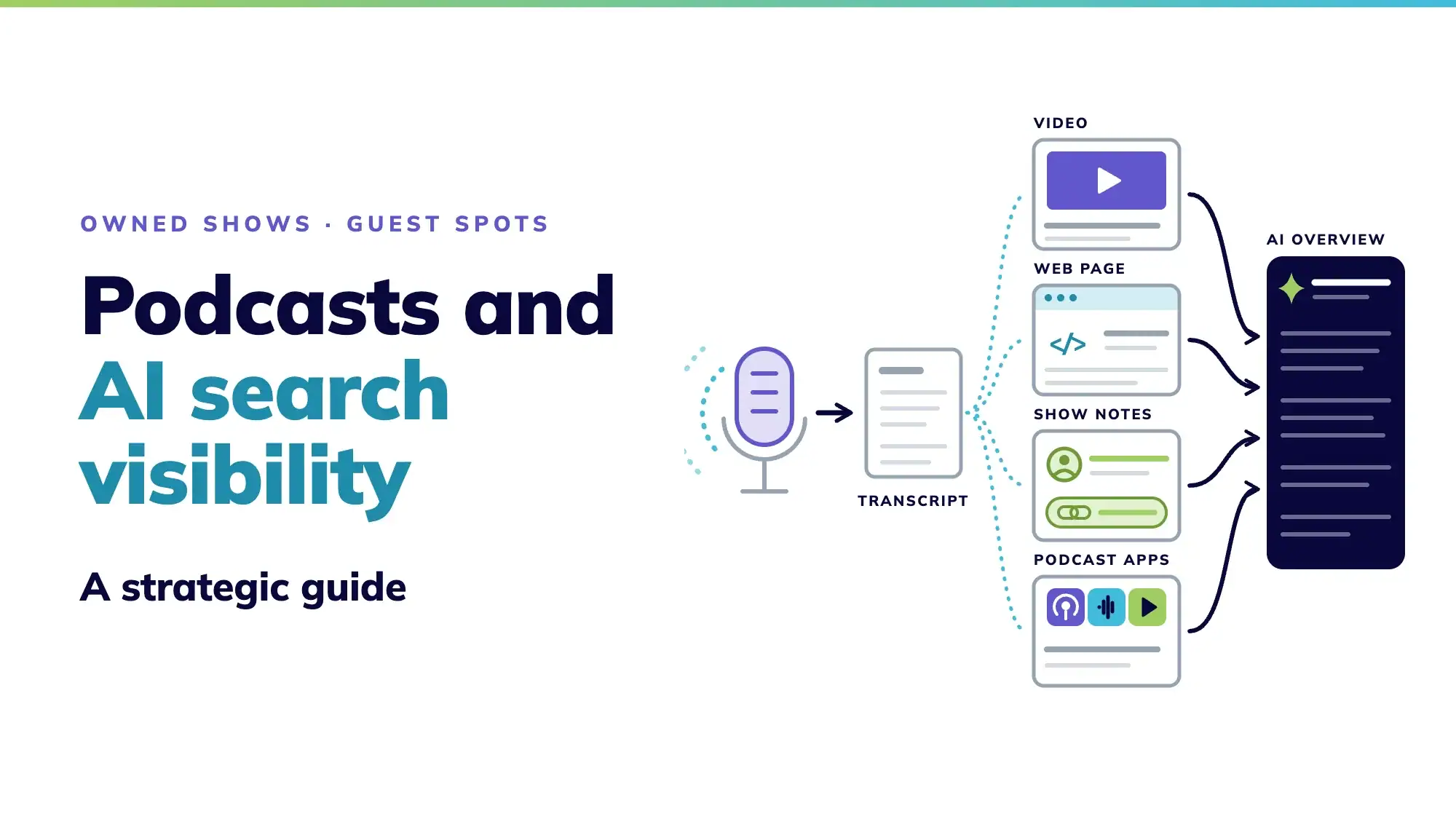
Podcast appearances influence AI search visibility by creating indexable content and generating third-party citations, which AI systems leverage for answers. This strategy extends beyond owned podcasts to include guest appearances, contributing distinct mechanisms to enhance a brand’s presence in AI-generated search results and AI Overviews.
Indexing Podcast Content for AI Search Recognition
AI search engines increasingly rely on diverse content formats to synthesize thorough answers. Podcast transcripts and show notes are critical because they convert audio content into searchable text, making the information accessible to AI models. Without these textual counterparts, valuable insights shared within audio files remain largely invisible to AI systems. Optimizing these textual assets involves including relevant keywords and structuring them for clear extractability, which allows AI to identify and cite specific points. A detailed show notes section, similar to an executive summary, highlights key discussion points and guest names, improving the chances of AI systems finding and referencing the content. Podcast publishing platforms like Buzzsprout provide robust transcription and metadata tools to support improved accessibility and AI visibility.
The impact of structured, indexed content is significant. Research indicates that AI Overview presence reduces the click-through rate (CTR) for top-ranking organic pages by roughly 58%, according to an Ahrefs’ analysis of 300,000 keywords. This shift means that being cited directly within an AI Overview is often more valuable than merely ranking high in traditional search results. Therefore, ensuring podcast content is not only transcribed but also enriched with metadata and clear segmentation becomes a core strategy for achieving AI search visibility. The goal is to provide AI systems with easily digestible, quotable chunks of information rather than requiring them to interpret an entire audio file. This also means structuring content that addresses common user questions directly, allowing AI to efficiently pull answers.
Third-Party Citations and AI Visibility
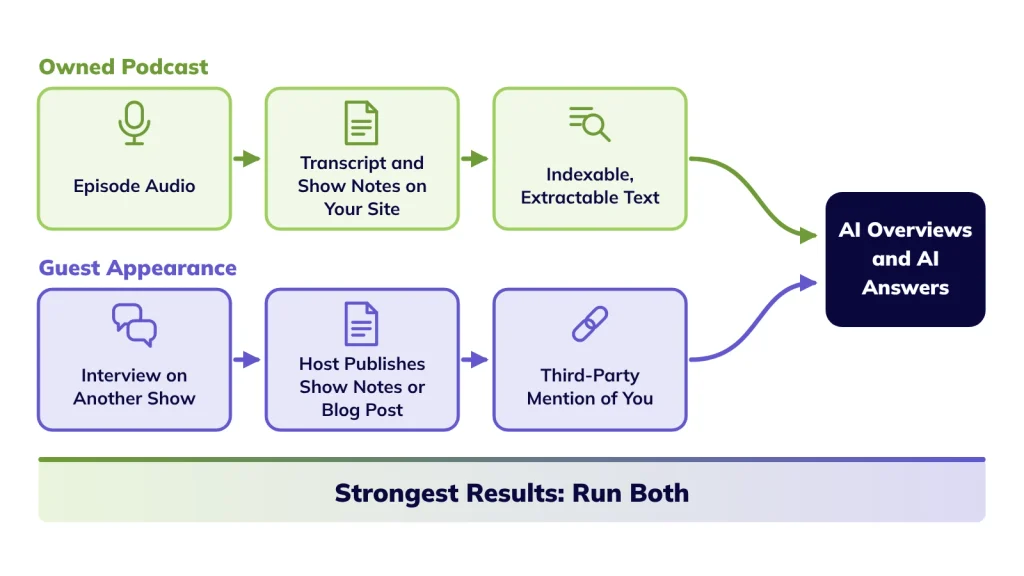
Guest appearances on other podcasts generate third-party citations, which function as earned media for AI search visibility. When an expert is interviewed on a relevant industry podcast, the host’s platform often publishes show notes, blog posts, or episode summaries that mention the guest and their company. An external mention indicates relevance and credibility, similar to a backlink in traditional SEO, but specifically weighted by AI systems as an endorsement. This mechanism is particularly effective because AI systems synthesize information from across the open web, evaluating not just a brand’s own content, but also how other reputable sources discuss that brand.
The quantitative impact of these citations is substantial. Brands cited in AI Overviews earned 35% more organic clicks than non-cited brands, as reported by Seer Interactive. Furthermore, these cited brands also earned 91% more paid clicks, demonstrating a clear advantage in both organic and paid performance. These figures underscore the importance of securing external mentions and the significant influence they have on a brand’s discoverability and perceived authority within AI search. Guesting strategies should therefore prioritize podcasts with well-indexed show notes and strong online presences to maximize citation potential. A guest appearing on a podcast about AI SEO should ensure the show notes clearly link back to their company’s expertise in that area, creating a verifiable citation.
Owned Podcasts Versus Guest Appearances for AI Search Value
Different approaches yield distinct benefits for a brand’s AI presence. An owned podcast allows for complete control over content creation, optimization, and distribution. Brands can ensure every episode is transcribed, show notes are meticulously crafted with relevant keywords and structured data, and the content directly addresses target audience queries. This control facilitates precise optimization for AI extractability, aligning directly with the principles of query fan-out optimization, where a single page can be structured to answer multiple related questions efficiently.
Conversely, guest appearances, while offering less direct content control, excel in generating high-value third-party mentions and expanding reach. When appearing on another podcast, the primary value for AI search comes from the host’s platform citing the guest. These external mentions signal credibility and authority to AI systems, contributing to a brand’s overall citation share. The Pew Research Center found that users clicked a traditional result on 8% of searches with an AI summary versus 15% without, emphasizing the shift in user behavior towards AI-generated answers. This makes being cited within AI Overviews, often spurred by third-party mentions, increasingly important for driving traffic. The limitation of owned podcasts is that they require consistent content production and distribution to build authority. The limitation of guest appearances is the reliance on the host’s content quality and SEO practices to ensure the mentions are discoverable and indexed by AI.
Podcast Formats and AI Extractability
The format of a podcast significantly influences how easily AI systems can extract and cite its content. Highly structured podcasts, such as interview-based shows with clear question-and-answer segments or educational series with defined topics per episode, are more extractable than free-form conversational podcasts. This is because AI models perform best when information is presented logically and can be segmented into discrete points. A podcast episode titled “Understanding AI SEO: Key Strategies for 2025” with distinct sections for “Transcript Optimization,” “Citation Building,” and “AI Overview Impact” provides clear markers for AI to identify and categorize information.
Detailed show notes and full transcripts are important for all podcast formats. Full transcripts ensure every word spoken is available for indexing, while well-crafted show notes act as a summary, guiding AI to the most important elements. Show notes that include timestamps for specific topics, bulleted key takeaways, and explicit mentions of guests and their affiliations enhance extractability. This allows AI systems, like those powering Google AI Overviews, to directly pull concise answers or summaries, which are increasingly appearing in search results (over 85% as of October 2026). Without this structured textual support, even high-quality audio content struggles to achieve AI visibility. Podcasts that rely solely on audio without textual support miss a significant opportunity for AI to discover and utilize their valuable content.
Measuring Podcast Impact on AI Visibility
Gauging the success of podcast efforts in AI search requires focusing on citations and brand mentions. Standard podcast metrics like downloads or listener demographics provide audience engagement data but do not directly reflect AI search performance. Instead, tracking tools are necessary to monitor how frequently a brand, its experts, or its unique insights are cited by AI systems across platforms. This involves using a robust prompt dataset that reflects real user questions.
For instance, CARL Intelligence is an AI visibility tracking platform that runs scheduled scans across AI search engines. It records a brand’s mention and citation rates across prompts and platforms, tracking sentiment, competitor position, and how visibility changes over time. This structured approach moves beyond simply tracking keywords to understanding actual AI citation performance. By monitoring specific queries related to podcast topics or guest expertise, businesses can directly correlate podcasting efforts with increases in AI citation share. Without such dedicated tracking, businesses cannot accurately assess the return on investment for their podcast strategy in the AI search landscape. The limitation of relying on traditional analytics is that they fail to capture the direct influence of podcasts on generative AI responses, leaving a significant blind spot in assessing true AI visibility.
Strategic Considerations for Podcast AI Search
Developing a podcast strategy for AI search visibility requires intentional planning beyond merely creating audio content.
First, content should be purpose-built for extractability.
This means producing episodes that address specific, high-intent user questions that AI systems are likely to encounter. Episodes should feature clear structures, including defined topics and subtopics, making it easier for AI to identify and quote relevant information. A series of short, focused episodes answering common industry FAQs will likely perform better in AI search than long, rambling conversations, as the former provides clear data points for AI extraction.
Second, the emphasis should be on detailed and optimized textual accompaniments.
Every episode needs a full, accurate transcript and full show notes. These notes should include key takeaways, relevant keywords, and proper attribution for guests and sources. Optimizing these text elements is critical for AI to index and understand the audio content. CARL AIO, Xponent21’s proprietary AI search optimization activity platform, helps ensure that content updates like transcript optimization are logged and attributed, connecting specific actions to AI visibility improvements. This detailed logging allows marketing teams to track the exact work done to enhance podcast extractability. A podcast without a strategy for its textual content is a missed opportunity for AI search. The limitation here is that creating high-quality, AI-optimized transcripts and show notes requires additional resources and expertise, which many podcasters may overlook.
Third, a dual approach of owned podcasts and strategic guest appearances maximizes AI visibility.
Owned podcasts provide a platform for consistent, controlled content creation and deep dives into niche topics, building long-term authority. Guest appearances, on the other hand, offer immediate access to new audiences and generate valuable third-party citations, which significantly boost a brand’s credibility with AI systems. This integrated approach links disparate services like video, web design, and SEO into a single narrative, ensuring that all content channels contribute to a unified AI visibility goal. Neglecting either owned content or external outreach limits the potential for deep AI search presence.
Optimizing Podcast Distribution for AI Discovery
Effective podcast distribution extends beyond traditional platforms to include channels and formats that enhance AI discovery. While podcast directories like Apple Podcasts and Spotify are important for listener reach, making content available in web-friendly formats is equally important for AI indexing. This means hosting podcast transcripts and show notes directly on a brand’s website as dedicated web pages. These pages should be structured with clear headings, schema markup, and internal links to related content, making them easily crawlable and indexable by AI systems.
Furthermore, leveraging video versions of podcasts on platforms like YouTube can significantly increase AI visibility. YouTube is a vast search engine in itself, and video transcripts are increasingly analyzed by AI for content. Optimizing video titles, descriptions, and tags with relevant keywords, alongside providing closed captions and full transcripts, ensures that the visual and audio content is accessible to AI. This multi-channel distribution strategy creates more touchpoints for AI to discover, understand, and cite the content. A podcast that is only distributed through audio-only platforms, without web-optimized textual or video counterparts, limits its potential for AI discovery.
Maximizing Authority through Podcast Guest Expertise
Showcasing expert guests on a podcast, or appearing as an expert guest on others, directly contributes to AI search visibility by building authority signals. When recognized experts in a field share their knowledge on a podcast, and their credentials are appropriately cited in show notes and transcripts, AI systems interpret this as a strong signal of credibility. This is particularly effective for AI Overviews, which prioritize authoritative sources to synthesize answers. A guest with a track record of being cited by industry publications or having a strong online presence adds significant weight to the content.
For brands hosting podcasts, inviting prominent figures and clearly highlighting their expertise in episode descriptions and transcripts reinforces the podcast’s authority. For individuals seeking to increase their own or their brand’s AI visibility, guesting on established, reputable podcasts is a powerful strategy. Each guest appearance creates an additional data point for AI systems to connect an expert with their field, increasing the likelihood of citation when relevant queries arise. Without this emphasis on verifiable expertise, podcast content may struggle to be recognized as authoritative by AI systems.
Crafting Podcast Titles and Descriptions for AI Search
To improve discoverability, titles and descriptions must immediately inform AI about the episode’s content. Clear, descriptive titles that incorporate primary keywords relevant to the episode’s content directly inform AI about the topic. Vague or overly clever titles, while potentially engaging for human listeners, often fail to provide sufficient context for AI models to accurately categorize and index the content. A title like “AI Search Strategy for B2B Marketing Leaders” is more effective than “Navigating the Digital Frontier.”
Episode descriptions are equally vital, functioning as mini-summaries that elaborate on the content and provide additional keywords and phrases. These descriptions should detail the key topics discussed, the expertise of any guests, and the specific questions answered within the episode. Crafting these for AI means using natural language that answers potential user queries, avoiding keyword stuffing, and ensuring that the most important information appears early in the description. This enables AI systems to quickly grasp the essence of the content and determine its relevance for various search queries. Poorly optimized titles and descriptions limit the initial discoverability of podcast content by AI.
Future-Proofing Podcast Strategies
Podcast strategies must anticipate change to maintain relevance in AI search. This involves focusing on fundamental principles that transcend specific algorithm updates: producing high-quality, genuinely helpful content; building verifiable authority; and ensuring maximum extractability. Content that clearly answers user intent and is supported by expert insights will remain valuable to AI systems regardless of how they process information.
Investing in structured data and rich metadata for all podcast-related content ensures compatibility with future AI advancements. This includes using schema markup for podcast episodes, transcribing audio accurately, and maintaining a clean, well-organized website where all content resides. Regularly monitoring AI citation data using tools like CARL Intelligence provides insights into how content performs and where adjustments are needed. This proactive approach helps brands maintain and grow their AI visibility in an increasingly AI-driven search environment. A podcast strategy that does not anticipate the ongoing evolution of AI search risks becoming obsolete.
Plan Your Podcast AI Search Strategy
Hosting and producing a podcast requires a lot of creativity, commitment, and follow through. Make sure the energy you’re putting into your production is being leveraged to its maximum capacity. By taking a strategic approach to content creation, indexing, and distribution, the team at Xponent21 can help ensure your audio content is recognized and cited by evolving AI systems.
Get started with your AI visibility strategy by partnering with Xponent21.

Will Melton
With nearly 20 years of experience leading businesses in technology and marketing, Will is passionate about helping companies worldwide harness their unique culture, dedication to service, and innovative solutions to outperform in the digital space. As a recognized expert in AI search and AI overviews, Will has developed cutting-edge strategies that not only elevate brands to the top of AI-driven search results but also transform the customer experience and drive business productivity. His talent for crafting modern brand strategies that deliver measurable impact, while pushing the boundaries of what's possible, is fueled by his relentless drive to see businesses succeed in the evolving digital landscape.