
By: Chuck McCarthy
Published Date: June 11, 2026
Modified Date: June 25, 2026
Is SEO Worth It in 2026? Here’s the Honest Answer.
Yes, for almost any business whose customers research before they buy. The return just looks different now. SEO used to pay you in clicks, and it still does. It now also determines whether ChatGPT, Perplexity, and Google’s AI Mode name your brand when a buyer asks a question, and whether people search for you afterward. The formula a lot of companies use to justify or kill an SEO budget only measures the clicks.
The uncomfortable part is that the articles telling you yes prove it with statistics from a search engine that no longer exists. The famous claim that SEO leads cost 61% less than outbound leads traces back to a HubSpot survey from January 2012. The 14.6% figure that recirculates through SEO ROI roundups is the same vintage. It measured close rate, but it usually gets misquoted as a conversion rate.
If a vendor is still citing those numbers to sell you SEO in 2026, they’re answering a current question with fourteen year old evidence. That should tell you something.
The case in 2026 rests on newer data. First Page Sage’s analysis of its own client campaigns indicates a median SEO ROI of roughly 748% over three years. The breakeven typically lands between month 7 and month 13. That’s one agency’s normalized client data. Treat it accordingly.
But it’s methodologically transparent and points in the same direction as everything we see in our own work at Xponent21. SEO pays off. It just pays differently than it did when most of the ROI literature was written.
The ROI Argument That Still Holds
The basic math never depended on any particular statistic. Paid advertising rents visibility. The day the budget stops, the traffic stops. SEO builds an asset you own. A page that earns authority keeps producing qualified visitors and leads for years without an incremental cost per click.
That gap compounds. In our own client work, organic-sourced revenue in year two and three routinely outpaces year one by a wide margin. A paid campaign runs the opposite direction, costing more in year three than in year one for the same output as auction prices rise.
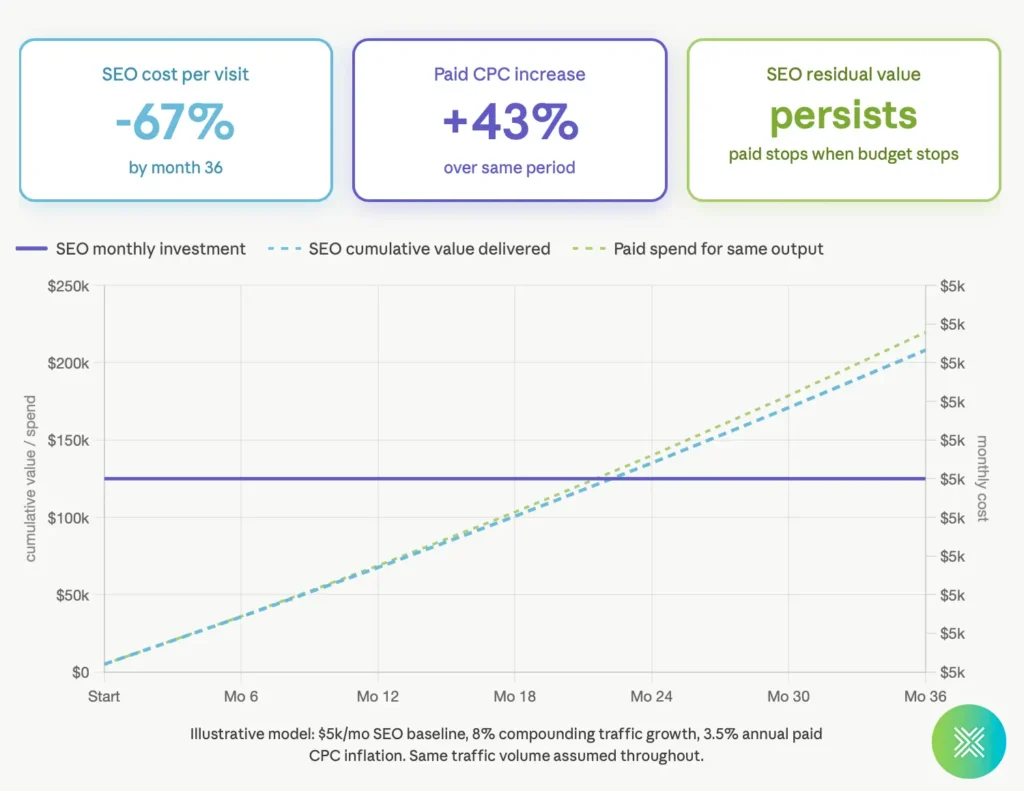
The rent-vs-own framing should not imply paid advertising is a safe harbor from what’s happening to search. It isn’t. Seer Interactive’s research found that paid click-through rates on queries with AI Overviews fell 68% between mid-2024 and late 2025, a steeper drop than organic took on the same queries. Paid leaves you with a receipt. SEO leaves you with an asset.
What Changed: The Click Got Scarce
The click, the unit nearly all SEO ROI math is built on, is shrinking.
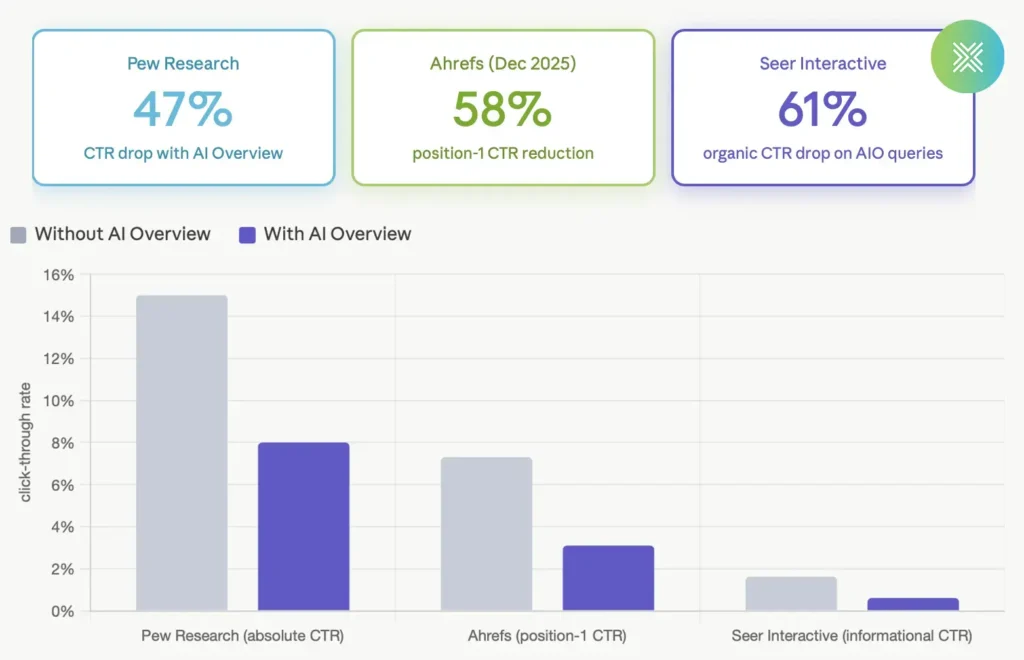
Ahrefs analyzed 300,000 keywords and found that the presence of an AI Overview reduces click-through rate for the top-ranking page by roughly 58%, after correcting for the general decline across all queries. Their framing is blunt enough that I’ll just borrow it. For every 100 clicks a top-ranking page historically earned, Google now keeps 58.
Pew Research Center tracked the real browsing behavior of 900 U.S. adults across nearly 69,000 searches. Users clicked a traditional result on 8% of searches with an AI summary versus 15% without one. Google has disputed Pew’s methodology, which you should know. That does not change the direction the other datasets show.
And Seer Interactive’s brand-level tracking found organic CTR on AI Overview queries fell 61% from mid-2024 before stabilizing in early 2026, a leveling off their own researchers are careful not to call a recovery.
The three methods share no data and no assumptions, and they land in the same place. The decline is real, and nothing in the three datasets points to a rebound.
I know those numbers sound like SEO dying. But the same data tells you where the clicks went. Brands cited inside AI Overviews earned 35% more organic clicks and 91% more paid clicks than non-cited brands on the same queries, and Seer’s 2026 update found cited brands earning over twice the organic clicks per impression. Their data cannot prove the citation causes the clicks, because higher-authority brands are also more likely to get cited in the first place.
Authority is what earns both the citation and the click. The clicks didn’t disappear. They moved toward the brands AI systems already trust.
The Three Surfaces of Search ROI
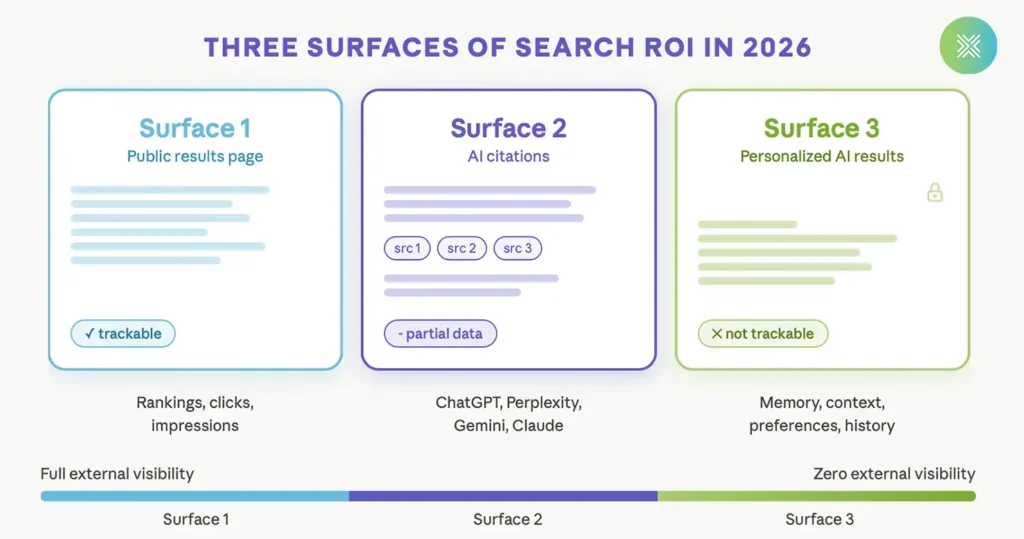
In our analysis, the return on SEO now arrives on three surfaces. Most SEO reporting only captures the first.
Surface One: The Public Results Page
This is traditional rankings and clicks, shrinking on informational queries but still real. Seer Interactive’s data shows that queries where no AI Overview appears are delivering more clicks per impression than before, because those are the results pages where attention still flows naturally.
Surface Two: AI Citations
When ChatGPT, Perplexity, or Google’s AI Mode answers a buyer’s question, the brands named in that answer are already on the buyer’s shortlist before they visit a single website.
My colleague Garry Callis drew a useful line in his piece on citations. A mention means you exist, a citation means you’re relied upon, and a recommendation means an AI system has effectively decided you’re the answer. Brands that earn citations at this level also earn measurably more clicks when they do appear in traditional results.
Surface Three: Personalized Results You Cannot See
This one is still emerging, so I’ll keep it short. At Google I/O in May 2026, Google expanded Personal Intelligence in AI Mode to nearly 200 countries at no cost, letting users connect Gmail and Google Photos so results draw on their own data. Two buyers asking the same question can now receive different answers shaped by their own inboxes. Google has not published opt-in or adoption rates, so treat prevalence as unknown. What you can say is that some portion of your SEO return is now generated inside results you have no way to monitor.
When the output becomes unobservable, the inputs you control grow more valuable. Will Melton puts it more simply. AI is a mirror. It reflects the body of evidence the internet holds about your brand, and it cannot reflect what you never published. You cannot track position inside a customer’s personalized results. You can build the authority and entity clarity that determine what any version of the system says about you, and that is the same work that wins the other two surfaces.
What It Costs to Stop
The strongest ROI evidence I can offer is what happened when we stopped.
As Xponent21 CEO Will Melton documented publicly, our Richmond, VA agency peaked at over 168,000 daily impressions in Google Search. In Q1 2026 we scaled back our own content program. By March we were at 8,000 to 9,000 daily impressions.
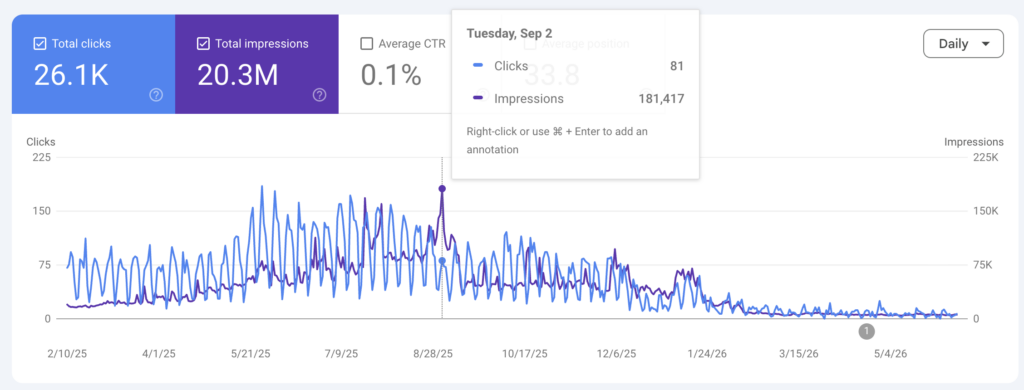
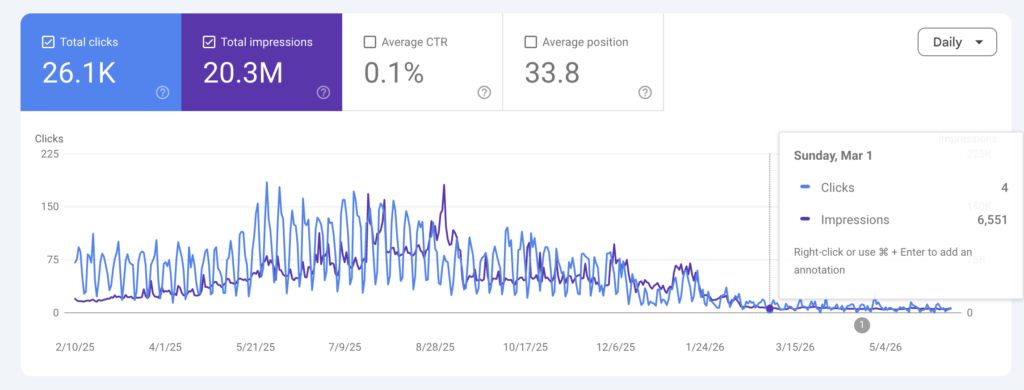
We’re a company that gets paid to prevent exactly that outcome for clients, and we watched it happen on our own site. Then we published the numbers. Impressions began recovering within weeks of resuming a disciplined publishing cadence. The full rebuild will take months.
Will boiled the mechanic down to two words. Authority depreciates. That cuts both ways for the ROI question. SEO is not a one-time purchase that yields forever. But it responds predictably to reinvestment, and you should budget for it accordingly.
What to Measure Instead
In an earlier piece I argued that the metrics shift from position to presence. For a business owner evaluating SEO ROI in 2026, that translates into five metrics, listed in the order they move, from earliest signal to final proof.
- Impressions are your early-warning system. A slow bleed shows up there weeks before it shows up in lead volume.
- Citation frequency is how often your brand appears in answers from ChatGPT, Perplexity, Gemini, and Google AI Overviews across many variations of your buyers’ questions. What you want is a pattern of appearances, since any brand can show up once.
- Branded search demand is the downstream signature of AI visibility you cannot directly observe. When AI systems name you, people search for you.
- LLM-referred traffic is small in volume today and unusually high in intent. A visitor who arrives after an AI system recommended you has already been pre-sold.
- Revenue per organic-sourced customer is the denominator that makes everything above mean something. Traffic that never connects to pipeline is a vanity metric no matter which surface produced it.
If your current SEO reporting consists of keyword rankings and sessions, you’re only measuring a fraction of what your investment produces. You may be underestimating its return right when competitors, looking at the same shrinking numbers, are concluding they should quit.
When SEO Is Not Worth It
SEO is a poor investment if your offering has little to no search demand, because no amount of optimization manufactures curiosity that doesn’t exist.
It’s the wrong primary channel if you need revenue this quarter, because the breakeven data above is measured in months, and anyone promising faster is selling you something.
And it’s a bad fit if you cannot sustain the investment past the first year, because authority depreciates, and a program you abandon at month ten forfeits most of the compounding you paid for. In those cases, paid acquisition or outbound will return more on the same dollars, and a good agency should tell you so before taking your money.
The Honest Bottom Line
SEO is worth it, and the return now arrives across three surfaces, only two of which you can watch. The businesses that will misjudge this are the ones still measuring a 2019 channel with 2012 statistics. The numbers were never going to show the return, and they will read that as the return disappearing.
I’ll leave you with three questions for your next marketing review. Does our SEO reporting track impressions, AI citations, and branded demand, or only rankings and sessions? Do we know what AI systems currently say when buyers ask about our category? And do we have a maintenance budget, or only a build budget?
If you can’t answer the second question, that is the gap to close first.
Where to Start Measuring
Rank trackers and session reports were built for the click economy, so they measure the first surface and nothing else. If the measurement framework has changed, the tooling has to change too.
Xponent21’s Cognitive AI Ranking Lab, led by Principal Investigator Courtney Turrin, analyzed more than 156,000 data points across hundreds of prompts and AI responses to find the signals that separate cited brands from invisible ones. The headline finding is that brands scoring in the lab’s higher alignment tiers were 13.7 times more likely to be cited in AI-generated answers than brands in lower tiers. AI citation follows patterns, and patterns can be measured.
CARL Intelligence, the tracking tool built on that research, measures citation frequency across prompt variations, the sources AI systems draw from in your category, and your competitive positioning inside those answers. There’s a free tier, and the launch announcement has the full detail.
Frequently Asked Questions
Is SEO still worth the investment for a mid-size business in 2026?
Yes, for most mid-size businesses whose customers research before buying. Published agency benchmarks indicate median SEO returns in the range of 748% over three years, with breakeven between months 7 and 13. The change in 2026 is that SEO investment also determines whether AI systems like ChatGPT, Perplexity, and Google’s AI Mode cite your brand when buyers ask about your category.
How long does it take for SEO to deliver a positive return on investment?
Industry data indicates 6 to 12 months to meaningful results. Published benchmarks show breakeven between month 7 and month 13 depending on vertical, with returns compounding after that. Anyone promising positive ROI in weeks is describing something other than SEO.
Is SEO a better investment than paid advertising?
They do different jobs, and most growth-focused businesses should run both. Paid advertising delivers immediate volume that ends when spending ends. SEO compounds over months and builds the authority that also earns AI citations no ad budget can buy. Paid is not insulated from AI-driven search changes either. Seer Interactive measured a 68% drop in paid click-through rates on queries with AI Overviews.
How should a business measure SEO ROI now that AI Overviews have reduced clicks?
Expand the measurement set beyond rankings and sessions. Track impressions as the early warning, citation frequency across AI platforms, branded search demand, LLM-referred traffic, and revenue per organic-sourced customer. Click math alone now understates the return. Seer Interactive found brands cited in AI Overviews earn 35% more organic clicks and 91% more paid clicks than uncited brands on the same queries.
What happens to SEO results if you stop investing in content?
Visibility erodes faster than most businesses expect. After Xponent21 scaled back its own content program in Q1 2026, daily Google impressions fell from a peak of over 168,000 to 8,000 to 9,000 by March. Recovery began within weeks of resuming a consistent cadence. Authority depreciates, so the investment case needs a sustain budget alongside the build budget.
Can SEO generate ROI if AI systems answer questions without sending traffic?
Yes, though the return shifts from clicks to presence. A brand cited in an AI answer enters the buyer’s shortlist before any website visit, and cited brands earn measurably more clicks per impression in Seer Interactive’s data. The work that earns citations, meaning topical authority, consistent publishing, and clear entity signals, is the same work traditional SEO rewards.

Chuck McCarthy
As Service Operations Lead, Chuck builds and refines the internal tools and AI-driven systems that power how we deliver work to clients. Working alongside our Director of Technology and Product Operations, he’s been central to developing CARL and the rest of our internal app suite, technology that now underlies our service delivery across the agency. Chuck brings the same precision and relentless improvement mindset to internal operations that once made him a PPC virtuoso, just pointed inward now: at the systems, workflows, and tools that make everyone else’s work faster and better.