Marketing
What Advertisers Need to Know About ChatGPT Ads
By: Chuck McCarthy
Published Date: November 23, 2026
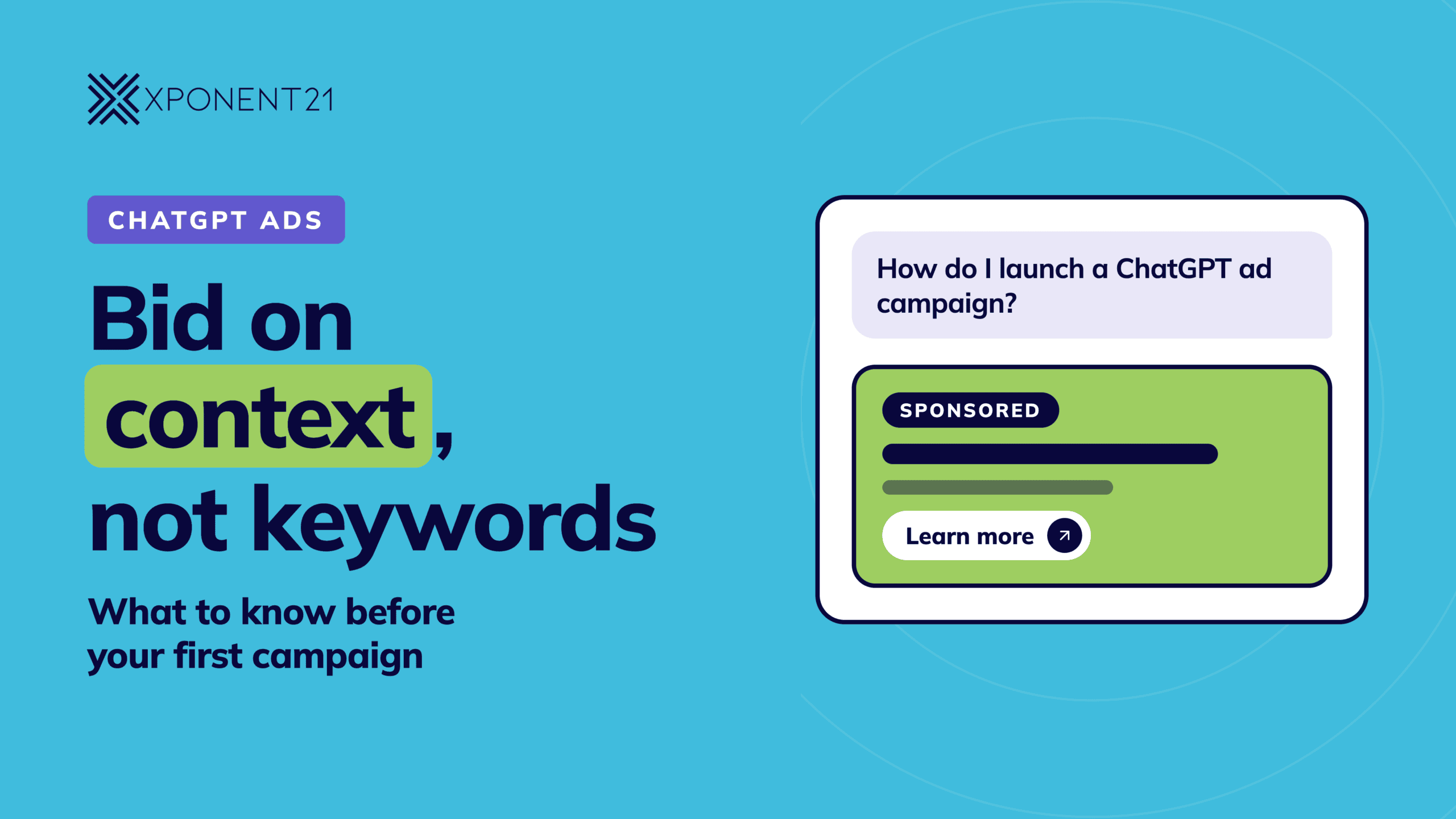
OpenAI has officially entered digital advertising by introducing paid ads directly within conversational AI sessions. For growth leaders and media buyers evaluating ChatGPT ads, the channel represents a shift from specific keyword bidding to semantic intent matching. Instead of bidding on the keyword “ChatGPT ads”, the targeting now becomes “business owners who are researching how to deploy a ChatGPT ad campaign”. And while this may allow you to dial in your targeting more effectively, it does create a lack of transparency when it comes to reporting. So, I think before you launch your first campaign, it is very important to have an objective understanding of early account mechanics, context-hint targeting, tracking configurations, and reporting constraints.
How Do ChatGPT Ads Actually Work?
When ChatGPT answers a question, it draws on what it knows about the topic and, in many cases, on sources it finds across the web. Brands that are authoritative, well documented, and consistently referenced get named or cited in those answers. You can’t “buy” that placement. You earn it through content, authority, and presence across the sources AI systems trust, and it can shift from one conversation to the next.
ChatGPT ads are the paid counterpart. OpenAI introduced Business Hub in ChatGPT in beta, providing businesses with a channel to connect with the 1.2 billion people who use ChatGPT each week. Ads are delivered mainly on the Free and Go tiers, where a sponsored ad appears alongside the conversational answer. That placement is separate from the answer itself. Being cited means ChatGPT chose to include you. Running an ad means you paid to be present next to the response.
The auction also works differently from a search results page. It evaluates intent across the whole conversation rather than a single query string. When someone asks for product recommendations, vendor comparisons, or help troubleshooting a problem with something around the house, the system looks at the context of the exchange. If commercial relevance passes OpenAI’s quality thresholds, an ad unit is inserted below or within the response.
The practical difference comes down to control and durability. With an ad, you decide when and where you appear, but your visibility stops the moment your budget does. With citations, you give up that control, but the visibility compounds and doesn’t carry a cost per click. The user is in the middle of an interactive dialogue, asking for synthesis or guidance, so either one reaches them at a high-intent moment. That is why the two work best together, and why it’s worth understanding how the paid side is structured before you commit budget.
Understanding the ChatGPT Ads Account Structure
Advertisers familiar with major paid media platforms will recognize the structural hierarchy in the OpenAI ads manager. Campaigns house ad groups, which in turn contain individual ad creative assets and tracking parameters.
Campaign objectives currently center around three primary goals: reach, clicks, or conversions. Reach and click campaigns operate primarily on a cost-per-click model, while conversion-focused campaigns utilize impression-based billing.
Campaign management introduces a helpful tool, appropriately title the ChatGPT Ads Manager plugin, that allows you to engage with your ad account via a conversation with ChatGPT. I found this particularly helpful when building and optimizing campaigns. Instead of relying solely on manual dashboards with multi-layered menus, media buyers can manage campaigns using natural language prompts. Advertisers can command the plugin agent to draft ad copy, adjust daily caps, allocate spend between ad groups, or retrieve top-level performance figures. This agent-driven workflow speeds up operational tasks, though final deployment still requires human oversight to verify targeting accuracy and budget rules.
Targeting Without Keywords: Using Context Hints and Audience Lists
The defining characteristic of ChatGPT ads is the complete absence of exact-match keyword bidding. Traditional search advertising relies on match types such as exact, phrase, and broad to anchor bids to specific terms. OpenAI replaces this framework with context hints.
Context hints are descriptive phrases and topical prompts provided by the advertiser to guide the matching algorithm. For instance, an enterprise cybersecurity company might specify context hints such as “discussions regarding cloud compliance audits, SOC 2 certification software, and IT security frameworks.”
Context hints act as directional guidance for OpenAI’s matching algorithms rather than hard keyword exclusion or placement rules. The matching engine evaluates the conversational context of a user session against the advertiser’s guidance, determining whether the conversation demonstrates intent relevant to the product.
Beyond conversational hints, the platform provides foundational demographic and platform parameters:
- Geographic targeting: Segmentation by country, region, state, or metropolitan area.
- Platform environments: Delivery segmentation across desktop, mobile web, and native mobile operating systems.
- First-party audience lists: Uploading customer match files containing verified emails and phone numbers for audience inclusion or exclusion.
Audience exclusion lists are particularly valuable in context-hint environments. By uploading existing customer databases, brands can prevent their ads from showing to current account holders who use conversational prompts for post-sale troubleshooting.
Reliable conversion attribution is important for any campaign, regardless of the platform. But without access to a robust suite of insightful data, it is absolutely required. OpenAI does have an advertising pixel you can place on your site. The implementation process resembles standard tag management; placing a base pixel script across all site headers and configuring standard event tracking for page views, lead submissions, sign-ups, and transactions. The setup can be completed via standard tag containers or direct code injection.
While conversion measurement functions smoothly, platform reporting presents a clear analytical challenge: query-level visibility is nonexistent. Media buyers receive aggregated performance metrics, including total impressions, reach, clicks, cost per click, and attributed conversions. However, advertisers cannot review search query logs or conversational transcripts. You cannot see the exact prompts that triggered your ad impressions.
The lack of detail in their reporting creates a blind spot, which also creates a challenge when optimizing campaigns. To be clear, I am not advising against using ChatGPT ads. I am simply advocating for close scrutiny of your campaign performance and how it is impacting your revenue. This will likely require cross-referencing landing page analytics and user engagement against conversion events to verify audience quality, but who doesn’t love getting a little creative!
Creative Constraints: Crafting Offers Within Strict Character Limits
Creative execution within ChatGPT ads requires extreme brevity. The platform imposes tight character limits on early ads, typically restricting headlines to 50 characters and body descriptions to roughly 100 characters.
Because copy space is severely restricted, complex value propositions cannot be explained entirely in ad copy. Successful ads rely on three creative adjustments:
- Lead with concrete offers: Vague brand taglines fail in conversational spaces. Copy must present a distinct offer, such as a trial, pricing calculator, or immediate diagnostic assessment.
- Use visual assets for message delivery: Because text space is minimal, the accompanying image can help do some heavy lifting from a messaging perspective.
- Align with conversational timing: Its all about meeting people where they are at. Your creative copy must meet the context of the user dialogue. For example, a home services provider running winter campaigns should tailor copy specifically to emergency repairs or seasonal maintenance rather than general service overviews.
Evaluating the Real Economics of ChatGPT Advertising
ChatGPT ads are still relatively new. The platform is in beta and the reporting is limited, so I will say that we still have a lot to learn about how this channel performs. So treat what follows as a way to help you make your own evaluations, not a set of benchmarks.
Start with cost. For CPC campaigns, OpenAI recommends starting with a maximum bid of $3–$5 USD per click. That is the platform’s suggested starting point, not a forecast of what you will actually pay or what a lead will cost. Real costs will depend on your audience, your location, and how many other advertisers are bidding in your category.
Be just as careful with cross-channel comparisons. You may hear that ChatGPT ads deliver a lower cost per acquisition than Google Ads, and there is some evidence behind it. OpenAI has published a result from WeightWatchers, whose attributed CPA was 15.3% below its blended paid search benchmark, as measured by DV Rockerbox. That is a partner result OpenAI chose to highlight, not an independent benchmark. Other early tests look different. One B2B compliance case study found cheaper leads from ChatGPT, but Google leads became customers at a higher rate, so Google had the lower cost per customer. Industry rankings, such as higher education looking strongest, mostly come from third-party projections rather than measured campaign results, and Search Engine Journal reports that advertisers still don’t know what good looks like. With this little data, a comparison to Google today says more about one advertiser’s test than about the channel itself.
A few trade-offs are worth weighing as you decide whether to test.
- Intent depth. People in a ChatGPT conversation are often working through a complex problem, which may signal higher intent than passive social browsing. That is a reasonable hypothesis to test, not a proven result.
- Wasted spend risk. With no negative keyword lists and no query reporting, you cannot see or filter the prompts that triggered your ad. Low-intent matches are hard to spot until they show up in your landing page and conversion data.
- Channel maturity. Competition for placements looks moderate so far, which could mean cheaper entry for early testers. As more advertisers arrive, expect that to change.
Treat budgets early in a campaign as discovery capital. Set a firm cap and decide in advance what a good result looks like, such as qualified leads and pipeline rather than clicks alone. Then judge the results against your own landing page and CRM data, not the platform’s numbers. Plan to revisit your assumptions often, because the channel will keep changing.
Strategic Next Steps for AI-Driven Advertising
The arrival of ChatGPT ads signals an evolution in how users interact with commercial solutions online. Paid conversational media should not be treated as an isolated acquisition silo. Instead, modern digital marketing requires an integrated approach that balances paid experimentation with organic presence across AI search engines.
Ambitious brands recognize that earning commercial visibility involves appearing both in sponsored ads and as authoritative citations in AI syntheses across platforms like ChatGPT, Claude, Google AI Overviews, and Perplexity. Relying solely on paid ads without addressing underlying organic authority leaves your brand exposed to high customer acquisition costs.
Xponent21 helps forward-thinking marketing leaders build unified AI search strategies that combine data-driven paid advertising with authoritative organic visibility. If your team is ready to test conversational ad campaigns with disciplined tracking and clear revenue attribution, contact Xponent21 to structure your AI marketing roadmap today.
Frequently Asked Questions
What Are Context Hints in ChatGPT Ads?
Context hints are descriptive phrases and topics provided by advertisers to guide OpenAI’s matching algorithms. Rather than bidding on exact search keywords, advertisers use hints to describe relevant conversation themes, user problems, or product categories. The platform uses these hints as directional guidance rather than rigid placement rules.
How Do Advertisers Track Conversions from ChatGPT Campaigns?
Conversion tracking can be deployed using the native OpenAI advertising pixel on your website. Once installed across your site headers, you can configure standard event triggers for form submissions, content downloads, and purchases. Performance events are attributed inside the ad manager reporting dashboard.
Can Advertisers See the Exact User Prompts That Triggered Their Ads?
No, the platform does not currently provide query-level visibility or prompt logs. Advertisers receive aggregate campaign metrics such as impressions, clicks, click-through rate, cost per click, and conversions. The exact conversational transcripts and prompts that triggered ads remain shielded from reporting dashboards.
What Is the Recommended Starting Cost per Click for ChatGPT Ads?
For CPC campaigns, OpenAI recommends starting with a maximum bid of $3–$5 USD per click. Final costs fluctuate based on audience parameters, targeted geographic regions, and auction density within specific industry categories.
How Do ChatGPT Ads Differ from Google Search Ads?
Google search ads rely on direct keyword bidding, exact-match controls, and transparent search query reporting. ChatGPT ads rely on conversational intent matching guided by context hints without keyword match types or search term logs. Additionally, ChatGPT creative units feature strict character limits and appear within conversational chat responses rather than standard search result lists.

Chuck McCarthy
As Service Operations Lead, Chuck builds and refines the internal tools and AI-driven systems that power how we deliver work to clients. Working alongside our Director of Technology and Product Operations, he’s been central to developing CARL and the rest of our internal app suite, technology that now underlies our service delivery across the agency. Chuck brings the same precision and relentless improvement mindset to internal operations that once made him a PPC virtuoso, just pointed inward now: at the systems, workflows, and tools that make everyone else’s work faster and better.