
Marketing
Where AI Gets Its Facts About Your Business: Data Aggregators, Directories, and Verifiers
By: Courtney Turrin
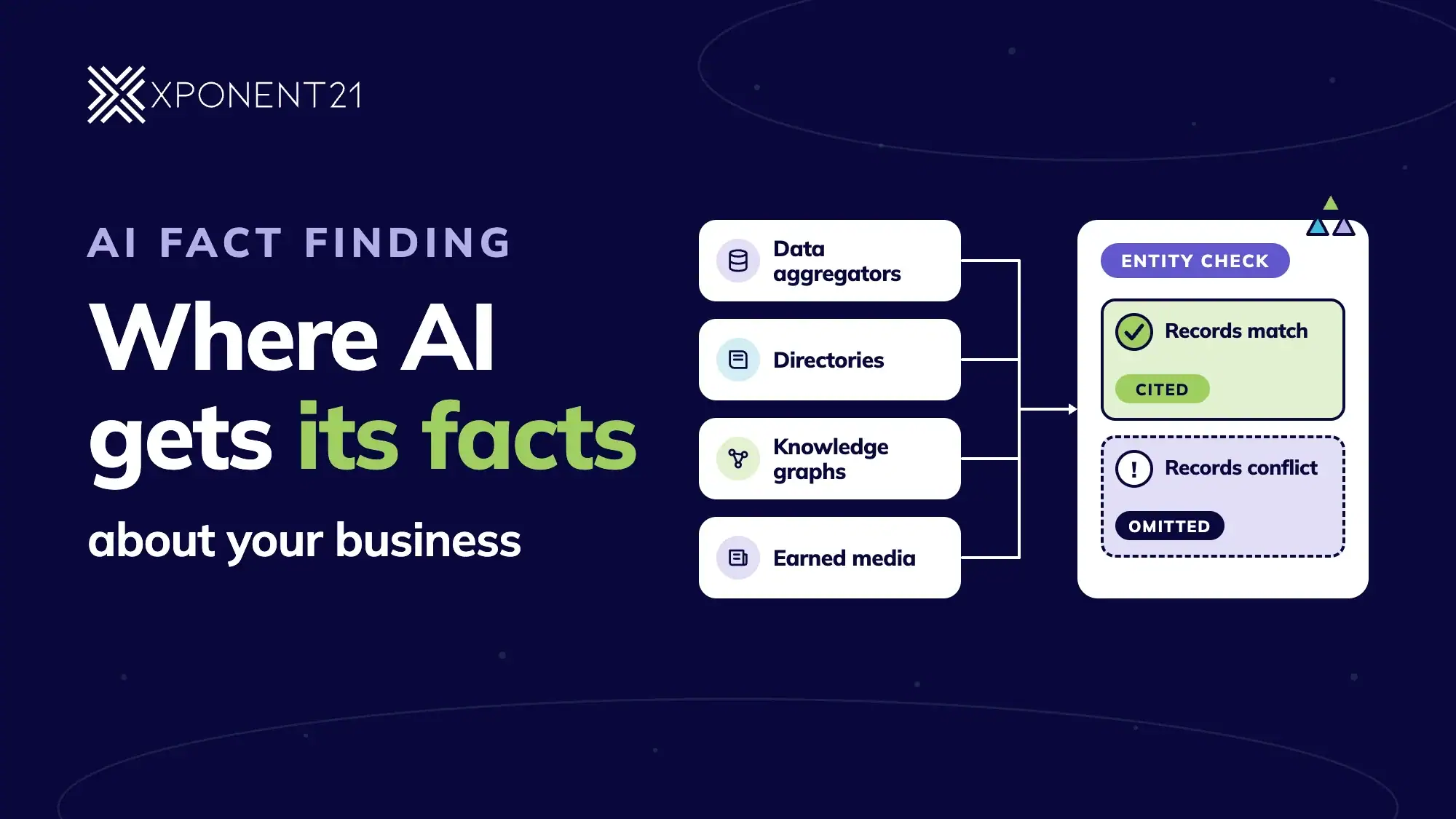
Published Date: November 19, 2026
Executive Summary
- Artificial intelligence engines do not evaluate enterprise websites in isolation. Systems like ChatGPT, Google AI Overviews, and Perplexity query commercial data brokers, industry directories, and structured knowledge graphs to resolve corporate identities before synthesizing recommendations.
- Discrepancies across external data aggregators AI search environments depend on introduce entity ambiguity, leading generative models to hallucinate operational details or omit brands entirely from retrieval candidate sets.
- Earned media and independent validation serve as the ultimate trust anchors for generative systems, driving the overwhelming majority of cited sources compared to brand-owned marketing assets.
- Sustainable AI visibility requires marketing executives to treat off-site entity alignment as a data supply chain problem, auditing and synchronizing foundational business records across primary digital registries.
How Large Language Models and AI Search Engines Gather Corporate Information
When prospective buyers ask conversational platforms for vendor recommendations, executive leadership often assumes the underlying model reads their corporate website, indexes their product pages, and summarizes the value proposition. In practice, modern generative discovery functions through an entirely different technical architecture.
To understand where do ChatGPT and Google AI get information about my business, marketing leaders must separate pre-training parametric memory from live retrieval-augmented generation (RAG). During foundational training, large language models ingest massive web corpora, academic papers, books, and common crawl archives. This static dataset allows the model to learn grammar, conceptual relationships, and broad industry terminology. Parametric memory alone, however, cannot reliably supply real-time corporate facts, such as current leadership, regional office footprints, enterprise service capabilities, or software integrations.
RAG discovery
User queryA buyer asks an AI engine a commercial question
Retrieval layer pulls from
- Aggregators and registries
- Knowledge graphs
- Industry directories
- Earned media
To deliver accurate responses without hallucinating operations, generative engines execute live RAG passes across verified web indexes and structured databases. According to Xponent21 Insights, Google AI Overviews now appear in over 85% of U.S. searches as of October 2026. These pervasive summaries rely on continuous background querying across multiple external data layers. Similarly, OpenAI introduced Businesses in ChatGPT in beta, providing businesses with a channel to connect with the 1.2 billion people who use ChatGPT each week.
When a user initiates a commercial query, the retrieval system performs entity extraction. It identifies the categorical problem, pulls potential corporate entities from its internal indexes, and runs corroboration checks. Aggregators and knowledge graphs form foundational grounding layers, though real-time web crawlers and direct site schema also contribute to final query synthesis. If the external data ecosystem displays conflicting records regarding who you are, what you deliver, or where you operate, the engine experiences low mathematical confidence. Rather than risk presenting erroneous facts, the system defaults to safer alternatives: it selects a competitor whose entity footprint is unambiguous. Addressing this breakdown requires recognizing why AI visibility is a business operations problem across your entire enterprise footprint.
The Core Tier: Data Aggregators and Commercial Entity Brokers
At the foundation of machine discovery lies a network of commercial data brokers and local aggregators. Historically, these data clearinghouses existed to supply telephone registries, credit bureaus, navigation systems, and traditional search engines with baseline operational records. Today, these pipelines feed enterprise AI retrieval pipelines.
Commercial data brokers harvest, clean, and syndicate primary business records, including legal business name, physical headquarters, operating subsidiaries, tax identifiers, telephone numbers, and Standard Industrial Classification codes. Major search systems and language model developers license these structured databases directly or crawl their syndicated endpoints to ground their entity extraction algorithms.
When an AI engine processes a query regarding regional B2B service providers or national enterprise suppliers, it queries these broker registries to build its initial candidate pool. The syndication pipeline functions through periodic synchronization cycles:
- Primary Ingestion: Aggregators collect raw corporate filings, utility connections, licensing records, and direct administrative submissions.
- Entity Deduplication: Algorithmic verification layers cross-reference incoming records against existing corporate clusters to resolve corporate identities.
- Downstream Syndication: Verified data clusters are pushed outward via real-time data feeds and application programming interfaces to search engines, mapping platforms, and voice assistants.
Aggregator pipeline
Data that travels with your entity
- Legal business name
- Headquarters
- Operating subsidiaries
- Tax identifiers
- Phone numbers
- SIC codes
Because generative engines prioritize information stability over promotional claims, they reference these broker feeds to confirm basic operational reality. If a mid-market manufacturing firm undergoes a rebrand or changes its physical headquarters but fails to update its records at the aggregator tier, downstream systems receive conflicting signals. The enterprise site may claim the new identity, but the licensed commercial broker feed still broadcasts the historical profile.
This conflict breaks the data supply chain. When an AI search engine attempts entity resolution, the mismatch between on-page copy and aggregator feeds degrades the model’s confidence score, preventing the brand from surfacing in high-intent commercial summaries.
Directories, Knowledge Graphs, and Authoritative Verifiers
Beyond raw corporate data brokers, generative search systems validate business entities using structured semantic databases, corporate registries, and niche-specific business directories. These repositories transform unstructured text into machine-readable relationship graphs, linking organizations to their founders, parent corporations, product categories, and validated operational capabilities.
Public and proprietary knowledge graphs represent the primary cognitive architecture AI engines use to understand the world. Open semantic databases like Wikidata, alongside proprietary graphs maintained by major technology platforms, store corporate profiles as unique entity nodes surrounded by defined attributes. A properly mapped entity node explicitly establishes:
- The exact corporate entity identifier and legal organizational structure.
- Official web properties, verified digital handles, and secondary domains.
- Standard industrial classifications and primary service categories.
- C-suite leadership, parent entities, subsidiaries, and key operational nodes.
When an AI engine synthesizes a response to queries concerning market alternatives or top-tier providers, it queries these knowledge graphs to determine whether an enterprise is a verified player in the category. An organization with a dense, interconnected entity node across authoritative verifiers enters the generation layer with high topical authority.
Authoritative directories and vertical business registries reinforce this verification layer. High-trust industry directories, regulatory registries, professional licensing boards, and prominent B2B software review platforms provide machine-readable schemas that generative crawlers parse during real-time retrieval passes. Local profiles also feed these models directly, making it critical to know how to optimize your Google Business Profile for machine-generated answer engines.
Entity ambiguity arises when these structured sources present conflicting name, address, phone number (NAP), or capability descriptions. If an enterprise describes itself as a cloud migration platform on its primary domain, but authoritative industry directories categorize it as an on-premises hardware reseller due to legacy profiles, the generative engine cannot resolve the discrepancy. In generative search environments, unresolved ambiguity does not yield a clarifying question; it yields total omission from the candidate set.
Earned Media and Third-Party Validation as Trust Anchors
A brand’s owned digital footprint represents only a fraction of the evidence generative models evaluate. When language models assemble business facts, they fundamentally distrust unverified self-descriptions. Marketing claims, promotional homepages, and self-published case studies carry low evidentiary weight unless third-party sources substantiate them.
Independent journalism, trade publication features, and established industry analysis act as the ultimate trust anchors for enterprise AI search engines. Empirical research confirms that generative systems prioritize independent editorial validation over corporate web properties by a staggering margin.
According to Muck Rack’s “What Is AI Reading?” report from May 2026, which analyzed more than 25 million links across ChatGPT, Claude, and Gemini in 17 industries, 84% of AI citations come from earned media. Journalism alone accounts for 27% of cited sources, while paid or advertorial content accounts for a mere 0.3%. Generative engines treat news reporting and editorial analysis as neutral, verified observations of market fact.
What AI cites
One bar, 100% of cited links, split by source type.
Earned media 84%
- Independent journalism27%
- Other editorial and industry coverage57%
- Brand-owned web properties15.7%
- Paid or advertorial0.3%
Source: Muck Rack, What Is AI Reading? (May 2026). Over 25 million links cited by ChatGPT, Claude and Gemini across 17 industries.
This earned-media bias is even more pronounced when contrasted directly with legacy organic search indexes. A University of Toronto study evaluated U.S. automotive queries and revealed that AI engines’ sources were 81.9% earned media, 18.1% brand-owned, and 0% social. In contrast, Google’s traditional results were 45.1% earned, 39.5% brand-owned, and 15.4% social. The researchers calculated that AI systems exhibit an earned-media bias of approximately 4.5 to 1 over traditional search engines. The study also determined that systems like ChatGPT and Claude maintain the most conservative sourcing standards, whereas platforms like Perplexity incorporate slightly more conversational and open sources.
These findings highlight why off-site data consistency dictates generative outcomes. When an enterprise receives sustained, authoritative press coverage, those articles are ingested across common crawl archives, cited in real-time RAG web passes, and linked within knowledge graphs. If your corporate narrative is consistently articulated across independent trade journals and news publications, generative engines adopt that factual consensus. If your media mentions are outdated or non-existent, the model lacks the third-party corroboration required to present your brand as an established market leader.
Why Discrepancies Across Sources Cause AI Omission
Generative search engines operate on probability, vector distance, and factual consensus. When a user asks an AI assistant for the leading supply chain consulting firms for enterprise logistics, the engine does not perform a simple keyword match across indexed documents. Instead, it assembles a coherent, defensible answer by corroborating candidate organizations across its structured data network.
When discrepancies exist across data aggregators, business directories, and editorial archives, the retrieval engine encounters cognitive friction. Common data fractures include:
- Name Inconsistencies: Operating under acronyms, legacy corporate designations, or unregistered trade names across different databases.
- Geographic Fragmentation: Listing closed corporate offices, unverified virtual addresses, or divergent headquarters locations between corporate filings and business directories.
- Service Line Conflicts: Highlighting modern enterprise software capabilities on primary domains while third-party business verifiers still classify the firm under outdated hardware distribution codes.
- Executive Attribution Gaps: Conflicting records regarding active chief executive officers, practice leaders, or board directors across business registries.
Why discrepancies cost you
- Name inconsistenciesAcronyms, legacy designations or unregistered trade names across databases
- Geographic fragmentationClosed offices, virtual addresses or conflicting headquarters
- Service line conflictsThe website shows modern capabilities while verifiers list outdated categories
- Executive attribution gapsRegistries disagree on current CEOs, practice leaders or directors
HallucinationThe model bridges contradictions and states outdated or inaccurate facts
Silent omissionThe model drops the company from its recommendation candidates
In technical terms, the engine measures the semantic similarity and factual agreement of incoming data points. When external data aggregators and business verifiers supply divergent facts, the variance increases the mathematical entropy of the generated output. Large language models are engineered to suppress high-entropy statements to minimize verifiable errors.
The operational consequence for an enterprise is severe. If your business profile fails the consistency check, the engine triggers one of two failure states:
- Hallucination: The model attempts to bridge contradictory facts, presenting outdated executive names, invented pricing structures, or discontinued capabilities to executive buyers.
- Silent Omission: The model completely drops the company from the candidate set, recommending less qualified competitors whose off-site data ecosystem is completely aligned and mathematically stable.
Auditing and Aligning Your Entity Footprint for AI Discovery
Resolving data fragmentation requires treating your brand’s digital presence as a coordinated, machine-readable supply chain. Marketing executives must move beyond standard on-page search engine optimization and conduct rigorous off-site entity audits to verify that external sources provide consistent data to machine crawlers.
Model updates, data syndication cycles, and index refresh latency mean off-site entity alignment takes time to propagate across AI training sets and live RAG pipelines. Alignment is an iterative governance process rather than an overnight technical patch.
Entity footprint audit
- 1Phase 1Multi-engine baseline auditRun multi-turn commercial queries across AI platforms and log inaccuracies and cited sources.
- 2Phase 2Registry and directory reconciliationBuild a reference sheet of verified facts, then standardize listings across aggregators, credit registries and B2B directories.
- 3Phase 3Semantic graph and schema groundingDeploy JSON-LD Organization schema with sameAs links to verified external profiles.
- 4Phase 4Citation and visibility trackingMonitor citation frequency, source attribution and factual stability over time.
Phase 1: The Multi-Engine Baseline Audit
Initiate your diagnostic process by mapping how primary generative interfaces currently perceive your corporate entity. Avoid running narrow, brand-name queries, which models easily answer from direct site titles. Instead, query platforms across realistic, multi-turn commercial scenarios:
- “What are the core enterprise capabilities and target markets of Company Name?”
- “Which companies are the primary competitors to Company Name in Specific Industry, and what differentiates them?”
- “Who are the leading enterprise providers of Core Solution for Target Industry?”
Document the exact factual inaccuracies, legacy service offerings, or omissions that surface across ChatGPT, Google AI Overviews, Claude, and Perplexity. Track whether models cite third-party industry directories, legacy press releases, or commercial registries when presenting incorrect information. Many of these breakdowns stem from complex multi-question retrieval patterns like query fan-out across search systems.
Phase 2: Systematic Registry and Directory Reconciliation
Identify the primary commercial aggregators and authoritative vertical directories driving industry validation in your category. Construct a definitive entity reference document containing:
- Exact legal corporate name, official trade names, and registered tax identifiers.
- Verified physical headquarters and registered regional operational facilities.
- Direct primary telephone lines, standard executive points of contact, and official digital communication channels.
- Standardized short, medium, and comprehensive corporate capability descriptions written in unambiguous, factual prose without marketing jargon.
- Comprehensive lists of current executive leadership, active brand subsidiaries, and official digital web properties.
Audit your presence across Tier-1 commercial aggregators, credit registries, and authoritative B2B directories. Update outdated profiles, claim abandoned corporate listings, and enforce strict typographical consistency across every single external node.
Phase 3: Semantic Graph and Schema Grounding
Ensure your owned digital properties provide unambiguous semantic instructions to machine crawlers. Deploy advanced JSON-LD Organization schema on your primary domain, explicitly defining your corporate entity attributes. Utilize sameAs schema arrays to establish direct, bi-directional links between your website and your verified external entity profiles, including:
- Wikidata entries and recognized authority records.
- Official corporate profiles on commercial verification hubs and business registries.
- Executive profiles, established corporate social records, and accredited professional associations.
By explicitly linking your primary web property to verified external records via structured schema, you reduce the computational overhead required for an AI engine to resolve your entity.
Phase 4: Systematic Citation and Visibility Tracking
Entity management is not a one-time administrative exercise. Enterprise brands require ongoing surveillance of their generative search visibility, tracking citation frequency, source attribution, and factual stability over time.
Marketing leaders can partner with a specialized AI SEO agency or utilize platforms such as CARL Intelligence, which monitors verified prompt universes across ChatGPT, Gemini, Claude, and Perplexity to identify when corporate profiles suffer from factual drift or competitor displacement. By coupling automated citation tracking with verifiable operational ledgers like CARL AIO, marketing teams gain clear observability into how off-site directory hygiene and data syndication efforts correlate with sustained generative visibility.
Turn Fragmented Business Data Into Coordinated AI Visibility
Generative engines like ChatGPT, Google AI Overviews, and Perplexity have dismantled the old paradigm where on-page keyword density dictated commercial search performance. Modern AI engines operate as synthesis networks that evaluate an organization’s total factual footprint across the digital ecosystem.
When your enterprise data is fragmented across commercial brokers, outdated directories, and dormant registries, your business becomes an unstable data point. The system avoids instability by turning to competitors whose identities are anchored in clean, verified, and corroborated external data.
Taking control of how generative engines perceive, cite, and recommend your business requires an integrated approach that connects technical data governance, authoritative schema engineering, and aggressive third-party validation. If your leadership team is ready to identify where machine discovery pipelines misrepresent your capabilities, talk with an Xponent21 strategist to Get Clarity on your entity footprint and establish measurable authority across modern search networks.

Courtney Turrin
As the company’s number two employee, Courtney has helped guide the direction of our business, build a powerhouse team, and implement technology and workflows to improve service delivery and produce outsized results for our clients. Her current role sits at the intersection of analytics, work management, and operations. Drawing on her background in scientific research, Courtney designs efficient processes and supports our teams so they can better serve our clients. She holds masters degrees in Biology and Psychology/Neuroscience from the College of William and Mary and Yale University, respectively. Offline, Courtney is a plant whisperer, Peloton enthusiast, and proud pet mom.